
科创成长层

Search documents
上交所:个人投资者参与科创成长层股票交易门槛仍为“50万元资产+2年经验”
news flash· 2025-07-13 07:18
智通财经7月13日电,上交所正式发布《科创板上市公司自律监管指引第5号——科创成长层》等配套业 务规则。其中提出,加强投资者适当性管理。本次改革没有对个人投资者参与科创成长层股票交易新增 投资交易门槛,仍为具备"50万元资产+2年经验"的资金门槛和投资经验即可。另外,按照《科创板意 见》要求,投资者投资科创成长层新注册的未盈利科技型企业之前需要签署专门风险揭示书。 上交所:个人投资者参与科创成长层股票交易门槛仍为"50万元资产+2年经验" ...
周末重磅!上交所发布,事关科创板“1+6”
Zheng Quan Shi Bao· 2025-07-13 07:16
Core Viewpoint - The Shanghai Stock Exchange has implemented a series of business rules to deepen the reform of the Sci-Tech Innovation Board, including the introduction of a "growth layer" for unprofitable companies, a pre-review mechanism for IPOs, and guidelines for professional institutional investors [1][2][6]. Group 1: Growth Layer Implementation - The new "growth layer" will accommodate 32 existing unprofitable companies and any new unprofitable companies will enter this layer upon listing [2]. - The exit criteria for existing companies will remain based on achieving profitability, while new companies must meet stricter conditions to exit the growth layer [3]. - The growth layer aims to support technology companies with significant breakthroughs and substantial R&D investments, even if they are currently unprofitable [3][5]. Group 2: Pre-Review Mechanism - A pre-review mechanism for IPOs has been introduced to prevent early disclosure of sensitive business information that could harm companies [6][7]. - Companies applying for pre-review must justify the necessity of this process, and the review will follow strict procedures similar to formal IPO applications [6][7]. - The pre-review process aims to enhance the quality of formal applications and improve the efficiency of the review process [7]. Group 3: Professional Institutional Investors - The guidelines for recognizing professional institutional investors have been clarified, encouraging companies to disclose information about these investors voluntarily [8][9]. - Criteria for identifying professional institutional investors include having a solid governance structure, significant asset management, and a good track record [9][10]. - The involvement of professional institutional investors is intended to provide market wisdom and enhance the credibility of companies seeking to list on the Sci-Tech Innovation Board [10].


周末重磅!上交所发布,事关科创板“1+6”
证券时报· 2025-07-13 07:06
Core Viewpoint - The Shanghai Stock Exchange has implemented a series of business rules to deepen the reform of the Sci-Tech Innovation Board, including the introduction of a "growth layer" for unprofitable companies, a pre-review mechanism for IPOs, and the establishment of criteria for professional institutional investors [1][2][4][10]. Group 1: Growth Layer for Unprofitable Companies - A total of 32 existing unprofitable companies will enter the growth layer from the date of the implementation of the "Growth Layer Guidelines" [2]. - New unprofitable companies will enter the growth layer from the date of their listing, with stricter exit conditions to encourage technological development and market expansion [4]. - The exit conditions for existing companies remain tied to achieving profitability, while new companies must meet either of two criteria: positive net profit for the last two years with a cumulative net profit of no less than 50 million or positive net profit for the last year with revenue of no less than 100 million [4]. Group 2: Pre-Review Mechanism for IPOs - The introduction of a pre-review mechanism aims to protect key technology companies from disclosing sensitive business information prematurely, which could adversely affect their operations [8]. - Companies applying for pre-review must justify the necessity of the request, and the review process will follow strict guidelines similar to formal IPO submissions [8][9]. - The pre-review process and results will not be publicly disclosed, but companies must disclose relevant inquiries and responses on the exchange's website upon formal application acceptance [9]. Group 3: Criteria for Professional Institutional Investors - The "Professional Institutional Investor Guidelines" have been established to enhance the identification of quality tech companies, encouraging self-identification and voluntary disclosure of professional investors [11]. - Criteria for recognition include having a sound governance structure, substantial asset management, and a good credit record, with specific investment experience requirements [12]. - The involvement of professional institutional investors is intended to provide market wisdom and enhance the credibility of companies seeking to list, without lowering the standards for IPO applications [13].

北交所策略专题报告:北交所小巨人主阵地的新质生产力扩容,高端制造链再升级
KAIYUAN SECURITIES· 2025-07-06 10:43
Group 1 - The report highlights that the Beijing Stock Exchange (BSE) is focusing on enhancing the quality of its listed companies, particularly by accepting firms in hard technology and advanced manufacturing sectors by 2025 [4][12][13] - As of July 4, 2025, a total of 133 new companies have been accepted, with 44 of them classified as "little giants," representing 33.08% of the total [4][16][29] - The majority of new companies are engaged in core manufacturing components, industrial technology, and key materials, primarily in sectors such as semiconductors, biomedicine, and artificial intelligence [4][16][29] Group 2 - The average revenue of new companies for 2024 is projected to be 799 million, which is higher than the average revenue of existing BSE companies [29][31] - The average net profit for new companies is expected to be 99.15 million, significantly exceeding the average net profit of existing BSE companies [29][33] - New companies are showing higher profitability metrics, with average gross margins of 34.23% and return on equity (ROE) of 20.08%, both above the averages for existing BSE companies [35][36] Group 3 - The report indicates that the BSE's market performance has seen fluctuations, with the BSE 50 index closing at 1,415.04 points, down 1.71% [5][41] - The overall price-to-earnings (PE) ratio for BSE A-shares has decreased from 51.33X to 50.35X, reflecting a broader trend in the market [5][38] - The liquidity of BSE A-shares has declined, with an average daily trading volume of 28.068 billion, down 19.15% from the previous week [5][39]
毕马威:2025年上半年香港位居全球IPO集资排行榜之首 总集资额较去年同期增长7倍
智通财经网· 2025-07-03 03:26
Group 1 - The Hong Kong IPO market recorded its strongest performance in the first half of 2025 since 2021, with total fundraising increasing sevenfold compared to the same period in 2024, making it the top global IPO fundraising market [1] - The total number of IPO applications on the Hong Kong main board has reached over 200, a historical high, indicating a sustained strong momentum expected to continue into the second half of 2025 [1] - In the first half of 2025, the global IPO market raised $60.9 billion with 544 listings, a 5% increase in fundraising compared to the previous year, although the number of listings decreased by 6% [1] Group 2 - A-share market activities remained stable in the first half of 2025, with 61 listings and a total fundraising amount of 53.7 billion RMB, despite a 5% decrease in fundraising compared to 2024 [1] - The introduction of a new reform by Chinese regulatory authorities allows companies listed in Hong Kong to also list on the Shenzhen Stock Exchange, promoting the H+A listing model [2] - The Shanghai Stock Exchange announced the establishment of a growth tier on the Sci-Tech Innovation Board to support high-growth potential but unprofitable tech companies, marking an important milestone for the A-share IPO market [2]
投教宣传|一图看懂《上海证券交易所科创板上市公司自律监管指引第5号——科创成长层(征求意见稿)》
野村东方国际证券· 2025-06-27 09:47
Core Viewpoint - The article discusses the introduction of the "Science and Technology Innovation Board Growth Layer" to support technology companies that are in the pre-profit stage but have significant technological breakthroughs and commercial potential [3][4]. Regulatory Framework - The reform establishes a growth layer within the Science and Technology Innovation Board to support technology companies that are not yet profitable at the time of listing, with all existing and newly registered unprofitable companies included in this layer [4][5]. - The investment threshold for investors remains unchanged, and new investors in the growth layer must sign a specialized risk disclosure document, while existing unprofitable companies are not affected by this requirement [4][5]. Main Institutional Arrangements - Newly registered companies that are unprofitable at the time of listing will be included in the growth layer from the date of listing [5]. - Existing companies that have not yet achieved profitability will be included in the growth layer from the date the guidelines are implemented [5]. Tier Adjustment Mechanism - A tier adjustment mechanism is established, allowing companies to be removed from the growth layer if they meet certain profitability criteria, such as achieving a positive net profit for two consecutive years with a cumulative net profit of at least 50 million RMB, or a positive net profit in the most recent year with revenue of at least 100 million RMB [6][9]. - Companies that achieve profitability after being listed will also be removed from the growth layer [6][9]. Information Disclosure Requirements - Companies in the growth layer must disclose reasons for not being profitable in their annual reports, along with impacts on cash flow, business expansion, talent attraction, and sustainability [11]. - Companies must also disclose any significant adverse events affecting their technological innovation, research capabilities, or growth prospects in a timely manner [11]. Special Identification and Risk Disclosure - The Shanghai Stock Exchange will implement special identification management for stocks or depositary receipts of companies in the growth layer, adding a "U" to their abbreviations [13]. - Investors participating in trading of growth layer stocks must meet suitability management requirements and sign a specialized risk disclosure document before their first transaction, while existing stock transactions do not require this [14].

皮海洲:管理层应尽快出台未盈利企业股东减持规则|立方大家谈
Sou Hu Cai Jing· 2025-06-26 23:27
Group 1 - The core viewpoint of the article is that the Chinese securities regulatory authority is focusing on enhancing the inclusiveness and adaptability of the market system, particularly through reforms in the Sci-Tech Innovation Board and the Growth Enterprise Market, to attract more unprofitable companies to go public [1][2] - The "1+6" policy measures include the reintroduction of the fifth listing standard on the Sci-Tech Innovation Board, specifically designed for unprofitable companies, creating a dedicated "growth layer" for these firms [1][2] - The introduction of the third listing standard on the Growth Enterprise Market also supports high-quality unprofitable innovative companies to list, indicating a broader acceptance of unprofitable firms across multiple exchanges [2] Group 2 - The support for unprofitable companies to go public aligns with global trends, as many major markets have opened doors for such listings, reflecting a national policy to support the development of new productive forces in China [3] - The article highlights concerns regarding the potential issues that unprofitable companies may bring to the market, particularly the problem of shareholder sell-offs, which could undermine the long-term development of these companies [3][4] - To address the issue of shareholder sell-offs, it is suggested that a tailored lock-up period and reduction policy should be established for unprofitable companies, linking share reductions to the achievement of profitability [5]
提升制度包容性 拥抱硬科技
Jing Ji Ri Bao· 2025-06-26 22:07
Core Points - The China Securities Regulatory Commission (CSRC) emphasizes the rapid growth of the Sci-Tech Innovation Board (STAR Market) and its role in supporting technological innovation, with the introduction of the "1+6" policy measures aimed at further reform [1][2] - The establishment of a Sci-Tech Growth Layer on the STAR Market is designed to better serve high-quality tech companies that are currently unprofitable but have significant technological breakthroughs and commercial potential [2][3] - The reforms aim to enhance the inclusivity and adaptability of the capital market for hard-tech enterprises, particularly in emerging fields such as artificial intelligence, commercial aerospace, and low-altitude economy [4][5] Group 1: Policy Measures - The "1" in the "1+6" policy measures refers to the creation of the Sci-Tech Growth Layer, which will include all existing and newly registered unprofitable tech companies [2][3] - The "6" includes six specific reform measures, such as introducing a pre-IPO review mechanism for quality tech companies and expanding the application scope of the fifth listing standard to more frontier technology sectors [4][5] - The reforms are expected to attract various innovative resources to key technology areas, thereby accelerating China's transition from a major tech power to a strong tech power [4][5] Group 2: Market Impact - The STAR Market has consistently supported the development of strategic emerging industries, with a significant portion of companies in new-generation information technology, biomedicine, and high-end equipment manufacturing [5][6] - In 2024, the total R&D investment of STAR Market companies reached 168.1 billion yuan, which is more than 2.5 times their net profit, indicating a strong focus on innovation [5][6] - The introduction of the Sci-Tech Growth Layer is seen as a breakthrough in differentiated management, guiding resources towards core technology and high-growth enterprises [3][4] Group 3: Investor Protection - The reforms include measures to enhance risk disclosure and investor protection, particularly for small and medium investors, who are crucial participants in the capital market [7][8] - Specific arrangements include a special identifier for stocks of companies in the Sci-Tech Growth Layer and requirements for regular disclosure of reasons for unprofitability [7][8] - The CSRC aims to maintain strict entry standards for listings to ensure the quality of companies on the STAR Market, focusing on supporting high-quality tech firms rather than merely increasing the number of listings [8]
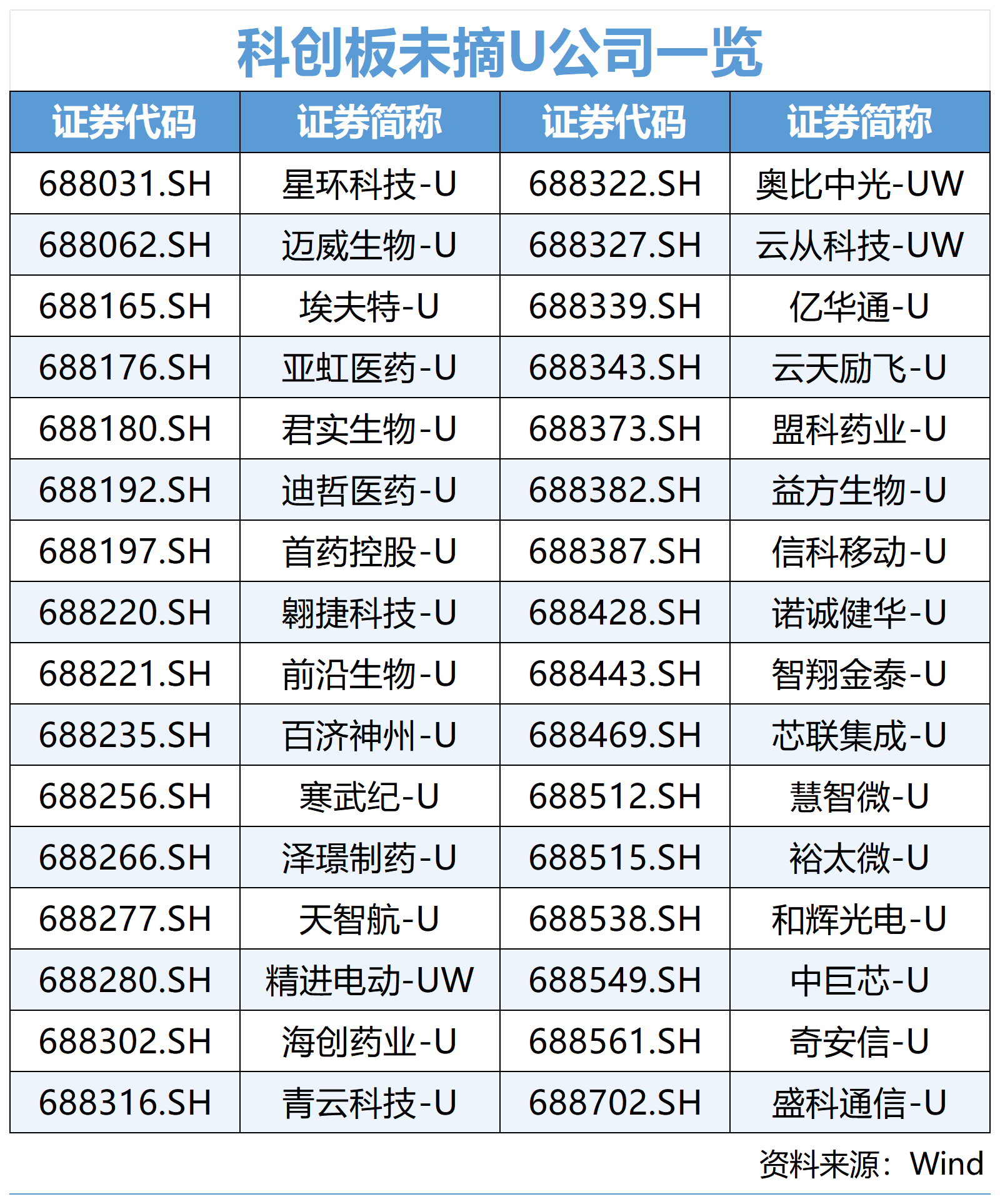
32家科创板未摘U公司纳入成长层 将受益两项“新老划断”安排
Zhong Guo Jing Ying Bao· 2025-06-26 03:22
Core Viewpoint - The newly established "Science and Technology Innovation Board Growth Layer" aims to support unprofitable technology companies by providing a more accommodating regulatory framework, benefiting existing companies while posing higher challenges for new entrants [1][2][5]. Group 1: Regulatory Changes - The Shanghai Stock Exchange has released the "Self-Regulatory Guidelines No. 5 for Science and Technology Innovation Board Listed Companies," which will include companies that have not yet achieved profitability since their listing [1][2]. - Currently, there are 32 companies on the Science and Technology Innovation Board that have not been delisted and will be classified as existing companies in the growth layer [2][3]. - The guidelines introduce a "new and old distinction" in the criteria for delisting and investor suitability management, favoring existing unprofitable companies [5][6]. Group 2: Impact on Companies - Existing companies will only need to achieve profitability for the first time to remain in the growth layer, while new companies face stricter criteria, including a requirement for positive net profit over the last two years or a minimum revenue of 100 million yuan [4][5]. - The introduction of a specialized risk disclosure document for investors in new registered companies increases compliance costs and liquidity pressure for these firms [5][6]. Group 3: Market Implications - The growth layer is designed to support technology companies with significant breakthroughs and ongoing R&D investments, even if they are currently unprofitable [6][8]. - The policy aims to enhance investor expectations for unprofitable companies, potentially improving their market valuation and financing environment [6][7]. - The reforms reflect a commitment to adapt the capital market to better serve the real economy and support emerging industries [6][8]. Group 4: Future Directions - Future reforms should focus on strengthening information disclosure regulations to ensure investors receive timely and accurate information [8][9]. - Enhancements to trading mechanisms, such as relaxing price limits and introducing more market makers, are suggested to improve market liquidity and attract quality technology companies [9]. - A refined delisting system is necessary to maintain a healthy market ecosystem by allowing non-compliant companies to exit while retaining high-quality firms [9].

21专访|田轩详解科创板新政:IPO预先审阅应健全预审标准
Sou Hu Cai Jing· 2025-06-24 12:46
Core Viewpoint - The recent launch of the "1+6" new policy for the Sci-Tech Innovation Board (STAR Market) by the China Securities Regulatory Commission (CSRC) has garnered significant market attention, particularly the reintroduction and expansion of the fifth listing standard, which opens up opportunities for high-quality unprofitable companies to go public [1][3][4] Group 1: Policy Changes and Implications - The fifth listing standard has been expanded to cover cutting-edge fields such as artificial intelligence, commercial aerospace, and low-altitude economy, enhancing the inclusivity and adaptability of the capital market for hard-tech companies [3][4] - The introduction of a new "U" label for unprofitable companies in the newly established Sci-Tech Growth Layer aims to improve transparency and help investors better identify and assess risks associated with these companies [9][10] - The new policy encourages collaboration between companies and experienced institutional investors, which is expected to enhance the identification and support of high-quality unprofitable enterprises [5][6] Group 2: Market Dynamics and Investor Considerations - The involvement of seasoned institutional investors is designed to provide a more accurate assessment of companies' innovation potential beyond just financial metrics, thereby guiding capital towards promising unprofitable firms [5][6] - The policy may lead to a situation where companies seek to partner with institutional investors primarily to meet listing requirements, potentially resulting in superficial collaborations rather than genuine partnerships [7][8] - The establishment of differentiated exit standards for companies in the Sci-Tech Growth Layer aims to ensure that only those with sustainable growth and profitability can transition out, thereby enhancing market quality [11][12] Group 3: IPO Pre-Review Mechanism - The newly introduced IPO pre-review mechanism allows companies to identify and address potential issues before formal submission, which could shorten the review cycle and increase the likelihood of successful listings [14][15] - This mechanism is particularly suited for strategic emerging industries with clear core technology projects that have significant implications for national and industry development [15] - However, the pre-review process may not fully uncover all issues, and there are concerns about the lack of transparency and potential information asymmetry in the market [16][17][18]