
长钱长投

Search documents
中长期资金加速入市 发挥市场“稳定器”与价值“引领者”作用
Shang Hai Zheng Quan Bao· 2025-12-09 18:47
今年以来,在政策持续引导与市场环境优化的推动下,保险资金、养老金、公募基金等中长期资金加速 进入A股市场,正在成为增强市场韧性、推动价值投资转型的重要力量。 "当前中长期资金入市提速,是资本市场结构优化与高质量发展的重要信号。"中国上市公司学术顾问委 员会委员程凤朝在接受上证报记者采访时表示,这类资金总体持仓稳健、偏向价值投资,能在市场情绪 波动时发挥"顺周期缓冲器"作用,提高市场的整体抗风险能力。这一趋势不仅体现在资金规模的显著增 长上,更反映在投资理念、考核机制与市场结构的深层变革中。 中国证券投资基金业协会数据显示,截至2025年10月底,我国境内公募基金管理机构共165家,管理的 公募基金资产净值合计36.96万亿元,与9月底相比,单月规模增长2182.74亿元,已经连续7个月创下历 史新高。 与公募基金同步增配A股的,还有规模庞大的保险资金。金融监管总局数据显示,截至今年三季度末, 人身险公司和财产险公司投资于股票和证券投资基金的余额合计达5.59万亿元,较年初大幅增长 36.2%,在保险公司资金运用余额中的占比提升至14.92%,创下近年新高。 除国内长期资金外,外资机构也展现出对中国资产的浓厚兴 ...
提高资本市场制度包容性适应性 积极发展直接融资
Jing Ji Ri Bao· 2025-12-09 00:54
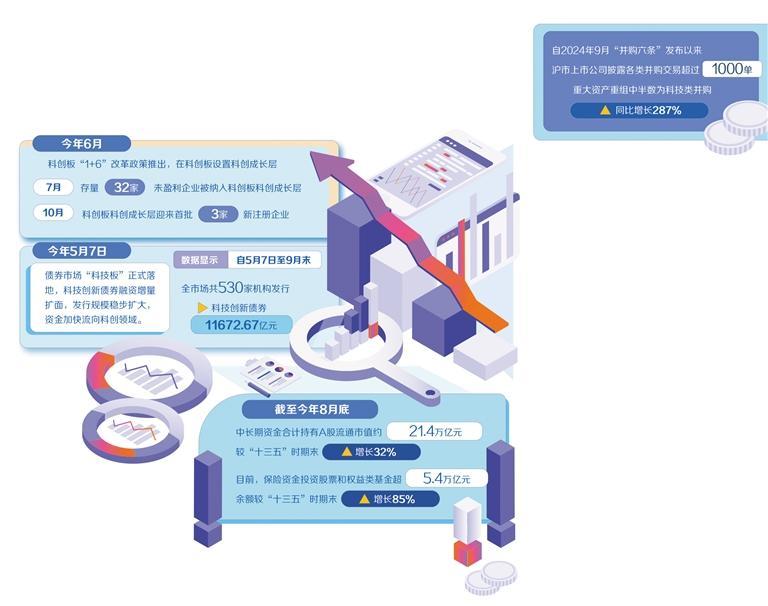
上海证券交易所理事长邱勇表示,一系列创新制度率先在科创板落地,科创板改革效应不断放大。目 前,科创板已汇聚592家科技型企业,总市值超9万亿元,科创板已成为中国硬科技企业上市首选地。 总市值超过100万亿元,投资者信心和预期明显改善,市场韧性和抗风险能力明显增强,今年以来,资 本市场总体稳健活跃,实现了量的合理增长和质的有效提升。 "十五五"规划建议明确了下一阶段资本市场改革发展的方向和目标:"提高资本市场制度包容性、适应 性,健全投资和融资相协调的资本市场功能。"业内认为,增强对科技创新的制度包容性,提升上市公 司投资价值,优化"长钱长投"市场生态,更好地发挥资本市场作为资源优化配置平台的核心功能是重要 着力点。 积极发展直接融资 积极发展股权、债券等直接融资,是"十五五"规划建议提出的明确任务,也是提高资本市场制度包容 性、适应性的关键举措。 近年来,证监会以深化科创板、创业板改革为抓手,积极发展多元股权融资,推动完善多层次资本市场 体系,提升对实体企业尤其是优质科创企业的全链条、全生命周期服务能力。今年6月,科创板"1+6"改 革政策推出,在科创板设置科创成长层。7月,存量32家未盈利企业被纳入科创板科 ...
提高资本市场制度包容性适应性
Jing Ji Ri Bao· 2025-12-08 22:14
Group 1 - The overall market capitalization has exceeded 100 trillion yuan, indicating a significant improvement in investor confidence and expectations, with enhanced market resilience and risk resistance [2] - The "14th Five-Year Plan" outlines the direction and goals for the next phase of capital market reform, emphasizing the need to improve the inclusiveness and adaptability of the capital market system [2] - The focus is on enhancing institutional inclusiveness for technological innovation, optimizing the market ecology for long-term investments, and better utilizing the capital market as a platform for resource allocation [2] Group 2 - The development of direct financing through equity and bonds is a key task outlined in the "14th Five-Year Plan," aimed at improving the inclusiveness and adaptability of the capital market [2] - The China Securities Regulatory Commission (CSRC) has been actively promoting multi-tiered capital market systems and enhancing services for high-quality technology enterprises [2][4] - The introduction of the "1+6" reform policy for the Sci-Tech Innovation Board in June and the establishment of a growth tier for unprofitable companies in July are significant steps in this direction [2][3] Group 3 - The bond market plays a crucial role in serving the real economy and optimizing resource allocation, with a focus on developing technology and green bonds [4] - Since the launch of the "Technology Board" for bonds on May 7, 2023, a total of 11,672.67 billion yuan in technology innovation bonds have been issued by 530 institutions by the end of September [4][5] - The future of the bond market is expected to continue focusing on technology innovation, foreign openness, and green development, with a diverse range of issuers [5] Group 4 - The A-share merger and acquisition market has been heating up, with significant reforms in the M&A market aimed at supporting the transformation and upgrading of listed companies [6] - Since the implementation of the "M&A Six Guidelines," over 1,000 M&A transactions have been disclosed in the Shanghai market, with a notable increase in technology-related mergers [6] - The future role of M&A is expected to further enhance the integration of technology and industry, reflecting a shift from factor-driven to innovation-driven economic growth [6][7] Group 5 - The cultivation of high-quality listed companies is essential for the stable operation of the capital market, with ongoing reforms to improve the delisting mechanism [7] - The delisting mechanism is being optimized to ensure a more orderly market ecology, allowing for a more effective selection process [7] - The focus on enhancing the delisting standards and mechanisms aims to improve the overall health and resource allocation efficiency of the capital market [7] Group 6 - As of the end of August, medium- and long-term funds held approximately 21.4 trillion yuan of A-share circulating market value, a 32% increase from the end of the "13th Five-Year Plan" period [8] - The acceleration of medium- and long-term funds entering the market is expected to stabilize market fluctuations and promote a shift towards value investment and long-term investment [8][9] - The establishment of a more attractive "long money, long investment" system environment is crucial for supporting innovation and capital formation [9][10] Group 7 - The "14th Five-Year Plan" period is expected to position the capital market as an aggregator of innovation, linking technology, industry, and policy [10] - The focus will be on providing long-term patient capital for technological innovation and supporting the transformation and upgrading of traditional industries [10]


政策周观察第58期:等待两大会召开
Huachuang Securities· 2025-12-08 11:23
宏观研究 宏观快评 2025 年 12 月 08 日 华创证券研究所 证 券 研 究 报 告 【宏观快评】 等待"两大会"召开——政策周观察第 58 期 近一周,政策出台不多,主要有以下内容。短期内,关注中央政治局会议和中 央经济工作会议"两大会"召开。 1、12 月 1 日,《求是》杂志发表习近平总书记重要文章《推进党的自我革命 要做到"五个进一步到位"》。文章中,习近平总书记指出"对党的自我革命认 识要进一步到位……我们党进行自我革命,刀刃向内、激浊扬清、刮骨疗毒, 非但不会影响党的形象和威信,反而能够提高党的形象和威信;非但不会挫伤 党员干部的积极性,反而能够更广泛更充分地调动党员干部的积极性;非但不 会影响经济社会发展,反而能够为高质量发展提供坚强政治保证","党员干部 增强党性要进一步到位","权力规范运行要进一步到位","从严监督执纪要进 一步到位","落实管党治党责任要进一步到位"。 2、资本市场:1)12 月 5 日,国家金融监管总局调整保险公司相关业务风险 因子,"针对保险公司投资的沪深 300 指数成分股、中证红利低波动 100 指数 成分股以及科创板股票的风险因子,根据持仓时间进行了差异 ...
大金融迎来顶层催化,优质券商杠杆限制有望被放松
Xuan Gu Bao· 2025-12-07 23:31
东吴证券分析认为,提升ROE可以通过提高杠杆率、提高费类业务占比、提升资本使用效率、降费等方 式。此次监管引导通过强化分类监管,对优质机构适度拓宽资本空间与杠杆上限,提升资本利用效率, 将有助于提升券商ROE的中枢。 同时行业内的资源整合仍将成为券商快速提升规模与综合实力的又一重要方式,大型券商通过并购进一 步补齐短板,巩固优势,中小券商通过外延并购有望弯道超车,快速做大,实现规模效应和业务互补。 其次,12月5日,国家金融监管总局发布《关于调整保险公司相关业务风险因子的通知》,通知要求: 持仓超过三年的沪深300指数成分股、中证红利低波动100指数成分股的风险因子从0.3下调至0.27;持仓 时间超过两年的科创板上市普通股的风险因子从0.4下调至0.36。 据上海证券报报道,12月6日,中国证监会主席吴清在中国证券业协会第八次会员大会上表示,鼓励头 部机构通过并购重组打造国际一流投行,告别价格战,中小机构旨在"小而美"。 据国泰海通测算,此次变动,预计合计释放最低资本210亿,若全部用于增配股票,则可带来约764亿增 量资金。 吴清表示,证监会将着力强化分类监管、扶优限劣,对优质机构适当松绑,进一步优化风控 ...
非银金融行业跟踪周报:吴清提出拓宽券商资本空间,保险优化股票风险因子-20251207
Soochow Securities· 2025-12-07 08:57
Investment Rating - The report maintains an "Overweight" rating for the non-bank financial sector [1] Core Insights - The non-bank financial sector currently has a low average valuation, presenting a safety margin and potential for growth [2] - The insurance industry is expected to benefit from economic recovery and rising interest rates, with a significant increase in the sales of savings-type products [7] - The securities industry is undergoing transformation, which may lead to new business growth opportunities [7] Summary by Sections Non-Bank Financial Sector Performance - In the recent five trading days (December 1-5, 2025), only the insurance sector outperformed the CSI 300 index, with insurance up 5.13%, while the overall non-bank financial sector rose 2.33% [6][13] - Year-to-date, the insurance sector has increased by 20.28%, outperforming other sectors [14] Securities Sector - Trading volume has decreased month-on-month, with an average daily trading amount of 19,654 billion CNY in December, down 12.30% from the previous month but up 11.93% year-on-year [18] - The China Securities Regulatory Commission (CSRC) is considering measures to enhance the capital space for quality brokerages, aiming for high-quality development [23] - The average price-to-book (PB) ratio for the securities industry is projected at 1.3x for 2025 [24] Insurance Sector - The total assets of the insurance industry surpassed 40 trillion CNY, growing by 12.5% year-to-date [35] - Regulatory changes are aimed at optimizing long-term stock holding risk factors, encouraging insurance funds to adopt a long-term investment approach [27] - The insurance sector's valuation is currently at historical lows, with a P/EV ratio between 0.61 and 0.97 for 2025 [36] Multi-Financial Sector - The trust industry is experiencing a significant decline in profits, with total profits down by 45.5% year-on-year [39] - The futures market saw a year-on-year increase in trading volume and value, indicating a potential recovery in market activity [45] - The financial leasing sector is being guided to focus on its core business and enhance service capabilities [53] Industry Ranking and Recommendations - The recommended ranking for the industry is insurance > securities > other multi-financial sectors, with key companies including China Life, Ping An, and CITIC Securities highlighted for investment [54]






ETF规模5.7万亿,“指数大厂”下一步会干啥
2 1 Shi Ji Jing Ji Bao Dao· 2025-12-07 06:57
Core Insights - The rapid growth of the ETF market in China, reaching a total scale of 5.7 trillion yuan by December 5, is attributed to the favorable policies and environment for long-term investments in the capital market [1] - Major index fund companies are focusing on enhancing investor experience and competitiveness through various strategies, including optimizing index quality, promoting systematic investment in ETFs, and building strong brands [1][2][3][4] Group 1: ETF Market Growth - The ETF market in China has surpassed two trillion yuan milestones within the year, indicating significant growth [1] - The characteristics of ETFs, such as transparency, low fees, comprehensive assets, and high liquidity, make them suitable for long-term investments in equity markets [1] Group 2: Index Optimization - Many fund companies are exploring ways to improve index construction, moving from single-factor to multi-factor approaches and incorporating AI and derivative tools [2] Group 3: Investor Engagement - Initiatives like the "定投中国——ETF定投案例展" aim to help investors understand the logic and advantages of systematic investment in ETFs, reducing emotional interference and enhancing investment experience [3] Group 4: Brand Development - Leading fund companies are launching index investment mini-programs and creating educational content to enhance service experience and investor engagement [4]
ETF规模5.7万亿,“指数大厂”下一步会干啥?|财经早察
2 1 Shi Ji Jing Ji Bao Dao· 2025-12-07 01:15
Core Insights - The rapid growth of the ETF market in China, reaching a total scale of 5.7 trillion yuan, is attributed to favorable national policies aimed at enhancing the capital market [1] - Major index fund companies are focusing on improving index quality and investor experience in the evolving landscape of index investing [1][2] Group 1: ETF Market Growth - The ETF market has crossed two trillion yuan milestones this year, indicating significant growth and interest from long-term investors [1] - The characteristics of ETFs, such as transparency, low fees, and high liquidity, make them attractive for medium to long-term investments, especially in high-risk sectors like technology [1] Group 2: Index Optimization - Many fund companies are exploring ways to optimize index construction, moving from single-factor to multi-factor approaches, and incorporating AI and derivative tools [2] - The goal is to create smarter index products that can outperform the market [2] Group 3: Investor Engagement - Initiatives like the "定投中国——ETF定投案例展" aim to educate investors on the benefits of systematic investment in ETFs, helping them to manage emotions and reduce risks associated with market volatility [3] - Fixed-amount, fixed-time investment strategies are highlighted as effective methods for enhancing investor experience [3] Group 4: Brand Development - Leading fund companies are launching index investment mini-programs to enhance user experience, allowing investors to track funds, analyze portfolios, and engage in community discussions [4] - The creation of educational content and brand identity, including mascots and comprehensive reports, reflects a commitment to improving service and investor education [4]
盘后!A股,迎来重磅利好!
券商中国· 2025-12-05 09:00
Core Viewpoint - The insurance sector has seen a significant rise in stock prices following the announcement of favorable policies aimed at encouraging long-term investments by insurance companies [1][5]. Group 1: Policy Adjustments - The Financial Regulatory Authority has announced a reduction in risk factors for insurance companies investing in certain stocks, specifically those held for over three years and two years, respectively [2][5]. - The risk factor for stocks in the CSI 300 index and the CSI Dividend Low Volatility 100 index has been lowered from 0.3 to 0.27 for holdings over three years [2]. - For stocks listed on the Sci-Tech Innovation Board held for over two years, the risk factor has been reduced from 0.4 to 0.36 [2]. Group 2: Implications for Insurance Companies - The reduction in risk factors means lower capital consumption for insurance companies, which will enhance their solvency ratios and provide more room for further stock purchases and investment operations [5][6]. - The adjustments are expected to benefit all insurance companies that meet the conditions for investing in the specified stocks [5]. Group 3: Industry Expectations - There has been a strong industry call for optimizing solvency policies to better support equity asset allocation, especially in a low-interest-rate environment [6][7]. - Industry insiders have suggested that the regulatory body should further refine risk factor classifications based on investment fields and holding periods to encourage long-term investments [6][7]. Group 4: Historical Context and Future Directions - The Financial Regulatory Authority has previously made several adjustments to solvency policies to guide insurance funds in supporting the capital market and the real economy [8]. - Future measures are expected to focus on enhancing the long-term investment management capabilities of insurance companies and ensuring accurate solvency data [8].

证监会主席吴清:实施六大重点任务举措,提高资本市场制度包容性适应性
Zhong Guo Jing Ying Bao· 2025-12-05 02:25
Core Viewpoint - The article emphasizes the need to enhance the inclusiveness and adaptability of the capital market system in China, outlining six key initiatives to achieve this goal [1]. Group 1: Direct Financing Development - The focus is on actively developing direct financing through equity and bond markets, with reforms in the Sci-Tech Innovation Board and Growth Enterprise Market as key drivers [1]. - There is a call to improve the identification and pricing mechanisms for technology innovation enterprises to support high-quality companies in going public [1]. - The development of private equity and venture capital funds is encouraged, along with a multi-tiered bond market system, including the promotion of Sci-Tech bonds and green bonds [1]. Group 2: High-Quality Listed Companies - The article stresses the importance of optimizing the structure of listed companies to enhance investment value [2]. - It advocates for deepening mergers and acquisitions market reforms and improving the flexibility of refinancing mechanisms to support company transformation and the development of new productive forces [2]. - There is a push for companies to strengthen their awareness of returning value to investors through cash dividends and share buybacks [2]. Group 3: Long-Term Investment Environment - The creation of a market environment that attracts long-term capital is highlighted, with a focus on establishing a long-term assessment mechanism for various types of funds [3]. - The article calls for reforms in public funds and the development of equity public funds to promote high-quality index investment [3]. - It emphasizes the importance of a smooth cycle for private equity and venture capital funds [3]. Group 4: Regulatory Effectiveness - The need for a comprehensive and multi-dimensional regulatory system for securities and futures is underscored to adapt to rapid market changes [4]. - The article advocates for the use of modern technologies like big data and AI to identify illegal activities and risks effectively [4]. - It stresses the importance of strict enforcement against financial fraud and market manipulation to maintain a fair market order [4]. Group 5: Open Capital Market - The article promotes a gradual approach to expanding the openness of the capital market, enhancing the international competitiveness of China's capital market [5]. - It supports the use of both domestic and international markets and resources by enterprises [5]. - The development of world-class exchanges and investment institutions is encouraged, along with the construction of international financial centers [5]. Group 6: Market Ecology - The article calls for strengthening the legal framework of the capital market and revising relevant laws to create a fair market environment [6]. - It emphasizes the need for investor protection mechanisms and the promotion of rational, value, and long-term investment [6]. - The establishment of high-end think tanks and talent development in the capital market is highlighted to address strategic and foundational issues [7].