
ESG投资

Search documents
ESG投资周报:本月新发33只绿色债券,流动性环比收窄-20251021
GUOTAI HAITONG SECURITIES· 2025-10-21 11:35
Market Performance - During the week of October 13-17, 2025, the A-share market experienced a pullback, with the CSI 300 index declining by 2.22% and the ESG 300 index falling by 2.80%[5] - The average daily trading volume for the entire A-share market was approximately 2.20 trillion RMB, indicating a contraction in liquidity[5] ESG Fund Issuance - No new ESG fund products were issued in October 2025; however, a total of 242 ESG public funds were issued in the past year, with a total share of 1,600.74 million[7] - As of October 17, 2025, there are 936 existing ESG fund products, with the largest share being ESG strategy funds at 50.41% of the total net asset value of 1,035.32 billion RMB[9] Green Bond Issuance - In October 2025, 33 new ESG bonds were issued, raising a total of 27.5 billion RMB, while 23 green bonds were issued in the interbank and exchange markets during the week of October 13-17, 2025, with a planned issuance scale of approximately 14.07 billion RMB[13] - Over the past year, 1,095 ESG bonds were issued, totaling 120.86 billion RMB, with a cumulative issuance of 3,691 ESG bonds in China, of which green bonds accounted for 2,529[13] Trading Activity - The total trading volume of ESG green bonds for the week of October 13-17, 2025, was 565.20 billion RMB, with the interbank bond market accounting for 76.35% of the total trading volume[17] - Repo transactions dominated the trading activity, comprising 95.09% of the total trading volume, while cash transactions accounted for only 0.08%[18] ESG Bank Wealth Management Products - In October 2025, 36 ESG bank wealth management products were issued, primarily focusing on pure ESG and social responsibility themes[19] - There are currently 1,091 existing ESG bank wealth management products, with pure ESG products making up the largest share at 55.64%[19] Risk Factors - Potential risks include insufficient policy support for ESG initiatives, lack of standardized data reporting, and lower-than-expected product issuance scales[21]
换帅背后 博时基金挑战与看点
Sou Hu Cai Jing· 2025-10-21 04:01
Core Viewpoint - The leadership change at Bosera Fund marks a critical moment for the company as it navigates a competitive public fund industry and seeks to enhance its investment strategies and performance amid talent loss and market challenges [3][10]. Group 1: Leadership Transition - Jiang Xiangyang has resigned as chairman, with Zhang Dong taking over the role while also serving as general manager, indicating a significant shift in leadership during a pivotal time for the company [3][4]. - Zhang Dong brings extensive banking and financial management experience, having worked at China Bank and China Merchants Bank for over 30 years, which may help in revitalizing the company's strategies [3][4]. Group 2: Company Performance - Under Jiang's leadership, Bosera Fund's public fund management scale grew from 132.4 billion yuan in 2015 to 1.19 trillion yuan, ranking 8th in the industry [4][10]. - Despite the growth in scale, the company's revenue and net profit showed limited growth, with 2025 first-half revenue at 2.356 billion yuan (up 6.37%) and net profit at 763 million yuan (up 0.13%) [4][10]. - The company has faced challenges with talent retention, particularly in its fixed income division, leading to a decline in bond fund performance and overall management scale [7][10]. Group 3: Talent and Investment Strategy - The departure of key personnel, including several core members of the fixed income team, has raised concerns about the company's ability to maintain its competitive edge in the market [7][10]. - The company has seen a significant drop in its bond fund scale, from a peak of 373.9 billion yuan in 2022 to 309.8 billion yuan, reflecting the impact of talent loss [10][11]. - Analysts emphasize the importance of a robust talent development and retention strategy to ensure long-term competitiveness in the fund management industry [8][10]. Group 4: Equity Fund Challenges - Bosera Fund's equity products have struggled, with stock and mixed fund scales significantly reduced from their peaks in 2021, indicating a lack of standout products in a recovering market [11][12]. - The company's mixed fund scale has decreased by over 50% from its high, raising concerns about its ability to attract investor interest [11][12]. - Despite recent improvements in equity product performance, the company lacks flagship products that can compete effectively in the market [12][19]. Group 5: Future Opportunities - Bosera Fund is focusing on building a technology-driven investment framework and has initiated several innovative strategies, including floating fee structures and diversified asset allocation [21][22]. - The company is also investing in AI technology to enhance research and decision-making processes, which could improve operational efficiency [24][25]. - Bosera Fund's commitment to ESG principles and sustainable investment practices is evident, with over 13 billion yuan in ESG-related fund assets, positioning it favorably in a market increasingly focused on responsible investing [25][26].

全球顶尖大脑最新研判:AI还像婴儿,标准必须建立,机器人也难替人工
Xin Lang Cai Jing· 2025-10-20 01:02
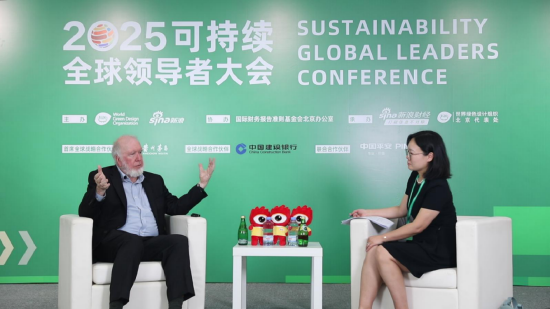
登录新浪财经APP 搜索【信披】查看更多考评等级 专题:2025可持续全球领导者大会&首届绿色产业与可持续消费博览会 炒股就看金麒麟分析师研报,权威,专业,及时,全面,助您挖掘潜力主题机会! 文 | 新浪财经报道组 2025可持续全球领导者大会于10月16日-18日在上海市黄浦区世博园区召开。 本届大会由世界绿色设计组织(WGDO)与新浪集团联合主办,国际财务报告准则基金会(IFRS Foundation)北京办公室协办,新浪财经与世界绿色设计组织北京代表处承办,上海市黄浦区人民政府 支持。 会议期间,《2049》作者、科技预言家、《连线》杂志创始主编凯文·凯利;Verimag实验室创始人, 2007年图灵奖得主约瑟夫·希发基思;2013年诺贝尔化学奖得主、美国国家科学院院士、英国皇家学会 院士、美国斯坦福大学结构生物学教授迈克尔·莱维特等多位嘉宾走进采访间,畅谈可持续发展及人工 智能等热门话题。 凯文·凯利:AI的生存完全依赖人类 会议期间,新浪财经对话了《2049》作者、科技预言家、《连线》杂志创始主编凯文·凯利。 有人担忧AI变得过于强大,可能会给人类带来冲击。他认为,现在的AI只能完成某些类型的认知任 ...

济安金信|ESG投资中国化实践:从ESG到ESG-V,打造ESG投资闭环
Xin Lang Ji Jin· 2025-10-18 03:14
Core Insights - The article emphasizes the growing importance of ESG (Environmental, Social, and Governance) principles in investment decision-making, highlighting the need for a sustainable financial system focused on long-term value creation [1][6] Group 1: ESG Investment Landscape - Despite increasing attention from investors on ESG performance, effective tools and methods for integrating these factors into investment decisions remain scarce, leading to an incomplete ESG investment loop [2] - Domestic investment institutions often lack standardized evaluation criteria for ESG investments, resulting in a market devoid of empirically validated ESG investment products and tools [2] Group 2: ESG-V Rating System - Jinan Jinxin has introduced the ESG-V rating system, which innovatively incorporates enterprise value into ESG ratings, bridging the gap between traditional ESG assessments and investment decisions [2][6] - The ESG-V rating framework aims to address the unique challenges of evaluating ESG performance in China, where international standards may not adequately reflect local conditions [3] Group 3: Environmental, Social, and Governance Dimensions - In the environmental dimension, the ESG-V rating focuses on the impact of a company's products and services on the environment, emphasizing the need for collective responsibility across the entire industry chain [4] - The social dimension of the ESG-V rating highlights the importance of ensuring that products and services align with ESG principles, while also addressing broader social responsibilities such as financial fraud and legal compliance [4] - The governance aspect of the ESG-V rating introduces a new perspective on corporate governance, emphasizing the importance of stakeholder relationships and the overall business environment in promoting effective governance [5] Group 4: Implementation and Impact - The ESG-V rating represents a significant advancement in integrating enterprise value into traditional ESG assessments, which is crucial for aligning stock market investments with social responsibility [6][7] - The evaluation of value within the ESG-V framework relies on Jinan pricing, a comprehensive pricing model that has been validated in the market, contributing to the identification of undervalued stocks [7] - The article asserts that the localization of ESG principles in China is not merely a modification of international concepts but an innovative reconstruction based on local industry characteristics [7]
对话香港品质保证局总裁陈沛昌:中国ESG投资机遇获全球关注
Xin Lang Cai Jing· 2025-10-18 02:20
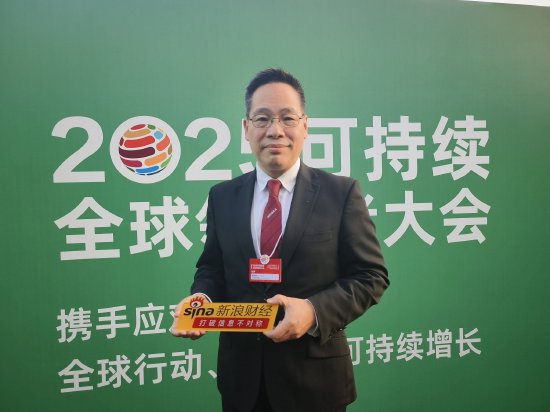
Core Insights - The 2025 Sustainable Global Leaders Conference is scheduled to take place from October 16 to 18 in Shanghai, highlighting the city's role as a key economic center in China and its contributions to sustainable development [1][3] Group 1: Sustainable Development Initiatives - The Chinese government has been actively promoting sustainable development through a series of important guidelines released from mid-last year to the end of the year, which include requirements for companies to disclose sustainability-related information [3] - The three major stock exchanges in mainland China have also mandated listed companies to provide sustainability disclosures, indicating a strong push towards transparency and accountability in the market [3] Group 2: Hong Kong's Role in ESG Investment - Hong Kong, as a global financial hub, has seen significant development in financial management, which enhances investor confidence and supports economic growth [3] - The Hong Kong government released the "Hong Kong Sustainable Disclosure Roadmap" at the end of last year, aligning with the broader push for sustainability and transparency in the region [3]
A股绿色周报|11家上市公司暴露环境风险 城发环境控股公司被罚44.8万元
Mei Ri Jing Ji Xin Wen· 2025-10-17 12:29
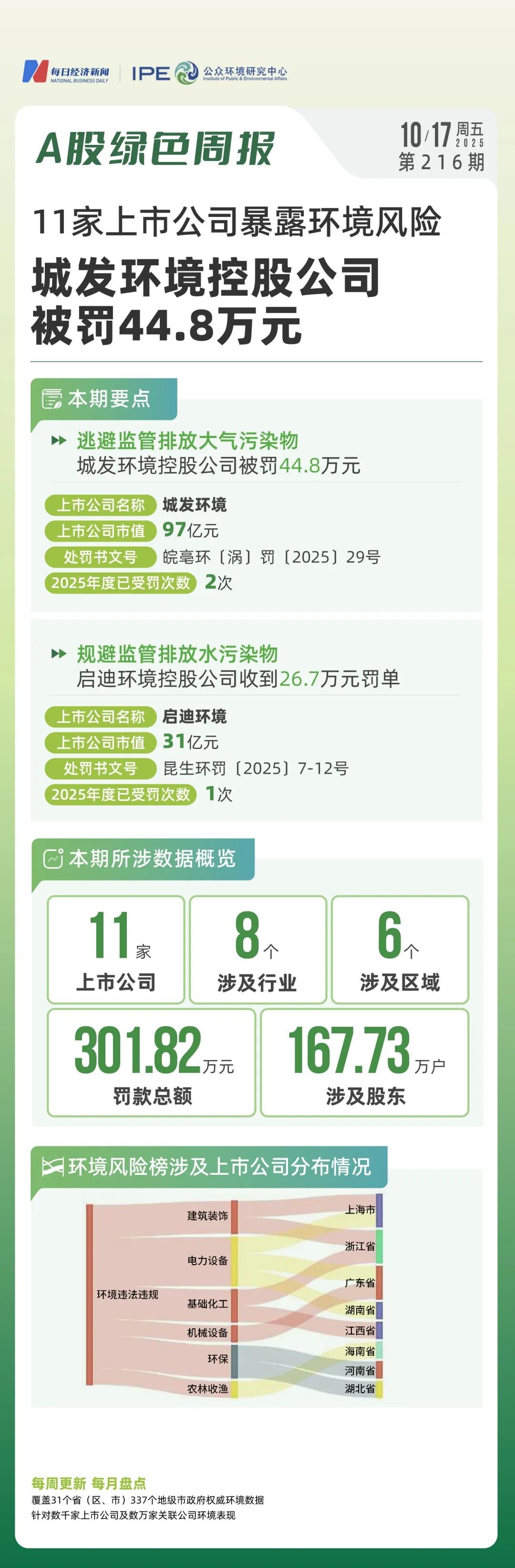
Core Points - The article discusses the environmental risks faced by 11 listed companies in China, highlighting recent penalties for violations related to air and water pollution [4][5][10] - It emphasizes the growing importance of environmental responsibility in corporate governance and investment decisions, particularly in the context of ESG (Environmental, Social, and Governance) principles [15] Group 1: Environmental Violations and Penalties - Chengfa Environment was fined 448,000 yuan for evading regulations related to air pollution by improperly operating pollution control facilities [10][13] - Qidi Environment received a penalty of 267,000 yuan for discharging water pollutants through unauthorized channels [13] - Shilong Industrial was fined 198,000 yuan for discrepancies in the number of exhaust outlets compared to its pollution discharge permit [11] Group 2: Impact on Shareholders - The 11 companies involved have a combined total of 1,677,300 shareholders, indicating potential investment risks due to their environmental violations [10] - The article suggests that these environmental issues could affect the companies' reputations and financial performance, thereby impacting shareholder value [6][10] Group 3: Regulatory Context - The article notes that the data on environmental violations is collected from various government sources across 31 provinces and cities in China, aiming to enhance transparency in corporate environmental practices [4][15] - It highlights the legal framework supporting public access to environmental information, which has been strengthened over the years [15]


福恩股份IPO遇阻!家族控股超八成,核心产品单价连跌三年,高度依赖优衣库等大客户
Hua Xia Shi Bao· 2025-10-16 05:03
Core Viewpoint - The IPO of Hangzhou Fu'en Co., Ltd. has been accepted but is currently suspended, raising concerns about the company's financial health and compliance issues [2][4][16]. Company Overview - Fu'en Co., Ltd. is a leading domestic supplier of recycled fabrics, focusing on sustainable development and eco-friendly materials [3][16]. - The company has established strong relationships with major global clothing brands, including H&M, Uniqlo, GU, and ZARA, and is recognized as a key supplier in their supply chains [3][16]. IPO Details - The company plans to raise 1.25 billion yuan through its IPO, with 800 million yuan allocated for an integrated color-spun fabric project and 450 million yuan for a high-end eco-friendly materials research institute and green manufacturing project [2][6]. - The IPO review status is currently suspended, which may impact the company's future listing prospects [4][16]. Financial Performance - From 2022 to 2024, the company reported revenues of 1.76 billion yuan, 1.52 billion yuan, and 1.81 billion yuan, with net profits of 277 million yuan, 229 million yuan, and 275 million yuan respectively [6][13]. - The top five clothing brands account for approximately 70% of the company's revenue, indicating a high dependency on a few major clients [6][16]. Product Analysis - The proportion of revenue from recycled fabrics increased from 75.61% in 2022 to 83.20% in 2024, while the share of virgin fabrics decreased from 24.39% to 16.8% [7][9]. - The average selling price of recycled polyester-cotton blended fabric has declined from 21.61 yuan/meter in 2022 to 20.92 yuan/meter in 2024 [9][10]. Shareholder Structure - The actual controllers of the company hold 83.89% of the shares, which raises concerns about the influence on decision-making and potential risks for minority investors [11][12]. - The company distributed a cash dividend of 380 million yuan in 2022, exceeding its net profit for that year, which has led to discussions about "last-minute dividends" before the IPO [13][16]. Inventory and Receivables - The company's inventory has been increasing, with balances of 221 million yuan, 239 million yuan, and 277 million yuan from 2022 to 2024, indicating potential inventory management risks [14][15]. - Accounts receivable have also risen, with balances of 246 million yuan, 255 million yuan, and 274 million yuan during the same period, and the accounts receivable turnover ratio has consistently been below industry averages [15][16].
过去十年年化投资回报率超8% 外部管理人精英荟萃 风险偏好与目标精心匹配 诺贝尔基金会“长钱术”揭秘
Zhong Guo Zheng Quan Bao· 2025-10-14 20:20
Core Insights - The Nobel Prize fund has grown from 31 million kronor to nearly 6.8 billion kronor by the end of 2024, achieving a growth of approximately 220 times since its inception [1][2] - The Nobel Foundation employs a cautious investment strategy, aiming for an annual return of at least 3% adjusted for inflation, while maintaining balanced financial risk management [2][8] Investment Performance - The total asset value of the Nobel Foundation reached 67.97 billion kronor by the end of 2024, an increase of 5.64 billion kronor from 62.33 billion kronor at the end of 2023 [2] - The investment return for 2024 was 11.6%, with a five-year annualized return of 9.2% and a ten-year annualized return of 8.3% [2][8] Asset Allocation - As of the end of 2024, the investment portfolio consisted of 66 billion kronor, with allocations including equity funds (56%), real estate and infrastructure funds (9%), fixed income and cash (12%), and alternative assets (24%) [2][5] - The Nobel Foundation's expenditures for 2024 totaled 135.8 million kronor, with 55 million kronor allocated for prize money [2][3] External Management - The Nobel Foundation utilizes a range of external managers for its investments, including prominent firms such as BlackRock, Sequoia Capital, and Millennium Management [5][6] - The investment strategy is divided into four main categories: equities and private equity, real estate and infrastructure, hedge funds, and fixed income, managed by various external institutions [5][6] Governance and Responsible Investment - The investment committee of the Nobel Foundation is responsible for asset allocation decisions and the selection of external managers, focusing on their investment philosophy, performance history, and risk management systems [8][9] - The foundation adheres to the Principles for Responsible Investment (PRI), integrating environmental, social, and governance (ESG) considerations into its investment processes [8][9] Future Outlook - The Nobel Foundation anticipates advancements in investment management systems, potentially incorporating AI to enhance analysis and decision-making efficiency [9] - The foundation remains confident in its long-term capital preservation capabilities, focusing on structural trends and maintaining a balanced risk profile [9]
诺贝尔基金会“长钱术”揭秘
Zhong Guo Zheng Quan Bao· 2025-10-14 20:17
Core Insights - The Nobel Prize fund has grown from 31 million kronor to nearly 6.8 billion kronor by the end of 2024, achieving a growth of nearly 220 times since its inception in 1901 [1][2] - The Nobel Foundation employs a careful investment strategy that includes external management, diversified asset allocation, and responsible investment principles to ensure the sustainability of the prize fund [1][6] Investment Performance - The Nobel Foundation's total asset value reached 67.97 billion kronor by the end of 2024, an increase of 5.64 billion kronor from 62.33 billion kronor at the end of 2023 [2] - The annualized investment return over the past five years was 9.2%, with a return of 11.6% in 2024 [2][5] - The foundation aims for an average annual return of at least 3% after inflation adjustments to cover its expenses [2] Asset Allocation - As of the end of 2024, the Nobel Foundation's investment portfolio consisted of 66 billion kronor in various assets, including equity funds (56%), real estate and infrastructure funds (9%), fixed income and cash (12%), and alternative assets (24%) [2][3] - The foundation's investments are managed by external institutions, including BlackRock, Swedish Commercial Bank, Sequoia Capital, and several top hedge funds [3][4][5] Governance and Management - The Nobel Foundation's investment committee is responsible for asset allocation decisions and selecting external managers, focusing on their investment philosophy, performance history, and risk management [6] - The foundation adheres to the United Nations-supported Principles for Responsible Investment (PRI), integrating environmental, social, and governance (ESG) considerations into its investment processes [6][7] Future Outlook - The foundation's CFO expressed confidence in the long-term sustainability of the fund, emphasizing a balanced approach to risk and investment goals [7] - The potential integration of advanced systems and AI in investment management is anticipated to enhance decision-making and efficiency in the future [7]
ESG投资浪潮下,化工企业如何靠低碳技术打开估值天花板?
Zhong Guo Hua Gong Bao· 2025-10-12 02:39
Core Insights - Market capitalization reflects investors' comprehensive expectations for a company's future development and is a crucial aspect of corporate governance through effective market value management [1] - The rise of ESG (Environmental, Social, Governance) investment has made ESG performance a key variable influencing market capitalization, with specific focus on environmental impact, social responsibility, and governance practices [1][2] Group 1: Market Capitalization and ESG - As of June 2025, there are over 5,400 A-share listed companies in China with a total market capitalization exceeding 100 trillion yuan, and the chemical sector alone has over 410 companies with a market cap exceeding 5.6 trillion yuan [1] - By 2025, global ESG assets are projected to reach $53 trillion, accounting for over 35% of total global assets under management [2] - Companies with strong ESG performance and ratings are more likely to attract long-term funding and enjoy lower financing costs [2] Group 2: ESG Impact on Chemical Industry - In the chemical industry, low-carbon technology, carbon emission management, and supply chain responsibility are critical ESG issues that investors focus on [3] - Companies with varying market capitalizations and stages of development exhibit different pathways in adopting low-carbon technologies, impacting their market valuations [3][4] - Smaller companies often leverage low-carbon technology through partnerships with academic institutions, while larger firms may focus on international benchmarks and technology upgrades to enhance their competitive edge [4] Group 3: Strategic Approaches to ESG - Leading companies in the supply chain can set low-carbon technology standards and collaborate with downstream partners to create a closed-loop supply chain, enhancing their ecological control and green premium [4] - The shift towards low-carbon technology-driven ESG practices is reshaping the valuation system of chemical companies, emphasizing the transformation of ESG from a compliance cost to a strategic asset [4] - The differentiation in market capitalization within the Chinese chemical industry is increasingly influenced by the level of ESG management practices, with a focus on green low-carbon technologies to break through traditional valuation ceilings [4]