
人工智能泡沫

Search documents
一天内近40万人爆仓 比特币崩了!近一个半月已跌超1/3,专家:还要继续跌
Mei Ri Jing Ji Xin Wen· 2025-11-21 11:47
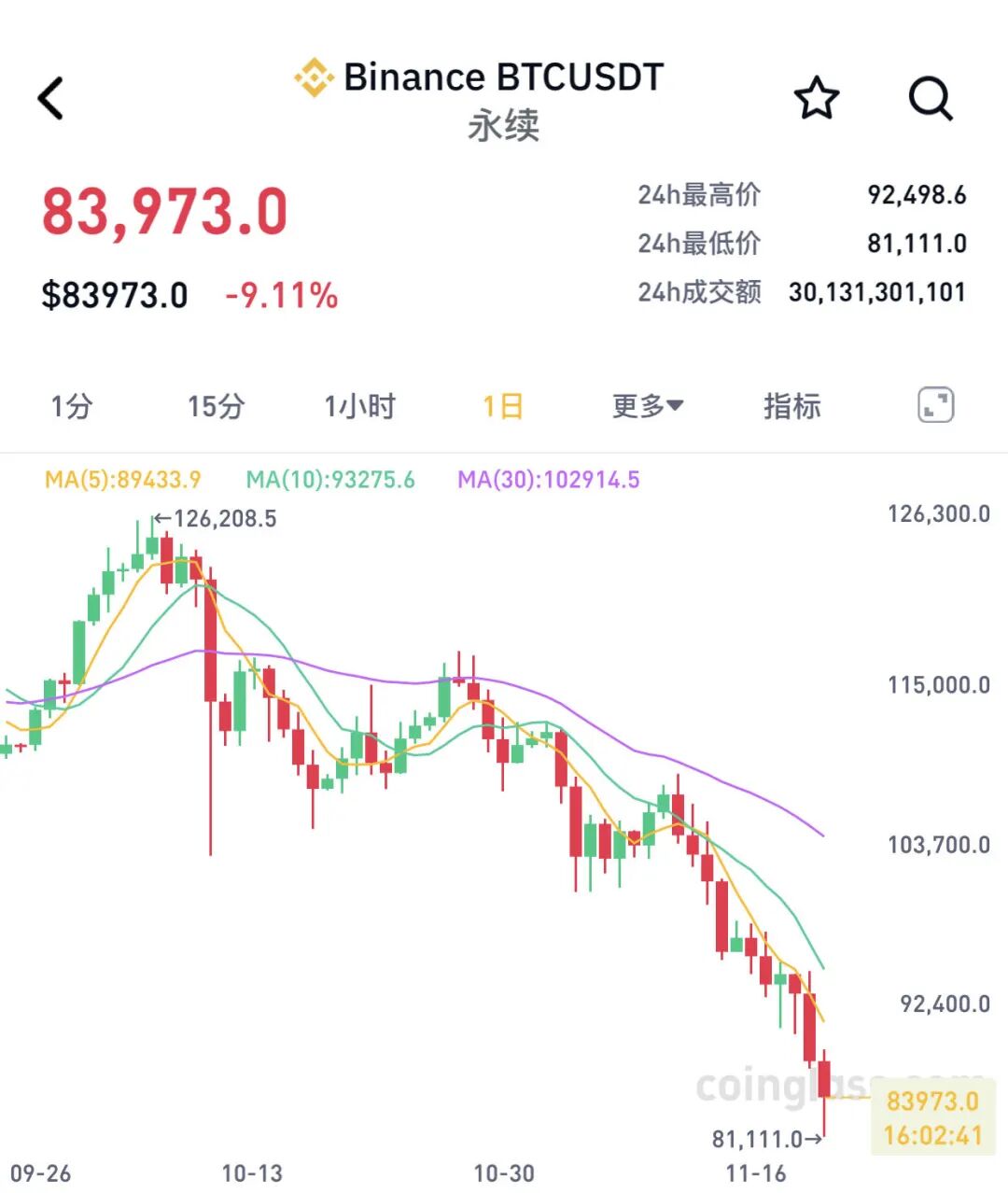
Core Viewpoint - The cryptocurrency market is experiencing significant declines, with Bitcoin dropping from over $125,000 to around $82,000, marking a 35% decrease in just a month and a half [1]. Price Movements - Bitcoin's price fell below $82,000, reaching a low of $81,111, the lowest since April 7, with a 24-hour drop of up to $11,000 before slightly recovering to $83,973, down over 9% [1]. - Other cryptocurrencies also faced declines: Ethereum down 10.8%, SOL down 11.7%, XRP down 10.5%, Dogecoin down 11.6%, and ADA down 13.3% [2]. Market Capitalization and Liquidations - Market capitalizations for major cryptocurrencies show significant losses, with Ethereum at $32.7 billion (-12.8%), SOL at $6.47 billion (-12.4%), and XRP at $3.05 billion (-14.9%) [3]. - In the last 24 hours, the cryptocurrency market saw liquidations totaling $1.914 billion, affecting 392,000 traders, with long positions accounting for $1.78 billion and short positions for $130 million [5]. Economic Factors - Bitcoin has erased all its gains for the year, with a cumulative decline of over 10%, indicating a potential annual drop for the first time since 2022 [7]. - Analysts attribute the downturn to reduced expectations for Federal Reserve interest rate cuts and concerns over an AI bubble, which pose significant challenges for cryptocurrencies and risk assets [7]. - Recent U.S. labor statistics showed unexpected job growth, leading to diminished expectations for a December rate cut by the Federal Reserve, with the probability of a 25 basis point cut estimated at 42% [7]. Market Sentiment and Predictions - Analysts suggest that Bitcoin's price is currently fragile, with previous bullish drivers like interest rate cuts failing to sustain upward momentum [10]. - Predictions indicate that Bitcoin could drop to $75,000 by year-end, with a 50% chance of falling below $90,000, while the likelihood of surpassing $100,000 by 2025 is only 30% [11]. - The inherent conflict in Bitcoin's value proposition—between being a speculative asset and a stable currency—poses risks for investors, as its high valuation relies on speculative expectations that may not be sustainable [11].

一天内近40万人爆仓,比特币崩了!近一个半月已跌超1/3,专家:还要继续跌
Mei Ri Jing Ji Xin Wen· 2025-11-21 11:34
Core Viewpoint - The cryptocurrency market is experiencing significant declines, with Bitcoin dropping from over $125,000 to around $82,000, marking a 35% decrease in just a month and a half [1]. Price Movements - Bitcoin fell below the $82,000 mark, reaching a low of $81,111, the lowest since April 7, with a 24-hour drop of up to $11,000 before recovering slightly to $83,973, down over 9% [1]. - Other cryptocurrencies also faced declines: Ethereum down 10.8%, SOL down 11.7%, XRP down 10.5%, Dogecoin down 11.6%, and ADA down 13.3% [2][3]. Market Liquidations - In the past 24 hours, the cryptocurrency market saw liquidations totaling $1.914 billion, affecting 392,000 traders, with long positions accounting for $1.78 billion and short positions for $130 million [4][5]. Economic Context - Bitcoin has erased all its gains for the year, with a cumulative decline of over 10%, indicating a potential annual drop for the first time since 2022 [6]. - Analysts attribute the downturn to reduced expectations for Federal Reserve interest rate cuts and concerns over an AI bubble, which pose significant challenges for cryptocurrencies and risk assets [6]. - Recent U.S. labor statistics showed unexpected job growth, leading to diminished expectations for a December rate cut by the Federal Reserve, with a 42% probability of a 25 basis point cut [6]. Market Sentiment - The current financial conditions are described as "quite loose," with warnings that further reductions in credit costs could encourage high-risk lending [7][8]. - Analysts express concerns that Bitcoin's price is vulnerable, with predictions of a potential drop to $75,000 by year-end, and a 50% chance of falling below $90,000 [9][10]. - The speculative nature of Bitcoin's high valuation is highlighted, suggesting a conflict between its role as a volatile asset and the need for stability to be widely adopted as a currency [10].
分析师:AI泡沫与美联储态度改变,股市波动或仍持续
Sou Hu Cai Jing· 2025-11-21 09:25
科普来看,K线图是投资分析中常用的工具,用于观察股票或指数的价格波动及趋势。长上影线或长下影线可能反映市场多空力量的不均衡。而股价占 指数 比重较大的公司,其价格波动往往对指数整体产生较大影响。另一方面,AI行业的发展与芯片供应密切相关,但技术突破可能改变行业格局,从而影响相 关公司的盈利能力和市场估值。 Button总结认为,美联储政策变化虽值得关注,但对整体市场的短期影响有限;相比之下,AI板块的波动性仍然较高,存在"高估值泡沫被修正"的可能性。 在这种背景下,市场仍可能维持一定波动,投资者需关注行业技术发展和宏观政策信号,以理解股市背后的逻辑。 原因在于,谷歌展示了无需依赖英伟达芯片也能打造出高性能的LLM,这意味着其他公司同样有能力进入该市场,从而可能降低英伟达未来的利润预期。 值得注意的是,英伟达在标普500指数中的权重约为8%,如果其股价大幅下跌,将直接对指数造成显著拖累。此外,AI相关股票整体估值偏高,也存在一定 的调整风险。 在宏观政策方面,美联储态度的变化也影响了市场情绪。此前市场几乎确定12月将降息,但美联储主席鲍威尔明确表示反对降息,使市场对降息的概率预期 从接近确定降至约36%。But ...

比特币,崩了!近40万人爆仓!
证券时报· 2025-11-21 08:48
Core Viewpoint - The cryptocurrency market is experiencing significant declines, with Bitcoin dropping below $82,000 and reaching a new low since April 7, indicating a bearish trend in the market [2][8]. Group 1: Market Performance - Bitcoin has seen a drop of over 9%, with a 24-hour decline of up to $11,000, currently trading at $83,973 [2]. - Other cryptocurrencies such as Ethereum (ETH) and Solana (SOL) have also faced declines of -10.8% and -11.7% respectively, with market capitalizations of $32.7 billion and $6.47 billion [4]. - The total liquidation in the cryptocurrency market over the past 24 hours reached $1.914 billion, affecting approximately 392,000 traders, with long positions accounting for $1.78 billion of the liquidations [6][7]. Group 2: Economic Factors - The recent U.S. employment report showed an unexpected increase of 119,000 jobs in September, significantly above the market expectation of 50,000, which has implications for Federal Reserve interest rate decisions [8]. - The likelihood of a Federal Reserve rate cut in December is currently estimated at about 42%, with market participants adjusting their expectations following the employment data [10]. - Concerns about the potential for further rate cuts and their impact on financial stability are being raised, as the current financial conditions are described as "quite loose" [11]. Group 3: Future Outlook - Analysts suggest that Bitcoin's price is vulnerable, with predictions indicating a potential drop to $75,000 by year-end, as previous bullish drivers like rate cuts have failed to sustain upward momentum [12][13]. - The probability of Bitcoin falling below $90,000 by the end of the year has increased to 50%, while the chances of it surpassing $100,000 by 2025 are estimated at only 30% [13].

比特币,崩了!近40万人爆仓!
Zheng Quan Shi Bao· 2025-11-21 08:48
Core Viewpoint - The cryptocurrency market is experiencing significant declines, with Bitcoin dropping below $82,000, marking its lowest point since April 7, and a 24-hour loss of over $11,000, reflecting a decline of more than 9% [1]. Group 1: Bitcoin and Major Cryptocurrencies - Bitcoin reached a low of $81,111, with a current price of $83,973, down over 9% [1]. - Ethereum fell by 10.8%, while other cryptocurrencies like SOL, XRP, Dogecoin, and ADA saw declines of 11.7%, 10.5%, 11.6%, and 13.3% respectively [2][3]. - The total liquidation in the cryptocurrency market over the past 24 hours amounted to $1.914 billion, affecting approximately 392,000 traders, with long positions accounting for $1.78 billion of the liquidations [4][5]. Group 2: Economic Factors Influencing the Market - Analysts indicate that expectations for a Federal Reserve interest rate cut have significantly cooled, alongside concerns about an artificial intelligence bubble, posing challenges for cryptocurrencies and risk assets as the year ends [6]. - The U.S. labor statistics report showed an unexpected increase in non-farm employment by 119,000 in September, leading to a rise in the unemployment rate to 4.4%, the highest since October 2021 [6]. - The market currently estimates a 42% probability of a 25 basis point rate cut by the Federal Reserve in December [7]. Group 3: Market Sentiment and Predictions - Cleveland Fed President warns that current financial conditions are "quite loose," suggesting that further rate cuts could exacerbate financial stability risks [8]. - Analysts predict Bitcoin's price is currently fragile, with estimates suggesting it could drop to $75,000 by year-end, as previous bullish drivers like rate cuts have failed to sustain upward momentum [8]. - The likelihood of Bitcoin falling below $90,000 by year-end has risen to 50%, with only a 30% chance of surpassing $100,000 by 2025 according to options market data [9].
黄仁勋否认AI泡沫 辉达股价先涨后跌
Sou Hu Cai Jing· 2025-11-21 08:03
黄仁勋否认AI泡沫,辉达股价先涨后跌 尽管辉达公布远优于预期的Q3财报与财测,市场却依然眉头深锁。股价周四早盘一度大涨逾5%,午盘后却急转直下,收报180.64美元,跌幅超过3%,单日 市值震荡规模高达约3,920亿美元,宛如坐了一趟华尔街限定「自由落体」。 执行长黄仁勋信心喊话,表示Blackwell晶片需求「爆表」,并否认外界的AI泡沫论。但亮眼成绩单仍不足以提振市场情绪——毕竟高估值压力如影随形, 华尔街分析师更点名应收帐款攀升可能让部分交易员心生警戒。有市场人士调侃,想要黄仁勋承认AI泡沫,大概跟期待卖铲子的告诉你「山里没金子」一 样不切实际。 AI概念股本月疲势未解,投资人今年大涨后纷纷获利了结,使辉达11月迄今跌逾8%,恐写下自3月以来最黯淡的单月表现。 前一天摘要 – 2025年11月20日,星期四 标普500:跌幅-1.5567%,至6538.76美元 道琼斯:跌幅-0.8377%,至45752.26美元 纳斯达克100:▼-2.3787%,报24054.38美元 罗素2000年:跌幅-1.8200%,至2305.11美元 美国股市于11月20日星期四大幅收低,早盘强势减弱,投资者日益警惕。虽 ...


AI日报丨英伟达乐观展望缓解AI泡沫担忧,谷歌生图模型升级受追捧
美股研究社· 2025-11-21 07:36
Core Viewpoint - The rapid development of artificial intelligence (AI) technology is creating extensive opportunities across various sectors, with significant discussions around its potential to alleviate poverty and enhance productivity [5][6]. Group 1: AI and Robotics - Elon Musk and Jensen Huang discussed the transformative potential of AI and humanoid robots at the Saudi Investment Forum, suggesting that these technologies could effectively eliminate poverty [5]. - Musk emphasized that Tesla will not be the only company producing humanoid robots but aims to create the first truly useful models, indicating a revolutionary shift in the industry [5]. Group 2: AI Hardware and Market Trends - SK Hynix plans to increase its monthly production capacity of the sixth-generation 10nm DRAM from 20,000 wafers to between 160,000 and 190,000 wafers, representing an increase of 8 to 9 times, driven by the surge in demand for AI applications [8]. - The company is expected to invest over 30 trillion Korean won in facilities next year, reflecting strong confidence in the "AI memory supercycle" [8]. Group 3: Market Reactions and Stock Performance - European stock markets ended a five-day decline, buoyed by Nvidia's unexpectedly strong revenue outlook, which alleviated concerns about an AI bubble [9]. - Nvidia's optimistic sales forecast provided relief to investors amid worries about high valuations in tech stocks and uncertainty regarding Federal Reserve interest rate policies [9]. - Despite Nvidia's positive earnings report, the U.S. stock market experienced significant volatility, with the S&P 500 index showing a drastic reversal from a 1.9% gain to a 1.1% loss within the same trading day [13][14].

11月21今日币圈:比特币、以太坊、山寨币行情分析及操作建议!
Sou Hu Cai Jing· 2025-11-21 06:05
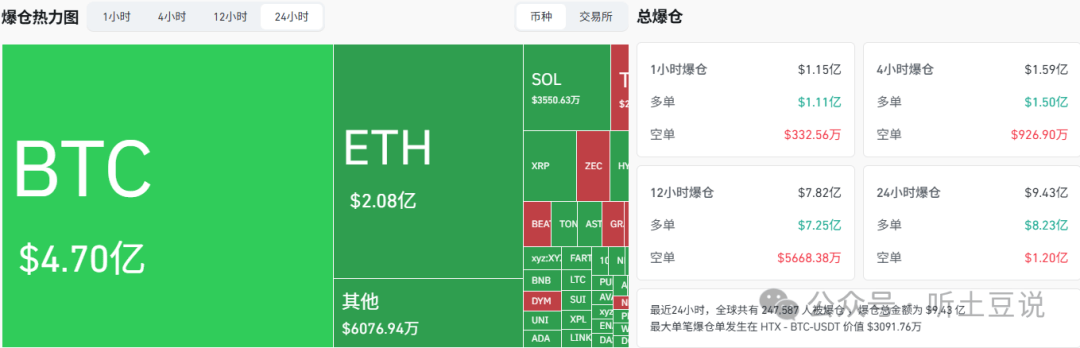
Core Insights - The cryptocurrency market has experienced a 6.22% decline in market capitalization over the past 24 hours due to rising global market risk aversion and weakened expectations for Federal Reserve interest rate cuts [1] Group 1: Market Trends - The correlation with Nasdaq has negatively impacted cryptocurrencies, with a 4% drop attributed to concerns over an AI bubble [1] - Uncertainty surrounding Federal Reserve policies, driven by strong employment data and signals of tightening monetary policy, has suppressed rate cut expectations [2] - Deleveraging has occurred as Bitcoin fell below the $87,000 support level, triggering over $1 billion in liquidations [3] Group 2: Liquidation Alerts - A total of 247,587 individuals were liquidated across the network in the last 24 hours, amounting to $943 million, with long positions suffering the most at $823 million [4] Group 3: Major Cryptocurrency Performance - Bitcoin (BTC) is priced at approximately $85,633, down 7.44% in 24 hours, with a critical resistance level at $86,780 [6] - Ethereum (ETH) is priced at around $2,798, down 8.115%, with a key resistance level at $2,840 [6] - BNB is priced at about $860, down 5.50%, with a resistance level at $873 [6] - Solana (SOL) is priced at approximately $132, down 7.58%, with a resistance level at $133 [7] Group 4: Market Sentiment - The total cryptocurrency market capitalization is approximately $2.94 trillion, with a 24-hour trading volume of about $210.89 billion [7] - Current market sentiment is at 15, indicating extreme fear, with the total market cap down 24% compared to the 30-day moving average, marking the most oversold level since April 2025 [7] Group 5: Price Movements of Other Cryptocurrencies - Top gainers include TNSR, up 140%, DYM, up 66%, and XAI, up 35% [9] - Top losers include ZK, down 19%, STRK, down 19%, and CYBEER, down 17% [9] - Other notable cryptocurrencies include Dogecoin (DOGE) down 6.58%, Cardano (ADA) down 7.33%, and Litecoin (LTC) down 6.13% [9]
综述|人工智能泡沫担忧加剧 美股遭遇巨幅震荡
Xin Hua She· 2025-11-21 05:21
截至当天收盘,道琼斯工业平均指数比前一交易日下跌386.51点,收于45752.26点,跌幅为0.84%;标 准普尔500种股票指数下跌103.40点,收于6538.76点,跌幅为1.56%;纳斯达克综合指数下跌486.18点, 收于22078.05点,跌幅为2.15%。 标普500指数11大板块10跌1涨。科技板块和非必需消费品板块分别以2.66%和1.73%跌幅领跌,仅必需 消费品板块上涨1.11%。 新华社纽约11月20日电 综述|人工智能泡沫担忧加剧 美股遭遇巨幅震荡 新华社记者刘亚南 由于市值龙头股英伟达公司财报未能持续提振市场人气,纽约股市三大股指20日由涨转跌,收盘时三大 股指均明显走低,遭遇少见的大幅反转行情。 与此同时,因美国联邦政府"停摆"而延迟发布的9月就业数据当日早间出炉。美国劳工部数据显示,9月 美国失业率升至4.4%,为2021年11月以来最高水平。 芝加哥商品交易所美联储观察工具显示,截至当日17时45分,市场认为美联储在12月货币政策会议上降 息25个基点的概率从前一日的30.1%升至39.5%,但仍明显低于一周前的50.1%和一个月前的98.8%。市 场对美联储12月继续降息 ...
综述|人工智能泡沫担忧加剧 美股遭遇巨幅震荡
Sou Hu Cai Jing· 2025-11-21 05:17
新华社纽约11月20日电 综述|人工智能泡沫担忧加剧 美股遭遇巨幅震荡 新华社记者刘亚南 由于市值龙头股英伟达公司财报未能持续提振市场人气,纽约股市三大股指20日由涨转跌,收盘时三大 股指均明显走低,遭遇少见的大幅反转行情。 截至当天收盘,道琼斯工业平均指数比前一交易日下跌386.51点,收于45752.26点,跌幅为0.84%;标 准普尔500种股票指数下跌103.40点,收于6538.76点,跌幅为1.56%;纳斯达克综合指数下跌486.18点, 收于22078.05点,跌幅为2.15%。 标普500指数11大板块10跌1涨。科技板块和非必需消费品板块分别以2.66%和1.73%跌幅领跌,仅必需 消费品板块上涨1.11%。 英伟达19日盘后发布的财报显示,在截至10月26日的本财年第三季度,该公司营业收入和净利润均显著 增长,利润率改善。英伟达还对本财年第四季度业绩给出乐观预期。财报公布后,英伟达股价在19日盘 后交易中出现超5%的涨幅。不过,20日英伟达股价在涨至每股196美元后回落,收盘时下跌超3%。 分析人士指出,美国多家科技巨头围绕AI推出总规模达数万亿美元的资本开支,引发投资者质疑,市 场对AI ...