加密资产

Search documents
价格波动+杠杆效应 海外10万比特币用户爆仓
Zhong Guo Jing Ying Bao· 2025-10-06 14:32
Core Insights - The cryptocurrency market remains highly active, with Bitcoin reaching a historical high of $125,800 per coin on October 5, 2023, before slightly retreating to $123,400 [1] - The market experienced a significant trading volume of $312 million within 24 hours, marking a 67.99% increase [1] - A total of 100,000 individuals faced liquidation in the last 24 hours, highlighting the volatility and risks associated with high-leverage trading [1] Group 1: Market Dynamics - Bitcoin's liquidation amount reached $360 million as of October 6, 2023, reflecting a 43.64% increase [2] - High leverage trading amplifies both potential gains and losses, posing significant risks to investors' capital [2] - The presence of high-leverage trading leads to rapid price fluctuations and a vicious cycle of liquidations, further destabilizing the market [2] Group 2: Regulatory Developments - Global regulatory bodies are intensifying their oversight of cryptocurrency assets, with 51 countries and regions implementing prohibitions by the end of 2024 [3] - In China, the regulatory framework for virtual currencies is rapidly evolving, with law enforcement agencies enhancing their capabilities to track and gather evidence related to cryptocurrency transactions [3] - Judicial authorities in regions like Beijing and Shanghai are collaborating with third-party institutions to manage and liquidate seized virtual currencies, thereby improving the recovery of assets for victims [3] Group 3: Industry Trends - Hong Kong is actively exploring a licensing regime for cryptocurrency assets, with 15 virtual asset trading platforms currently operating and 47 institutions providing virtual asset trading services [4]
Senator Accuses Crypto Billionaire of Dodging Puerto Rico Tax Evasion Investigation
Yahoo Finance· 2025-10-01 21:46
Core Points - A prominent crypto investor, Dan Morehead, is under investigation for alleged tax evasion linked to Puerto Rican residency [1][2][3] - Senator Ron Wyden has accused Morehead of not cooperating with the investigation, raising concerns about potential tax avoidance exceeding $100 million [3][4] - The investigation is part of a broader inquiry into how wealthy Americans exploit Puerto Rican tax incentives [2][5] Company and Industry Insights - Pantera Capital, founded by Morehead, has been actively investing in digital asset treasury companies, capitalizing on favorable conditions for crypto investments [6] - The firm has launched a significant initiative, investing $1.25 billion to transform a publicly traded neurotechnology company into a Solana treasury [6][7] - Helius Medical Technologies, the neurotechnology company, has rebranded to Solana Company, indicating a strategic shift in focus [7]
美联储换人倒计时 Solana钱包应对突变XBIT Wallet 适应加密新趋势
Sou Hu Cai Jing· 2025-09-30 07:14
Core Insights - The upcoming transition in the Federal Reserve leadership is creating a significant shift in monetary policy control, particularly impacting the cryptocurrency market [1][4][8] - XBIT Wallet, a decentralized wallet focused on the Solana ecosystem, is positioned as an ideal tool for investors to navigate policy fluctuations due to its fast transaction speeds and low costs [3][5][8] Group 1: Federal Reserve Dynamics - Jerome Powell's term as Fed Chair will end in May 2024, leading to a power struggle over key voting rights within the Federal Reserve Board [1] - The current political maneuvering includes Trump's camp gaining three seats on the board, with Lisa Cook facing increasing pressure to leave [1][4] - Predictions suggest that if a dovish leadership takes over, Bitcoin could surge to $200,000, highlighting the potential impact of Fed policies on cryptocurrency prices [4][8] Group 2: XBIT Wallet Features - XBIT Wallet offers near-zero gas fees and can process over 65,000 transactions per second, making it a cost-effective solution for large asset allocations [3][5] - The wallet incorporates advanced security features, including multi-signature encryption and biometric verification, ensuring high-level protection for users' private keys [3][5] - XBIT Wallet's integration with top DeFi protocols on Solana allows for streamlined staking, liquidity mining, and cross-chain services, significantly reducing operational costs for users [5][8] Group 3: Market Trends and Predictions - The evolving landscape of digital assets is reflected in the diverse predictions regarding potential Fed nominees and their implications for cryptocurrency regulation [4][7] - The softening stance of regulators towards Bitcoin ETFs and the gradual easing of restrictions on banks engaging with digital assets signal a shift towards broader acceptance [8] - XBIT Wallet's design philosophy caters to both casual users and professional investors, providing tools for effective asset management and compliance with emerging regulations [7][10]

突发大跳水,近14万人爆仓
Sou Hu Cai Jing· 2025-09-26 01:03
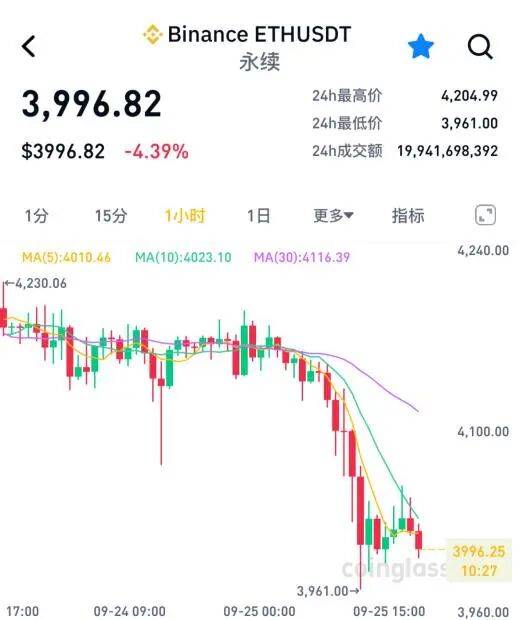
Market Overview - On September 25, the cryptocurrency market experienced a significant downturn, with Ethereum's price dropping over 4% and briefly falling below $4000, marking its fourth consecutive day of decline [1][2] - Bitcoin also faced multiple short-term declines, with a 24-hour drop exceeding 1% [1] Ethereum Performance - Ethereum's price reached a low of $3961 per coin, with a reported decline of 4.39% at the time of reporting [2] - In September, Ethereum's overall decline reached 10.75%, with historical data indicating an average return of -5.75% for September since 2016, showing only four positive September returns in the past nine years [5] Broader Market Impact - Other cryptocurrencies also saw significant declines, including Bitcoin, Binance Coin, Dogecoin, SOL, Ripple, Cardano, and SUI, with SOL and Dogecoin dropping over 4% [6] - The market capitalization for Bitcoin was reported at $80.05 billion, with a 24-hour change of -2.2%, while Ethereum's market cap was $57.76 billion [7] Liquidation Events - In the last 24 hours, nearly 140,000 liquidations occurred in the cryptocurrency market, totaling approximately $441 million, with long positions accounting for $380 million and short positions for $6.47 million [9] - The largest single liquidation was recorded on Hyperliquid—ETH, valued at $29.12 million [9] Market Analysis - Analysts from Matrixport noted that despite a favorable macro environment for crypto assets, a significant decline in trading volume is increasing the risk of forced liquidations, making long positions vulnerable to minor shocks [11] - The expectation of an interest rate cut by the Federal Reserve is accompanied by historical volatility, with rising U.S. Treasury yields adding pressure to the market [11] - Recent data indicated a net outflow of $141 million from Ethereum spot ETFs, with Fidelity's ETF experiencing the largest single-day outflow of $63.4 million [11]
刚刚!全线大跌,近14万人爆仓!
Sou Hu Cai Jing· 2025-09-25 12:37
Core Viewpoint - The cryptocurrency market experienced a significant downturn on September 25, with Ethereum dropping over 4% and Bitcoin also facing declines, leading to a liquidation of nearly 140,000 positions worth approximately $441 million [1][9]. Market Performance - Ethereum's price fell to a low of $3,961, with a reported decline of 4.39% at the time of reporting [2][3]. - Other cryptocurrencies, including Bitcoin, Binance Coin, Dogecoin, and Solana, also saw substantial declines, with some coins dropping over 4% [6][7]. Liquidation Data - In the last 24 hours, approximately 140,000 traders were liquidated, with total liquidation amounts reaching $441 million, including $380 million from long positions and $6.47 million from short positions [9][10]. Market Analysis - Analysts noted that despite a favorable macroeconomic environment for crypto assets, a significant drop in trading volume has increased the risk of forced liquidations. If prices breach key technical support levels, stop-loss orders may trigger, leading to a rapid deleveraging process [1][11]. - Recent data indicated a net outflow of $141 million from Ethereum spot ETFs, with Fidelity's ETF experiencing the largest single-day outflow of $63.4 million [11].
刚刚!全线大跌,近14万人爆仓!
中国基金报· 2025-09-25 12:36
Core Viewpoint - The cryptocurrency market experienced a significant downturn on September 25, with Ethereum's price dropping over 4%, falling below $4000, and Bitcoin also facing multiple short-term declines [2][3][4]. Market Performance - Ethereum's price reached a low of $3961, marking a decline of 4.39% [5][6]. - The overall cryptocurrency market saw a collective drop, with Bitcoin, Binance Coin, Dogecoin, SOL, Ripple, Cardano, and SUI all experiencing declines, with some like SOL and Dogecoin dropping over 4% [9][10]. Liquidation Data - Approximately 140,000 traders were liquidated in the last 24 hours, with a total liquidation amount of $441 million, including $380 million from long positions and $6.466 million from short positions [12][13]. - The largest single liquidation occurred in Hyperliquid-ETH, valued at $29.12 million [12]. Market Analysis - Analysts from Matrixport noted that despite a favorable macro environment for crypto assets, a significant decline in trading volume is increasing the risk of forced liquidations, making long positions vulnerable to minor shocks [14]. - Historical data indicates that the market often experiences volatility during periods when the Federal Reserve enters a rate-cutting cycle, which could further pressure the market [14]. - Recent data showed a net outflow of $141 million from Ethereum spot ETFs, with Fidelity's ETF experiencing the largest single-day outflow of $63.4 million [14].

中国资产大爆发,背后藏着这三个城市
盐财经· 2025-09-22 09:23
Group 1 - The year 2025 is expected to be filled with both turmoil and anticipation in the global financial markets, with the Shanghai Composite Index rising while US stock indices reach new highs [2] - The recent decline in the US dollar exchange rate contrasts with the rising US stock market, indicating underlying tensions in global financial dynamics [3][6] - The Euro has been recovering against the dollar, with the exchange rate approaching 1.2 since September, reflecting geopolitical influences on financial markets [4][6] Group 2 - The Guangdong-Hong Kong-Macao Greater Bay Area is positioned as a crucial player in the global financial landscape, benefiting from Hong Kong's status as an international financial center [7][8] - In the first half of 2025, Hong Kong's IPO market saw a significant recovery, with new stock financing reaching $14.1 billion, a 695% increase compared to the same period in 2024 [10] - The rise in Hong Kong's market activity is attributed to global investors seeking Chinese assets amid expectations of US dollar interest rate cuts [10][12] Group 3 - The introduction of the "Science and Technology Enterprise Special Line" in Hong Kong has made it easier for innovative companies to go public, enhancing the market's appeal for tech investments [14][16] - Recent regulatory changes have reduced the initial public offering (IPO) public shareholding requirement from 15% to 10%, facilitating easier access to capital for companies [16] Group 4 - The emergence of stablecoins is seen as a significant opportunity, bridging the gap between on-chain crypto assets and off-chain real-world assets, thus enhancing the usability of crypto in payments and settlements [20][23] - Hong Kong's proactive approach to stablecoin regulation, with the introduction of the "Stablecoin Regulation" in August 2025, positions it as a leader in the crypto asset space [20][23] Group 5 - The distinction between digital currencies is highlighted, with three categories: cryptocurrencies, central bank digital currencies (CBDCs), and stablecoins, each serving different purposes in the financial ecosystem [25][28] - CBDCs, such as the digital yuan, offer advantages like instant settlement and direct access without the need for a commercial bank account, promoting financial inclusion [30][32] Group 6 - The Guangdong-Hong Kong-Macao Greater Bay Area is recognized as a financial hub, with Hong Kong as an international center, Shenzhen as a model of financial and technological integration, and Guangzhou focusing on green finance [34][36] - Shenzhen's financial innovation and market-oriented approach are expected to continue driving growth, particularly in creating a multi-layered capital system [37] - Guangzhou's role in financial resource aggregation and its potential in green finance highlight the ongoing opportunities for innovation in the region [39]

国证国际港股晨报-20250922
Guosen International· 2025-09-22 09:06
Group 1: Company Overview - The company, 西普尼 (2083.HK), is a designer, manufacturer, and brand owner of gold case and gold bezel watches in China, primarily generating revenue from its flagship brand "HIPINE" and ODM business [6] - Revenue is projected to grow from 320 million RMB in 2022 to 456 million RMB in 2024, with a compound annual growth rate (CAGR) of 18% [6] - Net profit is expected to increase from 24 million RMB to 49 million RMB during the same period, with a CAGR of 43% [6] Group 2: Industry Status and Outlook - The precious metal watch market in China is expected to grow steadily, with a projected market size of 26.46 billion RMB by 2024, reflecting a CAGR of 4.54% from 2019 to 2024 [7] - The company's market share in the gold watch segment is the largest, with a projected market share of 27.08% in the gold case watch sector and 28.96% in the gold bezel watch sector by 2024 [7] Group 3: Strengths and Opportunities - The company has a strong reputation for product design that aligns with market demands, allowing it to capture changing consumer preferences effectively [8] - It possesses robust R&D capabilities, enabling the production of high-quality gold watches without compromising gold purity [8] - The company has a wide and stable sales network, with products available in over 3,000 offline retail points and various e-commerce platforms [8] Group 4: Fundraising and Use of Proceeds - The company anticipates net fundraising of 255 million HKD, with approximately 40% allocated to capacity enhancement, 17% to R&D improvement, 33% to brand activities and sales network expansion, and 10% for working capital [12]
ETH突破6750美元在即 XBIT Wallet 以太坊钱包一键参与加密资产配置
Sou Hu Cai Jing· 2025-09-21 08:38
Group 1 - Ethereum (ETH) price is gaining attention due to a bullish triangle pattern on the weekly chart, significant accumulation by whales, and rising expectations of Federal Reserve interest rate cuts, which provide both technical and macroeconomic support for a potential breakout [1][3][9] - Analysts predict that if ETH breaks above the current triangle's upper trendline, it could reach $6,750 in October, representing a 45% increase from the current price, with long-term targets ranging from $10,000 to $16,000 [1][9] - The recent accumulation of over 820,000 ETH (valued at $3.8 billion) by large wallets indicates strong institutional recognition of Ethereum's long-term value [4] Group 2 - The influx of $537 million into Ethereum spot ETFs over the past four days sets a record for weekly inflows, reflecting institutional demand and providing underlying support for ETH prices [4] - The upcoming Fusaka upgrade, scheduled for December 3, 2025, aims to enhance Ethereum's scalability and efficiency, which is expected to attract more developers and users, thereby increasing ETH demand [6][7] - XBIT Wallet offers advanced security features and tools for investors to monitor whale activities and market trends, facilitating informed investment decisions [3][4][6] Group 3 - The narrative of cryptocurrencies as "digital gold" is becoming more prominent amid macroeconomic uncertainties, positioning Ethereum as a key asset for capital allocation due to its smart contract ecosystem and staking yield features [6][9] - The phased increase in Blob capacity is expected to significantly reduce Layer 2 transaction fees and improve throughput, enhancing Ethereum's competitive edge as a "settlement layer" [7] - Investors are advised to closely monitor Federal Reserve policy changes, large on-chain transfers, and the development of Layer 2 ecosystems to capitalize on potential opportunities [9]
“币圈托管机构”BitGo申请IPO,上半年收入近42亿美元,盈利超1200万美元
美股IPO· 2025-09-21 05:52
Core Viewpoint - BitGo Holdings Inc. has officially initiated its IPO process in the context of a vibrant cryptocurrency market, showcasing significant revenue growth but a decline in net profit [2][3]. Group 1: Financial Performance - In the first half of 2025, BitGo's revenue surged to nearly $4.2 billion, up from $1.12 billion in the same period last year, marking a 275% year-over-year increase [2]. - The company's net profit was reported at $12.6 million, a decrease of approximately 59% compared to $30.9 million in the same period of 2024 [2]. Group 2: Market Context - BitGo's IPO application coincides with a new wave of IPOs in the U.S. cryptocurrency sector, driven by a favorable stance from former President Trump towards the industry [4]. - The market response to recent IPOs has been mixed, with Circle Internet Group Inc. seeing its stock price rise by 365% post-IPO, while Gemini Space Station Inc. experienced a 14% decline after raising $446 million [5]. Group 3: Company Overview - BitGo has established itself as a significant player in the cryptocurrency infrastructure space, with total assets under custody reaching approximately $90.3 billion, serving over 4,600 clients and 1.1 million users [6][7]. - The company supports more than 1,400 types of digital assets and launched a global OTC platform earlier this year to provide services such as spot trading, options, and margin lending [8]. Group 4: Valuation and IPO Details - As of the last round of private financing in August 2023, BitGo was valued at $1.75 billion [9]. - The IPO is being led by Goldman Sachs and Citigroup, with plans to list on the New York Stock Exchange under the ticker "BTGO" [9].