
戴维斯双击

Search documents
A股爆发!120只个股 创历史新高
Zhong Guo Zheng Quan Bao· 2025-12-28 14:12
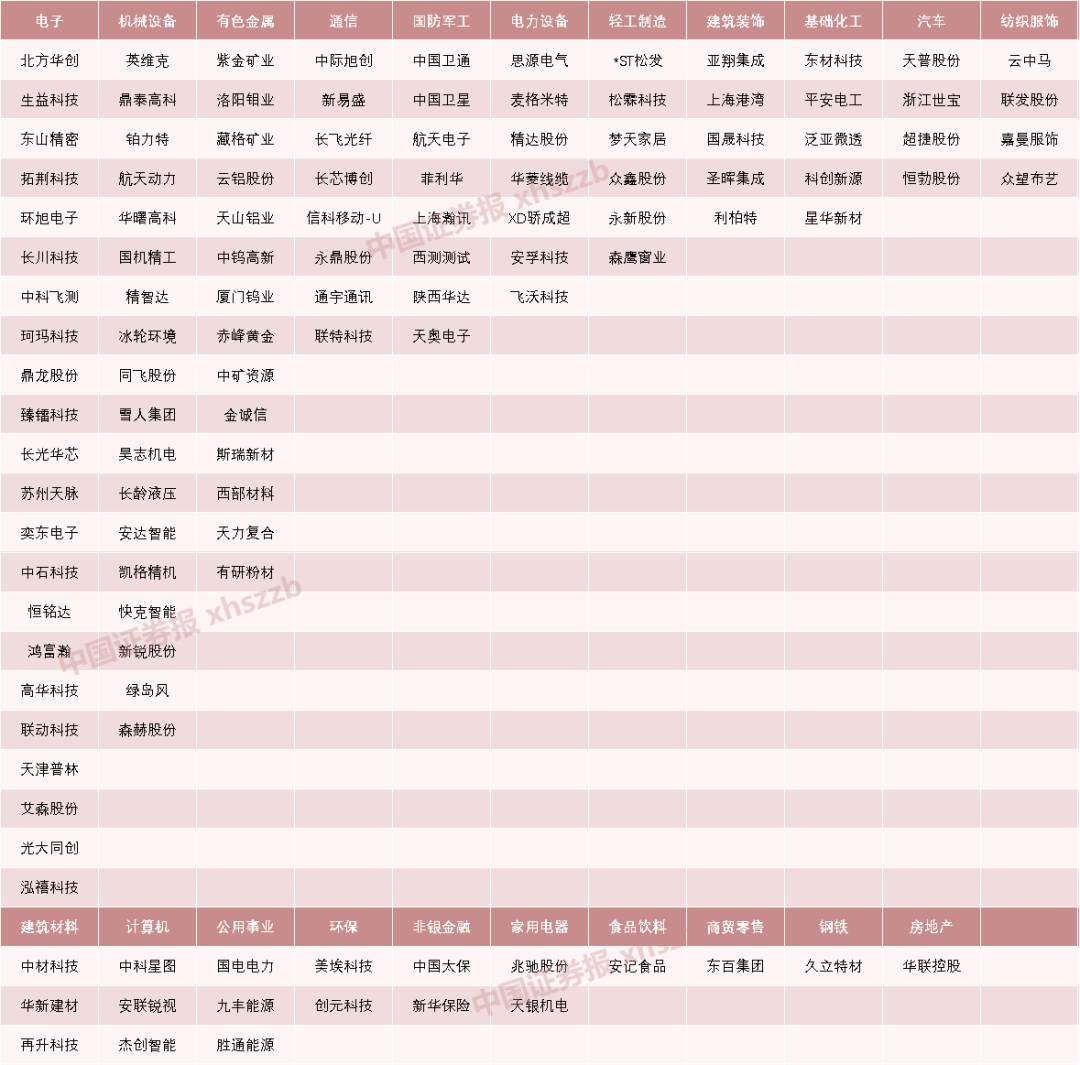
从成交额看,上述120只个股中,中际旭创、新易盛、航天电子、中国卫星、紫金矿业本周成交额居前,分别为830.96亿元、689.32亿元、548.58亿元、 543.34亿元、365.16亿元。 从近30个交易日股价创新高次数来看,上述120只个股中,亚翔集成19次创新高,藏格矿业15次创新高,斯瑞新材13次创新高,航天电子12次创新高,西 部材料12次创新高。 总市值方面,上述120只个股中,总市值超千亿元的个股有16只。总市值居前的为紫金矿业、中际旭创、新易盛、洛阳钼业、中国太保,分别为8915.54亿 元、6966.71亿元、4426.32亿元、4225.38亿元、4072.29亿元。 Choice数据显示,本周(12月22日至26日),A股三大指数齐涨,共有120只个股股价创历史新高(不含近一年上市的次新股,按前复权价、涨跌幅复权 算法统计)。按照申万一级行业进行划分,电子、机械设备、有色金属行业创新高的个股较为集中,分别有22只、18只、14只。从上市板块看,主板股票 67只、科创板股票18只、创业板股票33只、北交所股票2只。 从概念板块看,商业航天、大科技、有色金属等概念板块创新高的个股居多。本周 ...

锂电王者归来!化工ETF(516020)暴涨2.23%,收盘价创近3年新高!“戴维斯双击”将至?
Xin Lang Cai Jing· 2025-12-28 12:31
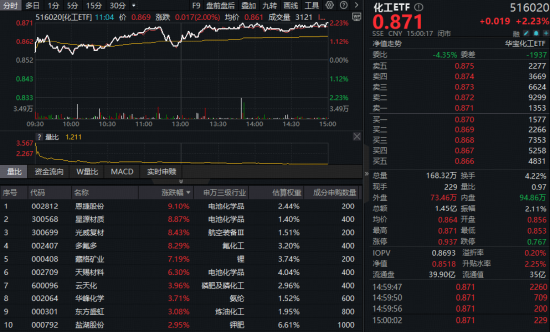
化工板块周五(12月26日)继续猛攻!反映化工板块整体走势的化工ETF(516020)全天强势,截至收 盘,场内价格大涨2.23%,收盘价创2022年9月以来新高。 成份股方面,锂电大面积爆发,氟化工、磷化工等板块部分个股亦涨幅居前。截至收盘,恩捷股份飙涨 9.1%,星源材质、光威复材、多氟多大涨超8%,藏格矿业涨超7%。 | 证券简称 | 应号 证券代码 | 区间涨跌幅 | | | --- | --- | --- | --- | | | | [区间首日] 2025-01-01 | | | | | [区间尾日] 2025-12-26 | | | | | [单位] % | | | :: 1 000813.CSI 细分化工 | | | 40.3522 | | ::: | 2 000001.SH 上证指数 | | 18.2565 | | ::: | 3 000300.SH 沪深300 | | 18.3569 | 注:统计区间为2025年1月1日至2025年12月26日,细分化工指数近5个完整年度的涨跌幅为:2020年, 51.68%;2021年,15.72%;2022年,-26.87%;2023年,-23.17%; ...
锂电爆发!化工板块继续猛攻,化工ETF(516020)盘中涨超2%!超80亿主力资金疯狂扫货
Xin Lang Cai Jing· 2025-12-26 06:30
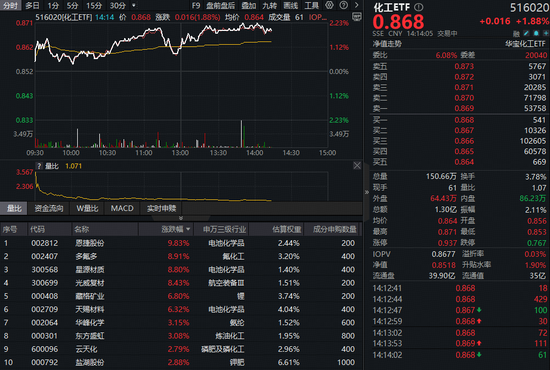
Core Viewpoint - The chemical sector is experiencing significant gains, with the chemical ETF (516020) showing a price increase of 1.88% as of the report, driven by strong performances in lithium battery and fluorochemical stocks [1][8]. Group 1: Market Performance - The chemical ETF (516020) reached a maximum intraday increase of 2.23% [1][8]. - Key stocks in the sector include Enjie Co., which surged over 9%, and other notable performers like Dofluorid, Xingyuan Material, and Guangwei Composites, all rising over 8% [1][8]. - The basic chemical sector attracted significant capital inflow, with over 8.7 billion yuan net inflow on the day, ranking third among 30 sectors [1][3]. Group 2: Industry Trends - The lithium carbonate market is facing intensified competition, with reports of some companies halting production for maintenance due to significant price discrepancies between long-term contracts and spot prices [3][11]. - The National Development and Reform Commission emphasized the need for order regulation and innovation in key industries such as new energy vehicles and lithium batteries [3][11]. - Analysts predict that the chemical industry will see a negative growth in capital expenditure starting in 2024, with supply-side contractions expected due to the "anti-involution" trend and the clearing of outdated capacities [11]. Group 3: Investment Opportunities - Investment strategies should focus on sectors with improving supply-demand dynamics and rising industry prosperity [11][12]. - The chemical ETF (516020) is recommended for efficient exposure to the sector, with nearly 50% of its holdings in large-cap leading stocks [12][13]. - Key investment directions include sectors poised for recovery, leading companies driven by capital expenditure and R&D, and high-end chemical new materials benefiting from increased demand or domestic substitution [11][12].





近三年业绩同类第一的冠军基金经理再“亮”剑,华宝优势产业基金(026286)迎新首发
Xin Lang Cai Jing· 2025-12-26 05:56
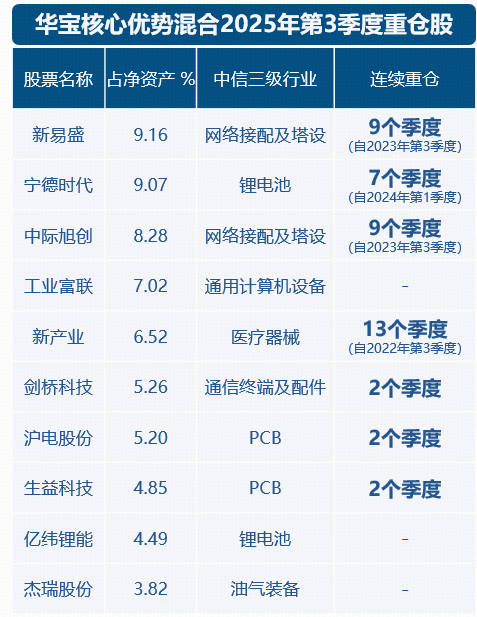
Group 1 - The core investment theme for 2026 in A-shares and overseas markets is expected to focus on technology breakthroughs, with global cycles and domestic demand transformation as supplementary factors [10][11][26] - The newly launched Huabao Advantage Industry Fund aims to invest in stocks benefiting from China's economic development and structural transformation, with a stock investment ratio of 60%-95% and a cap of 50% for Hong Kong Stock Connect stocks [3][18] - Fund manager Zheng Yingliang has demonstrated exceptional investment capabilities, with the Huabao Core Advantage Fund achieving a 144.70% return over the past three years, ranking first among 410 similar funds [1][10][19] Group 2 - The investment strategy combines top-down and bottom-up approaches, focusing on industries with good fundamentals and sustainable growth potential [3][18] - Zheng emphasizes the importance of industry lifecycle positioning, aiming to capture rapid growth phases while avoiding industry reshuffling periods [18][26] - The Huabao Core Advantage Fund has successfully leveraged this strategy, heavily investing in leading companies in the optical communication and lithium battery sectors, aligning well with long-term market trends [4][19] Group 3 - The fund's top holdings as of Q3 2025 include companies like Xinyi Technology (9.16%), CATL (9.07%), and Zhongji Xuchuang (8.28%), reflecting a strong focus on communication and new energy sectors [5][20] - The fund has consistently held its top positions for multiple quarters, indicating a stable investment strategy [20][21] - The macroeconomic environment is expected to improve in 2026, with signs of recovery in industrial profits and potential upward pressure on prices, which could lead to a "Davis Double" effect in the domestic market [10][25]

沪指冲击八连阳,A500大举“揽金”提振市场!兴业证券涨超3%,证券ETF龙头(560090)爆量上冲,一度涨超1%!证券板块2026年怎么看?
Sou Hu Cai Jing· 2025-12-26 03:57
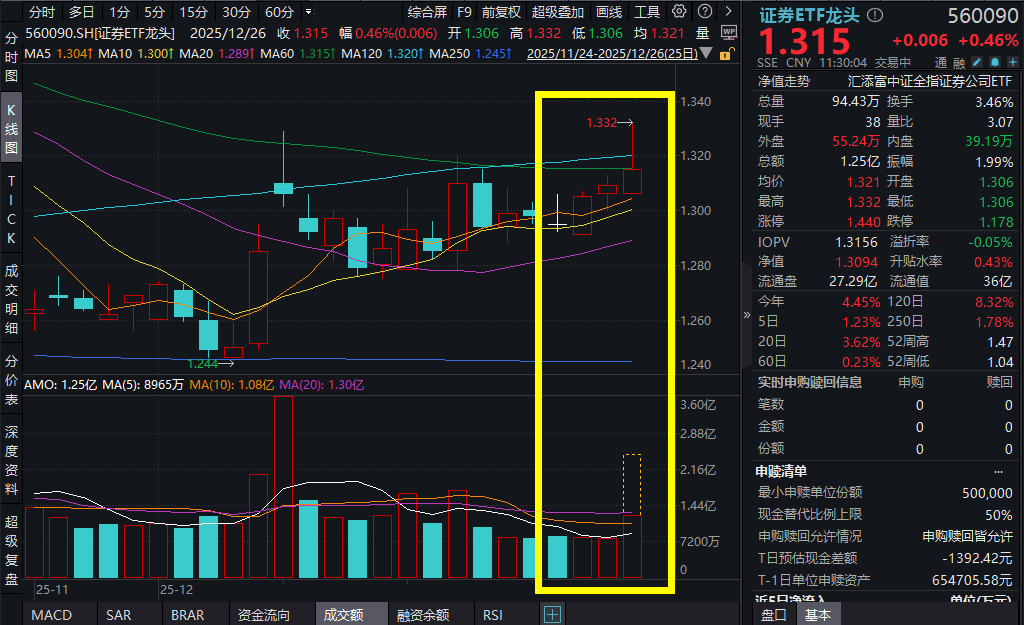
Core Viewpoint - The A-share market shows a mixed trend, with the Shanghai Composite Index continuing to rise, supported by strong inflows into broad-based indices like A500, leading to a seven-day consecutive increase in the index [1] Group 1: Market Performance - As of 11:30, the Securities ETF leader (560090) surged by 0.44%, aiming for a third consecutive day of gains, with trading volume exceeding 120 million yuan, surpassing the total trading volume of the previous day [1] - The majority of the constituent stocks of the Securities ETF leader (560090) experienced price increases, with Zhongyin Securities rising over 5% and Xingye Securities increasing over 3% [3] Group 2: Financial Performance - According to Ping An Securities, the performance of listed securities firms has shown significant improvement, with a year-on-year increase of 63.4% in net profit attributable to shareholders for the first three quarters [5] - The annualized ROE for 42 listed securities firms reached 8.65%, an increase of 2.6 percentage points compared to the entire year of 2024 [5] Group 3: Valuation Insights - Despite strong fundamentals, the valuation of the securities sector has not significantly improved, with a year-to-date increase of only 4.76% for securities companies, compared to an 18.6% increase in the Shanghai Composite Index [7] - The current price-to-book (PB) ratio stands at 1.5 times, indicating a rare combination of high growth and low valuation in the sector [7] Group 4: Future Outlook - The trend of "deposit migration" is evident, with the capital market expected to become a significant part of residents' asset allocation, supported by policies encouraging long-term investments [11] - The securities sector is viewed as a relatively undervalued asset with high year-on-year growth, making it an attractive investment opportunity [12]






ETF盘中资讯|继续猛攻!航空、锂电领涨,化工ETF(516020)上探1.53%!机构押注2026年周期大拐点
Sou Hu Cai Jing· 2025-12-26 02:21
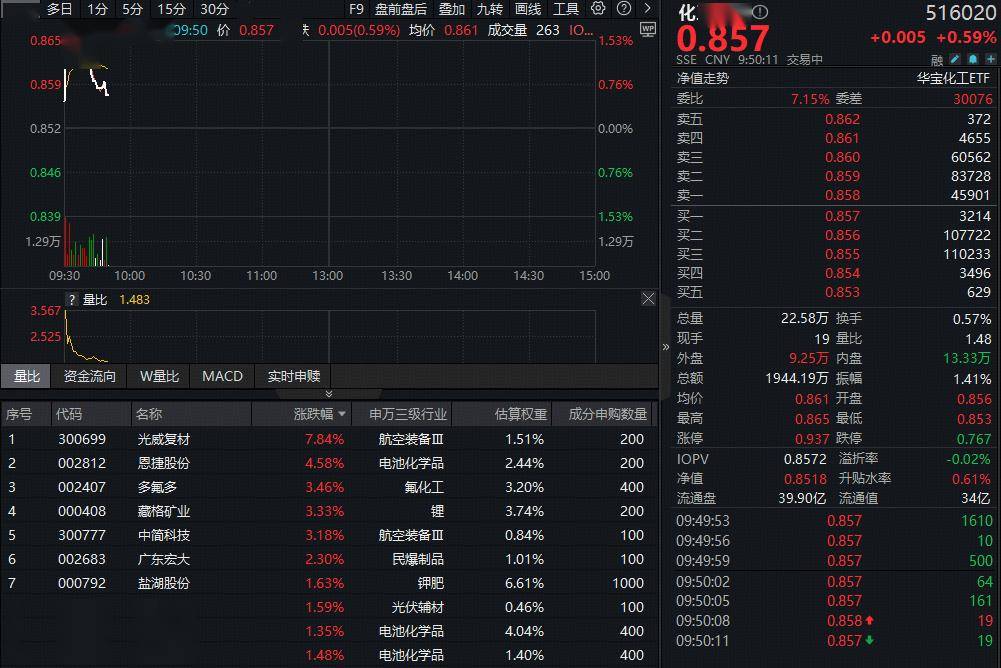
Group 1 - The chemical sector continues to rise, with the chemical ETF (516020) showing a peak intraday increase of 1.53% before settling at a 0.59% gain [1] - Key stocks in the sector include Guangwei Composites, which surged over 7%, and Enjie Co., which rose over 4% [1] - Other notable performers include Duofu Duo, Cangge Mining, Zhongjian Technology, and Guangdong Hongda, all experiencing gains of over 2% [1] Group 2 - The chemical ETF (516020) tracks the sub-sector chemical index, covering various segments of the chemical industry, with nearly 50% of its holdings in large-cap leading stocks [4] - The ETF provides an efficient way for investors to gain exposure to the chemical sector, including key areas like phosphate and fluorine chemicals [4] - Current valuation metrics indicate that the chemical sector offers reasonable long-term investment opportunities, with the ETF's index price-to-book ratio at 2.55, positioned at the 48.43 percentile over the past decade [3] Group 3 - Analysts predict that the lithium battery supply will transition into a prosperous phase, driven by strong end-demand from AI and energy storage, while supply growth slows due to reduced capital expenditures [2] - The chemical industry is expected to experience a cyclical turning point by 2026, supported by policy catalysts and a recovery in demand [3] - The overall sentiment indicates a marginal improvement in the chemical industry's outlook, with positive changes in supply, demand, and inventory dynamics [3]


继续猛攻!航空、锂电领涨,化工ETF(516020)上探1.53%!机构押注2026年周期大拐点
Xin Lang Cai Jing· 2025-12-26 02:02
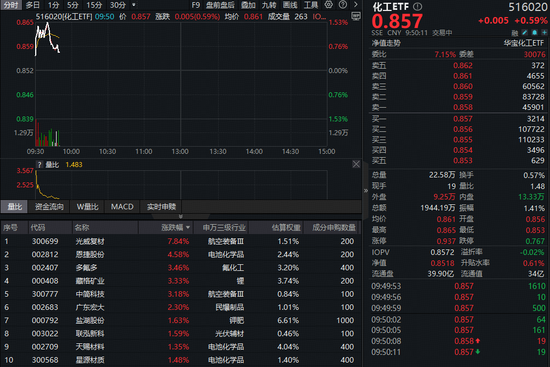
Group 1 - The chemical sector continues to rise, with the chemical ETF (516020) opening strong and reaching a maximum intraday increase of 1.53%, closing up 0.59% [1][8] - Key stocks in the sector include Guangwei Composite, which surged over 7%, and Enjie shares, which rose over 4% [1][8] - Other notable performers include Duofluor, Cangge Mining, and Zhongjian Technology, all increasing by over 3% [1][8] Group 2 - According to Guojin Securities, the lithium battery supply has transitioned from a surplus phase to an active replenishment phase, with a recovery expected in 2024 and a significant rebound by 2026 [2][10] - The demand is driven by AI and energy storage, while supply growth is slowing due to reduced capital expenditure, leading to a supply-demand mismatch [2][10] - The industry is shifting from price wars to price stabilization, which is expected to enhance profitability in the upstream materials sector [2][10] Group 3 - The chemical sector currently presents a favorable valuation, with the chemical ETF's underlying index price-to-book ratio at 2.55, positioned at the 48.43 percentile over the past decade [3][10] - The sector is anticipated to experience negative growth in capital expenditure starting in 2024, with supply expected to contract due to the "anti-involution" trend and the clearance of outdated overseas capacity [4][11] - The "14th Five-Year Plan" emphasizes expanding domestic demand, which, combined with the onset of a U.S. interest rate cut cycle, is expected to open up demand for chemical products [4][11] Group 4 - The chemical ETF (516020) tracks the CSI segmented chemical industry theme index, covering various sub-sectors, with nearly 50% of its holdings in large-cap leading stocks [5][12] - Investors can also access the chemical ETF through linked funds (Class A 012537/Class C 012538) for efficient exposure to the sector [5][12]
新华财经:2026年,贵金属的牛市还能走多远?
Xin Hua Cai Jing· 2025-12-26 01:56
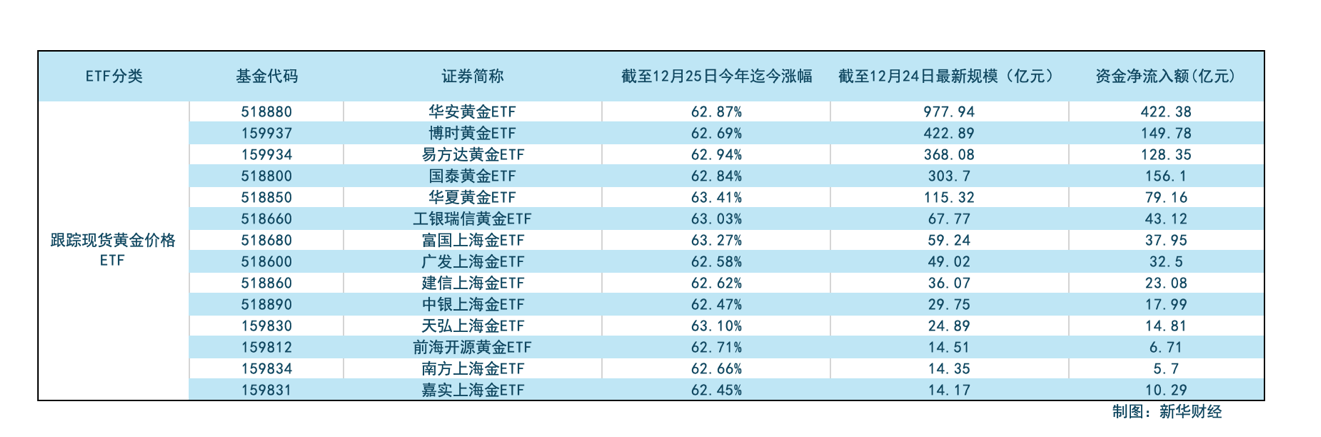
在美联储进入降息周期、外部不确定性加剧的背景下,2025年黄金、白银价格持续刷新历史新高,带动贵金属板块整体走强。 多位接受新华财经采访的分析师表示,在美联储降息与美国滞胀压力并存的宏观环境下,全球宏观秩序加速重构,黄金及黄金股在2026年仍具备进一步上行 的基础。同时,黄金股的内生成长性正在逐步兑现,叠加金矿龙头公司赴港上市提升了市场关注度与板块活跃度,当前具备较高估值性价比的黄金股后续表 现依然值得期待。 黄金再创历史新高多只概念股2025年翻倍 在各国央行大举购金、避险资金流入以及利率下行等多重因素推动下,2025年全球的贵金属走势迅速升温。截至12月25日,现货黄金价格今年已创造了54次 历史新高,现货白银价格突破了47次纪录新高。国际现货白银、铂金价格上涨均超过140%,钯金上涨超100%,国际现货黄金价格年内上涨超70%。 在今年国际金价不断走高的带动下,黄金ETF的投资收益也带来了显著提升。根据新华财经数据统计,今年以来,14只跟踪国内现货黄金价格的ETF,其年 收益率平均为62.83%。截至24日,上述14只ETF合并总规模超2497亿元,其中规模超过百亿元的ETF产品有六只,包括华安黄金ET ...
中信证券:2026年大类资产环境或呈现流动性边际宽松与经济温和修复特征 推荐商品>股票>债券
智通财经网· 2025-12-26 00:47
Core Viewpoint - CITIC Securities predicts a marginally loose liquidity environment and moderate economic recovery in 2026, recommending commodities over stocks and bonds [1] Group 1: A-shares - The expected annual increase for the Wind All A index is between 5% and 10% [2] - The net profit growth for listed companies in 2026 is projected at 4.8%, with price pressures on profits expected to ease gradually [2] - Structural opportunities may become the norm, with a "low volatility, slow bull" market anticipated, driven by absolute return funds [2] Group 2: Hong Kong Stocks - A rebound in performance and a second round of valuation recovery are expected for Hong Kong stocks [3] - The Hang Seng Index's dynamic PE is currently at 11.3 times, indicating a valuation gap [3] - Estimated net profit growth for the Hang Seng Index and Hang Seng Tech in 2026 is 6.7% and 24.3%, respectively [3] Group 3: US Stocks - The dual easing of fiscal and monetary policy in the midterm election year is expected to sustain growth momentum [4] - Projected net profit growth for the S&P 500, Nasdaq 100, and MAG 8 is 15.6%, 20.0%, and 24.5%, respectively [4] - The potential for a significant increase in stock buybacks due to lower interest rates and tax cuts is noted [5] Group 4: Bonds - The 10-year Chinese government bond yield is expected to range from 1.5% to 1.8% in 2026, with a downward trend initially [6] - The 10-year US Treasury yield is projected to fluctuate between 3.9% and 4.3% [7] Group 5: Commodities - Brent crude oil prices are expected to fluctuate between $58 and $70 per barrel, transitioning from oversupply to balance [11] - Gold prices may reach $5,000 per ounce, supported by liquidity easing and geopolitical risks [12] - Copper prices are projected to rise to $12,000 per ton due to supply constraints and demand from the power sector [13] Group 6: Currency - The RMB is expected to enter a mild appreciation cycle, with the USD/CNY exchange rate gradually approaching 6.8 [9][10]
浙商证券浙商早知道-20251226
ZHESHANG SECURITIES· 2025-12-25 23:30
证券研究报告 | 浙商早知道 报告日期:2025 年 12 月 26 日 浙商早知道 2025 年 12 月 26 日 市场总览 重要观点 http://www.stocke.com.cn 1/4 请务必阅读正文之后的免责条款部分 大势:周四上证指数上涨 0.47%,沪深 300 上涨 0.18%,科创 50 下跌 0.23%,中证 1000 上涨 0.97%,创业板指上 0.30%,恒生指数上涨 0.17%。 行业:周四表现最好的行业分别是国防军工(+2.91%)、轻工制造(+1.59%)、机械设备(+1.51%)、汽车(+1.46%)、 非银金融(+1.08%),表现最差的行业分别是综合(-1.12%)、有色金属(-0.77%)、商贸零售(-0.47%)、煤炭(-0.24%)、 通信(-0.18%)。 资金:周四沪深两市总成交额为 19245 亿元,南下资金净流出 11.75 亿港元。 【浙商大制造中观策略 邱世梁/王华君/周向昉】机械设备 年度行业策略报告:可控核聚变:招标提速,设备先行 ——20251224 【浙商大消费中观策略 钟烨晨】酒店餐饮 年度行业策略报告:2026 年餐饮行业风险排雷手册—— ...