
汽车出口

Search documents
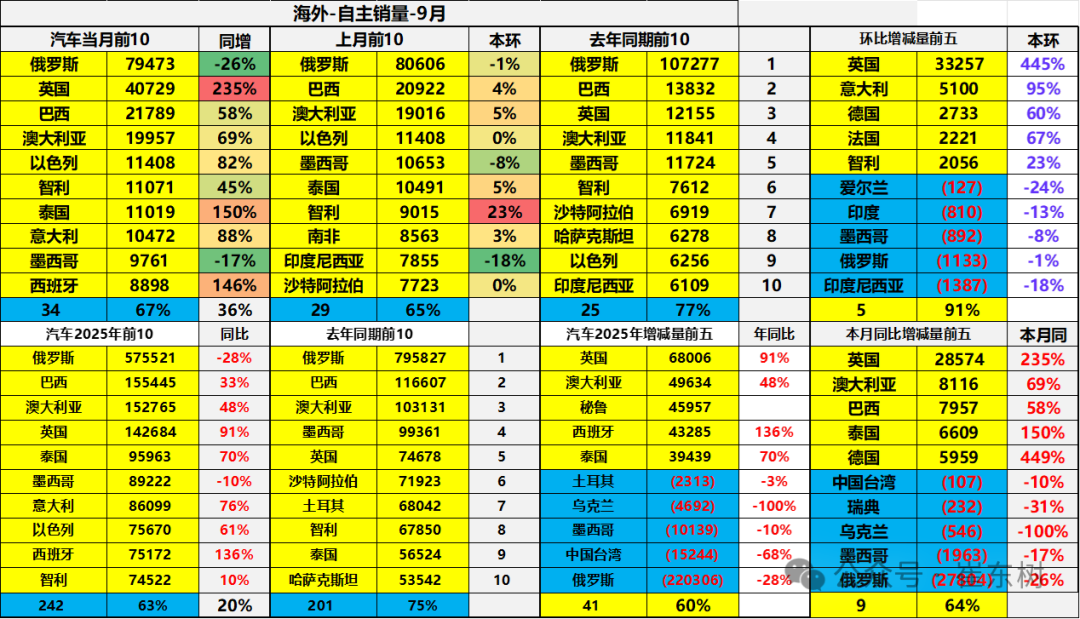
中国汽车在英国销量暴增235%
Di Yi Cai Jing· 2025-11-07 01:26
Core Insights - Chinese domestic brands achieved significant sales growth in the UK, with 40,729 vehicles sold in September, representing a year-on-year increase of 235% [1] - For the first three quarters of the year, total sales of Chinese domestic brands in the UK reached 142,684 vehicles, marking a 91% increase compared to the previous year [1] - The data indicates that Chinese brands are also experiencing growth in other markets such as Australia, Peru, Spain, and Thailand [1] Sales Performance - In September, the UK new car market saw a total of 312,891 registrations, a 13.7% increase year-on-year, making it one of the strongest months in the last decade [3] - Electric vehicles accounted for over 50% of new registrations in the UK, with plug-in hybrid electric vehicles (PHEVs) growing by 56.4% to capture a 12.2% market share [3] - Among the top-selling models in September, three Chinese brands made the list: Jaecoo 7, BYD Seal U, and MG HS, ranking 4th, 6th, and 8th respectively [4][5] Brand Highlights - Jaecoo 7 sold 6,489 units, while BYD Seal U sold 5,373 units, and MG HS sold 5,173 units in September [4][5] - BYD's sales in the UK reached 11,271 units in September, reflecting an 880% year-on-year increase and a 541% month-on-month increase [4] - The resilience of the Chinese automotive supply chain has been highlighted since the COVID-19 pandemic, contributing to strong export growth in recent years [5][6] Strategic Developments - Chinese domestic brands are entering a new strategic phase in exports, focusing on local assembly and building localized supply chains [6] - The total overseas sales of Chinese domestic brands reached 336,000 units in September, a 25% year-on-year increase and an 18% month-on-month increase [6] - From January to September, the total overseas sales of Chinese domestic brands amounted to 2.42 million units, representing a 12% year-on-year growth [6]


崔东树:9月中国自主车企海外销量初步统计达到33.6万台 同比增长25%
智通财经网· 2025-11-06 06:37
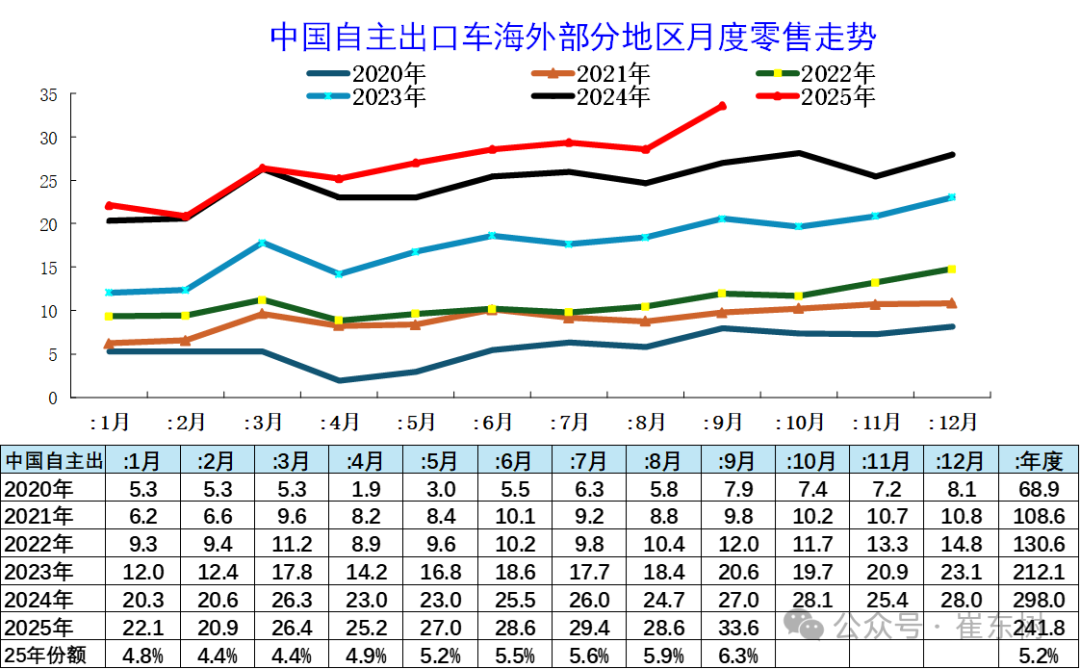
Core Insights - The resilience of China's automotive industry has been highlighted since the outbreak of the COVID-19 pandemic, with significant growth in automotive exports over the past two years [1] - In the first nine months of 2025, Chinese autonomous vehicle sales in overseas markets reached 2.42 million units, a year-on-year increase of 12% [5][6] - The strongest growth in overseas retail markets for Chinese vehicles is observed in Southeast Asia, Africa, and the European Union, while weaker performance is noted in the former Soviet Union, the United States, and Central and South America [6][7] Group 1: Overseas Performance of Chinese Automotive Companies - In September 2025, the preliminary statistics for local sales of Chinese autonomous vehicle companies in overseas markets reached 336,000 units, representing a year-on-year increase of 25% and a month-on-month increase of 18% [5][6] - The monthly export trends show a seasonal characteristic, with a notable increase in exports during the summer months [5] - The overall export data indicates a strong growth trajectory, particularly in the European market, which has seen continuous growth over the past three years [7][9] Group 2: Strategies and Market Dynamics - The strategy for automotive exports has evolved from KD assembly to localized production and overseas acquisitions, with significant success for companies like SAIC, Geely, Great Wall, and Chery [2] - Chinese automotive brands are increasingly establishing localized business management centers abroad to enhance their sales and service capabilities, leading to improved brand reputation in local markets [2] - The market share of Chinese vehicles varies significantly across regions, with Africa at 20%, Oceania at 15%, and Southeast Asia and the Middle East around 10% [8] Group 3: Challenges and Regulatory Environment - The Russian market presents challenges due to increased import taxes and fees, which have doubled since 2023, impacting the cost of Chinese vehicles [13] - Despite these challenges, Chinese companies like Chery and Geely have shown strong performance in Russia, with Chery achieving monthly sales exceeding 30,000 units [13][14] - The increase in vehicle scrappage tax in Russia is expected to raise the cost of imported vehicles, leading to a potential increase in retail prices by 10%-15% [13] Group 4: Electric Vehicle Export Performance - The export performance of Chinese electric vehicles is particularly strong, with brands like BYD, SAIC, Geely, and Great Wall showing significant growth [18] - BYD's overseas sales have surged, reflecting the growing demand for electric vehicles in international markets [18] - The overall trend indicates that Chinese automotive companies are increasingly competitive in the global electric vehicle market, despite challenges in certain regions [18]



宏观数据|2025年9月我国汽车整车出口情况简析
中汽协会数据· 2025-11-06 05:52
Group 1 - The core viewpoint of the article highlights the performance of China's automobile exports in September 2025, showing a slight month-on-month decline but a significant year-on-year increase in both volume and value [1] - In September 2025, the total automobile exports reached 756,000 units, representing a month-on-month decrease of 0.9% but a year-on-year increase of 24.3% [1] - The export value for the same month amounted to $12.81 billion, with a month-on-month decline of 0.1% and a year-on-year growth of 10.9% [1] Group 2 - For the period from January to September 2025, the total automobile exports were 5.684 million units, reflecting a year-on-year increase of 20.9% [1] - The total export value during this period reached $97.12 billion, which is a year-on-year growth of 10.8% [1]
比亚迪(002594):10月销量表现亮眼 四季度海内外共振可期
Xin Lang Cai Jing· 2025-11-06 00:44
Core Viewpoint - The company reported a total of 3.7019 million new energy vehicle sales from January to October, reflecting a year-on-year increase of 13.9%, with October sales showing a decline compared to the previous year but an increase compared to the previous month [1][2] Group 1: Sales Performance - In October, the company achieved a record high of 441,700 new energy passenger vehicle sales, with significant contributions from the Dynasty and Ocean series, as well as the Fangchengbao brand [2] - The sales breakdown for October includes 395,000 units from the Dynasty series, 31,100 units from the Ocean series, 10,100 units from the Tengshi brand, and 700 units from the Yangwang brand, with the Dynasty and Ocean series showing the most growth [2] - Year-to-date sales for new energy passenger vehicles reached 3.6557 million units, up 12.9% year-on-year [1] Group 2: Export Growth - The company’s export sales in October reached 83,900 units, marking a year-on-year increase of 169.0% and a month-on-month increase of 17.8%, indicating a return to growth [3] - Cumulative export sales from January to October totaled 781,000 units, reflecting a year-on-year increase of 137.3% [3] - The company has established a network of over 400 dealers across more than 80 countries and regions to support its export growth [3] Group 3: Future Outlook - The company anticipates continued strong demand in the fourth quarter, driven by the release of popular models and the upcoming launch of new vehicles [3] - Revenue projections for 2025-2027 are set at 898.15 billion, 996.54 billion, and 1,101.29 billion yuan, with expected year-on-year growth rates of 15.6%, 11.0%, and 10.5% respectively [4] - The company expects to achieve net profits of 36.82 billion, 46.28 billion, and 55.02 billion yuan for the same period, with a projected increase in profits in 2026 and 2027 [4]
乘联分会:10月全国乘用车市场零售238.7万辆 同比增长6%
智通财经网· 2025-11-05 07:52
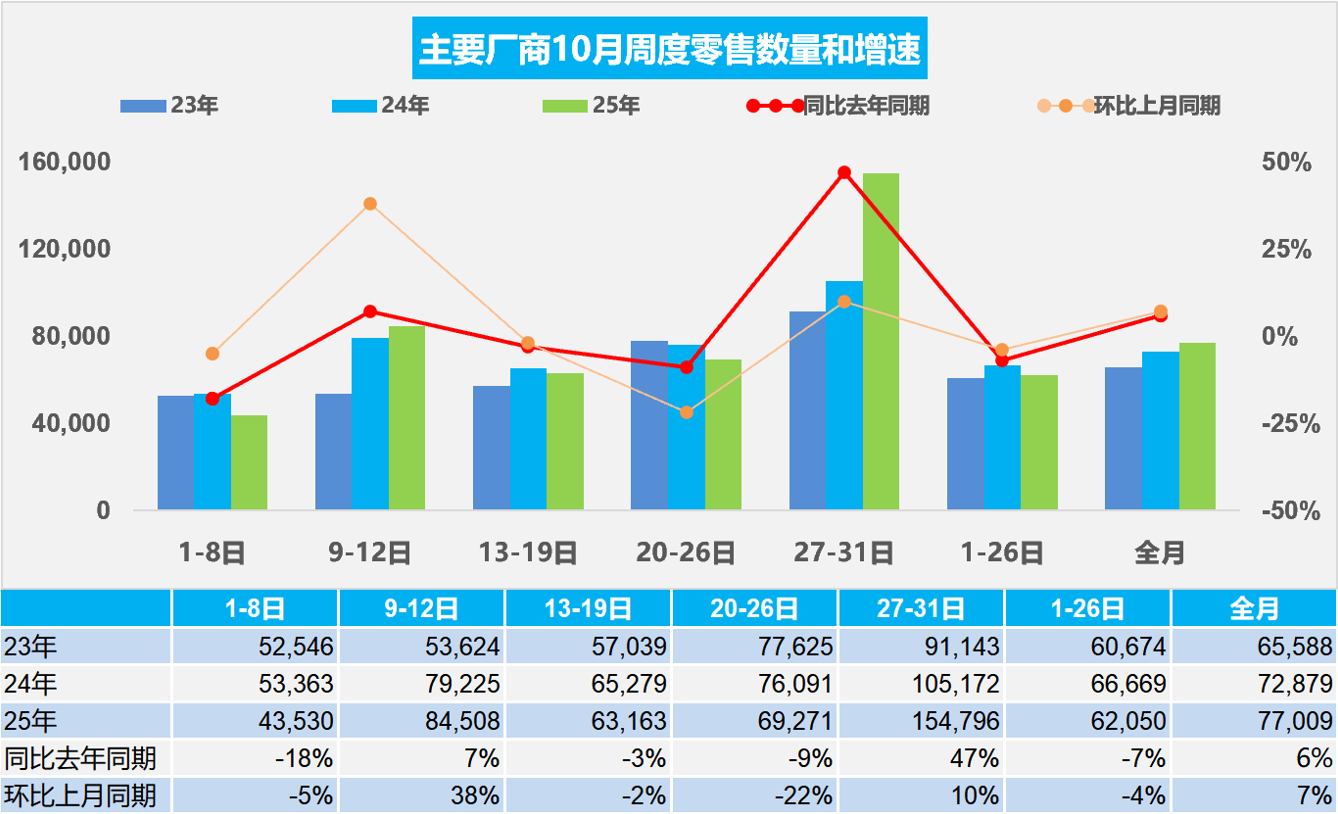
Core Insights - The retail sales of passenger cars in China for October 2023 reached 2.387 million units, representing a year-on-year increase of 6% and a month-on-month increase of 7% [1] - The wholesale volume for passenger cars in October 2023 was 2.922 million units, showing a year-on-year growth of 7% and a month-on-month growth of 4% [1] - The penetration rate of new energy vehicles (NEVs) in the passenger car market reached 58.7% in October 2023, with NEV retail sales totaling 1.4 million units, a year-on-year increase of 17% [1] Retail Market Performance - The average daily retail sales for the first week of October were 44,000 units, down 18% year-on-year and down 5% month-on-month [4] - The second week saw an increase to 85,000 units, up 7% year-on-year and up 38% month-on-month [4] - The average daily retail sales for the last week of October were 69,000 units, down 9% year-on-year and down 22% month-on-month [5] Wholesale Market Performance - The average daily wholesale volume for the first week of October was 30,000 units, down 21% year-on-year and down 36% month-on-month [8] - The second week recorded 76,000 units, with a year-on-year decrease of 1% but a month-on-month increase of 15% [8] - The average daily wholesale volume for the last week of October was 102,000 units, up 8% year-on-year and down 12% month-on-month [9] New Energy Vehicle Market - Cumulative retail sales of NEVs reached 10.27 million units in 2023, with a year-on-year growth of 23% [1] - Cumulative wholesale volume for NEVs was 12.061 million units, reflecting a year-on-year increase of 30% [1] - The NEV market is experiencing significant growth, with a penetration rate of 55.2% for wholesale [1] Market Trends and Influences - The "Golden September, Silver October" trend is evident, with October's retail performance affected by the holiday season and previous month’s strong sales [5] - The government's policy to promote vehicle trade-ins has positively impacted sales in September, leading to a strong performance that influenced October's figures [5] - The automotive export market is showing positive trends, particularly for domestic brands in overseas markets, indicating a shift in competitive dynamics [9]
上市车企2025年三季报透视:超七成实现盈利 行业结构性机会犹存
Xin Hua Cai Jing· 2025-11-04 14:00
Core Insights - The overall performance of A-share automotive companies is stable, with over 70% achieving profitability and five companies exceeding 100 billion yuan in revenue [1][2][5] - There is a significant divergence in quarterly performance, with ten companies experiencing a year-on-year decline in net profit, and GAC Group's losses expanding to 4.31 billion yuan [1][6] - The automotive industry is expected to see strong export performance and healthy inventory levels, with potential record sales in Q4 2025, but uncertainties loom for 2026 [1][9] Revenue and Profitability - In the first three quarters of 2025, 15 out of 22 A-share passenger vehicle companies reported a year-on-year increase in revenue, representing 68% of the total [4][5] - BYD, SAIC Motor, and Great Wall Motors lead in revenue, with figures of 566.27 billion yuan, 468.99 billion yuan, and 153.58 billion yuan respectively [5][6] - The top three companies in net profit are BYD, Great Wall Motors, and SAIC Motor, with net profits of 23.33 billion yuan, 8.63 billion yuan, and 8.10 billion yuan respectively [5][6] Profit Margin and Market Dynamics - The sales gross margin for most listed automotive companies has slightly increased quarter-on-quarter, attributed to rising sales and cost reduction efforts [6][8] - The highest sales gross margin is reported by Seres at 29.37%, followed by Yutong Bus at 22.35% [7][8] - The automotive market is experiencing a controlled discount environment, with stable average vehicle prices maintained [8] Future Outlook - Analysts predict a strong sales performance in Q4 2025, with expectations of record-breaking sales, particularly for companies with strong brand power in the mid-to-low-end market [9][10] - The market faces uncertainties in 2026, with potential challenges including a new round of competition and changes in subsidy policies affecting electric vehicle sales [9][10]


长城汽车10月车型销量解读
数说新能源· 2025-11-04 08:56
Core Viewpoint - The article discusses the significant growth in export sales for the company, particularly in October, driven by seasonal demand and favorable market conditions, with a focus on various regions and product lines [1][4][12]. Export Data Analysis - In October, overall export sales increased by approximately 5%, with notable growth in Latin America, Australia, the Middle East, Central Asia, Europe, and Africa [1]. - Exports to Russia and Brazil showed remarkable growth, achieving a month-on-month increase of nearly 10% to 15%, aided by local credit and monetary policies [2]. Brand Structure Insights - The brand structure remained stable, with the Haval brand accounting for over 70% of total exports. The Tank and pickup models maintained high export levels, with Haval's share at about 70%, pickups at 13%, and Tanks at 11% [3]. Regional Sales Performance - Sales figures by region include approximately 10,000 units in Latin America, around 5,500 in Australia, 4,000 to 4,400 in the Middle East, 3,000 in Central Asia, and over 4,000 in Africa. Russia and surrounding countries exceeded 25,000 units, while Southeast Asia accounted for about 3,000 units [4]. Product Line Outlook - The Ora product line is set for a significant product cycle, with the launch of 1 to 2 models this year and 5 new models expected next year, targeting urban users and aiming for a price range of up to 200,000 RMB [5]. Business Strategy - The company aims to enhance the reputation and visibility of the 300 and 500 series models, with the Tank series experiencing rapid growth in overseas markets, particularly with the introduction of diesel versions [6]. Diesel Model Strategy - The introduction of diesel versions of the Tank series in markets with high diesel acceptance is based on technical advantages and market opportunities, leading to increased sales and positive reception [7]. Future Product Plans - The company plans to prioritize the launch of Tank 400 and Tank 700 models in regions with strong sales and reputation, while also considering the introduction of PHEV models based on regional policies and user needs [8]. Upcoming Product Launches - The Tank brand will officially launch the Tank 400 on November 6, with the Ora 5 also set to debut. Increased product launches are expected during the sales peak in November and December [9]. High Mountain Model Enhancements - The High Mountain model has seen significant improvements in interior and functionality, becoming a practical and well-received new energy MPV suitable for family and commercial use [10]. High Mountain Model Future Plans - Continuous iterations and software upgrades are planned for the High Mountain model to enhance its smart capabilities, maintaining its competitive edge in the hybrid MPV market [11]. Industry Sales Outlook - The overall automotive market in China is expected to see significant growth this year, but a potential decline in sales is anticipated in the first quarter of next year due to the reduction of subsidies and seasonal factors [12]. Tank Export Projections - The Tank brand aims for a 20% year-on-year growth in exports, targeting a scale of 600,000 units, with current exports nearing 45,000 units and a monthly target of 5,000 units [13]. Global Promotion of Diesel Models - The Tank 300 diesel version is being promoted globally, with plans to increase participation in off-road events to enhance brand visibility and performance [14].

比亚迪股份(01211):4Q25 销量和利润端或仍承压,出口潜力或在 2026 年集中释放
BOCOM International· 2025-11-03 08:01
Investment Rating - The report assigns a "Buy" rating to BYD Company Limited (1211 HK) with a target price of HKD 133.00, indicating a potential upside of 27.6% from the current closing price of HKD 104.20 [5][10][11]. Core Insights - The report highlights that sales and profit may remain under pressure in Q4 2025, with export potential expected to be concentrated in 2026 [2]. - The revenue for BYD is projected to grow from RMB 602.3 billion in 2023 to RMB 1,097.8 billion by 2027, with a compound annual growth rate (CAGR) of approximately 16.2% [3][12]. - Net profit is expected to fluctuate, with a decrease from RMB 30.0 billion in 2023 to RMB 35.1 billion in 2025, before rising to RMB 54.3 billion in 2027 [3][12]. - The report notes a significant adjustment in profit forecasts for 2025-2027, with reductions of 16%-23% due to lower-than-expected gross margins and ongoing price wars [8]. Financial Overview - Revenue (in million RMB) is forecasted as follows: 2023: 602,315; 2024: 777,102; 2025E: 838,705; 2026E: 974,290; 2027E: 1,097,816, reflecting a growth rate of 42.0% in 2023 and a decline to 7.9% in 2025 [3][12]. - Net profit (in million RMB) is projected to be 30,041 in 2023, 40,254 in 2024, 35,148 in 2025E, 46,494 in 2026E, and 54,291 in 2027E, with a notable drop of 12.7% in 2025 [3][12]. - The report indicates a decrease in gross margin to approximately 17.9% in 2025, down from 20.2% in 2023, primarily due to competitive pricing pressures and increased costs associated with new technology [8][14]. Market Performance - BYD's stock has shown a year-to-date increase of 17.25%, with a 52-week high of HKD 155.07 and a low of HKD 83.07 [7][11]. - The average daily trading volume is reported at 24.68 million shares, indicating active market participation [7]. Strategic Outlook - The report emphasizes that while domestic sales face challenges, overseas sales are expected to grow significantly, particularly in Southeast Asia, Latin America, and Europe, which could enhance profitability in the medium to long term [8]. - The target price has been adjusted down to HKD 133 from a previous HKD 151, reflecting the revised profit outlook [8].
奇瑞汽车(09973) - 未经审核之二零二五年十月销量
2025-11-02 10:39
香港交易及結算所有限公司及香港聯合交易所有限公司對本公告的內容概不負責,對其準確性 或完整性亦不發表任何聲明,並明確表示概不就因本公告全部或任何部分內容而產生或因依賴 該等內容而引致的任何損失承擔任何責任。 Chery Automobile Co., Ltd. 奇瑞汽車股份有限公司 (於中華人民共和國註冊成立的股份有限公司) 未經審核之二零二五年十月銷量 奇瑞汽車股份有限公司(「本公司」,連同其附屬公司統稱為「本集團」)董事會欣然 宣佈,本公司於二零二五年十月的五大品牌總銷量為263,466輛汽車,較去年同期 增長約2%。詳細如下: | | 本月 | 去年同期 | 同比變動 | 今年累計 | 去年同期 | 同比變動 | | --- | --- | --- | --- | --- | --- | --- | | 品牌 | (輛) | (輛) | (%) | (輛) | 累計(輛) | (%) | | 奇瑞 | 169,696 | 165,289 | 3% | 1,377,558 | 1,278,830 | 8% | | 星途 | 9,494 | 16,594 | -43% | 97,445 | 112,540 ...
前三季度营收规模跃上2000亿元大关 奇瑞汽车业绩持续高增
Zheng Quan Ri Bao Wang· 2025-11-01 03:39
Core Viewpoint - Chery Automobile Co., Ltd. has reported strong financial performance in its first quarterly earnings report since its recent IPO, indicating significant growth in revenue and sales volume [1] Financial Performance - For the first three quarters, Chery achieved revenue of 214.83 billion yuan, representing a year-on-year increase of 17.94% [1] - The company's gross profit reached 29.464 billion yuan, up 9.1% from 27 billion yuan in the same period last year [1] Sales Performance - Chery Group's cumulative sales volume for the first three quarters was 2.0078 million units, marking a year-on-year growth of 14.5% and achieving a record pace of surpassing 2 million units within the year [1] - In the overseas market, Chery's cumulative export volume was 936,400 units, reflecting a year-on-year increase of 12.9%, maintaining its position as the top exporter of Chinese automobiles [1] - In Europe, Chery's cumulative sales reached 145,000 units, achieving more than double growth [1] Market Position - As of the end of September, Chery Group has over 17.72 million global users, with more than 5.43 million users located overseas [1] IPO Details - Chery Automobile officially listed on the Hong Kong Stock Exchange on September 25, with an IPO price set at 30.75 HKD per share, raising 9.14 billion HKD, making it the largest IPO for a car company in the Hong Kong market this year [1]