
电力市场化改革

Search documents
电力市场化改革涉深水区 电价下行重构行业格局
Zheng Quan Shi Bao· 2025-09-23 18:10
Core Viewpoint - The downward trend in electricity prices in China is significantly impacting the profitability and investment decisions of power generation companies, driven by market reforms and increased competition in the renewable energy sector [1][2][4]. Summary by Sections Electricity Price Trends - The average on-grid electricity price for Longyuan Power's generation business decreased to 399 RMB/MWh in the first half of the year, down 23 RMB/MWh from the same period in 2024 [2]. - The average on-grid price for wind power was 422 RMB/MWh, a decrease of 16 RMB/MWh, while solar power averaged 273 RMB/MWh, down 5 RMB/MWh [2]. - The implementation of the "136 Document" has led to a more market-driven pricing mechanism for renewable energy, contributing to the decline in electricity prices [2][3]. Market Dynamics - The marketization of electricity trading has reached over 60% of total electricity consumption, with a total of 2.95 trillion kWh traded in the first half of the year, marking a 4.8% increase year-on-year [5]. - The competitive landscape is intensifying as coal prices decline, allowing thermal power companies to lower their prices to capture market share, which in turn pressures renewable energy prices [3][8]. Investment and Strategic Adjustments - Power generation companies are adjusting their investment strategies in response to the changing market conditions, focusing on cost control, project site selection, and enhancing trading capabilities [9][10]. - Companies are encouraged to explore diverse applications for green electricity, such as data centers and zero-carbon parks, to create new growth points [8][10]. - Long-term power purchase agreements are seen as a viable strategy for stabilizing revenue and supporting project financing in the face of price volatility [10]. Future Outlook - The electricity market is expected to experience cyclical fluctuations, with overall downward pressure on prices, although some regions may see price increases at certain times [10]. - The rapid growth of solar power installations has led to an oversupply in the market, further driving down prices, while wind power installations have not increased as rapidly, resulting in less price pressure [7][10].
周报:8月全国规上工业发电量同比增长1.6%,天然气生产量同比增长5.9%-20250921
Xinda Securities· 2025-09-21 06:12
Investment Rating - The report maintains an investment rating of "Positive" for the utility sector [2][4]. Core Insights - The report highlights a year-on-year increase of 1.6% in national industrial power generation and a 5.9% increase in natural gas production for August [1][6]. - The utility sector has shown a decline of 2.2% as of September 19, underperforming the broader market [5][13]. - The report suggests that the power sector is expected to see profit improvement and value reassessment due to ongoing power supply-demand tensions and market reforms [6]. Summary by Sections Market Performance - As of September 19, the utility sector has decreased by 2.2%, with the power sector down by 2.52% and the gas sector up by 1.53% [5][15]. - The report notes that the average daily power generation exceeded 30 billion kWh for the first time in August, reaching 30.2 billion kWh [6]. Power Industry Data Tracking - The price of Qinhuangdao port thermal coal (Q5500) increased by 21 CNY/ton week-on-week, reaching 699 CNY/ton [5][23]. - The inventory of thermal coal at Qinhuangdao port decreased by 80,000 tons week-on-week, totaling 6.3 million tons [5][32]. - The outflow from the Three Gorges Reservoir increased by 239.9% year-on-year, reaching 25,900 cubic meters per second [6][47]. Natural Gas Industry Data Tracking - The LNG ex-factory price index in China was 4,019 CNY/ton as of September 19, a year-on-year decrease of 21.92% [6][60]. - The EU's natural gas supply for week 36 of 2025 was 5.6 billion cubic meters, a year-on-year increase of 16.7% [6][65]. - Domestic natural gas consumption in July 2025 was 36.17 billion cubic meters, a year-on-year increase of 2.9% [6][60]. Investment Recommendations - The report recommends focusing on leading coal power companies such as Guodian Power, Huaneng International, and Huadian International due to expected performance improvements [6]. - For natural gas, companies with low-cost long-term gas sources and receiving station assets are highlighted as potential beneficiaries [6].
专家解读丨持续健全电力市场体系 助力全国统一电力市场建设
国家能源局· 2025-09-19 06:15
Core Viewpoint - The article emphasizes the importance of advancing the construction of a unified national electricity market, with specific guidelines for accelerating the development of the electricity spot market by the end of 2025 [2][3]. Group 1: Optimization of Spot Market Trading Mechanism - The share of market-based trading of renewable energy has increased, reaching 52.3% in 2024, with a push for all renewable projects to enter the electricity market [3]. - The guidelines support local exploration of mechanisms for the full market participation of renewable energy, focusing on optimizing the clearing mechanism to reflect supply-demand relationships and cost adjustments [3]. - The guidelines also stress the importance of load forecasting and renewable power forecasting to ensure the safe and stable operation of the electricity system [3]. Group 2: Improvement of Medium- and Long-term Market Trading Mechanism - The medium- and long-term market is crucial for the stability and sustainability of the electricity market, with most provinces having normalized trading by the end of 2024 [5]. - Specific requirements are set for trading organization, contract duration, and pricing limits to enhance management and better connect with the spot market [5][6]. - The guidelines propose a dynamic adjustment mechanism for contract signing ratios to stabilize investment expectations while meeting green electricity consumption demands [5]. Group 3: Auxiliary Service Market System - The auxiliary service market is evolving to meet the increasing complexity of electricity system operations, with a need for diverse and refined service offerings [8]. - The guidelines suggest expanding the types of auxiliary services and establishing market mechanisms to convert system adjustment demands into price signals [8][9]. - Encouraging various entities, including new business models, to participate in the auxiliary service market is aimed at enhancing system flexibility and operational efficiency [9]. Group 4: Capacity Compensation Mechanism - Recent policies have explored compensation mechanisms for pumped storage and coal power, ensuring reasonable returns while reflecting their flexible adjustment value [10]. - The guidelines propose establishing a capacity assessment mechanism to evaluate the contribution of various power sources to system capacity, leading to a market-oriented capacity compensation mechanism [11]. Group 5: Retail Market Development - The retail market has seen steady growth, with an annual increase of approximately 14.9% in trading volume from 2021 to 2024 [12]. - The guidelines recommend building online retail trading platforms and enhancing market transparency to improve competition and reduce transaction costs [12]. - Encouraging innovative retail packages, including green electricity options, aims to support the transition to a low-carbon economy [12]. Group 6: Market Regulation and Management - The guidelines emphasize the need for a closed-loop management system to enhance market regulation, operational efficiency, and fairness [13]. - Establishing monitoring and intervention mechanisms is crucial for preventing market power abuse and reducing price distortions [13]. - The implementation of these guidelines is expected to support the continuous operation of the electricity market and contribute to the construction of a unified national electricity market [13].


为何发电企业上网电价下降超预期?
Xin Lang Cai Jing· 2025-09-19 05:01
Core Viewpoint - The decline in on-grid electricity prices has significantly impacted the performance of major power generation companies, exceeding expectations [1] Group 1: Financial Performance of Major Power Companies - All five major power generation companies reported a year-on-year decline in revenue for the first half of the year, compared to only three companies experiencing a decline in the same period last year [1] - Huaneng International (600011.SH) reported revenue of 112.032 billion yuan, a decrease of 5.7% year-on-year, primarily due to a drop in both electricity volume and price, with an average on-grid price of 485.27 yuan/MWh, down 2.69% [2] - Guodian Power (600795.SH) saw revenue of 77.655 billion yuan, down 9.52% year-on-year, attributed to a decrease in the selling price of electricity, with an average on-grid price of 409.7 yuan/MWh, down 6.72% [2] - Huadian International (600027.SH) reported revenue of 59.953 billion yuan, a decrease of 8.98%, mainly due to reduced power generation and lower electricity prices, with an average on-grid price of 516.8 yuan/MWh, down approximately 1.44% [2] - Datang Power (601991.SH) had operating revenue of 57.193 billion yuan, down 1.93%, with an average on-grid settlement price of 444.48 yuan/MWh, a decrease of about 3.95% [2] - China Power (02380.HK) reported main business revenue of 23.858 billion yuan, down 9.87%, with wind power average price at 410.66 yuan/MWh, down 8.05%, and solar power at 376.80 yuan/MWh, down 5.97% [3] Group 2: Market Dynamics and Price Trends - The decline in on-grid electricity prices is attributed to the accelerated construction of a unified national electricity market, increasing market-based trading volumes, and the entry of renewable energy sources, which have led to intensified competition and lower prices [4][8] - During peak output periods for renewable energy, aggressive pricing strategies are employed to ensure power clearance, with some regions reporting prices as low as 0.04 yuan/kWh, and instances of negative pricing [4][5] - The current market environment has resulted in a competitive landscape where renewable energy sources are prioritized for dispatch due to their lower marginal costs, leading to a homogenized competition pattern across different power sources [5] - The performance of nuclear power companies has also been affected, with China General Nuclear Power (003816.SZ) reporting revenue of 39.167 billion yuan, down 0.53%, and China Nuclear Power (601985.SH) seeing a decline in net profit margins due to falling electricity prices [6] - The overall electricity supply has outpaced demand growth, contributing to the downward pressure on prices, with total installed capacity reaching 3.65 billion kW, a year-on-year increase of 18.7% [7] Group 3: Regulatory Changes and Future Outlook - Recent regulatory changes, including the issuance of documents promoting market-oriented pricing for renewable energy, are expected to further influence electricity pricing dynamics [8] - The transition to a spot market for electricity trading is anticipated to enhance price discovery and reflect supply-demand relationships more accurately, potentially leading to continued price declines [8][9] - The current trend of declining electricity prices may persist unless new supportive policies are introduced to stabilize the market [9]






市场竞价破解新能源消纳难题
Jing Ji Ri Bao· 2025-09-18 22:00
今年迎峰度夏期间,山东电网负荷8次创历史新高,并首次突破1.3亿千瓦。同时,截至今年8月底,山 东新能源装机达1.2367亿千瓦。 随着市场化改革不断深入,电力市场助力新能源高质量发展的作用越发凸显。9月11日,山东新能源增 量项目机制电价竞价结果进入公示阶段,这是全国首次开展的新能源机制电价竞价。在首轮竞价中,有 3000多个新能源项目参与,覆盖风电、太阳能发电两大类别。此次竞价标志着电力市场化改革迈出了关 键一步。 如何平衡好规模与效率,促进新能源高质量发展?机制电价是一项重要创新。机制电价竞价类似于投 标,可以从"量"和"价"两个维度来理解。山东省发展改革委价格处副处长史华南介绍,"量"可以理解为 能"中标"的总规模,根据年度风电光伏消纳责任权重完成情况等因素确定。在总量之下,按照报价"低 价优先"的方式入围,"中标价"取入围项目的最高价。这样能够有效实现新能源"量"的合理增长 与"价"的有效竞争。 山东这次竞价形成的新能源机制电价,相当于一个动态的"价格保险":当电力市场价格低的时候,"价 格保险"会支付费用保证项目得到入围时获得的电价;当电力市场价格高的时候,"价格保险"会回收项 目高于入围电价的收 ...
国泰海通·洞察价值|公用事业吴杰团队
国泰海通证券研究· 2025-09-18 15:09
Core Insights - The article discusses the electricity market reform and its impact on supply and demand dynamics, predicting that electricity prices in Northern regions will stabilize by 2026, while Southern regions will experience fluctuations [3][6]. Group 1: Industry Analysis - The report emphasizes the creation of a power supply and demand model to forecast electricity prices, showcasing its empirical effectiveness [3]. - The author has 17 years of personal cycle research experience, indicating a strong continuity in viewpoints and an ability to identify turning points in the market [3]. Group 2: Market Trends - The report highlights uncertainties in electricity consumption growth rates, influenced by economic growth expectations and monetary policy, which lead to significant market style fluctuations [6]. - Technological advancements and cost reductions in renewable energy and energy storage may not meet expectations, affecting the overall market dynamics [6]. Group 3: Policy and Reform - The direction of electricity market reform is confirmed, but the pace of implementation remains uncertain, which could impact future market conditions [6].

华能国际20250917
2025-09-17 14:59
Summary of Huaneng International Conference Call Company Overview - **Company**: Huaneng International - **Industry**: Power Generation Key Points Industry Dynamics - The power industry reform has significantly improved the profitability of thermal power companies, especially after 2021 when electricity prices were allowed to rise, alleviating cost pressures from coal price increases [2][3] - The implementation of coal price control policies in 2022, with new long-term price regulations (500-700 RMB/ton), effectively reduced fuel costs and enhanced profitability [2][3] - Capacity pricing policies have improved the competitiveness of thermal power by compensating for the decline in utilization hours caused by the growth of renewable energy [2][3] Company Performance - Huaneng International has a significant advantage in the thermal power sector due to its large installed capacity and competitive edge in eastern and central eastern regions, with coal consumption levels below the industry average [2][11] - The company's performance has exceeded market expectations due to its transformation and adjustments, including increased investment in renewable energy projects since the introduction of the "dual carbon goals" in 2021 [3][6] - In the first half of 2025, Huaneng International's profit per kilowatt-hour reached 4.5 cents, an increase of approximately 2 cents compared to the same period in 2024, positioning it as a leader in the industry [14] Financial Insights - Huaneng International's dividend policy is generous, with a commitment to a 50% payout ratio, and actual dividends exceeding this commitment, providing a strong investment safety net [4][31] - The company has undergone significant changes, including a reduction in impairment losses from 30 billion RMB in 2021 to 20 billion RMB in 2024, improving overall profitability [10] Future Outlook - The future development of thermal power assets will diversify beyond reliance on coal and electricity price differentials, with the introduction of capacity markets and auxiliary service markets enhancing competitiveness [15][16] - Huaneng International plans to continue increasing its renewable energy capacity, with expectations of adding 800,000 kilowatts annually, contributing approximately 800 million RMB to performance [23] - The company’s renewable energy business currently accounts for about 30-40% of total revenue, with plans to increase this share as part of its energy transition strategy [17][21] Market Conditions - The current market environment is favorable for Huaneng International, with more stable electricity prices and a potential slight increase in coal prices by year-end, benefiting thermal power operations [30] - The introduction of the 136 document in 2025 will regulate new capacity projects through competitive bidding, which is expected to stabilize the market and improve profitability [25][27] Investment Considerations - Huaneng International's stock has shown recovery due to improved profitability and favorable market conditions, with a strong dividend yield making it an attractive investment option [6][31] - The company’s strategic positioning and early investments in renewable energy provide a solid foundation for future growth and resilience against market fluctuations [29][30]
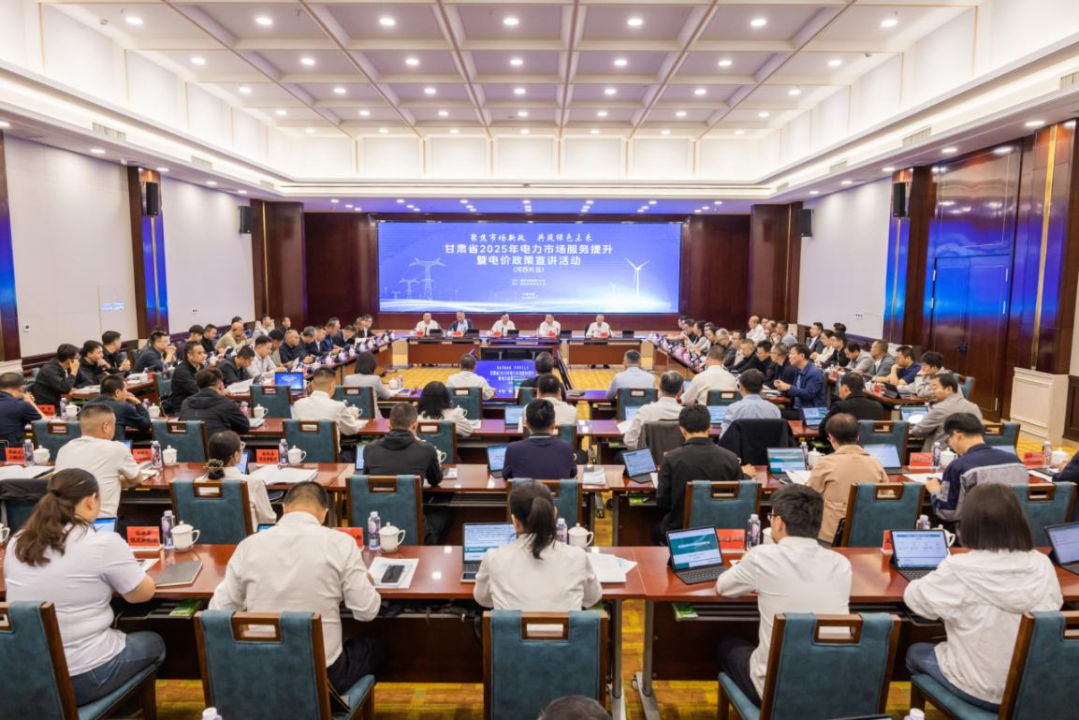
国网甘肃电力:开展电力市场服务提升暨电价政策宣讲活动
Zhong Guo Neng Yuan Wang· 2025-09-17 09:15
Core Viewpoint - The event organized by State Grid Gansu Electric Power Company focuses on enhancing electricity market services and promoting green development in Gansu Province by discussing new electricity pricing policies and market reforms [1][3]. Group 1: Event Overview - The event titled "Focusing on New Market Policies, Building a Green Future" was held in Zhangye City, attended by over 90 representatives from government departments and electricity generation and consumption enterprises from five cities [1]. - Experts provided in-depth explanations of the core content of electricity market reforms, including the mechanisms and operations of medium-to-long-term and spot markets, with a focus on the market-oriented reform policies for renewable energy pricing [3]. Group 2: Practical Strategies and Discussions - Experts shared practical strategies for reducing electricity costs, and participants engaged in discussions about transaction processes, electricity price volatility risks, and details of green electricity certificate trading [3]. - A representative from a Zhangye enterprise noted that the seminar clarified electricity pricing policies and market trading rules, enabling them to adjust production plans according to time-of-use pricing and actively consume green electricity [3]. Group 3: Future Directions - State Grid Gansu Electric Power Company plans to continue deepening the construction of the electricity market system, providing more precise policy services and technical support to help enterprises seize opportunities in the electricity market reform and achieve green development [3].
陕西发文!严禁利用“发售一体”关联关系操纵市场价格 进行不正当竞争
Sou Hu Cai Jing· 2025-09-17 02:03
Core Viewpoint - The notice issued by the Shaanxi Provincial Development and Reform Commission and the Shaanxi Provincial Market Supervision Administration aims to strengthen the standardized operation of the electricity sales market, ensuring that electricity sales companies fulfill their obligations to inform retail users accurately about policies and market information [4][5]. Group 1: Compliance and Responsibilities - Electricity sales companies must provide accurate and comprehensive market information to retail users and ensure users are aware of the pricing mechanism and market risks when signing contracts [7][8]. - Companies are prohibited from engaging in unfair pricing practices, such as signing contracts that significantly deviate from market prices, which could harm user interests [2][8]. - There is a strong emphasis on the independence of sales and generation operations within integrated companies to prevent market manipulation [2][8]. Group 2: Market Monitoring and Risk Management - The Shaanxi Electricity Trading Center is tasked with enhancing market monitoring and risk prevention capabilities, ensuring compliance with trading rules and reporting violations to relevant authorities [3][9]. - The center will increase transparency by disclosing information about high-priced electricity sales companies and abnormal trading activities [3][9]. - In the event of significant policy changes or unusual price fluctuations, the center will issue alerts to market participants [3][9]. Group 3: Service Improvement and User Focus - Electricity sales companies are encouraged to enhance service quality and provide tailored energy solutions to meet user needs while maintaining compliance with regulations [5][10]. - The focus is on improving service levels for smaller users who may be less sensitive to pricing, ensuring they receive adequate information and support [9][10]. - Companies are urged to adopt a compliance-oriented business philosophy to foster a healthy and orderly electricity market [10].
储能竞争下半场:唤醒“沉睡资产” 运营为王时代来临
Xin Jing Bao· 2025-09-16 17:37
"2027年……全国新型储能装机规模达到1.8亿千瓦以上,带动项目直接投资约2500亿元"。国家层面的 最新部署,让我们看到了中国储能行业正在从追求装机的"规模竞赛"转向运营效率的"价值博弈"。 9月12日,国家发展改革委、国家能源局印发《新型储能规模化建设专项行动方案(2025—2027年)》(以 下简称《方案》),为未来三年储能发展指明方向。 这份文件清晰地传递出一个信号:储能行业竞争的核心将从"建设规模"转向运营效率和市场价值。那些 没有被频繁调用的储能设施,将成为"沉睡资产";而没有深度融入市场机制的储能,则难以转化为"现 金流资产"。 从"量"的积累到"量""质"齐飞 国家能源局近日发布的《中国新型储能发展报告(2025)》显示,截至2024年底,全国已建成投运新型 储能7376万千瓦/1.68亿千瓦时,装机规模占全球总装机比例超过40%。中国新型储能规模已跃居世界第 一。 《方案》提出,到2027年,全国新型储能装机规模达到1.8亿千瓦以上,带动项目直接投资约2500亿 元。 AI成为唤醒"沉睡资产"的关键利器 随着一系列的电力市场化改革深化,传统储能依赖的峰谷价差套利模式面临挑战。 三年时间从7 ...