
生成式AI

Search documents
IDC:2025年上半年大模型公有云服务市场火山引擎占比49.2%,排名第一
Zheng Quan Shi Bao Wang· 2025-09-19 06:41
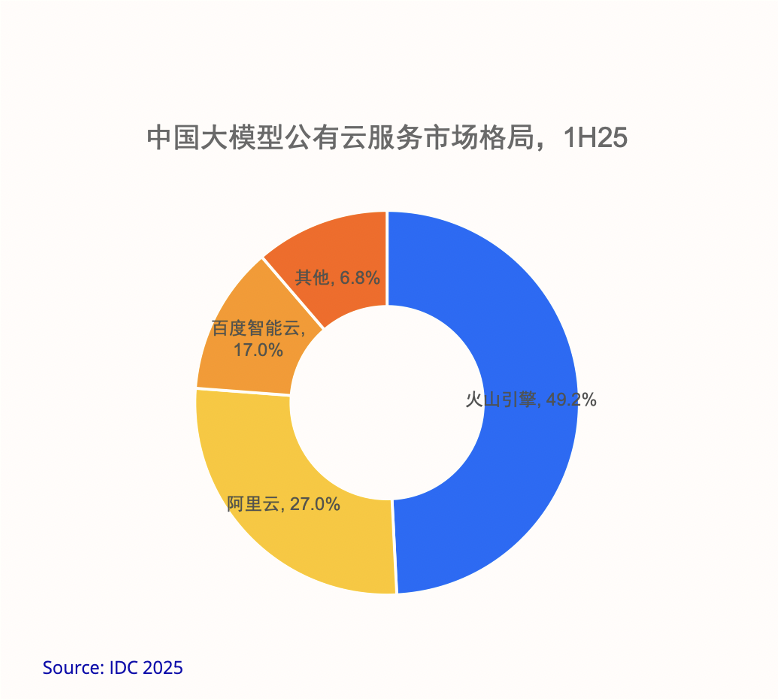
随着推理模型、多模态模型能力的进一步提升,模型调用的商业模式逐渐成熟。IDC指出,相比2024全年114万亿Tokens的市场规模,仅2025年上半年就实 现了近400%的增长。 火山引擎在公有云大模型市场进一步巩固领先优势。公开信息显示,全球Top10手机厂商,有9家已通过火山引擎接入豆包大模型。奔驰、宝马、奥迪、特 斯拉、蔚来等众多汽车厂商也与火山引擎建立大模型合作。 IDC预测,未来中国生成式AI软件将持续高速增长,在基础模型持续创新、模型开发应用工具链不断完善以及智能体的爆发下,该市场规模2028年将达到 482.4亿元人民币,未来仍将有数百倍增长空间。 近日,国际数据公司(IDC)公布的《中国大模型公有云服务市场分析,2025H1》报告指出,2025年上半年,中国公有云上大模型调用量达536.7万亿Tokens。 其中,火山引擎以49.2%的市场份额位居中国市场第一,阿里云、百度智能云分别占比27%、17%,位列第二、第三位。 据悉,IDC报告统计口径是各大云厂商对外部客户提供的大模型公有云服务调用量,不包含自有业务调用。 ...

IDC:上半年大模型公有云市场,火山引擎占比近半排名第一
Nan Fang Du Shi Bao· 2025-09-19 06:01
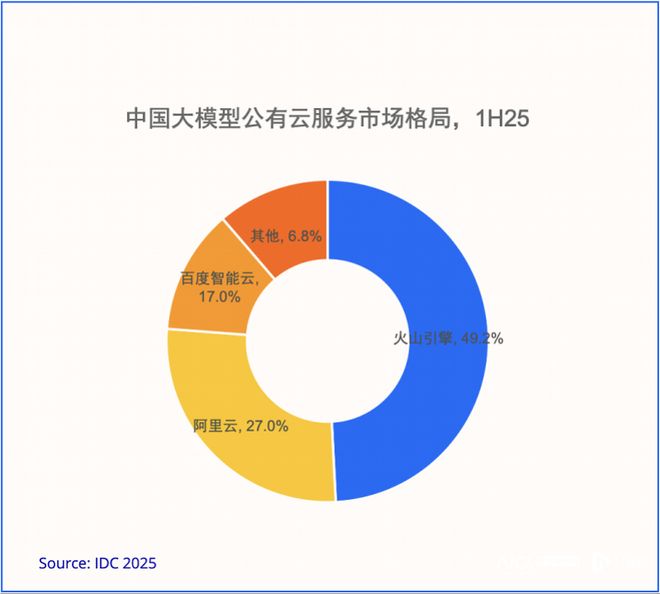
随着推理模型、多模态模型能力的进一步提升,模型调用的商业模式逐渐成熟。IDC指出,相比2024全 年114万亿Tokens的市场规模,仅2025年上半年就实现了近400%的增长。 中国公有云大模型调用量快速增长 近日,国际数据公司(IDC)公布的《中国大模型公有云服务市场分析,2025H1》报告指出,2025年上 半年,中国公有云上大模型调用量达536.7万亿Tokens。其中,火山引擎以49.2%的市场份额位居中国市 场第一,阿里云、百度智能云分别占比27%、17%,位列第二、第三位。 据悉,IDC报告统计口径是各大云厂商对外部客户提供的大模型公有云服务调用量,不包含自有业务调 用。 火山引擎在公有云大模型市场进一步巩固领先优势。公开信息显示,全球Top10手机厂商,有9家已通 过火山引擎接入豆包大模型。奔驰、宝马、奥迪、特斯拉、蔚来等众多汽车厂商也与火山引擎建立大模 型合作。 IDC预测,未来中国生成式AI软件将持续高速增长,在基础模型持续创新、模型开发应用工具链不断完 善以及智能体的爆发下,该市场规模2028年将达到482.4亿元人民币,未来仍将有数百倍增长空间。 ...
恒生指数早盘涨0.12% 澳门板块涨幅居前
Zhi Tong Cai Jing· 2025-09-19 04:07
Group 1 - The Hang Seng Index rose by 0.12%, gaining 31 points to close at 26,576 points, while the Hang Seng Tech Index increased by 0.62%. The early trading volume in Hong Kong stocks reached HKD 179 billion [1] - Gaming stocks led the gains, with Macau's August gambling revenue slightly exceeding expectations, and gaming companies anticipating strong demand during the National Day holiday. Wynn Macau rose by 5.41%, Melco International Development increased by 5.85%, and Sands China gained 5% [1] Group 2 - Weimob Group surged over 10% as the company plans to raise over HKD 1.5 billion through a share placement, with Wujie Capital becoming the largest single shareholder [2] - Ganfeng Lithium saw an increase of over 10%, stating that its energy storage cell production capacity is currently at full capacity [2] - Longi Green Energy's optical fiber business rose over 12%, reaching a new high, with the market favoring hollow-core optical fibers, although the related business has not yet significantly impacted financial data [2] Group 3 - Hongteng Precision rose over 16% as the company plans to build an electric vehicle charging station factory in Saudi Arabia, accelerating its AI multi-product layout [3] Group 4 - China Rare Earth Holdings increased by nearly 9% due to an increase in reserves at the Mt Bundy project, with plans to spin off its gold business for a listing in Hong Kong [4] - The stablecoin concept saw most stocks rise, as Hong Kong is implementing a stablecoin issuer system, potentially benefiting third-party payment institutions. Duodian Smart rose by 4%, Yaocai Securities Financial increased by 5.85%, and OSL Group gained 5% [4] Group 5 - Haijia Medical rose over 6% after the founder Zhu Yiwen increased his stake by 1.6648 million shares [5] Group 6 - SenseTime rose over 3% after Goldman Sachs raised its expectations for the company's ToC business expansion, driven by generative AI promoting innovation in its business development [6] Group 7 - Tesla's robot order rumors were denied by Elon Musk, leading to a drop of over 7% for Sanhua Intelligent Controls [7] Group 8 - Fortior fell nearly 5% as shareholder Shanghai Huaxin plans to reduce its stake by no more than 3% [8]
港股午评|恒生指数早盘涨0.12% 澳门板块涨幅居前
智通财经网· 2025-09-19 04:06
Group 1: Market Performance - The Hang Seng Index rose by 0.12%, gaining 31 points to close at 26,576 points, while the Hang Seng Tech Index increased by 0.62% [1] - The early trading volume in the Hong Kong stock market reached HKD 179 billion [1] Group 2: Notable Stock Movements - Gaming stocks saw significant gains, with August Macau gaming revenue slightly exceeding expectations, and strong demand anticipated for the upcoming National Day holiday. Wynn Macau rose by 5.41%, Melco International Development increased by 5.85%, and Sands China gained 5% [1] - Weimob Group surged over 10% as the company plans to raise over HKD 1.5 billion through a share placement, with Wujie Capital becoming the largest single shareholder [1] - Ganfeng Lithium rose over 10%, stating that its energy storage cell production capacity is currently at full capacity [1] - Changfei Optical Fiber and Cable increased over 12%, reaching a new high, driven by market enthusiasm for hollow-core fiber, although the related business has not yet significantly impacted financial data [1] - Hongteng Precision surged over 16% after announcing plans to build an electric vehicle charging station factory in Saudi Arabia, with accelerated AI product layout [1] - China Rare Earth Holdings rose nearly 9% as the Mt Bundy project reported increased reserves, and the company plans to spin off its rare earth gold business for a Hong Kong listing [1] - Stablecoin-related stocks mostly rose, as Hong Kong implements a stablecoin issuer system, potentially benefiting third-party payment institutions. Duodian Smart rose by 4%, Yaocai Securities Financial increased by 5.85%, and OSL Group gained 5% [1] Group 3: Company-Specific Developments - Haijia Medical rose over 6% after founder Zhu Yiwen increased his stake by purchasing 1.6648 million shares [2] - SenseTime-W increased over 3% as Goldman Sachs raised its expectations for the company's ToC business expansion, driven by generative AI innovations [3] - Musk denied rumors of Tesla receiving an order for 10,000 robots, leading to a decline of over 7% in Sanhua Intelligent Controls [4] - Fortior fell nearly 5% as shareholder Shanghai Huaxin plans to reduce its stake by up to 3% [4]
异动盘点0919|三花智控跌超7%,极兔速递-W涨超3%;台积电涨超2%,诺和诺德涨超6%
贝塔投资智库· 2025-09-19 04:04
Market Performance Summary - Changfei Optical Fiber Cable (06869) surged over 10% following an announcement regarding unusual trading volatility, with the company stating that related business has not yet significantly impacted financial data [1] - Jitu Express-W (01519) rose over 3% after announcing a plan to repurchase up to 10% of its Class B shares, with institutions optimistic about the company's overseas market share expansion [1] - Sanhua Intelligent Control (02050) fell over 7% after rumors of PharmAGRI signing a letter of intent with Tesla to deploy up to 10,000 Optimus Gen3+ humanoid robots were denied by Musk [1] - InnoCare Pharma (02577) increased over 1% after reports of collaboration with leading companies in the robotics field, successfully launching the world's first gallium nitride robot [1] - Evergrande Property Services (06666) rose over 3% as the liquidator received acquisition offers, indicating potential separation from the Evergrande Group [1] - NIO-SW (09866) increased over 5% ahead of the NIO Day 2025 event, where the new ES8 will be officially launched, with Everbright Securities optimistic about the company's cost reduction and efficiency improvement prospects [1] - SenseTime-W (00020) rose over 4% as Goldman Sachs upgraded its expectations for SenseTime-W's ToC business expansion, driven by generative AI and innovative business development [1] Additional Company Updates - Haijia Medical (06078) increased over 7% after the founder and controlling shareholder, Zhu Yiwen, purchased 1.6648 million shares [2] - Weimob Group (02013) surged over 11% after announcing plans to raise over HKD 1.5 billion through a share placement, with Wujing Capital becoming the largest single shareholder [2] - CATL (03750) rose nearly 2% after signing a five-year comprehensive strategic cooperation agreement with Li Auto to jointly promote battery technology innovation [2] US Market Highlights - TSMC (TSM.US) rose 2.23% as reports indicated it will begin mass production of 2nm process technology by the end of the year, with Apple securing half of the capacity for 2026 [3] - Palantir (PLTR.US) increased 5.13% as insiders revealed a forthcoming five-year agreement worth GBP 750 million with the Department of Defense [3] - Novo Nordisk (NVO.US) rose 6.27% after reporting positive results from Phase III clinical trials for its oral weight loss medication [3] - Micron Technology (MU.US) increased 5.56% as forecasts predict a comprehensive price increase in the storage market for Q4 [4] - CrowdStrike (CRWD.US) surged 12.82% after launching Threat AI, the industry's first intelligent threat intelligence system [5]

商汤-W涨超5% 高盛上调公司ToC业务扩张预期 生成式AI推动X创新业务发展
Zhi Tong Cai Jing· 2025-09-19 02:26
Core Viewpoint - SenseTime-W (00020) has seen a stock price increase of over 5%, currently trading at 2.74 HKD with a transaction volume of 1.798 billion HKD, driven by positive analyst reports regarding its ToC business expansion [1] Group 1: Business Expansion and Revenue Generation - Goldman Sachs has raised its expectations for SenseTime-W's ToC business expansion, anticipating the company will monetize through subscription fees after offering new users free trials [1] - SenseTime is entering the generative AI application space with productivity tools like Raccoon Office AI and Kapi Accounting AI, leveraging deep analytical capabilities supported by the SenseNova foundational model to address AI-native issues [1] - The company is providing AI industry solutions based on high-demand scenarios, covering market analysis, sales analysis, product development, and enterprise management, creating a differentiated advantage compared to other AI applications [1] Group 2: Financial Performance and Future Outlook - According to Guotai Junan, SenseTime-W is expected to see significant improvement in performance by the first half of 2025, with losses narrowing considerably and generative AI business revenue increasing by 72.7% year-on-year [1] - The "Artificial Intelligence +" policy is anticipated to catalyze the company's visual and X business growth, indicating a positive long-term development outlook [1] - CITIC Securities believes that the company's large model applications will accelerate penetration with a focus on productivity and interactive tools, enhancing customer stickiness [1]
港股异动 | 商汤-W(00020)涨超5% 高盛上调公司ToC业务扩张预期 生成式AI推动X创新业务发展
智通财经网· 2025-09-19 02:15
Core Viewpoint - SenseTime-W (00020) has seen a stock price increase of over 5%, currently trading at 2.74 HKD with a transaction volume of 1.798 billion HKD, driven by positive analyst forecasts regarding its ToC business expansion [1] Group 1: Business Expansion and Revenue Generation - Goldman Sachs has raised its expectations for SenseTime-W's ToC business expansion, anticipating the company will monetize through monthly or annual subscription fees after offering new users free trials [1] - SenseTime is entering the generative AI application space with productivity tools such as Raccoon Office AI and Kapi Accounting AI, leveraging deep analytical capabilities supported by the SenseNova foundational model to address AI-native issues [1] - The company is providing AI industry solutions based on high-demand scenarios, covering market analysis, sales analysis, product development, and enterprise management, creating a differentiated advantage compared to other AI applications [1] Group 2: Financial Performance and Future Outlook - According to Guotai Junan, SenseTime-W is expected to see significant performance improvement in the first half of 2025, with a notable reduction in losses and a 72.7% year-on-year increase in revenue from generative AI business [1] - The "Artificial Intelligence +" policy is anticipated to catalyze the company's visual and X business growth, indicating a positive long-term development outlook [1] - CITIC Securities believes that the company's large model applications will accelerate penetration with a focus on productivity and interactive tools, enhancing customer stickiness [1]
不想被AI浪潮抛下?先识破这些致命误判
3 6 Ke· 2025-09-19 01:42
Core Insights - The article argues that there are six fundamental misconceptions about AI, leading to overly optimistic short-term expectations from the market and companies. The true power of AI lies in long-term applications and deep integration rather than immediate disruptive miracles [1][3][4] Group 1: AI's Development and Impact - AI's development will follow a slow and complex trajectory, similar to past general-purpose technologies like electricity and the internet, which took decades to fully integrate into the economy [3][4] - Research indicates that only 5% of job tasks will be completed profitably by AI in the next decade, contributing just 1% to the US GDP, which is far less than many expect [4] - The challenges of AI adoption include high costs related to technology transformation, employee retraining, and system integration, which often outweigh the benefits [4][6] Group 2: Market Misjudgments and Valuations - Investors are misjudging AI companies as high-growth, low-asset software firms, while these companies are actually capital-intensive and highly dependent on infrastructure [7][8] - Current trading premiums for AI-focused tech stocks are 20% to 40%, reflecting unrealized future profit expectations [7] - The valuation of companies like OpenAI is inflated, with a target of $300 billion, which is significantly higher than historical valuations of similar companies [8] Group 3: Competitive Landscape and Profitability - Competition is rapidly compressing profit margins in the AI sector, with open-source models gaining market share and offering free services [9] - The true winners in the AI field will be those who can integrate AI into business processes that create lasting economic advantages, rather than those chasing high valuations [9][11] Group 4: Application vs. Development - The real value of AI lies in its application rather than the development of advanced models, as many companies mistakenly believe that foundational models will directly generate value [11][12] - Successful companies will be those that effectively integrate AI into their core operations, transforming labor-intensive services into scalable applications [12][13] Group 5: Future Directions and Strategic Planning - The future of AI will involve multi-modal systems capable of processing various types of information and simulating human cognitive processes [15][16] - Companies should focus on building infrastructure that supports multi-modal integration rather than investing in single-function solutions [16][17]





腾讯研究院AI速递 20250919
腾讯研究院· 2025-09-18 16:01
Group 1: Huawei Ascend AI Chips - Huawei has released a roadmap for its Ascend AI chips, planning to launch five products over four years, including Ascend 950PR in Q1 2026 and Ascend 970 in Q4 2028 [1] - The new chip series supports low-precision data formats, with Ascend 950PR achieving 1 PFLOPS in FP8/MXFP8/HiF8 precision and 2 PFLOPS in MXFP4, utilizing self-developed HiBL 1.0 memory [1] - Huawei also introduced powerful computing supernodes and clusters, including Atlas 950 SuperPoD supporting 8192 cards and Atlas 960 SuperCluster with a computing scale of up to one million cards [1] Group 2: OpenAI and Gemini in ICPC - OpenAI's model achieved a perfect score in the ICPC 2025 programming competition, solving all 12 problems in 5 hours, equivalent to the top human ranking [2] - Google's Gemini 2.5 Deep Think solved 10 problems in 677 minutes, ranking second among university teams, showcasing significant advancements in AI's complex reasoning and programming capabilities [2] - Both models were not specifically trained for ICPC, with Gemini solving a problem that no university team could, indicating breakthroughs in AI reasoning [2] Group 3: Meta's AI Glasses - Meta launched three new smart glasses, including the Meta Ray-Ban Display, the first AI glasses with a color waveguide HUD display, priced at $799 [3] - The Ray-Ban Meta (Gen 2) features doubled battery life, 3K resolution recording, and a new Conversation Focus function, priced at $379 [3] - Oakley Meta Vanguard targets athletes with a windproof design, 9-hour battery life, and integration with Strava and Garmin devices, priced at $499 [3] Group 4: DeepSeek-R1 Paper in Nature - The DeepSeek-R1 paper was featured as a cover article in Nature, demonstrating that the reasoning ability of large language models can be enhanced through pure reinforcement learning without manual annotation [4] - The research team introduced the "Group Relative Policy Optimization" (GRPO) algorithm, which helps models evolve more diverse and complex reasoning behaviors, performing well on 21 mainstream benchmark tests [4] - Nature's editorial praised DeepSeek-R1 as the first mainstream LLM published after peer review, marking a positive step towards AI transparency [4] Group 5: Alibaba's Open Source Deep Research Agent - Alibaba has open-sourced its first deep research agent model, Tongyi DeepResearch, featuring 3 billion active parameters, competing with flagship models like OpenAI's o3 and DeepSeek V3.1 [5] - The model performed excellently across seven major agent evaluation benchmarks, with its model, framework, and solutions fully open-sourced on platforms like GitHub and Hugging Face [5] - The research team developed a complete training pipeline driven by synthetic data, addressing issues like "cognitive space congestion" and "irreversible noise pollution" [5] Group 6: Skywork Super Agents and AI Developer - Skywork Super Agents launched the Vibe Coding Agent—AI Developer, enabling non-professional developers to quickly build, deploy, and manage full-stack web applications through natural language interaction [6] - The AI Developer can generate front-end pages and deeply integrate with Supabase for backend functionalities, including database management and user authentication [6] - This feature also supports Stripe payment and Resend email service integration, significantly lowering the barrier for full-stack development [6] Group 7: AI Disease Prediction Tool - A new AI tool, Delphi-2M, developed by a research team from Germany's cancer research center, can predict the risk of over 1,000 diseases, some up to decades in advance [7] - Delphi-2M is based on an improved GPT architecture and trained on data from 400,000 UK Biobank participants, providing potential disease risk estimates for up to 20 years [7] - The model showed stable performance in large-scale external validation (AUC value of 0.67), enhancing personalized health risk awareness, but is recommended as a supplementary tool rather than a replacement for existing diagnostic processes [7] Group 8: AI Economy and Digital Divide - Google DeepMind published a paper titled "Virtual Agent Economy," suggesting that autonomous AI agents are forming a new economic layer that operates beyond human comprehension [8] - The default development path may lead to "high-frequency negotiations" dominating the economy, with wealthy AI agents gaining advantages in economic interactions, potentially creating a digital divide [8] - Researchers proposed building a "fair economy" through equitable distribution of digital currency and establishing a trust-based digital infrastructure to ensure AI economy serves long-term human welfare [8]

商汤20250918
2025-09-18 14:41
Summary of SenseTime Conference Call Company Overview - **Company**: SenseTime - **Date**: September 18, 2025 Key Points Industry and Company Performance - SenseTime's overall revenue increased by 36% year-on-year, with generative AI business growing by 73%, accounting for 77% of total revenue, indicating significant revenue scale advantages in the generative AI sector [2][3] - The company has narrowed its adjusted net loss by 50% year-on-year, attributed to revenue and gross profit growth, as well as improved accounts receivable quality [2][4] Financial Adjustments - SenseTime has restructured its financial reporting to categorize revenue into three segments: generative AI, visual AI, and X innovation business, aiming for clearer visibility of core business drivers [2][6] - The company reduced accounts receivable provisions by approximately 450 million RMB, reflecting better collection quality in generative AI compared to other segments [4] X Innovation Business Progress - SenseTime has made significant progress in its X innovation business, with two subsidiaries successfully financing and achieving market presence, enhancing overall competitiveness [2][7] Market Dynamics and Capital Market Impact - The global capital market's deepening understanding of generative AI has positively impacted SenseTime's development, leveraging its decade-long experience in visual AI for infrastructure investment and algorithm breakthroughs [2][8][9] Infrastructure and Model Development - Generative AI infrastructure encompasses not only GPU scale but also software, industry understanding, and data capabilities, requiring tailored training and optimization for specific scenarios [4][11] - SenseTime has developed multi-modal models, with successful commercial applications in finance, education, and e-commerce, showcasing the potential of dynamic fusion models [4][19] Agent Capabilities - SenseTime's "Xiaohuanxiong" product line has shown strong user engagement and conversion rates, indicating effective application of generative AI technologies in various industries [13][14] Strategic Focus and Future Goals - The company emphasizes the importance of end-to-end delivery solutions tailored to customer needs, rather than merely providing raw computing power [16] - SenseTime is committed to achieving profitability but has not set a specific timeline due to the complexities involved in revenue and cost structures [20] Challenges and Innovations - Current market skepticism regarding the ceiling of generative AI models has prompted SenseTime to pivot towards multi-modal integration, focusing on hardware and customer scenarios for enhanced interaction [18][19] Competitive Landscape - The company recognizes the rapid changes in technology and customer demands within the generative AI space, highlighting the need for adaptability and innovation to maintain competitive advantage [10][12] Additional Important Insights - SenseTime's strategic partnerships and resource acquisition strategies, including a light asset model for chip supply, enable quick adaptation to market changes [17] - The company has established a leading AI computing center in Shanghai, enhancing its capabilities in AI model development and deployment [12]