
区块链

Search documents
天阳科技:与甲骨文、IBM等厂商是合作关系
Mei Ri Jing Ji Xin Wen· 2025-09-15 13:29
Core Viewpoint - Tianyang Technology (300872) is focused on providing financial technology services to the banking sector, leveraging advanced technologies such as artificial intelligence, blockchain, cloud computing, and big data to facilitate digital transformation in the financial industry [1] Group 1 - The company serves clients primarily in the banking sector [1] - Tianyang Technology offers consulting, financial technology, digital finance, and financial IT products and services [1] - The company collaborates with major firms like Oracle and IBM [1]
每日数字货币动态汇总(2025-09-15)
Jin Shi Shu Ju· 2025-09-15 10:44
Group 1 - The likelihood of the U.S. government establishing a strategic Bitcoin reserve by the end of this year is high, as indicated by Galaxy Digital's research head Alex Thorn, who believes the market is underestimating this possibility [1] - Recent legislative proposals suggest that the U.S. Treasury is reviewing the feasibility and technical considerations of a strategic Bitcoin reserve [1] - Bitcoin is currently experiencing strong support between $110,000 and $114,000, with the next resistance level around $117,000 [1] Group 2 - The IRS has expanded its cryptocurrency monitoring from targeted investigations to near real-time blockchain tracking, having seized $3.5 billion worth of cryptocurrency in 2021, which accounted for 93% of total asset seizures that year [2] - A report indicates that 75% of cryptocurrency users identified through exchange data may have potential tax compliance issues [2] - The IRS is set to implement a new reporting system for cryptocurrency transactions starting in 2025 [2] Group 3 - Standard Chartered Bank is interested in engaging in cryptocurrency trading in Hong Kong, anticipating the development of related custody and financing services in the next one to two years [2] - Goldman Sachs highlights the increasing trend of blockchain integration in capital markets, with tokenized securities moving from concept to mainstream application [3] - Gemini's co-founder predicts Bitcoin could reach $1 million in ten years, viewing it as a modern version of gold [3] Group 4 - South Africa's Pizza Hut and KFC have begun accepting Bitcoin payments, facilitated by payment service provider ZAPPER integrating with the Lightning Network [5] - Circle's USDC has approximately 90% of its asset reserves managed by BlackRock, emphasizing the importance of network security and regulatory oversight for digital assets [9] - Amazon has posted a job opening for a "Crypto Ecosystem Lead" with a salary of $500,000, indicating a growing interest in the cryptocurrency sector [10] Group 5 - Analysts expect an increase in institutional investment in Bitcoin during Q4 of this year, as traditional finance prepares for the upcoming year [6] - Yala reported a recent attack on its protocol but confirmed that all user assets remained unaffected [6] - Gemini's strategy of reserving 30% of its IPO shares for retail investors may help mitigate the risks associated with initial price surges seen in recent cryptocurrency-related IPOs [7] Group 6 - Ethereum's co-founder Vitalik Buterin announced plans for a tenfold expansion of the Ethereum network next year while maintaining decentralization and security [8] - Former U.S. Treasury Secretary Lawrence Summers expressed skepticism about stablecoins significantly increasing demand for U.S. Treasury bonds, emphasizing the need for regulatory measures to prevent bank runs and anonymous transactions [10]


中国检验检测认证行业「十五五」展望:如何以智能化技术重构行业生态?
Sou Hu Cai Jing· 2025-09-15 10:34
Core Insights - The TIC industry is undergoing a transformation driven by the integration of smart technologies, which is essential for enhancing quality infrastructure and meeting the demands of digitalization in manufacturing [4][28] - The industry faces significant challenges, including fragmented technical standards, a shortage of skilled talent, and high costs associated with smart technology implementation [14][15][16] Group 1: Industry Trends - The TIC industry's smart transformation has shifted from an optional upgrade to a strategic necessity for manufacturers, addressing key pain points in quality assurance [4][11] - The Ministry of Industry and Information Technology has set a target for 2027 to achieve breakthroughs in key calibration technologies, promoting a shift from static laboratory calibration to dynamic monitoring on production lines [4][11] - Over 80% of China's TIC market consists of small and micro enterprises, indicating a highly fragmented market that presents opportunities for smart integration [4] Group 2: Technological Advancements - Smart technologies are providing dual core values to the TIC industry: breaking spatial and temporal limitations through IoT and enabling dynamic evolution of standards via AI [5][6] - AI is identified as the core driver for process innovation in the TIC industry, particularly in enhancing the efficiency and accuracy of report reviews [7][8] - IoT technology is facilitating a shift from offline testing to real-time monitoring, significantly improving production efficiency [8] Group 3: Implementation Pathways - The TIC industry is focusing on three core directions for the implementation of smart technologies: AI-driven process innovation, real-time monitoring through IoT, and establishing secure data systems via blockchain [6][9][10] - Blockchain technology is being utilized to build a trustworthy data infrastructure, addressing trust barriers in cross-border trade and enhancing data flow efficiency [9] Group 4: Challenges and Future Directions - The TIC industry faces three main challenges in its smart transformation: technical adaptation, resource allocation, and external environmental barriers [13][14] - The fragmentation of technical standards and cross-border compliance barriers are significant obstacles to the global service capabilities of TIC enterprises [14] - The industry is evolving towards three main directions: deep integration of technologies, expansion of service ecosystems, and upgrading of value dimensions [18][19] Group 5: Strategic Recommendations - TIC enterprises are advised to adopt a phased approach to AI deployment, starting with intelligent auditing systems and gradually moving towards comprehensive smart solutions [24] - Collaboration with educational institutions to develop specialized training programs in smart detection and AI is essential for addressing the talent gap [25] - Cost optimization strategies, such as leasing smart detection equipment and participating in data-sharing platforms, can help reduce initial investments and operational costs [28]

调研速递|龙利得接受多家投资者调研 透露转型与发展要点
Xin Lang Zheng Quan· 2025-09-15 10:22
Core Viewpoint - The company is actively transforming from a traditional packaging provider to a consumer-oriented packaging solutions provider, focusing on optimizing product structure and exploring various investment opportunities [1][2]. Company Transformation and Business Expansion - The company is transitioning towards offering packaging solutions aimed at end consumers, with an emphasis on products such as color boxes, bags, and boutique boxes [1]. - While the company is open to investment opportunities, there are currently no specific plans for mergers or expansions into non-packaging sectors [1]. Technology Application and Innovation Park Progress - The company is advancing the integration of digital technologies such as big data, blockchain, and IoT in the Anhui Mingguang Green Intelligent Cultural Innovation Park, which is set to enhance its digital capabilities and meet emerging market demands [2]. - The Shanghai "Longlide Cultural Innovation Park" is also focusing on expanding its main business to solidify the company's market position as a comprehensive packaging and printing solution provider [2]. R&D, Marketing, and Talent Investment Focus - In the first half of 2025, the company concentrated its R&D investments on technological innovations in paper packaging and other container developments [3]. - The marketing system is being enhanced to improve customer resource expansion and service capabilities, with a focus on recruiting professionals in R&D, marketing, and management [3]. Product Advantages and Market Competitiveness - The company's eco-friendly paper bags are recognized for their high-quality materials and overall performance, finding applications across various consumer sectors [4]. - The subsidiary's paper cup products have achieved two significant international certifications, enhancing their global recognition [4]. - The company has established technological and product barriers through increased R&D investments, improving product quality and expanding application scenarios [4]. Revenue Growth and Profitability Strategies - In the first half of 2025, the company's revenue grew by 20.71% compared to the same period last year, driven by leveraging its strengths, increasing R&D and marketing investments, and expanding customer resources [5]. - The company aims to enhance profitability through six main strategies: upgrading product structure, smart manufacturing, capacity expansion, seizing downstream demand opportunities, strengthening cost control, and increasing the proportion of high-end products [5]. - The investor communication event provided comprehensive responses to investor concerns, showcasing the company's plans and progress in transformation, technology application, and market expansion [5].
龙利得(300883) - 300883龙利得投资者关系管理信息20250915
2025-09-15 09:38
Group 1: Company Communication and Investor Relations - The company utilizes various channels such as investor hotlines and interactive platforms to communicate with minority shareholders and address their concerns [2] - The company is focused on maintaining a communication mechanism with small shareholders to report valuable feedback to management [2] Group 2: Strategic Transformation and Market Positioning - The company is transitioning from a "traditional transportation packaging provider" to a "packaging solution provider for end consumers," optimizing its product structure to include high-end packaging items [3] - The company aims to enhance its market share and competitiveness by focusing on core business and exploring various investment opportunities [2] Group 3: Technological Advancements and Innovations - The company is actively integrating digital technologies such as big data, blockchain, and IoT to create new industry models in the "Internet + Digital Intelligence + Packaging" sector [3] - The company has made significant progress in R&D investments, focusing on technological innovation and new product development to build competitive barriers [8] Group 4: Financial Performance and Growth Drivers - In the first half of 2025, the company achieved a revenue growth of 20.71% compared to the same period last year, driven by core business advantages and increased resource investments in R&D and marketing [7] - The company is enhancing its profitability through six key strategies, including product structure upgrades driven by environmental policies and optimizing customer structure [8] Group 5: Environmental Initiatives and Product Certifications - The company has obtained important international certifications for its paper cup products, enhancing their market recognition and compliance with environmental standards [5] - The company’s eco-friendly paper bags are made from high-quality materials, ensuring their biodegradability and recyclability, and are widely applicable in various consumer sectors [4] Group 6: Market Expansion and Customer Base - The company has a diverse customer base covering multiple sectors, including high-end food, cosmetics, and fast-moving consumer goods, with a focus on expanding its reach to end consumer brands [5] - The company plans to leverage its new technology and production capabilities to meet the demands of emerging markets, particularly in the fast-moving consumer goods sector [6]
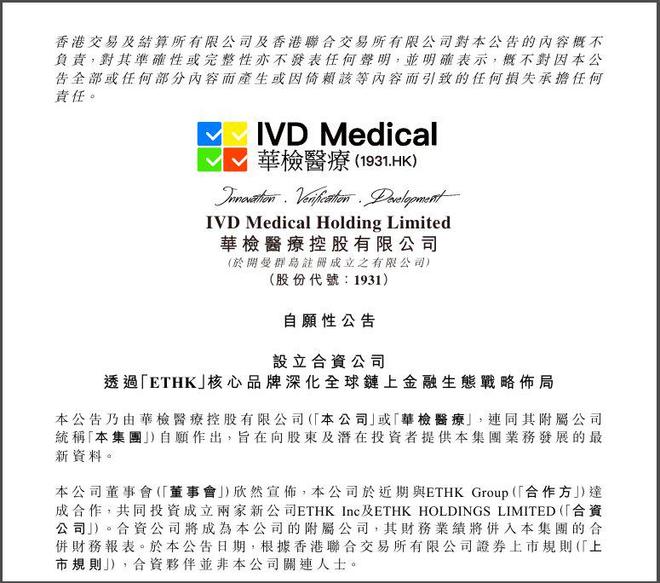
华检医疗 (01931) 换新号 以 ETHK引领链上融通
Zhi Tong Cai Jing· 2025-09-15 08:10
Core Viewpoint - The announcement by Huajian Medical Holdings Limited regarding its partnership with ETHK Group marks a significant step towards creating a new financial ecosystem on the blockchain, aiming to facilitate the global flow and reconstruction of value, particularly in the Chinese healthcare sector [1][3]. Group 1: Company Overview - Huajian Medical is transitioning from a focus on in vitro diagnostics (IVD) to a broader role in the financial ecosystem by exploring the integration of assets and finance [7]. - The company is rebranding itself to reflect its new strategic direction, changing its name to Huajian Digital Industry Group Limited [1]. Group 2: Strategic Initiatives - The establishment of ETHK INC and ETHK HOLDINGS LIMITED is not merely a capital partnership but aims to build a decentralized and open financial platform [4]. - The ETHK ecosystem is built on five key pillars: technological infrastructure, financial products and asset matrix, sustainable business models, global compliance frameworks, and seamless user experience [5][6]. Group 3: Market Positioning - The collaboration is seen as a strategic extension that addresses the challenges of capital acceptance and value realization for innovative assets [7]. - The tokenization of assets is expected to enhance liquidity and provide a global platform for investment, breaking down geographical and institutional barriers [8][9]. Group 4: Industry Implications - The initiative is positioned as part of a broader trend towards the tokenization of real-world assets (RWA), which is gaining traction among major financial institutions [11]. - The ETHK ecosystem aims to serve as a public infrastructure for the global economy, emphasizing the importance of technology in rebuilding trust and facilitating cooperation [11]. Group 5: Future Outlook - The partnership represents a bold attempt to redefine the narrative of Chinese assets in the global capital landscape, with the potential to reshape financial order [14][15]. - The success of this venture could lead to significant changes in how value is discovered and exchanged on a global scale, particularly for Chinese innovative assets [13][15].
天合光能(688599.SH):参与了《可信区块链实体资产可信上链技术规范》标准制定
Ge Long Hui· 2025-09-15 07:57
Group 1 - The company, Trina Solar (688599.SH), is involved in the formulation of the "Trusted Blockchain Entity Asset Trusted On-Chain Technology Specification" standard [1] - The company is closely monitoring the implementation of the stablecoin legislation and is actively engaging in financial innovation to promote its business development [1]

伦敦证交所推出面向私募基金的区块链平台
Ge Long Hui· 2025-09-15 07:38
伦敦证券交易所集团宣布推出基于区块链的数字市场基础设施平台,初期将专注于私募基金领域, 标志着这家交易所运营商正式进军数字资产领域。根据周一的公告,MembersCap公司已利用该平台为 其代币化基金MCM Fund 1完成募资。伦敦受监管的数字证券交易所Archax担任名义持有人。通过运用 区块链技术,伦交所集团旨在提升私募市场效率——该领域日益被视为数字化转型的成熟试验场。虽然 当前平台仅向私募基金开放,但集团计划未来扩展至其他资产类别。 【免责声明】本文仅代表作者本人观点,与和讯网无关。和讯网站对文中陈述、观点判断保持中立,不对所包含内容 的准确性、可靠性或完整性提供任何明示或暗示的保证。请读者仅作参考,并请自行承担全部责任。邮箱: news_center@staff.hexun.com (责任编辑:董萍萍 ) ...
成都在列!国务院批复10个改革试点
Zhong Guo Fa Zhan Wang· 2025-09-15 07:23
Core Viewpoint - The State Council of China has approved a pilot implementation plan for the market-oriented allocation of factors in ten regions, including Chengdu, to enhance innovation, resource efficiency, and economic development [1]. Group 1: Innovation and Technology - The plan aims to stimulate innovation in technology by reforming the ownership of scientific achievements and promoting the establishment of specialized technology transfer institutions [4]. - It encourages the integration of technology and capital by supporting the development of a comprehensive service system connecting technology and capital markets [5]. Group 2: Land Resource Efficiency - The plan includes reforms in land management to optimize the approval processes for construction projects and to promote the efficient use of idle land [6][7]. - It proposes innovative supply methods for industrial land, including flexible leasing and mixed-use land supply [6]. Group 3: Human Resource Mobility - The plan seeks to reform the household registration system to facilitate the movement of human resources and improve the integration of migrant populations into urban areas [9]. - It emphasizes the importance of attracting innovative and entrepreneurial talent through a reformed talent evaluation system [10]. Group 4: Data Flow and Utilization - The initiative aims to establish a foundational support system for data markets, including the protection of data rights and promoting public data sharing [11][12]. - It encourages the development of a data-driven economy by facilitating the circulation and commercialization of social data [12]. Group 5: Financial Services for the Real Economy - The plan aims to enhance financial services to support the real economy, including expanding the application of digital currency and improving the investment environment for venture capital [13]. Group 6: Environmental Resource Market Development - The initiative promotes the establishment of a market-oriented trading mechanism for resources, including green energy and ecological products [14][15]. - It encourages the development of green finance products and the integration of environmental resources into asset trading [15]. Group 7: Collaborative Resource Allocation - The plan focuses on improving the collaborative allocation of factors across regions, particularly in the Chengdu-Chongqing economic circle, to enhance resource efficiency and market integration [17].
兴业银行跌2.01%,成交额13.91亿元,主力资金净流出2.35亿元
Xin Lang Cai Jing· 2025-09-15 06:43
Company Overview - Industrial Bank Co., Ltd. is located at 398 Jiangbin Middle Avenue, Taijiang District, Fuzhou, Fujian Province, and was established on August 22, 1988. The company was listed on February 5, 2007. Its main business includes corporate banking, interbank business, funding business, and retail banking [1]. Stock Performance - As of September 15, the stock price of Industrial Bank fell by 2.01% to 20.99 CNY per share, with a trading volume of 1.391 billion CNY and a turnover rate of 0.31%. The total market capitalization is 444.208 billion CNY [1]. - Year-to-date, the stock price has increased by 15.97%, but it has decreased by 2.19% over the last five trading days, 7.21% over the last 20 days, and 11.62% over the last 60 days [1]. Capital Flow - The net outflow of main funds was 235 million CNY, with large orders buying 393 million CNY (28.27% of total) and selling 457 million CNY (32.84% of total). Special large orders bought 133 million CNY (9.57% of total) and sold 304 million CNY (21.89% of total) [1]. Shareholder Information - As of June 30, the number of shareholders of Industrial Bank was 191,300, a decrease of 6.23% from the previous period. The average number of circulating shares per person increased by 8.64% to 110,646 shares [2]. - The bank has distributed a total of 216.103 billion CNY in dividends since its A-share listing, with 68.718 billion CNY distributed in the last three years [3]. Financial Performance - For the first half of 2025, Industrial Bank reported an operating income of 0.00 CNY and a net profit attributable to shareholders of 43.141 billion CNY, representing a year-on-year growth of 0.21% [2].
