低空经济

Search documents
师钰然:新修订民航法给低空经济插上翅膀
Huan Qiu Wang Zi Xun· 2026-01-06 22:47
来源:环球时报 更清晰的法律框架,为低空经济营造了更加可预期的法治环境,也是为企业发放了"定心丸"。这有助于 企业厘清责任边界,规范运营行为,显著降低制度性交易成本,增强投资可预期性。未来随着配套政策 逐步落地,企业在运营合规、技术研发、商业模式创新上也能享受到更加高效、清晰的制度支持。此 外,政府鼓励相关技术创新和应用拓展的政策信号,也将提振市场信心,推动资本、人才加速聚集,激 发产业链上下游创新活力,推动更多应用场景的加速拓展,进一步释放产业发展潜能。 近年来,我国低空经济快速起势,应用场景不断拓展,从空中观光到无人机快递,"低空经济"已悄然融 入我们的生活。然而,新型航空器飞行高度低、速度慢、类型多样,传统的空域管理和审批流程难以全 面适配其运行特征,也给这片蓝海留下了不少待解决的难题。空域怎么划分?新型航空器的适航与驾驶 安全如何保障?去年某地无人机"黑飞"导致航班延误、景区无人机失控坠落等事件,都暴露出空域划设 及周边防护体系的不足。如何合法有效实施无人机反制手段,也面临法律依据不足的挑战。 低空作为新的发展领域,法治正是让它有序、安全、繁荣的翅膀。新修订的民用航空法不仅回应了当下 低空飞行的安全与 ...
开放创新 前海交出“硬核”成绩单
Ren Min Ri Bao Hai Wai Ban· 2026-01-06 22:45
Core Insights - The Qianhai Modern Service Industry has achieved a value-added of 146.03 billion yuan with a growth rate of 7.9% in the first three quarters of 2025, showcasing significant progress in institutional innovation and high-level openness [1] - The Qianhai Plan has seen 115 out of 271 key tasks implemented, indicating a strong momentum in reform and development [1] Group 1: Deepening Hong Kong-Shenzhen Integration - The Qianhai Plan designates Qianhai as a leading area for deep integration between Shenzhen and Hong Kong, enhancing cooperation [2] - From January to October 2025, over 80% of newly added foreign enterprises in Qianhai were from Hong Kong, marking an 83.8% year-on-year increase [2] - The Qianhai Youth Dream Factory has incubated 1,591 entrepreneurial teams, with a total financing amount of 6.8 billion yuan [2] Group 2: Reform and Opening-up Initiatives - Qianhai is characterized as a "testing ground" for reform and innovation, with a focus on a high-level open economy [4] - The implementation of a shorter negative list for the free trade zone has facilitated market access in finance, logistics, and professional services [4] - By October 2025, actual foreign investment in Qianhai reached 16.1 billion yuan, a 27.1% increase year-on-year, with 2,528 new foreign enterprises established [5] Group 3: Modern Service Industry Development - Qianhai has achieved a dual 80% development level in modern services, with both the service sector's contribution to GDP and modern services' share of the service sector reaching 80% [6] - By the end of 2025, the Qianhai International Financial City had attracted 508 financial institutions, including 371 from Hong Kong and foreign sources [6] - The Qianhai International Talent Port has welcomed seven new "international talent partners," enhancing its service offerings [6] Group 4: Technological and Innovative Advancements - As of September 2025, Qianhai has gathered 191 innovation carriers, including engineering centers and laboratories, with 103 national-level specialized "little giant" enterprises and 11 unicorn companies [7]


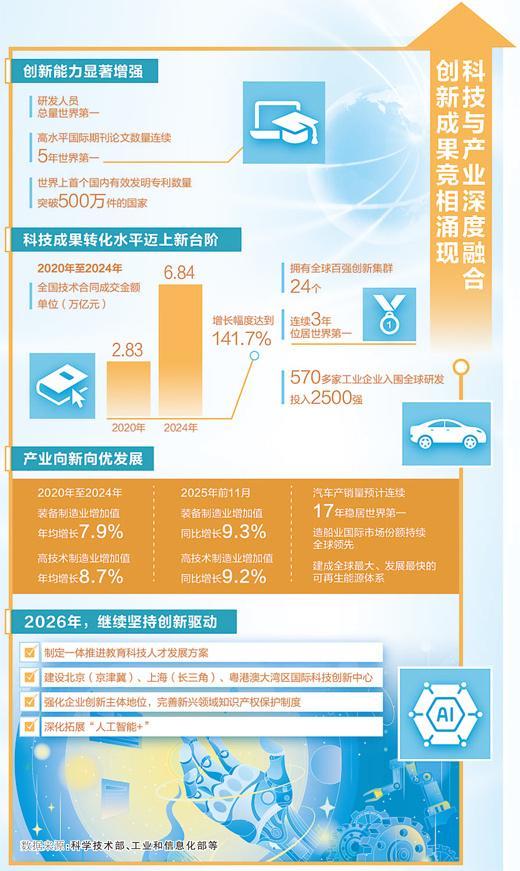
依靠创新为高质量发展赋能(新年谈“新”·五位企业研发负责人谈科技与产业深度融合)
Ren Min Wang· 2026-01-06 22:41
Group 1: Technological and Industrial Innovation - The core path to developing new productive forces is through technological and industrial innovation, aiming for high-quality development by 2025 [2] - The integration of technology and industry is essential for China's economic advancement and modernization of the industrial system [2] Group 2: Development of AS700 Airship - The AS700 airship is China's first manned airship developed under airworthiness standards, showcasing complete independent intellectual property rights [3][4] - Significant milestones for AS700 include the successful first flight of the electric AS700D in February 2025 and obtaining the first production license for a domestic manned airship in December 2025 [3][4] - The AS700 has signed contracts for 42 units and has applications in various regions, indicating a successful transition from technical validation to market application [4] Group 3: Advancements in Tunnel Construction - The Chongtai Yangtze River Tunnel is a key project for high-speed rail, utilizing the world's largest diameter high-speed shield machine, "Linghao," which achieved a record-breaking continuous tunneling distance [5][6] - The introduction of the "Qiming" vertical shaft tunneling machine aims to enhance construction efficiency and safety by addressing the challenges of different geological conditions [6] Group 4: Innovations in Energy Storage - The vanadium flow battery system developed by Dalian Rongke Storage Technology can store 3000 kWh of energy, equivalent to a household's annual electricity consumption, with a lifespan exceeding 20 years [8][9] - The company has achieved domestic production of key materials for vanadium flow batteries, significantly reducing costs and improving performance [8][9] Group 5: Growth in Smart Home Technology - Cloud Whale Intelligent's sales in North America and Europe saw significant growth, driven by continuous innovation in their robotic vacuum cleaners [11] - The company has developed advanced technologies such as dual-vision and AI models, resulting in over 1400 patent applications [11][12] Group 6: AI Integration in Healthcare - The integration of AI technology in healthcare has led to the development of intelligent systems that automate electronic medical record generation, enhancing efficiency in medical practices [13][14] - The company has focused on deepening industry-specific applications of AI, with significant investments in R&D and a high percentage of patents related to foundational technologies [14]
“空中出租车”即将在安顺试产
Xin Lang Cai Jing· 2026-01-06 22:38
Group 1 - The core product, EH216-S, is referred to as an "air taxi" and has obtained necessary certifications for commercial operation in China [1][2] - EHang Intelligent Guizhou is preparing for trial production and is collaborating with local government to expedite the establishment of its manufacturing facility [1] - Guizhou's unique karst topography and rich cultural tourism resources provide natural application scenarios for unmanned aerial vehicles [1] Group 2 - EHang Intelligent has partnered with Anshun City to develop a complete ecosystem for unmanned aerial vehicle research, component production, and testing [2] - The company aims to enhance low-altitude industry development towards high-end, intelligent, and green directions, creating an internationally influential industrial cluster [2] - Guizhou Travel Group has ordered 50 EH216-S units for low-altitude tourism services, with initial deliveries already in testing phases at various scenic locations [2]

湖北潜江产业升级步伐坚实
Jing Ji Ri Bao· 2026-01-06 22:23
Group 1 - Hubei Province's Qianjiang City has integrated into the advanced manufacturing industry cluster, showing solid industrial upgrades with a 9% year-on-year growth in industrial added value for the first 11 months of 2025 [1] - Qianjiang has established a complete industrial chain in optical fiber, represented by Yangtze Optical Fibre and Cable Company, covering electronic materials to optical information services [1] - The city is excelling in emerging sectors, with high-end wet electronic chemicals recognized as a provincial characteristic industry cluster and a hydrogen energy action plan being developed to create a full-chain demonstration [1] Group 2 - The local government aims to build a modern industrial system that emphasizes intelligence, greenness, and integration, focusing on traditional, emerging, and future industries [2] - Plans include advancing the modern chemical industry towards a trillion-yuan industry cluster and developing textile, clothing, and green food industries into hundred-billion-yuan characteristic clusters [2] - There is a forward-looking layout for future industries such as low-altitude economy and embodied intelligence, alongside the growth of emerging industries like optoelectronic information and aluminum-based new materials [2]

“十四五”时期民航固定资产投资再创新高 累计完成固定资产投资6300亿元
Zhong Guo Zheng Quan Bao· 2026-01-06 20:55
Core Insights - The national civil aviation work conference held on January 6 reviewed achievements during the 14th Five-Year Plan and outlined development strategies for the 15th Five-Year Plan, focusing on the main tasks for 2026 [1] Group 1: Achievements and Performance - During the 14th Five-Year Plan, China's civil aviation fixed asset investment reached a record high, totaling 630 billion yuan, with the addition of 49 runways, 2,232 parking spaces, and terminal area of 6.8274 million square meters [1] - In 2025, the civil aviation industry reported a total transportation turnover of 1,640.8 billion ton-kilometers, with passenger transport reaching 770 million and cargo/mail transport at 10.172 million tons, representing year-on-year growth of 10.5%, 5.5%, and 13.3% respectively [2] - The international aviation market showed strong recovery, with international flights restored to over 90% of 2019 levels and international passenger transport increasing by 21.6% year-on-year [2] Group 2: Future Plans and Goals - The 15th Five-Year Plan aims to enhance the strategic role of the civil aviation industry, emphasizing coordination with the aviation manufacturing sector, improving airworthiness certification capabilities, and advancing the aviation maintenance industry [3] - For 2026, the civil aviation sector is expected to achieve a transportation turnover of 1,750 billion ton-kilometers, with passenger transport projected at 810 million and cargo/mail transport at 1.07 million tons [4] - The focus will be on building a high-capacity, high-frequency, and efficient air transport network, enhancing the low-altitude economy policy framework, and improving airworthiness certification capabilities [4]
“十四五”时期民航固定资产投资再创新高
Zhong Guo Zheng Quan Bao· 2026-01-06 20:42
Core Insights - The national civil aviation conference held in Beijing on January 6 reviewed achievements during the 14th Five-Year Plan and outlined development strategies for the 15th Five-Year Plan, focusing on the main tasks for 2026 [1] Group 1: Achievements during the 14th Five-Year Plan - Civil aviation fixed asset investment reached a record high, totaling 630 billion yuan over five years, with 49 new runways, 2,232 new parking spaces, and terminal area expansion of 6.8274 million square meters [1] - The total number of transport airports reached 270, with total airport capacity exceeding 1.8 billion passengers [1] - The fleet size grew to 4,574 aircraft, with a net increase of 671 transport aircraft, and the main air route network was largely completed, surpassing 270,000 kilometers in total route length [1] Group 2: Performance in 2025 - The civil aviation industry achieved a total transport turnover of 1,640.8 billion ton-kilometers, with passenger transport reaching 770 million and cargo mail transport at 10.172 million tons, representing year-on-year growth of 10.5%, 5.5%, and 13.3% respectively [2] - The flight volume increased by 4.7%, maintaining a flight punctuality rate above 90%, with average delay time reduced by 3.5 minutes, resulting in a profit of 6.5 billion yuan for the year [2] - The international aviation market showed strong recovery, with international flights restored to over 90% of 2019 levels and international passenger transport increasing by 21.6% [2] Group 3: Future Plans for the 15th Five-Year Plan - The civil aviation industry aims to enhance its strategic role, deepen coordination with the aviation manufacturing sector, and improve airworthiness certification capabilities [3] - The focus will be on developing the aviation maintenance industry, implementing national transportation plans, and promoting the digital and green transformation of civil aviation [3] - The industry will also support the development of the low-altitude economy and cultivate new productive forces in the civil aviation sector [3] Group 4: Projections for 2026 - The civil aviation industry is expected to achieve a total transport turnover of 1,750 billion ton-kilometers, with passenger transport projected at 810 million and cargo mail transport at 1.07 million tons [4] - Plans include building a high-capacity, high-frequency, and efficient air transport backbone network, and enhancing the domestic air express service [4] - The low-altitude economy policy framework will be further improved, with the establishment of low-altitude flight service stations and optimization of unmanned aerial vehicle testing zones [4]
锚定产业升级,探索“低空+旅游”新模式
Xin Lang Cai Jing· 2026-01-06 20:32
Group 1 - The integration of low-altitude economy and tourism in Tibet is being actively explored, with recent investment discussions held in Lhasa and Nyingchi [1] - The Tibet Autonomous Region, known for its world-class natural landscapes and unique cultural heritage, aims to enhance its tourism industry through the "low-altitude + tourism" model [1] - The first low-altitude economic industrial park in Tibet has attracted 17 leading companies, establishing a preliminary industrial cluster focused on research, manufacturing, and operational services [1][2] Group 2 - Tibet Civil Aviation Development General Aviation Co., a state-owned enterprise, is working to create a safe, efficient, and intelligent low-altitude service system suitable for high-altitude environments [2] - In 2024, Tibet is expected to receive over 63.89 million domestic and international tourists, with total tourism spending exceeding 74.6 billion yuan [2] - Discussions among various companies and government departments focused on tourism resource development, scene creation, and cross-border tourism activation [2] Group 3 - The exploration of outdoor leisure opportunities in Tibet is being pursued by companies like Beilai Industrial Group, which sees potential for deep collaboration in the region [3] - Innovations in low-altitude economy and tourism integration, such as AR aerial photography and low-altitude logistics, are viewed as significant opportunities for enhancing visitor experiences in Tibet [3]
低空经济成增长新引擎
Xin Lang Cai Jing· 2026-01-06 20:32
(来源:中华工商时报) 转自:中华工商时报 1月4日,上海市印发《上海市关于链接长三角加快建设低空经济先进制造业集群的若干措施》(简称 《若干措施》),提出到2028年,上海低空经济核心产业规模达到800亿元左右,形成低空新型航空器 完整产业链体系,建设低空经济国家先进制造业集群,加快迈向比较优势凸显的"世界eVTOL之都"。 从"十五五"规划建议的顶层设计,到各地方政策的不断出台,低空经济作为各地产业升级的重要抓手与 增长新引擎,正朝着规模化、集群化方向发展,吸引着资本市场的广泛关注。 利好政策密集出台 自2024年首次被写进政府工作报告起,国家及各地方陆续出台的促进低空经济发展的各项政策不胜枚 举。岁末年初,低空经济产业又密集迎来一拨政策利好。 2025年12月25日,全国工业和信息化工作会议召开,提出培育壮大新兴产业和未来产业。打造新材料、 航空航天、低空经济等新兴支柱产业。有序开展卫星物联网等新业务商用试验。加强6G技术研发。发 布新版《无线电频率划分规定》,出台低空经济发展等领域频率开发利用指南。 2025年12月26日,国家发展改革委印发《低空经济及其核心产业统计分类(试行)》,明确低空经济的 概 ...
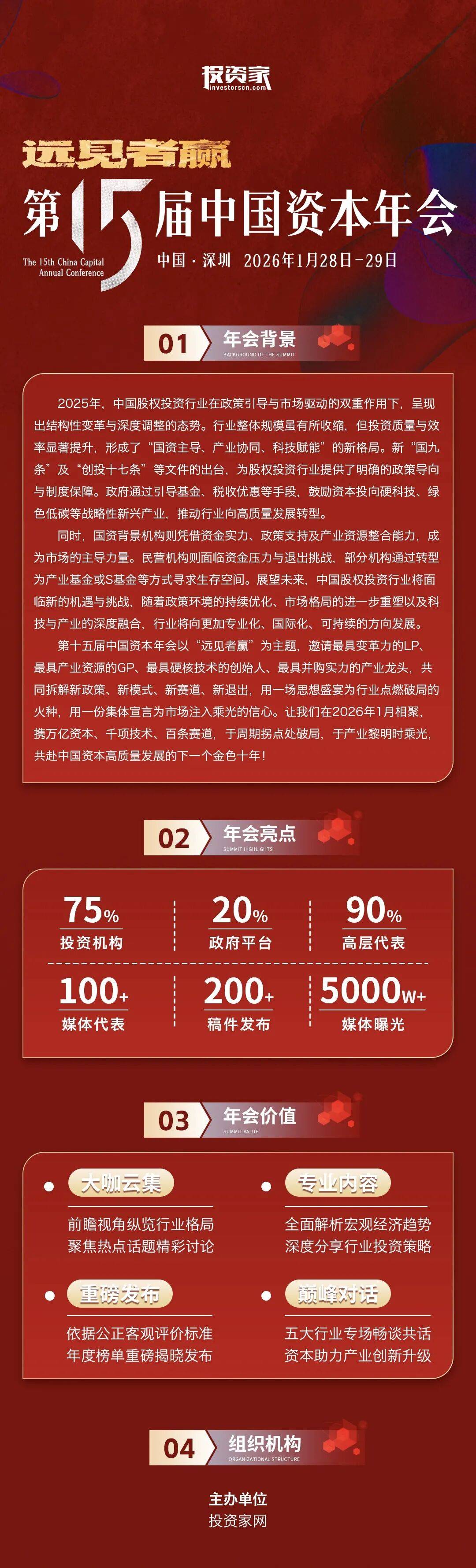
投资家网“第十五届中国资本年会”即将在深圳隆重召开
Sou Hu Cai Jing· 2026-01-06 20:26
Core Insights - The Chinese private equity investment industry has reached a historic turning point after years of adjustment, with long-term investors beginning to reap rewards as short-term speculators exit the market [1] - In 2025, the total fundraising amount for the industry is expected to exceed 1.16 trillion yuan, a year-on-year increase of 8%, with over 3,500 new funds, marking an 18% increase [1] Group 1: Structural Changes and Investment Strategies - The role of state-owned capital (国资) has been further strengthened, with local guiding funds and state-owned capital accounting for over 50% of contributions, while the fundraising of foreign currency funds has decreased by 55% year-on-year [3] - State-owned limited partners (LPs) are integrating national strategies and regional economic development goals into their investment decisions, with a clear directive to allocate 70% of funds to early-stage technology companies [3] - The investment strategy of VC/PE has shifted from broad-based approaches to more targeted investments, with a noticeable decrease in the concentration of large funds exceeding 5 billion yuan [3] Group 2: Focus on Hard Technology - Hard technology is expected to be the primary focus for private equity investments in 2025 and the coming years, encompassing areas such as artificial intelligence, robotics, semiconductors, low-altitude economy, commercial aerospace, life sciences, and new energy [5] - The establishment of the Science and Technology Innovation Board, Growth Enterprise Market, Hong Kong Stock Exchange, and Beijing Stock Exchange has provided critical windows for capitalizing on hard technology investments [5] - Early-stage financing transactions (A-round and earlier) are projected to account for 62% of total transactions, with small investments under 10 million yuan exceeding 67% [5] Group 3: Exit Strategies and Market Recovery - The exit environment is showing signs of recovery, particularly in the IPO market, with A-share and Hong Kong markets accounting for 16% and 33% of global IPO numbers and fundraising amounts, respectively [7] - The number of IPO cases for invested companies in Hong Kong increased by 46.9% year-on-year, while the fundraising amount grew by 148.1% [7] - Mergers and acquisitions (M&A) have also seen significant growth, with a year-on-year increase of 84% in exit cases, totaling 352 cases in the first three quarters of 2025 [7] Group 4: Long-term Vision and Future Outlook - The theme "Visionaries Win" reflects the need for foresight in navigating the challenges and opportunities within the private equity investment landscape [9] - The upcoming 15th China Capital Annual Conference aims to gather key players in the industry to discuss emerging trends and strategies for success in fundraising and investment [9][10] - The investment landscape is expected to evolve towards greater specialization, internationalization, and sustainability, driven by ongoing policy optimization and the deep integration of technology and industry [13]