
育儿补贴

Search documents
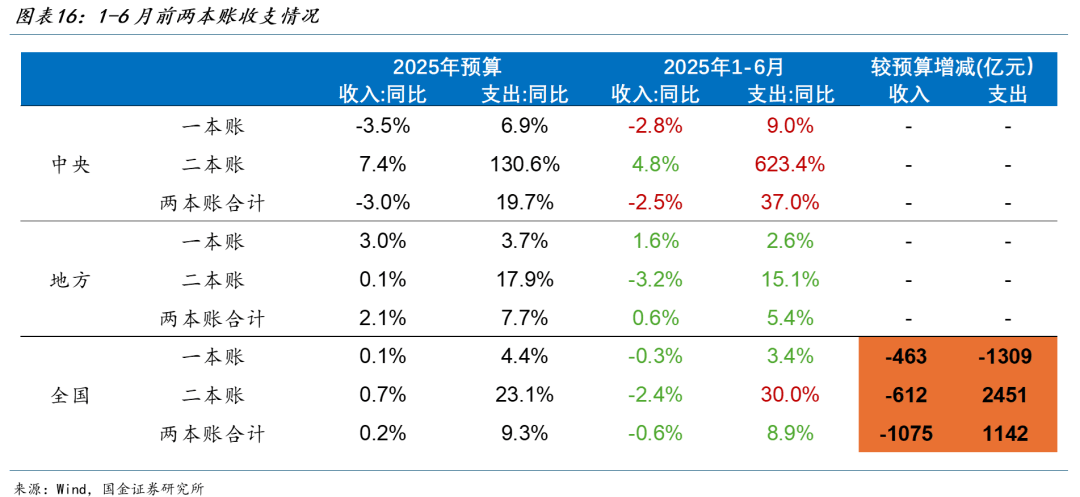
国金证券:预计将动用财政政策的储备空间,以弥补发放育儿补贴和养老服务消费补贴带来的收支缺口
Sou Hu Cai Jing· 2025-08-07 01:25
Core Viewpoint - The fiscal revenue and expenditure in the second half of the year are under pressure, but the probability of additional deficits is low. The government is expected to utilize fiscal policy reserves to cover the revenue gap caused by childcare and elderly service subsidies [1][5][11]. Fiscal Revenue and Expenditure Analysis - In the first half of the year, the national fiscal revenue and expenditure deviated slightly from the initial budget, with revenue falling short by 463 billion yuan and expenditure by 1309 billion yuan for the general public budget [2][6]. - The central government's general public budget revenue decreased by 3.5% year-on-year, while expenditure increased by 6.9%. Local governments showed a revenue increase of 3.0% and expenditure increase of 3.7% [3][6]. - For the second half of the year, the expected year-on-year growth rates for the general public budget are -4.5% for revenue and 1.5% for expenditure, leading to a projected revenue shortfall of 516.6 billion yuan and an expenditure shortfall of 547.2 billion yuan compared to the budget [5][11]. Budget Execution and Adjustments - Historically, the completion rate for the general public budget has been over 98%, and significant deviations typically necessitate budget adjustments or additional deficits. However, the flexibility of the special fund budget allows for a completion rate of 80%-90% without strict requirements [2][5]. - The government plans to cover the expected 1200 billion yuan revenue gap from subsidies without increasing the budget by utilizing reserves, including the budget stabilization fund and profits from central financial enterprises [11][12]. Central Financial Enterprises' Role - The profits from central financial enterprises are crucial for offsetting revenue shortfalls. In 2024, these enterprises contributed significantly to the budget, with non-tax revenue showing substantial increases in late 2024 [7][12]. - The central budget stabilization fund had a balance of 2739.22 billion yuan at the end of 2024, with plans to allocate 1000 billion yuan in 2025, leaving a remaining balance of 1739.22 billion yuan [12].


小心!电诈蹭上“育儿补贴”
Zhong Guo Jing Ji Wang· 2025-08-07 01:19
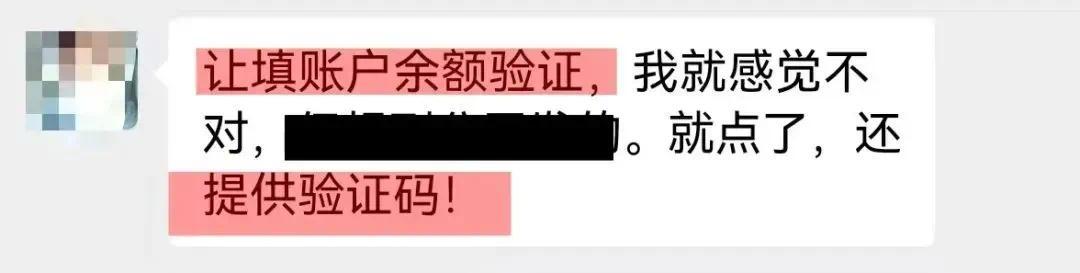
"育儿补贴"诈骗套路有哪些?警方公布了三大诈骗类型:一是假冒官方发布短信,诈骗分子冒充卫健 委、财政局等政府部门,发送含有虚假链接的短信,声称可"快速申领育儿补贴",诱导群众点击陌生链 接填写个人信息及银行卡信息。二是伪造政府网站,诈骗分子制作高仿"国家政务服务平台"或地方卫健 委网站,设置"育儿补贴申领"飘窗,要求输入身份证、银行卡及验证码等信息。三是制造紧张氛围,诈 骗分子在微信群、QQ群发布"育儿补贴快速申领""过期视为放弃"等虚假信息,制造紧张氛围,通过"名 额有限""最后三天""点击链接即可申请"等诈骗话术诱导群众。 育儿补贴如何申领?线上渠道主要通过全国统一的育儿补贴信息管理系统申领。国家卫健委依托各地省 级政务服务平台设置育儿补贴申领专区,同时在支付宝、微信等第三方服务平台开通了育儿补贴申领入 口。线下则是到婴幼儿户籍所在地乡镇或街道办理,需携带户口簿、出生医学证明等材料。发放渠道为 申领人或者婴幼儿的银行卡或其他金融账户。 (责任编辑:叶景) 日前,国家育儿补贴制度实施方案公布,从2025年1月1日起,无论一孩、二孩、三孩,每年均可领取 3600元补贴,直至年满3周岁。许多家庭都能享受到这项全 ...
小心!电诈蹭上“育儿补贴” 警方公布三大诈骗类型
Shen Zhen Shang Bao· 2025-08-06 19:07
Group 1 - The core point of the news is the implementation of a national childcare subsidy program starting January 1, 2025, where families can receive an annual subsidy of 3,600 yuan per child until the child turns three years old [1] - The subsidy program is designed to be universal and inclusive, benefiting many families across the country [1] - There is a rising concern about telecom fraudsters exploiting the subsidy announcement to scam individuals by sending fake notifications through social media [1] Group 2 - Police have identified three main types of scams related to the childcare subsidy: impersonating official messages, creating counterfeit government websites, and generating a sense of urgency through misleading information in social media groups [2] - The legitimate application process for the childcare subsidy involves an online channel through a national information management system, as well as offline applications at local administrative offices [2] - Required documents for applying include household registration books and birth certificates, with funds being deposited into the applicant's or child's bank account [2]
杨德龙:A股两融余额时隔十年重回2万亿 这轮牛市氛围越来越浓
Xin Lang Ji Jin· 2025-08-06 07:33
Economic Growth - China's GDP grew by 5.3% year-on-year in the first half of the year, surpassing the government's target of around 5% for the full year [1] - Domestic demand contributed 68.8% to GDP growth, with consumption alone accounting for 52%, indicating a strong consumer-driven economy [2] Consumption and Policy Measures - The government issued 1.3 trillion yuan in long-term special bonds, with 300 billion yuan allocated for consumer goods replacement programs, leading to over 30% sales growth in related products [2] - New policies, including childcare subsidies and free preschool education, aim to boost birth rates and subsequently increase consumption in related sectors [2] Inflation and Economic Policy - The Consumer Price Index (CPI) was -0.1% and the Producer Price Index (PPI) was around -3% in the first half, indicating deflationary pressures [3] - The government aims for a CPI growth target of around 2%, suggesting more proactive fiscal and monetary policies to stimulate demand and moderate inflation [3] Market Trends - The humanoid robot sector is expected to grow significantly, with a projected market size of nearly 38 billion yuan by 2030 and a compound annual growth rate of over 61% from 2024 to 2036 [5] - Recent adjustments in the humanoid robot market have created a favorable environment for investment, with signs of renewed interest and potential for significant returns [5] Stock Market Activity - The A-share market saw a notable increase in margin trading, surpassing 2 trillion yuan for the first time in nearly a decade, reflecting investor optimism [6] - Hong Kong stocks experienced substantial inflows, with southbound funds net buying 820 billion HKD, indicating strong demand from mainland investors [7]
警方提醒:这些“育儿补贴”不要领
Zhong Guo Zheng Quan Bao· 2025-08-06 07:16
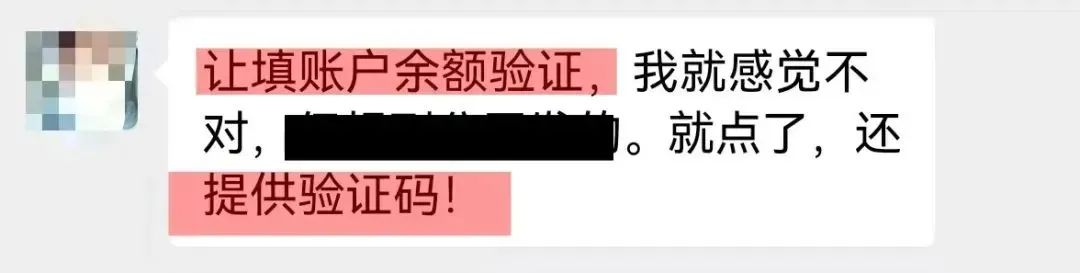
日前,国家育儿补贴制度实施方案公布,从2025年1月1日起,无论一孩、二孩、三孩,每年均可领取3600元补贴,直至年满3周岁。许多家庭都能享受到 这项全国性、普惠式的经济补贴。 然而,诈骗分子也是如影随形,很快便开始"蹭热点"。据福建漳州长泰区警方消息,近日,有诈骗分子打着"发放育儿补贴"的旗号实施电信网络诈骗。 云南昭通市昭阳区警方也发布消息,8月4日,接群众反映:自己通过社交平台接到领取"育儿补贴"通知,要求限时办理,通知内含有"网址链接",登录后 发现异常。 图片来源:昭阳警方 按照工作计划,各地将在8月下旬陆续开放育儿补贴申领,8月31日之前各地全面开放育儿补贴的申领。目前,各地均尚未开通线上申领育儿补贴渠道。 常见育儿补贴诈骗套路 公安部门解析了育儿补贴诈骗套路: 1. 假冒官方发布短信。诈骗分子冒充卫健委、财政局等政府部门,发送含有虚假链接的短信,声称可"快速申领育儿补贴",诱导群众点击陌生链接填写个 人信息及银行卡信息。 2. 伪造政府网站。诈骗分子制作高仿"国家政务服务平台"或地方卫健委网站,设置"育儿补贴申领"飘窗,要求输入身份证、银行卡及验证码等信息。这类 网站界面看似与官方一致,实则网址 ...
这些“育儿补贴”不要领!多地警方提醒
Zheng Quan Shi Bao· 2025-08-06 05:30
Core Points - The national childcare subsidy program will provide an annual subsidy of 3,600 yuan per child until the child reaches the age of three, starting from January 1, 2025, benefiting many families [1] - Fraudsters are exploiting the announcement of the subsidy program to conduct telecom network scams, as reported by police in various regions [1][4] Fraudulent Activities - Scammers are impersonating government agencies, sending fake messages with links claiming to facilitate quick subsidy applications, aiming to collect personal and bank information [6] - High-fidelity counterfeit government websites are being created, mimicking official platforms to trick individuals into entering sensitive information [6] - Scammers are creating a sense of urgency by spreading false information in social media groups, claiming limited availability and deadlines for subsidy applications [7] Application Process - The application for the childcare subsidy will be available online through a national information management system and via third-party platforms like Alipay and WeChat [9] - Offline applications can be made at local administrative offices, requiring documents such as household registration and birth certificates [9][10]
这些“育儿补贴”不要领!多地警方提醒
证券时报· 2025-08-06 03:42
Core Viewpoint - The article discusses the implementation of a national childcare subsidy program starting January 1, 2025, which will provide families with an annual subsidy of 3,600 yuan per child until the child reaches three years old. However, it also highlights the rise of scams related to this subsidy program, where fraudsters exploit the situation to deceive individuals [2]. Summary by Sections Childcare Subsidy Implementation - The national childcare subsidy program will offer 3,600 yuan annually for each child, applicable to families with one, two, or three children, until the child turns three years old [2]. Scam Alerts - Police reports indicate that fraudsters are using the announcement of the childcare subsidy to conduct telecom network scams, targeting individuals through various deceptive methods [2][5]. Common Scam Tactics - Fraudsters impersonate official government departments, sending fake messages that include links for quick subsidy applications, prompting individuals to provide personal and banking information [6]. - They create counterfeit government websites that closely resemble official platforms, tricking users into entering sensitive information [6]. - Scammers generate a sense of urgency by spreading false information in social media groups, claiming limited availability and deadlines for subsidy applications [6]. Application Process - The subsidy can be applied for online through a unified national childcare subsidy information management system, with access via provincial government service platforms and third-party services like Alipay and WeChat [9]. - Offline applications can be made at local administrative offices, requiring documents such as household registration and birth certificates [9]. Police Warnings - Individuals are advised to be cautious of unsolicited messages regarding subsidy claims, especially those containing links or QR codes [12]. - If personal information is requested through suspicious links, individuals should not comply and should report any concerns to authorities [13][14].

中国育儿补贴少?还是养育费高?
日经中文网· 2025-08-06 03:01
Core Viewpoint - The Chinese government is initiating a nationwide childcare subsidy of 3,600 yuan per year for children under three years old, but there are concerns that the amount is insufficient and the duration is too short, especially in the context of rising childcare costs due to educational pressures [2][4][6]. Group 1: Subsidy Details - The subsidy is aimed at families with children under three years old, with local governments starting to accept applications from late August [2]. - The central government has allocated approximately 90 billion yuan for this subsidy in 2025, with an estimated annual financial burden of around 100 billion yuan based on the projected population of over 28 million children under three [4]. Group 2: Comparative Analysis - Childcare subsidies in Japan and South Korea are higher than China's, with Japan providing approximately 8,786 yuan per year and South Korea around 6,200 yuan per year for children under eight [6]. - The proportion of childcare subsidies relative to GDP is similar for China and Japan at 3.8%, while South Korea's is lower at 2.4% [6]. Group 3: Rising Childcare Costs - Despite government efforts to control educational expenses through policies like the "double reduction" policy, the overall cost of raising children continues to rise, with average expenses reaching about 538,000 yuan by the time children graduate from high school, an increase of 11% from 2022 [7]. - Parents express dissatisfaction with the limited duration and amount of the subsidy, particularly as significant costs arise when children begin attending tutoring and extracurricular classes [6][7]. Group 4: Educational Pressure - The cultural emphasis on education in China leads to increased spending on private tutoring, often exceeding the costs of formal classes, as parents seek to ensure their children gain admission to prestigious universities [9]. - Expanding the subsidy to cover expenses until high school graduation would significantly increase the financial burden on the government, potentially reaching nearly 1 trillion yuan annually, which would account for 3% of the general public budget in 2025 [9].
股指期货:多空观点不一,利多利空因素交织
Sou Hu Cai Jing· 2025-08-05 14:12
Group 1 - The article presents mixed views from eight institutions regarding stock index futures, with three bullish, two bearish, and three expecting volatility [1] - Bullish factors include the nationwide opening of childcare subsidy applications by August 31, the World Artificial Intelligence Conference boosting tech sector sentiment, a net liquidity injection of 49 billion from the central bank, and the extension of tariff relief between China and the U.S. [1] - Bearish factors consist of the Politburo meeting lacking new policies exceeding market expectations, a slight decrease in the average daily trading volume of A-shares to 1.8099 trillion, the Federal Reserve maintaining interest rates for the fifth consecutive time in July, a reduction of 1.9 billion shares in the CSI 300 ETF this week, and a drop in the manufacturing PMI to 49.3% in July [1]
股指期货:多空观点不一,490亿投放与数据回落并存
Sou Hu Cai Jing· 2025-08-05 13:43
Group 1 - The market sentiment is mixed with differing views from eight institutions, where three are bullish, two are bearish, and three expect a volatile market [1] - Bullish factors include the nationwide opening of childcare subsidy applications by August 31, the World Artificial Intelligence Conference boosting tech sector sentiment, a net liquidity injection of 49 billion from the central bank, and the extension of tariff relief between China and the US [1] - Bearish factors consist of the Politburo meeting lacking any new policies that exceed market expectations, a slight decrease in the average daily trading volume of A-shares to 1.8099 trillion, the Federal Reserve maintaining its stance for the fifth consecutive meeting, a reduction of 1.9 billion shares in the CSI 300 ETF this week, and a drop in the manufacturing PMI to 49.3% in July [1]