AI编程

Search documents
Meta产品经理采用氛围编程技术,快速制作App原型直接向CEO演示
Sou Hu Cai Jing· 2025-11-08 11:17
Core Insights - Meta is utilizing "Vibe Coding" to enable product managers to quickly create app prototypes without needing assistance, allowing them to present directly to CEO Mark Zuckerberg [1][3] - The approach enhances product iteration speed as product managers can showcase their work directly to upper management [3] - Vibe Coding involves using natural language commands and AI tools to rapidly generate, modify, or test code and product prototypes [5] Industry Context - Meta's implementation of Vibe Coding is part of a broader trend in the tech industry, with companies like Google and Microsoft also integrating AI into their product development processes [6] - Google reported that over 25% of its internal code is AI-generated, while Microsoft has made AI usage a mandatory practice [6]


藏师傅 Kimi K2 Thinking 首测!教你用 Kimi 编程全家桶
歸藏的AI工具箱· 2025-11-06 16:59
Core Insights - Kimi has released the K2-Thinking model, which enhances its previous K2 model by introducing reasoning capabilities and achieving state-of-the-art (SOTA) scores in various benchmarks [3][4][61] - The company has developed a comprehensive ecosystem around its models, including tools like Kimi CLI and subscription packages like KFC (Kimi For Coding) to facilitate programming tasks [6][54] Model Upgrades - The K2-Thinking model features an agent-based upgrade allowing for multi-turn reasoning and tool usage, with up to approximately 300 iterations [4] - It has achieved SOTA scores in HLE (44.9) and IMO (76.8), significantly improving complex retrieval and long-range planning capabilities [4] - Programming capabilities have been enhanced, with better stability in Agentic Coding and improved performance across various programming languages [4] Ecosystem Development - Kimi has introduced the Kimi CLI tool, which simplifies the installation and usage of the K2-Thinking model, making it accessible for developers [11][12] - The KFC subscription offers 7168 API calls per week for 199 yuan, providing a cost-effective solution for developers [6] Testing and Performance - The article discusses a series of tests conducted on the K2-Thinking model, focusing on its ability to handle iterative modifications and complex requirements in real-time coding scenarios [17][30] - The model successfully managed to adapt to increasing complexity in tasks, demonstrating its robustness and reliability [20][30] Strategic Insights - Kimi's approach addresses three major industry pain points: the "last mile" problem in API economics, the integration burden of open-source models, and the dependency issues of pure tool products [54][55] - The company emphasizes that in the AI era, developers prioritize "delivery certainty" over "freedom of choice," highlighting the need for reliable, end-to-end solutions [55][58]

对华禁令收紧,字节腾讯旗下AI编程工具移除Claude模型
Guan Cha Zhe Wang· 2025-11-06 10:26
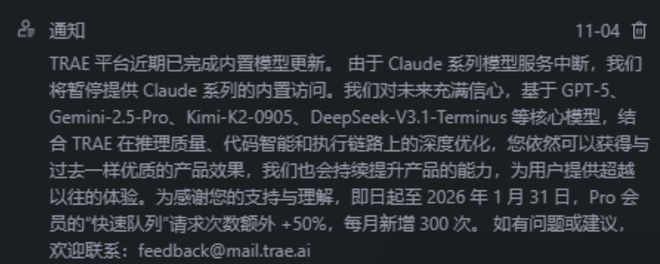
Core Insights - The article discusses the impact of Anthropic's ban on the Claude model for Chinese companies, leading to the removal of Claude from AI programming tools like Trae and CodeBuddy [1][3][8] - The ban has created opportunities for domestic AI models to fill the gap left by Claude, with companies like Zhiyu and Kimi launching migration plans for developers [9][12] Group 1: Company Actions - ByteDance's Trae international version has removed access to the Claude model as of November 4, following a service adjustment notification to users [1][4] - Tencent's CodeBuddy international version had already removed the Claude model by October 1, replacing it with models like OpenAI's GPT-5 and Gemini-2.5-Pro [3][8] - Trae has offered Pro members an additional 50% request quota as compensation for the removal of Claude, valid until January 31, 2026 [6] Group 2: Market Response - The removal of Claude has accelerated the development of domestic AI models, with companies like Zhiyu and Kimi quickly introducing alternatives [9][12] - Zhiyu has launched a "migration plan" for Claude API users, promoting its GLM model as a cost-effective alternative, priced at one-seventh of Claude's cost [9][12] - Kimi updated its model on the same day the ban was announced, positioning it as a competitor to Claude at a significantly lower price point [12] Group 3: Industry Trends - The ban on Claude has prompted a shift in the AI programming landscape, with domestic models gaining traction and attracting attention from both local developers and international companies [9][12] - Major Chinese tech firms are increasingly focusing on developing their own integrated development environments (IDEs) to compete in the AI space, with products like Trae, CodeBuddy, and Alibaba's Qoder emerging [12][13] - ByteDance has restricted internal use of third-party AI development tools, promoting its own Trae tool among employees, which has seen over 1 million monthly active users [13]

喝点VC|a16z对话Replit创始人:最后要抽象掉的就是代码本身;语法对人类来说是反直觉的。所以最终英语才是编程语言
Z Potentials· 2025-11-06 03:03
Core Insights - The article discusses how Replit, an AI programming platform, is transforming the coding experience by allowing users to interact with AI agents that can write code based on simple prompts, effectively making AI the new "programmer" [4][7][18]. Group 1: AI Programming Experience - Replit aims to eliminate the complexities of setting up development environments, allowing users to focus on their ideas and projects [6][10]. - Users can input their project ideas in plain English, and the AI agent will interpret these inputs to create a task list and execute the necessary coding tasks [16][18]. - The platform supports multiple programming languages and automatically selects the most suitable technology stack based on user input [8][9]. Group 2: AI Agent Capabilities - The AI agents are designed to perform tasks autonomously, effectively taking on the role of the programmer [18][19]. - The agents can run for extended periods, with improvements in their ability to maintain coherence and complete complex tasks over time [22][26]. - Innovations such as "context compression" and the introduction of verification loops have enhanced the agents' long-term reasoning capabilities [24][28]. Group 3: Future of AI in Programming - The next iteration, Agent4, aims to allow users to deploy multiple agents simultaneously, enhancing collaborative coding efforts [45]. - The article suggests that the programming field is on the verge of explosive growth, with AI enabling individuals without technical backgrounds to achieve advanced coding capabilities [45][46]. - There is a discussion on the potential of AI to reach a level of general intelligence (AGI), but concerns remain about the current limitations in transferring learning across different domains [47][50].

卓易信息(688258):深度报告:AI+编程核心标的未来可期
Jianghai Securities· 2025-10-31 09:05
Investment Rating - The report assigns an investment rating of "Buy (First Coverage)" with a current price of 64.70 CNY and a target price of 101.82 CNY over a 12-month period [1][5]. Core Insights - The report highlights that the IDE (Integrated Development Environment) business is expected to be the core growth driver for the company, with significant revenue growth projected from 2025 to 2027 [5][33]. - The company is strategically positioned in the AI and programming sector, leveraging AI technologies to enhance its IDE products [5][27]. - The global software development tools market is projected to grow from 6.517 billion USD in 2025 to 14.680 billion USD by 2031, with a CAGR of 14.5% [28]. Company Overview - The report details that Jiangsu Zhuoyi Information Technology Co., Ltd. was established in May 2008 and went public on the Shanghai Stock Exchange in December 2019 [13][19]. - The company’s main business segments include IDE business, core firmware for cloud computing devices, and cloud services [13][33]. Financial Performance - The company’s projected revenues for 2025, 2026, and 2027 are 414.33 million CNY, 583.64 million CNY, and 827.17 million CNY, respectively, with year-on-year growth rates of 28.12%, 40.87%, and 41.72% [6][5]. - The net profit attributable to the parent company is expected to reach 93.87 million CNY in 2025, 154.42 million CNY in 2026, and 289.99 million CNY in 2027, with significant growth rates of 185.84%, 64.50%, and 87.79% [6][5]. IDE Industry Analysis - The IDE industry is characterized by a deep integration with AI technologies, enhancing development efficiency and reducing errors [27][31]. - The report notes that the current market for IDEs is dominated by foreign companies, with a lack of domestic players capable of mature IDE development and commercialization [27][28]. - Key trends in the IDE industry include AI programming support, low-code technology applications, and cloud-native support [31][32]. Business Segments - The company’s IDE products include SnapDevelop, EazyDevelop, PowerBuilder, and PowerServer, targeting various customer segments including large enterprises and independent software developers [36][37]. - The cloud computing firmware business provides essential BIOS and BMC firmware for computing devices, serving major clients like Intel and Huawei [44][45]. - The cloud services segment focuses on IoT cloud services, primarily targeting government and enterprise clients [47]. Management and Ownership - The report indicates that the company is controlled by its actual controllers, Xie Qian and Wang Ye, who together hold a 40.74% stake [20][23]. - The core management team has a strong educational background and stability, with key figures having long tenures in the company [23][24]. Stock Incentive Plan - In May 2025, the company announced a stock incentive plan aimed at core technical and key personnel, with performance targets set for the IDE business from 2025 to 2027 [25][26].

AI编程:被忽视的全社会商业模式革命的引擎
3 6 Ke· 2025-10-30 09:22
Core Insights - The AI programming revolution is fundamentally transforming value creation in all industries, not just software development, by lowering the barriers to creativity and redefining competitive advantages [1][4][5] Group 1: AI Programming and Its Impact - AI programming tools like GitHub Copilot are revolutionizing software development by automating repetitive tasks and enabling new collaborative work methods, termed "Vibe Coding" [2][3] - "Vibe Coding" emphasizes a collaborative relationship between humans and AI, where developers act more as creative directors, focusing on higher-level intentions rather than specific instructions [3][4] Group 2: Economic and Organizational Changes - The cost of creating fully functional software applications is drastically reduced, shifting the focus from efficiency to the ability to conceptualize and define ideas, which poses a strategic challenge for traditional businesses [4][6] - New entrants in the market can leverage AI programming to rapidly prototype and validate ideas, fundamentally altering the entrepreneurial landscape and creating a crisis for established companies [6][7] Group 3: Case Studies of Disruption - Pieter Levels exemplifies the "one-person unicorn" model, successfully creating multiple profitable ventures using AI tools, demonstrating that individuals can build businesses that previously required large teams [7] - Hadrian is disrupting traditional manufacturing by using AI to automate the production process, significantly reducing delivery times and redefining competition in the sector [9][10] Group 4: New Business Models and Strategies - The emergence of AI-native business models necessitates a shift in strategic focus from what can be done to what should be done, emphasizing the importance of business model design [11][12] - The introduction of AI software engineers like Devin indicates a future where AI can autonomously handle the entire software development process, reducing the cost of business model validation [12][14] Group 5: Organizational Transformation - Traditional organizational structures are becoming redundant as AI reduces the need for middle management and coordination roles, leading to a rise in "task-oriented organizations" [19][20] - Companies will increasingly rely on modular collaboration and open interfaces, allowing for a more flexible and efficient organizational structure [21][22] Group 6: Human Value and Future Workforce - The role of humans in the workforce will shift from executing tasks to providing strategic insights and creative direction, as AI takes over repetitive cognitive tasks [24][25] - Future talent will be defined by their ability to think abstractly and innovate across disciplines, rather than by specific technical skills [24][25] Group 7: Recommendations for Industry Leaders - Companies should adopt AI programming tools and foster a culture of rapid prototyping and market validation to stay competitive [25][26] - Emphasizing business model design and open collaboration will be crucial for adapting to the new landscape shaped by AI [26]
老黄亲自站台,英伟达编程神器,Cursor 2.0自研模型狂飙4倍
3 6 Ke· 2025-10-30 07:33
Core Insights - Cursor has launched its self-developed coding model, Composer, which is reported to be four times faster than comparable models, designed for low-latency intelligent coding tasks that can be completed in under 30 seconds [1][6][9]. Group 1: Product Features - Composer achieves a speed of 200 Tokens per second and allows for the parallel operation of up to eight intelligent agents, utilizing git worktrees or remote machines to prevent file conflicts [2][6]. - The update introduces a new code review feature that simplifies the process of viewing changes across multiple files without switching back and forth [3]. - A voice mode has been added, enabling voice-activated programming, along with improvements in context-aware copy/paste prompts [5][6]. Group 2: Market Position and Strategy - Cursor, valued at over $10 billion, has historically relied on external models like Claude, which limited its innovation and profitability. The release of Composer marks a strategic shift towards self-reliance in AI model development [6][22]. - The recent updates indicate a move away from dependence on external models, with Composer being tested alongside open-source alternatives rather than proprietary models like GPT and Claude [22][30]. Group 3: User Experience and Feedback - Early testers have reported that Cursor 2.0 is significantly faster, with results generated in mere seconds, enhancing the overall user experience [16][26]. - Some developers have expressed that while Composer is fast, its intelligence may not match that of competitors like Sonnet 4.5 and GPT-5, indicating a competitive landscape in AI programming tools [30][34].


AI 编程工具在大型企业“遇冷”?网易 CodeWave 升级研发模式,不只关注“代码生成”
AI前线· 2025-10-26 05:32
Core Insights - The article discusses the increasing penetration of AI in software development, highlighting the evolution from programming assistance tools in 2022 to the emergence of intelligent agents like Devin in 2023, and the redefinition of IDEs by products like Cursor in 2024, with natural language programming becoming the mainstream form of AI coding products [2][3] Group 1: AI Coding Tools in C-end Market - General AI coding tools have shown excellent performance among individual users and independent developers, significantly enhancing development efficiency by quickly generating lightweight application code [3] - However, the penetration rate of AI technology in the enterprise market remains low, primarily concentrated in leading internet companies, while many state-owned and traditional enterprises are still in a wait-and-see phase [3][7] Group 2: Pain Points in Enterprise AI Coding - Code quality is often uncontrollable in enterprise-level applications, which require complex business logic and high security standards, leading to potential security vulnerabilities when using general AI tools [5][6] - Maintainability is poor as AI-generated code lacks business context, making it difficult for developers to understand and iterate on the code, resulting in high debugging and modification costs [5][6] - General AI tools struggle with the specificity of enterprise applications, lacking industry knowledge and the ability to reuse past development assets, leading to code that does not fit specific business scenarios [6][7] Group 3: CodeWave's Approach - CodeWave focuses on enterprise-level complex application development, aiming to integrate AI capabilities with existing development frameworks to achieve a balance between efficiency and control [8][10] - The company has developed a visual and AI-integrated development approach that retains space for manual adjustments, creating a more controllable and standardized intelligent development model [10][11] Group 4: Evolution of CodeWave's Capabilities - CodeWave has undergone four key phases since 2023, transitioning from single-step efficiency improvements to full-process coverage, addressing the limitations of traditional low-code platforms [12][13] - The introduction of NASL (NetEase Application Specific Language) allows developers to use natural language to generate visual interfaces, ensuring compliance with enterprise standards through type checking and translation [13][14] - The team has established a data-driven model iteration system to quantify AI's efficiency improvements and ensure stable enhancement of AI functionalities [14][15] Group 5: Future Directions - Looking ahead, CodeWave plans to integrate its extensive enterprise development practices with AI to create a Spectrum standard-driven development model, ensuring flexibility and control in complex applications [19][20]


AI编程迎全球大厂密集布局 对话亚马逊云科技Jeff Barr:未来个体开发者或将能撑起10亿美元估值
Mei Ri Jing Ji Xin Wen· 2025-10-24 12:18
Core Insights - The AI coding sector is rapidly gaining momentum globally, with significant investments and innovations leading the charge in commercialization [1][7] - Major players like Anthropic have achieved remarkable valuations, indicating a strong market interest and potential for growth in AI-driven development tools [1][2] - The transformation in software development is characterized by a shift from traditional coding to more collaborative and efficient methods, enabled by AI technologies [2][3] Investment Landscape - Anthropic's recent funding round raised $13 billion, tripling its valuation to $183 billion in just six months, highlighting the lucrative nature of the AI coding market [1] - Chinese tech giants such as Alibaba, Tencent, and ByteDance are actively launching independent IDE products, indicating a competitive domestic landscape [1][4] - The influx of capital into AI coding is creating a "nationwide pursuit of AI programming," with startups quickly securing funding through niche solutions [3][5] Technological Evolution - AI tools are not merely replacing existing technologies but enhancing their value, allowing developers to focus on higher-level tasks such as requirement analysis and solution design [2][3] - The emergence of Vibe Coding allows non-technical individuals to create application prototypes, showcasing the democratization of software development [2] - The core demands for flexibility, security, and scalability remain unchanged, even as AI applications evolve [3][5] Industry Challenges - Despite the advancements, challenges such as low payment capacity and intellectual property protection in China persist, hindering the full potential of AI coding [4] - The industry is witnessing a shift in developer roles, where interpersonal communication skills are becoming increasingly important alongside technical expertise [6][7] - The traditional software industry is being disrupted as companies opt for in-house development over purchasing commercial software, forcing a transformation in business models [5][6] Future Outlook - The combination of cloud and AI technologies is expected to empower individual developers, leading to a more dynamic and competitive environment in the next decade [7] - The industry anticipates that those who can overcome technical barriers and address business pain points will emerge as leaders in the AI coding space [7]

快手进军AI编程!“模型+工具+平台”一口气放三个大招
Sou Hu Cai Jing· 2025-10-23 11:55
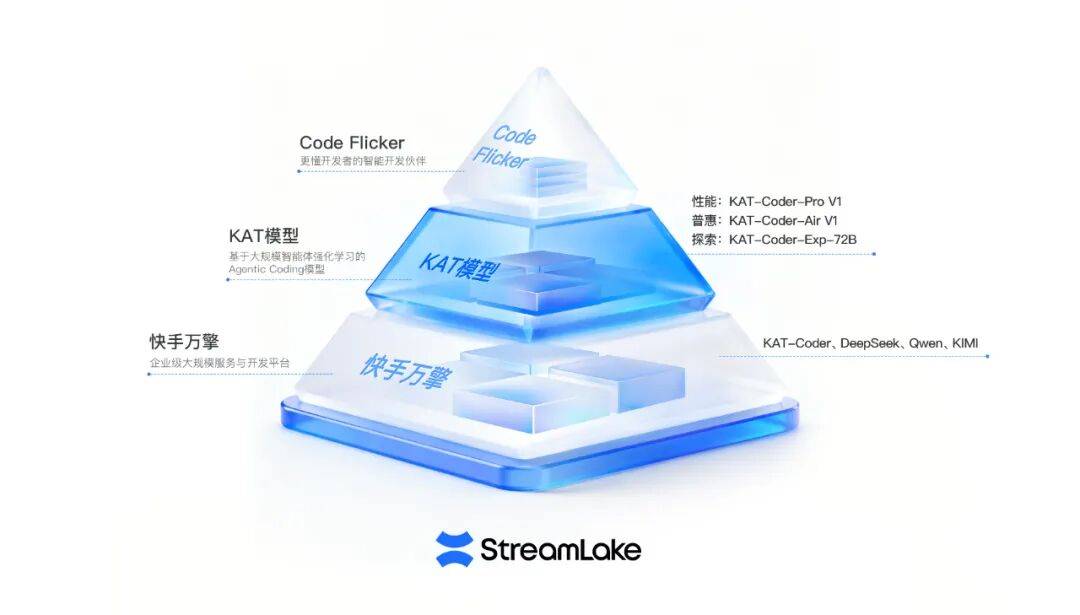
Core Insights - Kuaishou has officially entered the AI coding sector by launching a comprehensive AI programming product matrix, including self-developed models, intelligent development tools, and a MaaS platform [1][3][19] - The introduction of the CodeFlicker intelligent development partner aims to reshape AI development collaboration paradigms and enhance developer experience [3][5][6] - KAT-Coder models have gained significant attention in the developer community, positioning themselves as strong contenders against established models like GPT and Claude [9][11][14] Product Matrix Overview - Kuaishou's AI programming product matrix includes KAT-Coder-Pro V1, KAT-Coder-Air, and KAT-Coder-Exp-72B 1010, catering to various user needs from performance to academic applications [1][14] - CodeFlicker integrates seamlessly with mainstream development tools like VS Code and JetBrains, providing a native experience for developers [5][6] - The platform supports full-process coverage in development, from intelligent Q&A and architecture design to code generation and diagnostics [6][8] Market Positioning - KAT-Coder has achieved a 73.4% solution rate on the SWE-bench Verified leaderboard, indicating its competitive performance [11][14] - The KAT-Coder family includes various models tailored for different scenarios, with KAT-Coder-Air being offered for free to enhance accessibility [13][14] - Kuaishou's pricing strategy for KAT-Coder is designed to be transparent and cost-effective, lowering barriers for enterprises and developers [17] Strategic Vision - Kuaishou's Vanchin platform serves as a robust foundation for its AI strategy, offering high availability and security, with a 99.95% SLA guarantee [21][23] - The transition of the StreamLake brand from "audio-video+" to "AI+" reflects Kuaishou's commitment to becoming a leading provider of generative AI technologies [19][24] - Kuaishou aims to empower various industries through its AI capabilities, fostering a new intelligent economy [24]