理性消费

Search documents
双节消费观察:这些“老字号”成爆款 国潮范与经典款成宠儿
Zhong Guo Xin Wen Wang· 2025-09-26 09:08
Core Insights - The upcoming Mid-Autumn and National Day festivals are driving a surge in consumer spending, with gift boxes becoming a prominent category due to their essential role in festive celebrations [1][2] - Consumers are shifting towards rational purchasing decisions, prioritizing "reliable quality, cost-effectiveness, and value alignment" in their buying choices [1][10] - The integration of national trends and traditional brands' innovation is enhancing the appeal of classic products, reflecting consumers' dual pursuit of quality and cultural significance [2][7] Company Strategies - Qingdao Beer and Beijing Daoxiangcun are leading the festive market with their strategic product offerings, showcasing a blend of quality and cultural elements [2][9] - Qingdao Beer has introduced various gift box combinations, such as the "8+2" mix, catering to diverse consumer preferences for family gatherings and social visits [4][6] - Beijing Daoxiangcun has launched themed gift boxes like "Jingyun Zhongxian" and "Jinya Yiyue," which incorporate cultural artistry and practical value, aligning with consumer expectations for meaningful gifts [6][7] Market Trends - The trend towards rational consumption is evident, with 72% of consumers preferring established brands or classic products, and 68% emphasizing the importance of quality matching price [10] - The focus on product quality and emotional value over luxury packaging is reshaping the festive consumption landscape, promoting healthier and more meaningful purchasing behaviors [9][10] - The market is transitioning from "concept marketing" to "value competition," indicating a return to the essence of product quality and consumer satisfaction [10]



果然财经|长假还未到,租赁先火爆:有门店已订出近500台相机
Qi Lu Wan Bao· 2025-09-26 08:26
Core Insights - The camera rental market in Jinan is experiencing a surge in demand ahead of the National Day and Mid-Autumn Festival holidays, with many consumers opting for rentals over purchases due to changing consumption habits and the desire for cost-effective solutions [4][12] - The trend of "scene-based demand" is becoming prominent, with consumers renting cameras for specific events such as concerts, photo shoots, and travel, reflecting a shift in how people utilize camera equipment [6][7] Group 1: Market Demand and Trends - The rental demand for portable action cameras has increased by 600% compared to the same period last year, indicating a significant shift in consumer behavior towards renting [5] - The majority of renters are young adults aged 20-30, with 63.5% of this demographic showing a preference for renting digital products [5][10] - The rental market is evolving from seasonal spikes to a more consistent demand driven by various events and experiences, with consumers now renting for specific needs rather than just holidays [7][10] Group 2: Consumer Behavior and Preferences - Consumers are increasingly adopting a rational consumption mindset, focusing on the usage value of products rather than ownership, as evidenced by the popularity of short-term rentals [9][12] - The average rental cost for high-end equipment is significantly lower than the purchase price, making rentals an attractive option for consumers who want to avoid idle equipment [9] - The introduction of no-deposit rental options is lowering barriers for consumers, encouraging more people to rent rather than buy [9][10] Group 3: Industry Adaptation and Services - Rental companies are adapting by offering additional services such as equipment tutorials and rental-to-sale options, enhancing customer experience and satisfaction [11] - The industry is facing challenges such as potential fraud and deposit disputes, prompting a need for better practices and customer education [11] - The growth of the rental market is part of a broader trend towards a circular economy, where the focus is on usage rather than ownership [12]

长假还未到,租赁先火爆:有门店已订出近500台相机
Qi Lu Wan Bao Wang· 2025-09-26 07:36
Core Insights - The camera rental market in Jinan is experiencing a surge in demand ahead of the National Day holiday, with many consumers opting for rentals over purchases, reflecting a shift in consumer behavior towards rational spending and the sharing economy [1][7] Group 1: Market Demand and Trends - The rental demand for cameras has increased significantly, with over 80% of available equipment already booked ahead of the holiday, indicating a strong consumer interest in photography for travel and events [2][5] - The trend of "scene-based demand" is emerging, where consumers rent cameras for specific occasions such as concerts, photo shoots, and events, rather than general use [3][4] - The rental market is seeing a 600% increase in demand for portable action cameras compared to the same period last year, particularly among younger consumers aged 20-30 [2][5] Group 2: Consumer Behavior and Preferences - Young consumers are increasingly favoring rental options to avoid the costs and responsibilities associated with ownership, with 63.5% of this demographic showing a preference for renting digital products [2][5] - The concept of "avoiding idle assets" is driving the popularity of rentals, as consumers recognize the financial benefits of renting over purchasing, especially for high-cost items like cameras [5][6] Group 3: Industry Adaptation and Services - The camera rental industry is evolving to offer more comprehensive services, including educational support for users to enhance their rental experience and ensure proper equipment usage [6] - Companies are implementing flexible rental terms, such as no deposit policies, to attract more customers and streamline the rental process [5][6] - The industry is also moving towards a model that combines rental and sales, allowing customers to purchase rented equipment at a discount if they find it satisfactory [6]
以案说险|广发银行南京分行提醒您:理性消费 别让非法校园贷“贷”走你的青春
Jiang Nan Shi Bao· 2025-09-23 07:09
Core Points - The article highlights the dangers of campus loans, particularly focusing on a case where a student was lured into a high-interest loan scheme, leading to significant financial distress and harassment from debt collectors [1] Group 1: Loan Scheme Details - A student named Xiao Wang was approached by a stranger on WeChat, who offered assistance with online loans [1] - The loan manager, identified as Manager Xia, charged an exorbitant interest rate of 30% per week and provided a total of 30,000 yuan in loans [1] - Within three months, the total loan amount ballooned to 60,000 yuan due to the compounding interest and pressure to take new loans to pay off old debts [1] Group 2: Impact on Student Life - The harassment from debt collectors included physical visits to the student's dormitory and public postings demanding repayment, severely disrupting the student's life and studies [1] - The situation prompted Xiao Wang to seek help from the police due to the escalating threats and intimidation [1] Group 3: Risk Awareness and Financial Planning - A warning from Guangfa Bank's Nanjing branch emphasized the importance of risk awareness regarding campus loans, including interest and credit risks [1] - Students are advised to create a clear consumption plan based on their actual needs and financial capabilities to avoid falling into debt traps [1]
伯希和冲刺IPO:安徽“70后”夫妻白手起家、年销17亿元,顶流明星成毅代言
Mei Ri Jing Ji Xin Wen· 2025-09-23 01:20
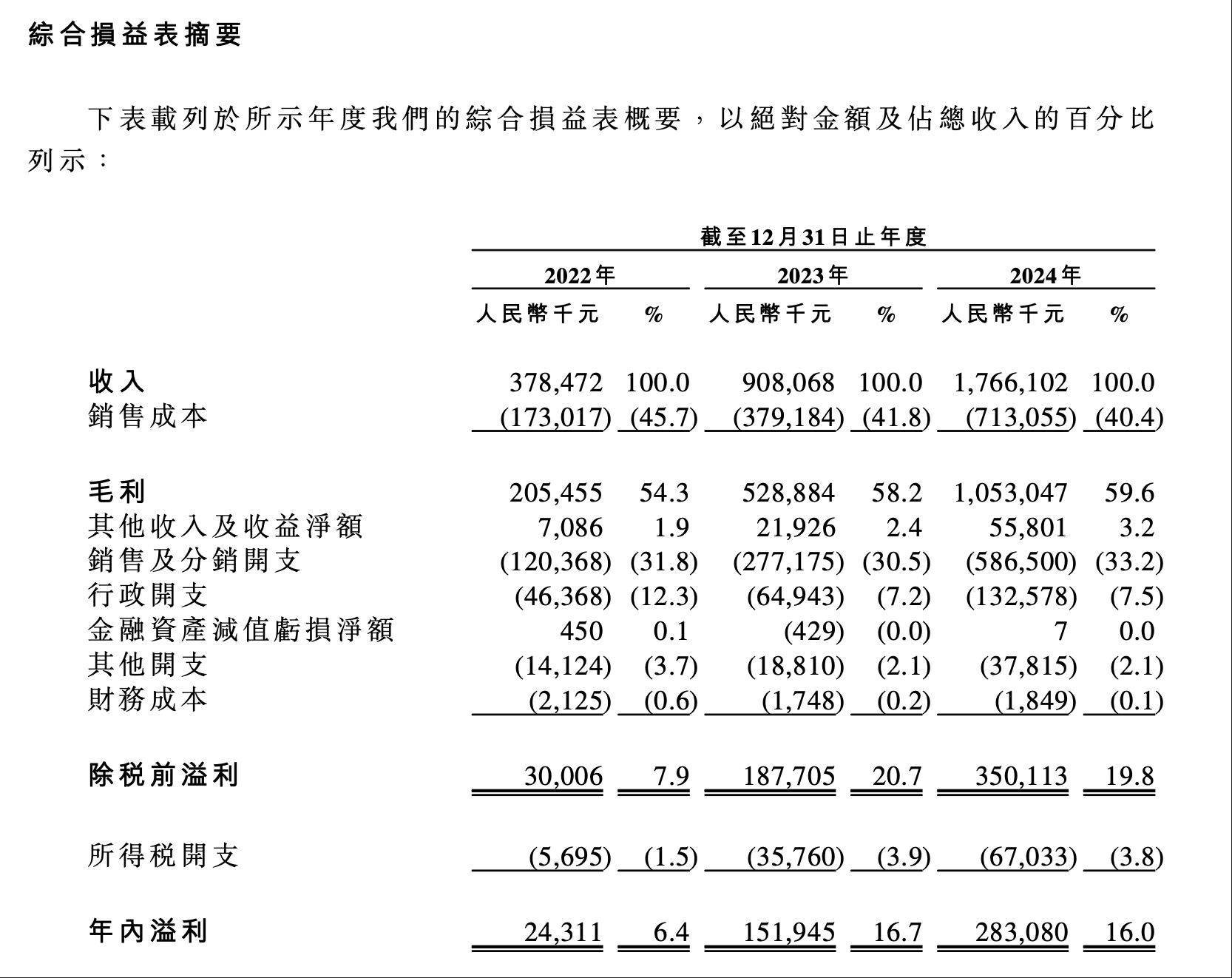
Core Viewpoint - The company PELLIOt, founded by a couple in 2012, is preparing for an IPO with a revenue of 1.7 billion RMB, leveraging a "value-for-money" strategy in the outdoor apparel market [1][3]. Company Overview - PELLIOt was established in 2012 as a small outdoor goods trading company and has evolved into a brand known for its affordable outdoor apparel [4][5]. - The founders, Liu Zhen and Hua Jingling, are outdoor enthusiasts who have successfully expanded their business by focusing on product development and brand marketing [5]. Financial Performance - The company's projected revenues for 2022, 2023, and 2024 are 378 million RMB, 908 million RMB, and 1.766 billion RMB, respectively [3][4]. - Gross profit margins are expected to improve from 54.3% in 2022 to 59.6% in 2024, indicating efficient cost management [4]. - Net profit is projected to grow from 24.31 million RMB in 2022 to 283.08 million RMB in 2024 [4]. Market Positioning - PELLIOt has positioned itself in the market by offering products at a price point significantly lower than competitors, such as Arc'teryx, while maintaining comparable quality [3][4]. - The brand has gained recognition as a "value alternative" to high-end outdoor apparel, appealing to cost-conscious consumers [3][10]. Investment and Growth - The company has attracted significant investment, including 400 million RMB in 2023 and 288 million RMB in 2024, raising its valuation to 2.8 billion RMB [7]. - Major investors include Tencent, which acquired a stake for 300 million RMB, highlighting the brand's growth potential [7]. Brand Controversy - The brand name "PELLIOt" has faced criticism due to its association with a historical figure known for cultural appropriation, raising questions about its branding strategy [9]. - This controversy may impact consumer perception and brand identity in the long term [9]. Future Strategy - The IPO proceeds will be used for product development, brand promotion, and expanding offline retail presence, with plans to open over 60 new stores in the next three years [10]. - Analysts suggest that while the "value alternative" strategy is effective in the short term, establishing a unique brand identity will be crucial for long-term success [10].

两大“毒瘤”不除掉,老百姓如何敢消费呢?原来老百姓的钱都被吸走了
Sou Hu Cai Jing· 2025-09-22 22:56
Group 1: Core Issues in Consumer Spending - High housing costs are consuming a significant portion of disposable income, with an average of 42% of monthly income spent on housing in first and second-tier cities, exceeding the international warning line of 30% [2] - The average disposable income ratio for urban residents has dropped from 48% in 2015 to 35% in 2024, largely due to rising housing-related expenses [2] - E-commerce has led to impulsive buying behaviors, with 63% of consumers admitting to unplanned purchases due to promotional activities, averaging 817 yuan per month in impulsive spending [3][4] Group 2: Consumer Behavior and E-commerce Challenges - The quality of goods and services on e-commerce platforms is inconsistent, leading to a rise in consumer complaints, which reached 673,000 in 2024, a year-on-year increase of 18.5% [4] - Trust in e-commerce platforms is declining, with 43% of consumers being cautious about promotional activities and 25% planning to reduce their spending on these platforms [4] Group 3: Solutions for Consumer Dilemmas - Recommendations for managing housing costs include keeping monthly mortgage payments within 30% of income, optimizing housing choices, and considering policy-based housing options [5][7] - Strategies to combat e-commerce impulsivity include setting shopping budgets, implementing a 24-hour cooling-off period before purchases, and supporting local brick-and-mortar stores [8][9] Group 4: Societal and Regulatory Responses - The real estate market is stabilizing, with many cities experiencing slower price increases and some areas seeing slight declines, supported by regulatory measures aimed at stabilizing prices [11] - Increased regulatory scrutiny on e-commerce platforms has led to fines exceeding 1.2 billion yuan for 23 major platforms due to violations related to product quality and consumer rights [11] - Consumer education initiatives are being launched to improve financial literacy and promote rational consumption behaviors [11]


冲锋衣1件几百元,“始祖鸟平替”冲刺IPO!安徽“70后”夫妻白手起家,年销17亿元,顶流明星成毅代言
Mei Ri Jing Ji Xin Wen· 2025-09-22 13:51
Core Viewpoint - The recent "Ancient Bird" fireworks incident has drawn public attention, while the domestic outdoor brand "Bershka," known as the "alternative to Ancient Bird," has initiated its IPO process in Hong Kong [1] Company Overview - Bershka was founded in 2012 by a couple from Anhui, initially starting as a small outdoor goods trading company before expanding into proprietary brand products [4][6] - The company has achieved significant revenue growth, with projected revenues of 3.78 billion RMB in 2022, 9.08 billion RMB in 2023, and 17.66 billion RMB in 2024 [4][5] Financial Performance - The gross profit margins for Bershka are projected to be 54.3% in 2022, 58.2% in 2023, and 59.6% in 2024, indicating a positive trend in profitability [4][5] - Net profit is expected to grow from 24.31 million RMB in 2022 to 151.94 million RMB in 2023, and further to 283.08 million RMB in 2024 [4][5] Market Positioning - Bershka has positioned itself in the market by offering professional-grade performance at prices below 1,000 RMB, significantly lower than similar products from Ancient Bird [3] - The brand has successfully captured the mass market by focusing on affordable pricing while maintaining quality and trendy designs [3][12] Investment and Growth - The company has attracted significant investment, with a valuation reaching 2.8 billion RMB after multiple funding rounds, including a notable investment from Tencent [8] - The IPO proceeds are intended for product development, brand promotion, and channel expansion, with plans to open over 60 new offline stores in the next three years [12] Brand Challenges - The brand name "Bershka" has faced controversy due to its association with a historical figure linked to cultural heritage loss, which has sparked discussions on social media [11] - The competitive landscape in the outdoor apparel industry is intense, with potential risks of market share loss to larger competitors [9] Future Outlook - Analysts suggest that while the "alternative" strategy has been effective in the initial market expansion, Bershka needs to establish stronger brand independence and recognition for long-term success [12] - The company's ability to balance quality and price will be crucial in navigating the evolving consumer market dynamics in China [12]
“70后”夫妻店、腾讯入股……“始祖鸟平替”伯希和冲刺港股IPO
Sou Hu Cai Jing· 2025-09-22 07:25
Core Viewpoint - The recent "Arcteryx" incident has drawn public attention, while the domestic outdoor brand "Pelliot," known as the "Arcteryx alternative," has initiated its IPO process in Hong Kong, aiming to leverage its story and annual revenue of 1.7 billion RMB to enter the capital market [1]. Group 1: Company Overview - Pelliot was founded in 2012 by a couple from Anhui, initially starting as a small outdoor goods trading company before expanding into proprietary brand products [5]. - The company has positioned itself in the market by offering professional-grade performance at prices below 1,000 RMB, significantly lower than similar products from Arcteryx [1][2]. - Pelliot's revenue for 2022, 2023, and 2024 is projected to be 378 million RMB, 908 million RMB, and 1.766 billion RMB, respectively, with gross margins increasing from 54.3% in 2022 to 59.6% in 2024 [3][4]. Group 2: Product Strategy - Pelliot has adopted a strategy of aligning its product design and functionality with Arcteryx, using similar waterproof and breathable materials, and incorporating fashionable elements into its designs [2]. - The brand has successfully gained recognition as the "Arcteryx alternative" by offering affordable products that meet consumer demands for both functionality and style [2]. Group 3: Financial Performance - The net profit for Pelliot is expected to grow from 24.31 million RMB in 2022 to 283 million RMB in 2024, indicating a strong upward trend in profitability [3][4]. - The company has seen significant investment, with a valuation reaching 2.8 billion RMB following multiple funding rounds, including a notable investment from Tencent [6]. Group 4: Market Position and Challenges - Pelliot faces intense competition in the outdoor apparel industry, with larger competitors potentially impacting its market share and profitability [7]. - The brand name "Pelliot" has sparked controversy due to its association with a historical figure known for cultural heritage loss, which has led to discussions on social media regarding its branding strategy [7]. Group 5: Future Prospects - The IPO proceeds will primarily be used for product development, brand promotion, and channel expansion, with plans to open over 60 new offline stores in the next three years [8]. - Analysts suggest that while Pelliot's "alternative" strategy has been effective in initial market expansion, long-term success will depend on establishing a stronger brand identity and value proposition [8].
2025中国消费人群心智地图与品牌未来战略白皮书
Sou Hu Cai Jing· 2025-09-21 07:50
Group 1 - The core viewpoint of the report is that the Chinese consumer market is undergoing a profound transformation, influenced by economic fluctuations, technological innovations, and cultural confidence, leading to a reconfiguration of consumer psychology and behavior [1][15][20] - The report highlights the dual existence of "rational consumption" and "emotional consumption," where consumers seek both value for money and emotional satisfaction, indicating a shift in consumer priorities [1][15][20] - Generational differences and regional disparities shape the market landscape, with distinct consumption values and behaviors emerging from different age groups, such as Baby Boomers, Generation X, Millennials, and Generation Z [1][24][30] Group 2 - Approximately 90% of future consumption growth is expected to come from non-first-tier cities, necessitating brands to adopt localized and refined operational strategies rather than a one-size-fits-all approach [2][26][29] - The report identifies four differentiated development models for cities: emerging hotspots, public service advantage cities, tourism-driven cities, and cities facing housing price pressures, each requiring tailored marketing strategies [2][29] - The emotional connection and cultural recognition are becoming increasingly important for consumers, particularly among Generation Z, who prioritize brands that resonate with their values and interests [1][25][30] Group 3 - Technological innovations are reshaping consumer experiences, with personalized recommendation systems evolving from "precision" to "understanding," enhancing engagement and satisfaction [3][4] - The report emphasizes the importance of brands becoming "spiritual partners" for consumers, especially during economic downturns, by focusing on cultural and emotional fulfillment rather than mere material possession [3][4] - Six brand case studies illustrate the growth logic in the new consumption era, showcasing how brands leverage emotional value, cultural empowerment, and innovative strategies to connect with consumers [4][5]

预制板房或“全拆”?定了:一部分人的机会已经开始了
Sou Hu Cai Jing· 2025-09-20 17:51
Core Insights - The article discusses the contemporary consumer dilemma, highlighting the significant impact of high housing costs and the evolving e-commerce consumption model on household spending behavior [1][2][3]. Group 1: Housing Costs - Housing costs in first and second-tier cities consume an average of 42% of household monthly income, exceeding the internationally recognized threshold of 30% [1][2]. - The average disposable income for urban residents has dropped to 35%, down from 48% in 2015, largely due to high housing-related expenses [2]. Group 2: E-commerce Consumption - E-commerce has led to impulsive buying behaviors, with 63% of consumers admitting to unplanned purchases due to promotional activities, averaging 817 yuan per month in impulsive spending [3][5]. - Complaints related to e-commerce platforms surged to 673,000 in 2024, a year-on-year increase of 18.5%, primarily concerning product quality and misleading promotions [5][7]. Group 3: Strategies for Rational Consumption - Recommendations for managing housing costs include keeping monthly mortgage payments within 30% of income and considering refinancing options to lower interest rates [8][9]. - To combat impulsive e-commerce spending, consumers are advised to create shopping lists, implement a "24-hour cooling-off period," and set monthly spending limits [9][10]. Group 4: Social and Regulatory Measures - The real estate market is stabilizing, with many cities experiencing slower price growth and regulatory measures focusing on maintaining stable prices and expectations [12]. - Enhanced regulations for e-commerce platforms have been introduced, with 23 major platforms fined over 1.2 billion yuan for violations related to product quality and consumer rights [12]. - Consumer education initiatives are being launched to improve financial literacy and promote rational spending habits [12].