云智一体

Search documents
让 AI 云帮客户赚钱,云厂商的下一个赛点
晚点LatePost· 2025-08-29 16:18
Core Viewpoint - The article emphasizes the transition of cloud computing from cost reduction and efficiency enhancement to directly creating value through AI integration, highlighting the importance of AI capabilities in driving business growth and innovation [3][5][10]. Group 1: AI Integration and Business Impact - A report from MIT indicates that 95% of companies attempting to use AI have not seen commercial returns, but the remaining 5% have generated significant value, with some startups achieving revenues of $20 million within a year by focusing on specific business pain points [3]. - Baidu's intelligent cloud has supported 65% of central enterprises and 80% of systemically important banks, showcasing its extensive reach and impact in various industries [5]. - Baidu's AI capabilities are being transformed into revenue-generating tools for enterprises, with AI new business revenue expected to exceed 10 billion yuan by Q2 2025 [14]. Group 2: Cloud Computing Evolution - The cloud computing landscape is shifting from resource leasing to supporting AI capabilities for training, deployment, and invocation, marking a new phase in cloud competition [17]. - Baidu's cloud strategy has evolved from "cloud intelligence integration" to "intelligent priority," focusing on redefining how enterprises utilize cloud services starting from AI [7][10]. - The competition among cloud providers is now centered on engineering capabilities, scene adaptation, and system integration rather than just model capabilities [8]. Group 3: Technological Advancements and Offerings - Baidu has upgraded its AI computing platform to version 5.0 and its Qianfan platform to version 4.0, enhancing multi-model high-concurrency scheduling and integrating various capabilities for enterprise services [10]. - The company has developed a digital employee and compliance analysis tools, aiming to standardize AI applications across industries [10]. - Baidu's self-developed Kunlun AI chips and training platforms provide a competitive edge in terms of cost efficiency and scheduling capabilities [8][9]. Group 4: Market Position and Future Outlook - Baidu holds a leading position in China's AI public cloud service market with nearly 25% market share and 15% share in the large model platform market [14]. - The company aims to convert complex AI capabilities into practical business solutions, addressing the dual challenges of finding new growth curves and ensuring secure development space in a competitive global landscape [18][19]. - Baidu's strategy includes comprehensive self-research across infrastructure, model frameworks, and engineering platforms to reduce reliance on external ecosystems [19].



AI云时代:云计算产业的新变局与长期主义者的领跑之路
Sou Hu Cai Jing· 2025-08-29 12:10
Core Insights - The integration of AI and cloud computing is reshaping the technology and business landscape, marking a new starting point for the industry [2][4] - In 2024, China witnessed the emergence of 50 trillion-level parameter models, leading to a 74.1% year-on-year growth in intelligent computing power, significantly outpacing general computing growth [1] - Baidu's intelligent cloud has become a leader in the AI field, leveraging its comprehensive AI technology stack to drive innovation and transformation in cloud services [4][6] Industry Trends - The cloud computing sector is undergoing unprecedented changes due to the incorporation of AI technologies, which are redefining service architectures and value propositions [1][4] - The competitive landscape in cloud computing is shifting from cost-based competition to a focus on innovative solutions that address specific business challenges [4][6] Company Developments - Baidu has made significant advancements in AI, launching the first deep learning framework "PaddlePaddle" in 2016 and the AI chip "Kunlun" in 2018, establishing a robust foundation for its AI capabilities [4][5] - Baidu's intelligent cloud has achieved a 24.6% market share in China's AI public cloud market, maintaining its position as the leader for six consecutive years [6][7] - The "Cloud Intelligence Integration" strategy of Baidu's intelligent cloud is set to evolve further, aiming to enhance intelligence capabilities and expand its market penetration [6][7] Product Innovations - The Baidu "Baihe" AI computing platform has been upgraded to version 5.0, focusing on enhancing inference capabilities and optimizing resource utilization [6][7] - The "Qianfan" platform has transitioned to version 4.0, providing a one-stop enterprise service platform centered around AI agents, aimed at accelerating application deployment [7] Financial Performance - Baidu's intelligent cloud revenue grew by 27% year-on-year, contributing to the company's AI new business surpassing 10 billion yuan for the first time, with a 34% year-on-year increase [7]

AI云,重画的起跑线
远川研究所· 2025-08-29 07:04
Core Viewpoint - The integration of AI and cloud computing is creating a new paradigm known as "AI cloud," which is driving significant growth in the cloud computing industry and reshaping its competitive landscape [1][2]. Group 1: AI and Cloud Computing Dynamics - In 2024, China is expected to add 50 large models with over 100 billion parameters, leading to a 74.1% year-on-year growth in intelligent computing power, significantly outpacing general computing power growth [1]. - AI is fundamentally altering the architecture and value logic of cloud services, pushing the demand for comprehensive end-to-end solutions rather than just basic AI computing infrastructure [1][9]. - The relationship between AI and cloud computing is redefining the boundaries of technology and business, creating a new starting line for competition in the cloud computing sector [1]. Group 2: Market Trends and Competitive Landscape - In 2020, the Chinese cloud computing market grew by 33.6% to reach 178.1 billion RMB, making it one of the fastest-growing regions globally, despite facing intense price wars and homogenization challenges [5]. - Major cloud providers like Amazon AWS, Microsoft Azure, and Google Cloud engaged in aggressive price cuts, with reductions of up to 60% in some services, intensifying competition [5][8]. - The shift from standardized cloud resources to customized solutions is seen as a potential remedy for the homogenization issue, although it has led to fragmentation challenges [8]. Group 3: Baidu's Strategic Positioning - Baidu has established a complete AI technology stack from hardware to applications, which is a competitive advantage not shared by its rivals [10][11]. - The "cloud-intelligence integration" strategy initiated by Baidu aims to transform the AI development paradigm and lead the evolution of the Chinese cloud computing industry [11]. - Baidu's intelligent cloud revenue grew by 27% year-on-year, with AI new business surpassing 10 billion RMB for the first time, indicating strong market performance [21]. Group 4: Future Outlook and Innovations - Baidu's intelligent cloud is set to upgrade its strategy to focus on intelligent-first AI cloud infrastructure, aiming to enhance the capabilities and penetration of AI technologies [18]. - The Baidu Baige AI heterogeneous computing platform has achieved significant performance improvements, allowing for efficient training and inference of large models [19]. - The introduction of the Agent-based AI development framework in Baidu's Qianfan platform aims to lower development barriers and accelerate application deployment across various industries [20].

云市场淘汰赛,谁能活到最后?
虎嗅APP· 2025-08-28 13:54
Core Viewpoint - The rapid evolution of large models, particularly since the release of ChatGPT in November 2022, has led to significant market transformations, with Nvidia's market value increasing tenfold to over $4.4 trillion, and the emergence of 4,000 large models and nearly 500 AI unicorns attracting around $500 billion in investments [2] AI Cloud Market Dynamics - The AI cloud market in China is projected to reach 19.59 billion yuan in 2024, with the top three players—Baidu, Alibaba, and Huawei—holding a combined market share of 62%, an increase of 8% from 2023 [5] - The shift from CPU server competition to GPU-based intelligent computing clusters marks a significant transition in the cloud services industry, emphasizing the delivery of intelligent outcomes rather than merely renting computing resources [3][6] Challenges for Smaller Players - Smaller cloud service providers face significant barriers, including high costs for GPU procurement, which can be 10-30% higher than those for leading firms, and the complexity of developing AI cloud capabilities that require a full-stack approach [6][7] - Over 30% of regional cloud service providers are expected to exit the market by 2024 due to unsustainable operational costs and low utilization rates of computing resources [7] Importance of Ecosystem and Industry Experience - Enterprises increasingly seek cloud service providers that can address specific industry pain points, with 65% of central enterprises and 80% of systemically important banks choosing Baidu Intelligent Cloud for its industry experience [8] - Baidu's approach focuses on creating value for enterprises by helping them reduce costs and improve efficiency, as demonstrated by successful collaborations in various sectors [8][19] Competitive Landscape and Strategic Positioning - Baidu Intelligent Cloud leads the AI public cloud market with a 24.6% share in 2024, emphasizing an AI-driven cloud model that redefines traditional cloud services [13][20] - The company has established a strong competitive edge through its full-stack capabilities and strategic focus on industry-specific solutions, allowing it to secure significant contracts and partnerships [13][19] Future Trends and Innovations - The evolution of AI applications towards more autonomous and intelligent agents is expected to create a market exceeding 3 trillion yuan by 2027, highlighting the urgency for players to innovate and lead in technology [15] - Baidu's advancements in AI infrastructure, such as the "Kunlun" super node and self-developed computing clusters, position it as a key player in the domestic AI industry, reducing reliance on external technologies [16][20]

当拼算力不再稀缺,AI云开始拼懂行业
3 6 Ke· 2025-08-28 13:42
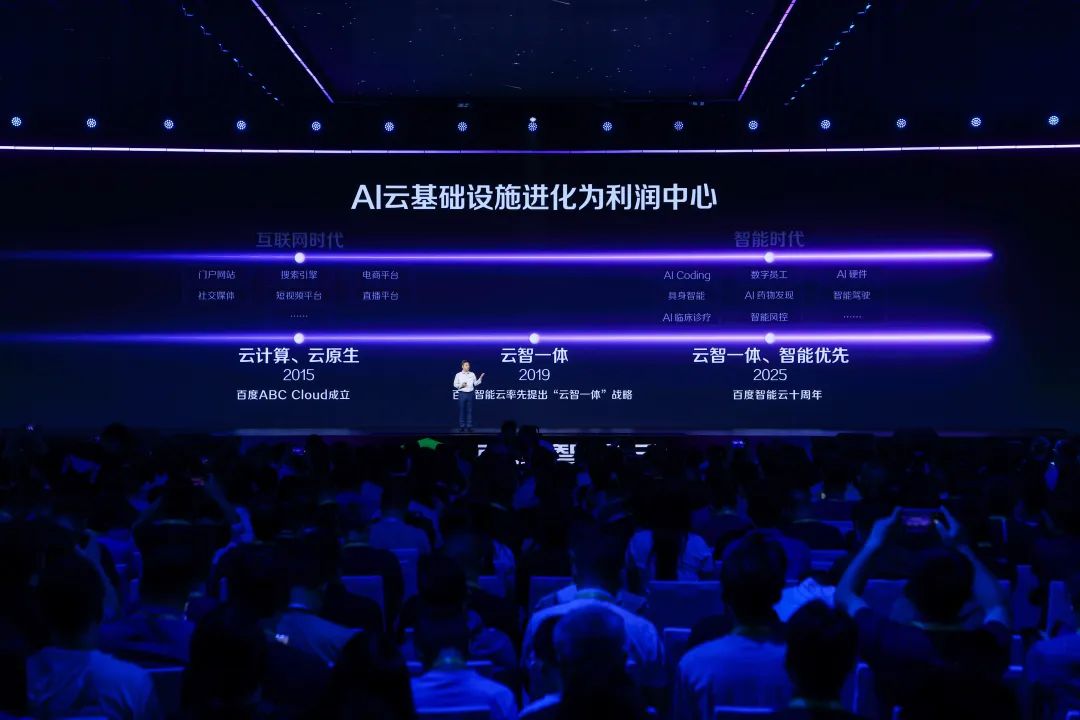
Core Insights - The evolution of cloud computing is marked by a shift from resource-based competition to a focus on intelligence and industry understanding, driven by the rise of large models [1][2][19] - Baidu Smart Cloud has positioned itself as a leader in the AI cloud sector by integrating AI capabilities into its cloud services from the outset, differentiating itself from competitors who primarily focused on infrastructure [4][6][14] Industry Transition - The cloud computing market has transitioned from a focus on resource availability and cost optimization to a demand for intelligent capabilities that can address specific business needs [2][19] - The emergence of AI companies like OpenAI and Anthropic has reshaped customer expectations, requiring cloud providers to deliver not just computing power but also advanced AI functionalities [2][19] Baidu's Strategic Decisions - Baidu established its AI cloud strategy as early as 2015, which was unconventional at the time, allowing it to develop a robust AI architecture that supports large-scale business systems [4][5][6] - By 2020, Baidu fully launched its "cloud-intelligence integration" strategy, focusing on AI as a core component of its cloud offerings [4][6] Competitive Differentiation - Baidu Smart Cloud has developed a unique methodology that combines self-developed technologies with a deep understanding of industry needs, allowing it to provide tailored solutions [7][10] - The company has created a closed-loop capability across computing power, models, and applications, ensuring continuity and flexibility in its technology offerings [7][10] Product and Service Innovations - The upgraded Qianfan 4.0 platform offers comprehensive capabilities for AI development, significantly lowering deployment barriers for enterprises [10][11] - Baidu's digital employee product line leverages advanced AI technologies to serve various business functions, enhancing operational efficiency [11][12] Market Position and Performance - Baidu Smart Cloud has achieved a leading market share of 24.6% in China's AI public cloud market, reflecting its strong competitive position [16] - The company reported significant revenue growth, with AI new business revenue reaching 194 billion yuan, a 36% year-on-year increase, indicating its successful transition to an AI-focused cloud provider [16][19] Future Outlook - The cloud computing industry is entering a phase where understanding industry-specific needs and creating value will be crucial for success, moving away from mere resource selling [19] - Baidu's decade-long investment in AI integration positions it as a model for other cloud providers, potentially shaping the future landscape of the industry [19]
当拼算力不再稀缺,AI云开始拼懂行业
36氪· 2025-08-28 13:35
Core Viewpoint - The competition in cloud computing is shifting from "selling resources" to "selling intelligence and value," positioning Baidu as a central player in this transformation [2][3]. Industry Evolution - The evolution of cloud computing has undergone several paradigm shifts, with each technological advancement leading to a restructuring of the industry. Initially, cloud services were seen as outsourced IT infrastructure, then as a means to support high concurrency in mobile internet, and now as a provider of intelligent capabilities for business growth [2][5]. - The emergence of large models has triggered a new round of competition among cloud providers, emphasizing the need for intelligent capabilities rather than just computational resources [3][5]. Strategic Decisions - Baidu's strategic choice to focus on AI cloud services from the outset has differentiated it from competitors who primarily focused on infrastructure before adding AI capabilities [7][9]. - Baidu established its AI cloud strategy in 2015, which was unconventional at the time, but this foresight allowed it to develop a robust AI architecture that supports large-scale business systems [9][10]. Differentiated Competition - Baidu's competitive edge lies in its comprehensive self-developed capabilities, forming a closed-loop system from computing power to application delivery [14][21]. - The "千帆" platform has evolved to become a leading enterprise-level AI development platform, enhancing the deployment stability of intelligent agents and supporting the entire lifecycle of data management and model training [16][19]. Market Position - Baidu has transitioned from being a follower in the cloud market to a leader in the AI cloud sector, evidenced by its significant market share and revenue growth [23][26]. - As of 2025, Baidu's intelligent cloud revenue reached 65 billion yuan, marking a 27% year-on-year increase, and it holds a 24.6% share of the AI public cloud market in China [26][29]. Future Outlook - The cloud computing industry is entering a new phase where understanding industry needs and creating value will be crucial for success, moving away from mere resource selling [29][30]. - Baidu's decade-long journey provides a new paradigm for Chinese cloud providers, emphasizing the importance of integrated capabilities in navigating the evolving landscape of cloud computing [31].