
人工智能推理

Search documents
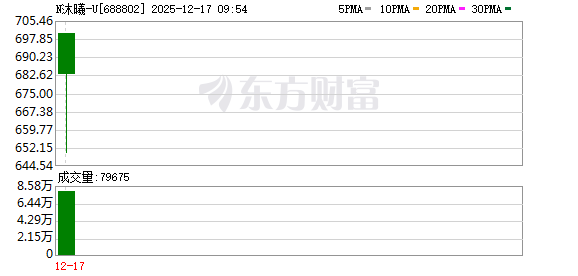
国产GPU第二股沐曦股份大涨近560% 单签盈利近30万元
Xin Hua Cai Jing· 2025-12-17 01:54
Group 1 - The core viewpoint of the article highlights the successful IPO of Muxi Co., a leading domestic high-performance general-purpose GPU company, which saw its stock price surge by 559% on its debut, reaching approximately 690 yuan per share and a total market capitalization close to 280 billion yuan [1][2]. - Muxi Co. issued shares at a price of 104.66 yuan each, making it the second highest IPO price on the STAR Market this year, following Moer Technology [2]. - The funds raised from the IPO will be allocated to the development and industrialization of new high-performance general-purpose GPUs, AI inference GPUs, and advanced GPU technology for emerging applications [2]. Group 2 - Muxi Co. is focused on the independent research and development of a full-stack high-performance GPU chip and computing platform, with key products including the Xisi N series for intelligent computing inference and the Xiyun C series for training and general computing [2]. - The latest product, the Xiyun C600 series, is positioned between NVIDIA's A100 and H100 in terms of performance and is expected to enter risk mass production by the end of this year, with formal mass production slated for the first half of next year [2]. - In the A-share market, seven semiconductor stocks have been listed this year, with an average first-day increase of approximately 242.94% [3].

苹果首款服务器芯片,更多细节曝光
半导体行业观察· 2025-12-16 01:22
Core Viewpoint - Apple is focusing on vertical integration by developing its own AI server chip, codenamed "Baltra," which is expected to debut in 2027 [2]. Group 1: Chip Development - Apple is collaborating with Broadcom to develop the "Baltra" AI server chip, which will utilize TSMC's 3nm "N3E" process, with design completion anticipated within the next 12 months [2]. - The deployment of these custom AI chips is expected to begin in 2027, following the delivery of Apple-manufactured servers starting in October 2025 [2]. Group 2: Purpose and Architecture - The primary use of the "Baltra" chip is projected to be for AI inference, which involves executing specific tasks based on previously trained models, rather than training large AI models [3]. - The architecture of inference chips differs fundamentally from training chips, focusing more on latency and throughput, and likely employing lower precision mathematical architectures such as INT8 [3]. Group 3: Expansion of Custom Chip Line - Apple's custom chip product line is expanding beyond the well-known A and M series chips, now including the self-developed C1 modem chip [3]. - There are plans to introduce a derivative product based on the S series chip for the upcoming AI smart glasses expected to launch next year [3].


明日(12月5日)!摩尔线程登陆A股 沐曦股份开启申购
Xin Hua Cai Jing· 2025-12-04 14:25
Group 1: Moer Technology IPO - Moer Technology is set to be listed on the Sci-Tech Innovation Board on December 5, with an issue price of 114.28 yuan per share, corresponding to a projected market value of approximately 53.715 billion yuan at listing [2] - The company plans to raise a net amount of 7.576 billion yuan from the IPO, which will be the highest fundraising amount for a new stock on the Sci-Tech Innovation Board this year [2] - Moer Technology's revenue is projected to grow from 46 million yuan in 2022 to 438 million yuan in 2024, while net losses are expected to decrease from 1.894 billion yuan in 2022 to 1.618 billion yuan in 2024 [2] Group 2: Muxi Co., Ltd. Subscription - Muxi Co., Ltd. will also open subscriptions on the same day, with an issue price of 104.66 yuan per share, leading to an estimated market value of about 41.874 billion yuan at listing [3] - The company aims to raise a total of 4.197 billion yuan, which will be used for the development and industrialization of new high-performance general-purpose GPUs and AI inference GPUs [3] - Muxi Co., Ltd. is recognized as a leading domestic enterprise in high-performance general-purpose GPU products, with a projected market share of approximately 1% in China's AI chip market in 2024 [3][4] Group 3: Financial Performance - Muxi Co., Ltd. reported revenues of 426,400 yuan in 2022, increasing to 740 million yuan in 2025 Q1, but has not yet achieved profitability, with net losses of 777 million yuan in 2022 and 2.32 billion yuan in 2025 Q1 [4]
博通:AI 推理需求爆发,有望大幅上涨
美股研究社· 2025-11-28 11:06
Core Viewpoint - The artificial intelligence ecosystem is transitioning from the training phase to the inference phase, becoming a strong revenue engine for large tech companies and providing structural growth benefits for Broadcom's custom chips and networking products [1][22]. Group 1: AI Demand and Market Trends - There is a significant increase in demand for AI inference, which is expected to drive custom chip demand in the second half of 2026, leading to revenue growth in AI business [1][5]. - Major tech companies, including Google and ByteDance, are increasingly adopting Broadcom's custom chips, which are more cost-effective compared to Nvidia's GPUs [2][4]. Group 2: Custom Chip Advantages - Broadcom's custom accelerators are significantly cheaper than Nvidia's GPUs, with performance improvements in each generation [2]. - Google's upcoming seventh-generation Tensor Processing Unit (TPU) Ironwood is designed specifically for inference, showcasing the trend towards more efficient custom solutions [4]. Group 3: Financial Performance - Broadcom reported a 22% year-over-year revenue growth in Q3, reaching $15.95 billion, driven by strong performance in custom AI accelerators and networking switches [11]. - The AI semiconductor business saw a 63% year-over-year revenue increase, contributing significantly to overall revenue [13]. Group 4: Future Projections - Broadcom anticipates a substantial increase in AI business revenue, projecting it could reach nearly $54 billion by FY2027, accounting for about 50% of total revenue [5][12]. - The company expects to see a 34.9% year-over-year revenue growth in FY2026, reaching $85.4 billion [12]. Group 5: Networking Solutions - Broadcom is focusing on its Tomahawk 6 switch, which is the first Ethernet switch with a capacity of 102.4 Tbps, facilitating the deployment of large-scale AI accelerator clusters [9][10]. - The shift from Nvidia's GPU+InfiniBand ecosystem to Ethernet is beneficial for Broadcom, as demand for Ethernet solutions is on the rise [8]. Group 6: Cash Flow and Valuation - Broadcom has a strong cash flow generation capability, converting 44% of revenue into free cash flow, which supports its valuation premium [18][19]. - The company maintains a competitive valuation compared to Nvidia, with a forward P/E ratio of 36.9, indicating strong profit margins and growth potential [19][20].

从iPhone17热卖到“AI推理超级蓝海” 苹果(AAPL.US)悄然踏向新一轮牛市轨迹
智通财经网· 2025-09-30 04:43
Core Viewpoint - Bank of America highlights strong demand for Apple's iPhone 17 series, despite initial user criticism regarding lack of standout features, driven by significant upgrades in AI capabilities and key performance metrics [1][2] Group 1: iPhone 17 Demand and Delivery - The delivery cycle for the iPhone 17 series is significantly longer than last year's models, indicating strong demand, with the average delivery time around 19 days compared to 5 days for the iPhone 16 series [2][3] - In China, the standard iPhone 17 has a delivery time of up to 25 days, while other international regions average about 18 days, reflecting robust demand [3] - The iPhone 17 Pro and Pro Max models have delivery times similar to last year, with Pro Max slightly longer at 21 days, while the Pro model remains at 14 days [3] Group 2: Market Sentiment and Stock Performance - Apple's stock has rebounded over 10% since September, driven by strong iPhone 17 demand and market optimism regarding its potential benefits from the AI sector, with analysts projecting a target price of $300 [2] - As of the latest market close, Apple's stock price was $254.43, with a market capitalization of $3.8 trillion, ranking just behind Nvidia and Microsoft [2] Group 3: AI Market Potential - Bernstein's report anticipates a massive $1 trillion opportunity in AI inference systems by 2030, benefiting large tech companies like Apple focused on IT hardware and consumer electronics [1][5] - The AI infrastructure market is expected to see exponential growth, with Nvidia's CEO predicting AI infrastructure spending could reach $3 trillion to $4 trillion by 2030 [5][6] - Apple is positioned as a key player in the AI inference revolution, with its extensive ecosystem of 2.35 billion active devices providing a significant advantage for integrating AI capabilities [6][7]
NPU,大有可为
半导体行业观察· 2025-08-28 01:14
Core Insights - The global AI inference market is expected to grow rapidly, reaching approximately $10.6 billion in 2023 and projected to increase to about $25.5 billion by 2030, with a CAGR of around 19% [2] - The NPU market is anticipated to expand due to the demand for higher inference throughput, lower latency, and improved energy efficiency, which NPU technology is well-suited to meet [2] - Companies like Sambanova and Grok are leading the NPU market, focusing on specialized AI applications and cloud-based services [3] Group 1 - The AI inference market is projected to grow from $10.6 billion in 2023 to $25.5 billion by 2030, indicating a significant market opportunity [2] - NPU technology is emerging as a viable alternative to traditional GPUs, offering low power consumption and high efficiency tailored for AI applications [2] - The semiconductor industry is shifting towards application-specific integrated circuits (ASICs) for AI, moving away from mature CPU and GPU technologies [2] Group 2 - Sambanova integrates its dataflow architecture NPU with proprietary software, targeting major clients including the U.S. government and financial institutions [3] - Grok specializes in real-time inference with its custom-designed chips, focusing on cloud-based LLM services for high-speed data center applications [3] - AI semiconductor companies must prioritize energy efficiency and target customized markets to compete effectively against general-purpose GPUs like those from Nvidia [3]
华为发布AI黑科技UCM,下个月开源
Zheng Quan Shi Bao Wang· 2025-08-12 09:23
Core Insights - Huawei has launched a new AI inference technology called UCM, aimed at significantly reducing inference latency and costs while enhancing efficiency in AI interactions [1][2] Group 1: Technology and Innovation - UCM utilizes a KVCache-centered architecture that integrates various caching acceleration algorithms to manage KVCache memory data, thereby expanding the inference context window and achieving high throughput with low latency [1][2] - The technology features hierarchical adaptive global prefix caching, which allows for the reuse of KV prefix cache across various physical locations and input combinations, reducing the first token latency by up to 90% [2] - UCM can automatically tier cache based on memory heat across different storage media (HBM, DRAM, SSD) and incorporates sparse attention algorithms to enhance processing speed, achieving a 2 to 22 times increase in tokens processed per second (TPS) [2] Group 2: Market Context and Challenges - Currently, Chinese internet companies' investment in AI is only one-tenth of that in the United States, and the inference experience in domestic large models lags behind international standards, which could lead to user attrition and a slowdown in investment [3] - The rise in user scale and request volume in AI applications has led to an exponential increase in token usage, with a projected daily token call of 16.4 trillion by May 2025, representing a 137-fold increase from the previous year [4] - Balancing the high operational costs associated with increased token processing and the need for enhanced computational power is a critical challenge for the industry [4] Group 3: Strategic Initiatives - Huawei has initiated pilot applications of UCM in three business scenarios with China UnionPay, focusing on smart financial AI inference acceleration [3] - The company plans to open-source UCM by September 2025, aiming to foster collaboration within the industry to develop inference frameworks and standards [4]
北京亦庄发布“具身智能机器人十条”;华为即将发布AI推理领域突破性成果丨数智早参
Mei Ri Jing Ji Xin Wen· 2025-08-10 23:21
Group 1 - Beijing Economic and Technological Development Zone released a plan for embodied intelligent robots, introducing eight support measures to accelerate innovation and development in the robotics industry [1] - The measures focus on key areas such as soft and hard technology collaboration, data element trials, application scenario promotion, and nurturing new business models [1] - The robotics industry is at a critical turning point, with companies that identify and cultivate essential demand scenarios likely to succeed in the next competitive phase [1] Group 2 - Huawei is set to unveil breakthrough technology in AI reasoning on August 12, which may reduce reliance on high bandwidth memory (HBM) and enhance domestic AI model reasoning performance [2] - The anticipated results could improve self-sufficiency, decrease dependence on foreign technology, and ensure the security of AI infrastructure [2] - This development is expected to activate reasoning performance and application ecosystems, facilitating the efficiency of domestic AI models in high real-time scenarios like finance [2] Group 3 - OpenAI officially launched GPT-5 on August 7, which is expected to transform work, learning, and innovation through its enhanced capabilities [3] - GPT-5 shows significant improvements in health advice accuracy, with potential future versions like GPT-8 possibly aiding in the treatment of diseases such as cancer [3] - The vision of AI as a "virtual chief scientist" could reshape scientific discovery and medical research, although challenges remain regarding reliability, ethical regulation, and scientific validation [3]

AI芯片公司,估值60亿美元
半导体芯闻· 2025-07-10 10:33
Core Viewpoint - Groq, a semiconductor startup, is seeking to raise $300 million to $500 million, with a post-investment valuation of $6 billion, to fulfill a recent contract with Saudi Arabia that is expected to generate approximately $500 million in revenue this year [1][2][3]. Group 1: Funding and Valuation - Groq is in discussions with investors to raise between $300 million and $500 million, aiming for a valuation of $6 billion post-funding [1]. - In August of the previous year, Groq raised $640 million in a Series D funding round led by Cisco, Samsung Catalyst Fund, and BlackRock Private Equity Partners, achieving a valuation of $2.8 billion [4]. Group 2: Product and Market Position - Groq is known for producing AI inference chips designed to optimize speed and execute pre-trained model commands, specifically a chip called Language Processing Unit (LPU) [5]. - The company is expanding internationally by establishing its first data center in Helsinki, Finland, to meet the growing demand for AI services in Europe [5]. - Groq's LPU is intended for inference rather than training, which involves interpreting real-time data using pre-trained AI models [5]. Group 3: Competitive Landscape - While NVIDIA dominates the market for chips required to train large AI models, numerous startups, including SambaNova, Ampere, Cerebras, and Fractile, are competing in the AI inference space [5]. - The concept of "sovereign AI" is being promoted in Europe, emphasizing the need for data centers to be located closer to users to enhance service speed [6]. Group 4: Infrastructure and Partnerships - Groq's LPU will be installed in Equinix data centers, which connect various cloud service providers, facilitating easier access for businesses to Groq's inference capabilities [6]. - Groq currently operates data centers utilizing its technology in the United States, Canada, and Saudi Arabia [6].

AI芯片新贵Groq在欧洲开设首个数据中心以扩大业务
智通财经网· 2025-07-07 07:03
Group 1 - Groq has established its first data center in Helsinki, Finland, to accelerate its international expansion, supported by investments from Samsung and Cisco [1] - The data center aims to leverage the growing demand for AI services in Europe, particularly in the Nordic region, which offers easy access to renewable energy and cooler climates [1] - Groq's valuation stands at $2.8 billion, and it has designed a chip called the Language Processing Unit (LPU) specifically for inference rather than training [1] Group 2 - The concept of "sovereign AI" is being promoted by European politicians, emphasizing the need for data centers to be located within the region to enhance service speed [2] - Equinix, a global data center builder, connects various cloud service providers, allowing businesses to easily access multiple vendors [2] - Groq's LPU will be installed in Equinix's data centers, enabling enterprises to access Groq's inference capabilities through Equinix [2]