以人民为中心

Search documents
中心工作推进到哪 政协履职跟进到哪——从省政协常委会工作报告看履职亮点和方向
Si Chuan Ri Bao· 2026-01-06 11:16
Group 1 - The core theme of the Provincial Political Consultative Conference (PPCC) is centered around unity and democracy, emphasizing the importance of aligning its functions with the provincial government's central work [1] - The PPCC aims to accelerate the construction of a strong economy by implementing new development concepts and contributing to the "13th Five-Year Plan" [2] - The focus will be on three major battles: risk prevention, targeted poverty alleviation, and pollution control, while also planning around a vision that includes two leaps, three development strategies, and four key projects [2] Group 2 - The development of the capital market is deemed crucial for transitioning from an economic province to a strong economic province, with a call for proposals related to economic development [3] - The PPCC has engaged over 70,300 members in activities aimed at poverty alleviation, completing 330,000 practical tasks by the end of 2017 [4] - Continuous efforts will be made to address issues related to employment, education, healthcare, and social security to enhance the well-being of the populace [4] Group 3 - The PPCC has conducted 106 various consultation activities over the past five years, with plans to improve the consultation process and enhance its effectiveness [6] - There is a need for the PPCC to explore effective forms of consultative democracy and improve the quality of proposal handling [6] - New forms of consultation, such as online discussions and micro-proposals, are suggested to enhance engagement [7] Group 4 - Strengthening the capacity of PPCC members and staff is essential, with ongoing activities aimed at improving the quality of proposals and enhancing participation [8] - There is a focus on adapting to new tasks and improving the political, research, and collaborative skills of members [8] - Training for new members is emphasized to ensure they are equipped to fulfill their roles effectively [8]
把对上负责与对下负责统一起来
Ren Min Ri Bao· 2026-01-04 03:38
Group 1 - The core argument emphasizes the unity of responsibility to both the upper leadership and the people, highlighting that being accountable to the Party is fundamentally being accountable to the people [1][2] - The historical context shows that the Party has consistently recognized the importance of balancing responsibilities to both the leadership and the populace, as articulated by leaders like Mao Zedong and Deng Xiaoping [2] - The article critiques certain behaviors among some Party members who separate the responsibilities, leading to a focus on superficial achievements rather than genuine service to the people [3] Group 2 - The principle of serving the people is identified as the fundamental tenet of the Party, necessitating a high-quality execution of tasks while addressing the needs and expectations of the populace [3] - The concept of "unity of purpose" is introduced, suggesting that success in governance comes from aligning the responsibilities to the Party and the people throughout all levels of work [3] - The article calls for a revival of the tradition of engaging with the grassroots, emphasizing the need for Party members to actively listen and respond to the concerns of the people to enhance satisfaction and trust [3]
述评:体育之窗展现中国式现代化万千气象
Xin Hua Wang· 2026-01-02 01:25
Core Viewpoint - The article highlights the vibrant development of China's sports sector as a reflection of Chinese-style modernization, showcasing unity, inclusiveness, and innovation in sports activities and events [3][5][12]. Group 1: Sports Events and Achievements - The 2025 National Games, co-hosted by Guangdong, Hong Kong, and Macau, marked a significant milestone as the first cross-border competition in the event's history, emphasizing collaboration under the "One Country, Two Systems" principle [5]. - The successful hosting of international events, such as the Harbin Asian Winter Games and Chengdu World Games, has set new benchmarks for sports organization and fostered international friendships [5][6]. - The "Su Super" football league attracted over 2.43 million spectators, with a record attendance of 62,329 at the finals, demonstrating the grassroots appeal of local sports events [6][8]. Group 2: Economic Impact and Development - The integration of sports with tourism and commerce has led to the rise of "event economy" and "ticket economy," significantly enriching the cultural and economic landscape [6]. - The ice and snow industry is projected to generate 1 trillion yuan by 2025, transforming cold resources into a hot economy and fostering new consumption scenarios and regional development [6]. - The State Council's policy aims to cultivate influential sports enterprises and events, targeting a sports industry scale exceeding 7 trillion yuan by 2030, contributing to high-quality economic development [6]. Group 3: Technological Innovation in Sports - Advances in embodied intelligence technology have enabled the emergence of robot athletes, showcasing China's innovative capabilities in integrating technology with sports [10][12]. - The development of domestic sports equipment is advancing in materials, design, and intelligence, enhancing both competitive sports and public fitness experiences [10][12]. Group 4: Institutional Innovation and Future Outlook - The exploration of a more market-oriented "new national sports system" and the integration of education and sports are aimed at creating a sustainable sports development ecosystem [12]. - The article emphasizes that a strong sports sector is integral to national strength and prosperity, with a call for continued contributions to the nation's development and rejuvenation [12].


体育之窗展现中国式现代化万千气象
Xin Hua Wang· 2026-01-02 01:19
Core Viewpoint - The article highlights the vibrant development of sports in China, showcasing its role in national modernization and unity, as well as the integration of technology in sports. Group 1: Sports Events and Achievements - The 2025 National Games, co-hosted by Guangdong, Hong Kong, and Macau, exemplify the innovative practice of "One Country, Two Systems" in sports, fostering collaboration among the three regions [2] - China successfully hosted two major international events in 2025, the Harbin Asian Winter Games and the Chengdu World Games, promoting friendship and cultural exchange [3] Group 2: Grassroots Sports and Economic Impact - Grassroots sports events like "City Super" and "Village Super" have gained immense popularity, with the "Su Super" event attracting over 2.43 million spectators and setting a record of 62,329 attendees at the finals [4] - The integration of sports with tourism and commerce has led to the rise of "event economy" and "ticket economy," enriching people's lives and driving economic growth [4] - The ice and snow industry in China is projected to generate 1 trillion yuan by 2025, transforming "cold resources" into a "hot economy" [4] Group 3: Policy and Industry Development - The State Council's policy aims to cultivate world-class sports enterprises and events by 2030, with the sports industry expected to exceed 7 trillion yuan in total scale [5] Group 4: Innovation and Technology in Sports - Advances in embodied intelligence technology have led to the emergence of robotic athletes, with events showcasing human-robot competitions and highlighting China's innovation in technology [6] - The integration of technology in sports is enhancing athlete performance and making fitness more engaging through smart equipment and virtual environments [7] - Institutional innovations are being explored to create a more sustainable sports development ecosystem, including market-oriented reforms and deeper integration of education and sports [7]
筑牢善法之基,方能行稳善治之路
Xin Lang Cai Jing· 2026-01-01 23:53
Group 1 - The core idea emphasizes the importance of establishing good laws for effective governance at both national and global levels, highlighting the historical significance of legal frameworks in achieving societal stability and prosperity [1][2][5] - The concept of "good law" is rooted in the principle of being people-centered, adaptable to changing times, and ensuring the protection of public interests, which has been a consistent pursuit throughout Chinese history [3][4][5] - Historical examples illustrate that successful governance relies on a legal system that aligns with societal needs and evolves with the times, as seen in various dynasties and reform movements [4][6] Group 2 - The ongoing development of the socialist legal system in China is aimed at enhancing the rule of law, with a focus on constitutional implementation and adapting laws to modern governance needs [5][6] - Legislative efforts are being made to address emerging fields and ensure that laws reflect contemporary societal challenges, such as environmental protection and civil rights [6][7] - The commitment to "good law" is seen as essential for resolving governance challenges and achieving effective governance, with a call for high-quality legislation and fair judicial practices [7]
以个体微光,燃山河滚烫
Xin Lang Cai Jing· 2025-12-31 21:05
Group 1 - The core idea emphasizes the integration of technology, particularly AI, into daily life, with over 500 million people in China interacting with AI in various aspects such as health, career, and emotions [1] - The narrative highlights the importance of human values that cannot be quantified, such as love, faith, courage, and compassion, which define humanity [1] - The article discusses China's advancements in technology, including the "artificial sun" achieving a world record and the successful construction of a quantum computing prototype, showcasing the country's technological breakthroughs [1] Group 2 - The concept of "investing in people" is presented as a central theme, reflecting a shift towards prioritizing individual well-being and societal values in development [2] - The article notes tangible benefits for individuals, such as childcare subsidies, consumer vouchers, and improved healthcare access, illustrating the government's commitment to enhancing the quality of life [2] - The narrative connects the broader story of China's modernization with the everyday experiences of its citizens, emphasizing the importance of individual happiness in the national narrative [2] Group 3 - The rapid advancement of technology is acknowledged, but there is a call to ensure that human values remain central to this progress, emphasizing the need for technology to resonate with real human experiences [3] - The article stresses that the ultimate value of technology lies in its ability to listen and respond to the needs of individuals, reinforcing the idea that people are the foundation of societal progress [3] - It highlights the collective strength of individuals' stories, which contribute to the resilience and unity of the nation [3] Group 4 - The transition into the "14th Five-Year Plan" is marked as a pivotal moment for realizing national goals, with an emphasis on the importance of individual contributions to collective progress [4] - The narrative suggests that the realization of national aspirations is rooted in the everyday actions of citizens, linking personal growth to national development [4] - The article concludes with a hopeful vision for 2026, encouraging a shared commitment to the country's future [5]
“中国已成为国际关注中心和焦点”——中外学者热议《2025年中国国际形象全球调查报告》
Huan Qiu Shi Bao· 2025-12-30 01:08
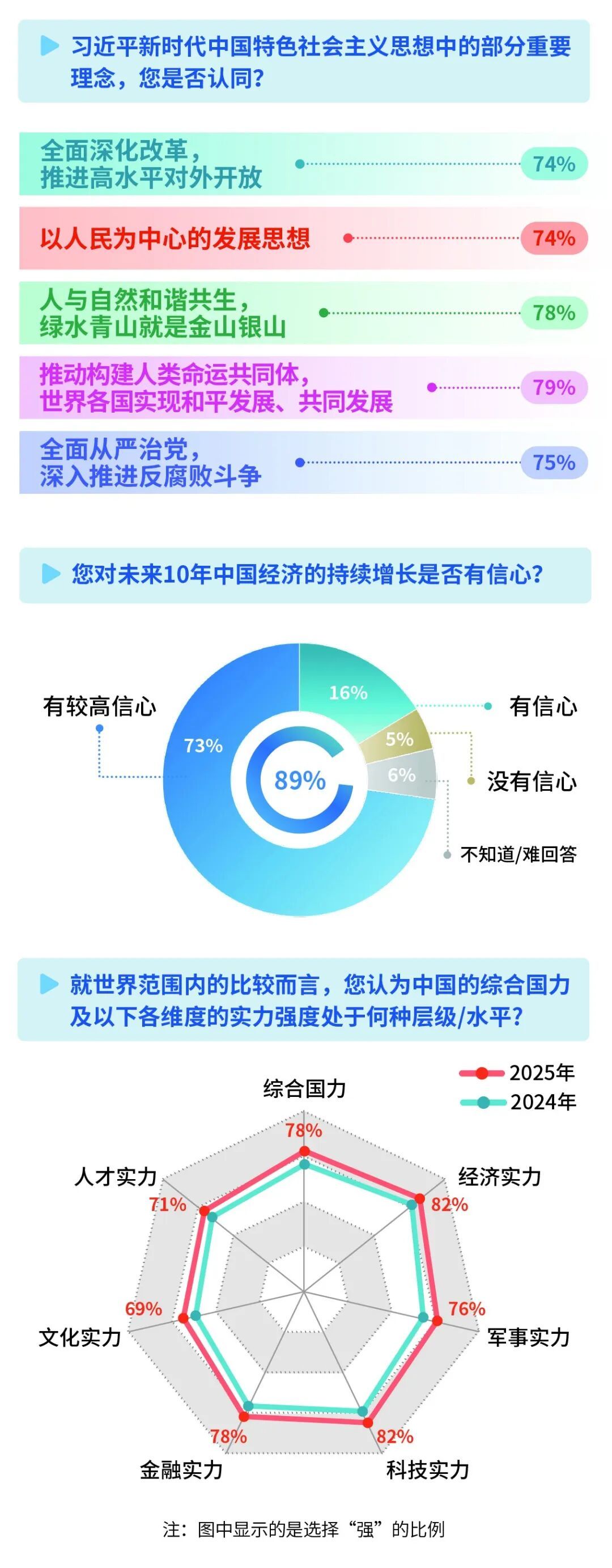
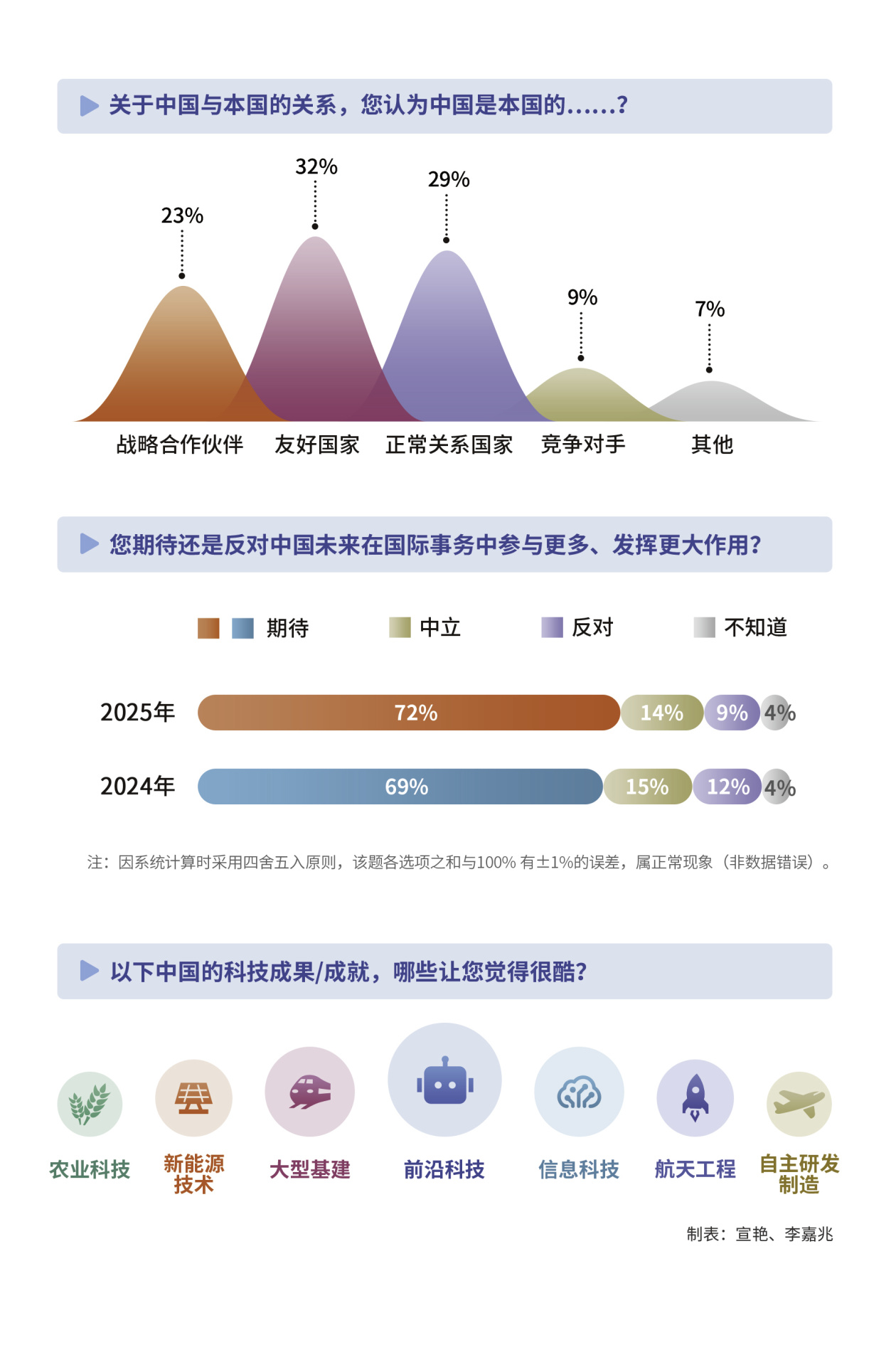
Core Insights - The 2025 Global Survey on China's International Image indicates a growing recognition of Xi Jinping's Thought on Socialism with Chinese Characteristics, with significant international support for key concepts such as "building a community with a shared future for mankind" and "green development" [3][4][5]. Group 1: International Perception of China - Approximately 78% of foreign respondents acknowledge China's increasing comprehensive national strength, an 8 percentage point increase from 2024 [11]. - Nearly 69% of foreign respondents express a favorable view of China, up 6 percentage points from the previous year [11]. - Over 90% of respondents show interest in China, with cultural aspects being the primary interest for developed countries and technology for developing nations [11]. Group 2: Recognition of Governance and Development Models - About 70% of foreign respondents positively view the Chinese Communist Party's strict governance practices and the implementation of five-year plans, recognizing them as important experiences for economic and social development [7][9]. - The international community appreciates China's long-term planning and strong execution capabilities, which are seen as key factors in its development success [8][9]. Group 3: China's Global Initiatives - The survey highlights that over 70% of respondents recognize China's global initiatives, such as the Global Development Initiative and the Global Security Initiative, reflecting a growing awareness and acceptance of these concepts [3][4]. - China's emphasis on mutual respect, common development, and collective security resonates with many countries, particularly in the context of rising global uncertainties [5][6]. Group 4: Expectations for China's Role in Global Affairs - More than 70% of respondents expect China to play a larger role in international affairs, particularly in promoting a fairer global order and addressing regional issues [16][17]. - Over 80% of foreign respondents believe their countries maintain normal, friendly, or strategic cooperative relations with China, indicating a positive perception of bilateral relations [19].
社评:一份民调,测出了当代中国的感召力
Xin Lang Cai Jing· 2025-12-29 16:09
Group 1 - The core viewpoint of the report is that Xi Jinping's Thought on Socialism with Chinese Characteristics for a New Era has gained high recognition from the international community, with nearly 80% of respondents supporting concepts like "building a community with a shared future for mankind" and "green mountains and clear waters are as valuable as mountains of gold and silver" [1] - The report indicates that over 70% of respondents recognize the principles of "comprehensively governing the Party with strictness," "comprehensively deepening reforms," and "putting people at the center" [1] - The survey reflects a growing international consensus on China's development achievements and the desire to understand China's proposed ideas and initiatives, especially in the context of rising protectionism and widening development gaps [1][2] Group 2 - The international recognition of Chinese ideas and solutions is attributed to the institutional realization of long-term goals by the Communist Party of China and its self-restraint in power [2] - The positive evaluation of China's five-year plans signifies global acknowledgment of "long-termism" and the effective transformation of institutional advantages into governance efficiency and public welfare [2] - Keywords that resonate most with foreign respondents regarding China include economy, technology, culture, and innovation, highlighting the tangible aspects of China's development [2] Group 3 - There is a strong international expectation for China's experience in genuine multilateralism and a fair international order, with over half of foreign respondents expressing hope for China's involvement in resolving international conflicts [3] - The rising discontent with unilateralism and the weaponization of rules indicates a global demand for cooperation and mutual benefit rather than a zero-sum approach [3] - The survey captures the growing global appeal of contemporary China, emphasizing the need for continued openness and sustainable cooperation, particularly among youth [3]
2025年中国国际形象全球调查报告:习近平新时代中国特色社会主义思想获国际社会高度认同 国际社会对华好感度持续提升
Xin Hua She· 2025-12-29 03:23
2025年中国国际形象全球调查报告:习近平新时代中国特色社会主义思想获国际社会高度认同 国 际社会对华好感度持续提升 调查显示,超过八成国外受访民众对2025年中国经济增长给予积极评价,近九成受访者表示对未 来10年中国经济增长有信心。近八成国外受访民众认可中国综合国力在增强,近七成国外受访民 众对中国抱有好感,对中国人的奋斗精神、创新精神的认同比例超过四分之三。九成多国外受访 民众对中国感兴趣,其中四成多兴趣程度很高。 在推动国际秩序朝着公正合理方向发展、改革完善全球治理、开展国际和地区热点问题斡旋与协 调,以及经贸合作、教科文合作等方面,八成左右国外受访民众期待中国未来开展更多行动或发 挥更大作用。 总体国际民意中,超过七成国外受访民众希望未来中美关系"趋向缓和"或"保持现状"。在"对中美 两国哪一个好感度更高"的比较中,国外受访民众选择中国的比例为39%,选择美国的比例为 26%,对华好感度超过对美好感度。美国政府对全球加征高额关税招致广泛担忧与批评,超过六 成国外受访民众持批评反对意见。中国政府采取了坚决反对和有力反制措施,超过七成国外受访 民众对此表示认同。 超过八成国外受访民众认为本国与中国是正常 ...
习近平新时代中国特色社会主义思想获国际社会高度认同 2025年中国国际形象全球调查报告发布
Huan Qiu Shi Bao· 2025-12-29 01:29
Group 1 - The survey conducted by Global Times Research Institute involved 15 developed countries and 31 developing countries, with a total of 51,689 valid samples collected from August to October 2025 [1] - The survey aimed to objectively understand foreign public perceptions of China, focusing on its international image and influence on global growth, technological change, and governance [1] Group 2 - Key concepts from Xi Jinping's Thought on Socialism with Chinese Characteristics for a New Era received high recognition internationally, with nearly 80% support for "building a community with a shared future for mankind" and "green mountains and clear waters are as valuable as mountains of gold and silver" [2] - Over 70% of respondents recognized initiatives such as the "Global Development Initiative" and "Global Security Initiative," indicating an increase in awareness compared to 2024 [2] Group 3 - Approximately 89% of respondents expressed confidence in China's comprehensive national strength, with 82% supporting its economic and technological capabilities [4][6] - The survey indicated that 78% of foreign respondents acknowledged the enhancement of China's comprehensive national strength, an increase of 8 percentage points from 2024 [9] Group 4 - Nearly 70% of foreign respondents held a favorable view of China, with the highest approval rates in Middle Eastern and ASEAN countries [10] - Interest in China was notably high, with over 90% of respondents expressing interest, particularly in cultural and technological aspects [13] Group 5 - More than 60% of respondents anticipated China's increased participation in international affairs, with a strong desire for China to contribute to resolving global issues [14] - The survey revealed that over 70% of respondents supported the idea of a fair and orderly multipolar world, with significant backing from developing countries [14] Group 6 - Over 75% of respondents viewed China's foreign policy positively, recognizing its role in promoting regional stability and development [20] - The desire for improved bilateral relations with China was expressed by over two-thirds of foreign respondents, reflecting a growing trend compared to 2024 [21]