信贷危机

Search documents
美国区域性银行信贷危机再起,会重蹈硅谷银行覆辙吗?
Hua Xia Shi Bao· 2025-10-19 08:36
Core Viewpoint - The recent significant stock price declines of Zions Bancorp and Western Alliance Bancorp highlight emerging credit risks in the U.S. banking sector, particularly related to commercial mortgage fraud, raising concerns about a potential credit crisis [2][5][6]. Group 1: Bank Performance and Financial Impact - Zions Bancorp reported a full provision for approximately $60 million in unpaid debts related to two commercial loans, which represents about 3.5% of its net revenue for 2024, estimated at $3.1 billion [3][4]. - Western Alliance Bancorp also indicated involvement in similar fraudulent loan activities and has initiated legal action against the same borrower [5]. Group 2: Risk Assessment and Market Reaction - The market reacted negatively, with Zions Bancorp and Western Alliance Bancorp's stock prices dropping by 13% and 11% respectively, marking one of the worst trading days for regional banks since the Silicon Valley Bank collapse in March 2023 [2][6]. - Analysts express that while the current situation may be an isolated incident, the potential for similar credit risks to spread remains a concern due to the reliance of regional banks on commercial mortgage loans and small business credit [2][6]. Group 3: Broader Implications for the Banking Sector - The incidents at Zions and Western Alliance reflect systemic issues in credit quality and risk management within regional banks, particularly regarding due diligence and oversight of non-depository financial institutions [5][7]. - The ongoing high-interest rate environment and cooling commercial real estate market have led to increased default rates on commercial mortgages, putting additional pressure on regional banks, which account for 80% of the U.S. commercial mortgage market [7][8].


恐慌再现!两家美国区域性银行“爆雷”
Jin Rong Shi Bao· 2025-10-17 12:50
Group 1 - The core issue driving the recent downturn in the US stock market is the renewed concerns over credit, particularly following the significant stock price drops of regional banks Zions Bancorp and Western Alliance Bancorp, which both fell by over double digits [2] - The S&P Regional Banking Select Industry Index experienced a sharp decline of 6.3%, marking the largest single-day drop since April, driven by the fallout from the regional banks [2] - The total market capitalization of 74 large US banks decreased by over $100 billion in a single day due to the widespread sell-off in bank stocks [2] Group 2 - The recent loan defaults by Zions Bancorp and Western Alliance Bancorp have reignited fears of a potential financial crisis reminiscent of the subprime mortgage crisis, with investors worried about the implications of relaxed financial regulations in recent years [3] - Jamie Dimon, CEO of JPMorgan, warned that the current credit defaults may only be the tip of the iceberg, suggesting that more issues could arise in the US credit market [3] - The recent turmoil in the banking sector follows a series of failures earlier in 2023, including Silicon Valley Bank and Signature Bank, which had already raised concerns about the stability of the US banking system [3]


亚太市场“黑色星期五”!港A股全线杀跌,千亿巨头崩了!
Ge Long Hui A P P· 2025-10-17 09:26
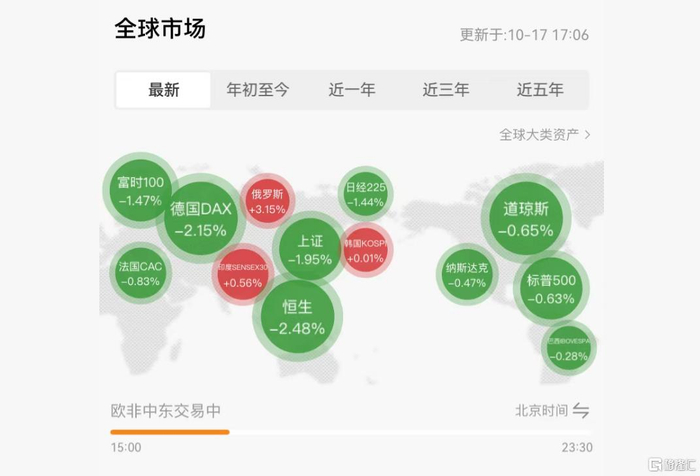
Market Overview - The U.S. banking sector is experiencing panic, leading to significant declines in the Asia-Pacific markets, termed "Black Friday" [1] - The South Korean stock market stands out with the composite index reaching a historical high, achieving a cumulative increase of over 56% this year [1] - Japanese stocks fell after two days of gains, with the Nikkei 225 index dropping by 1.44% [1] A-share and Hong Kong Market Performance - A-shares saw a decline, with the Shanghai Composite Index down by 1.95%, the Shenzhen Component down by 3.04%, and the ChiNext Index down by 3.36% [3][6] - The total trading volume in the Shanghai and Shenzhen markets was 19,544 billion yuan, an increase of 57 billion yuan from the previous day [4] - Hong Kong stocks continued to decline, with the Hang Seng Technology Index falling approximately 4% and the Hang Seng Index down over 2% [5][6] U.S. Stock Market Trends - U.S. stock index futures are continuing to decline, with the Nasdaq 100 futures down by 1.65%, S&P 500 futures down by 1.4%, and Dow futures down by 1% [6][8] - Major tech stocks, including Tesla and Nvidia, are experiencing declines of around 2% [7] Credit Crisis Concerns - There are growing concerns about a potential credit crisis in the U.S. banking sector, with the KBW Bank Index experiencing its largest drop in six months [12] - Two regional banks, Zions Bancorp and Western Alliance Bancorp, saw their stock prices plummet by 13% and 11% respectively due to exposure to fraudulent loans [13] - Recent bankruptcies in the auto loan sector have raised alarms about the overall credit market, with significant losses reported [16] Gold Market Dynamics - The global market is shifting towards a risk-averse mode, with gold prices surpassing $4,300 and its total market value reaching $30 trillion [16] - UBS predicts that the structural forces driving the current "gold rush" will continue, with gold prices potentially rising to an optimistic target of $4,700 per ounce [17]
黑色星期五!全球暴跌原因找到了
Zhong Guo Ji Jin Bao· 2025-10-17 08:37
Market Overview - Global markets experienced a significant downturn on October 17, with major indices in the US, Japan, and Europe all reporting declines. The Nasdaq 100 futures fell by 1.5%, S&P 500 futures dropped by 1.4%, and Dow futures decreased by 1% [2]. The Nikkei futures in Japan fell approximately 2% after market close [3]. In Europe, stock markets opened with collective declines, while in China, the Shanghai Composite Index fell by 1.95%, the Shenzhen Component dropped by 3.04%, and the ChiNext Index decreased by 3.36% [4]. Stock Performance - In the Chinese market, only 602 stocks rose, with 44 hitting the daily limit up, while 4,783 stocks declined [5]. The Hang Seng Index in Hong Kong fell by 2.5%, and the Hang Seng Tech Index dropped over 4% [6]. Key Factors Influencing Market Decline - The decline in the market is attributed to several key factors: 1. Concerns over a potential credit crisis were heightened by the significant drop in stock prices of two US regional banks, Zions Bancorp and Western Alliance Bancorp, which reported losses due to fraudulent loans related to commercial mortgage-backed securities. Zions Bancorp's stock fell by 13% after announcing a $50 million loan write-off, while Western Alliance Bancorp's stock dropped nearly 11% [7][8]. 2. The KBW Bank Index experienced its largest drop in six months, with a total market value loss exceeding $100 billion across 74 large US banks [8]. 3. Recent bankruptcies in the lending sector, including Tricolor Holdings and First Brands Group, have further exacerbated concerns about the stability of the credit market. JPMorgan's CEO Jamie Dimon referenced the "cockroach theory," suggesting that visible issues may indicate more problems beneath the surface [8]. 4. Additionally, there are rising fears regarding potential setbacks in US-China trade relations, particularly following Micron's announcement to halt the supply of server chips to data centers in China [9].
美国区域性银行再现信贷危机,不良商业抵押贷款风险或加速暴露
Bei Ke Cai Jing· 2025-10-17 08:05
Core Insights - The recent fraud incidents involving commercial real estate loans at regional banks in the U.S. have triggered significant market panic, leading to a sharp decline in bank stock prices, with the KBW Regional Banking Index dropping 6.3%, marking its worst single-day performance in months [1][2] Group 1: Market Reaction - The market's concerns over the credit quality of U.S. banks and the economic outlook have intensified, resulting in a surge in demand for safe-haven assets, with over $100 billion wiped off the total market capitalization of 74 large U.S. banks in a single day [2] - Investors have flocked to bonds and gold, causing the yield on 10-year U.S. Treasury bonds to fall below 4%, while gold prices reached historic highs [3] Group 2: Bank-Specific Issues - Zions Bancorp and Western Alliance Bancorp reported fraudulent activities related to loans provided to funds investing in poor-quality commercial mortgages, leading to significant stock price declines of 13% and nearly 11%, respectively [1][5] - Western Alliance Bancorp disclosed to the SEC that it had filed a lawsuit in August due to improper actions by borrowers in commercial real estate loans [5] - Zions Bancorp indicated that its subsidiary California Bank & Trust had two revolving credit loans totaling over $60 million that were in default, resulting in a provision for bad debt impairment of approximately $50 million [6] Group 3: Broader Implications - The incidents at these regional banks highlight a broader concern regarding the deterioration of credit quality and risk management deficiencies, particularly in the context of loans to non-depository financial institutions, which could expose regional banks to higher risks [7] - The recent bankruptcies of automotive suppliers and subprime auto loan companies are expected to lead to significant credit asset losses for U.S. banks, further exacerbating market fears [8][9] - The commercial real estate sector is identified as a potential primary source of credit crises for financial institutions, especially given the high vacancy rates in office buildings and the reliance of smaller banks on commercial real estate loans [10]
刚刚,大跌原因找到了!
天天基金网· 2025-10-17 08:04
Market Overview - On October 17, global markets experienced a significant downturn, with major indices in the US, Japan, and Europe all reporting declines. The Nasdaq 100 futures fell by 1.5%, S&P 500 futures dropped by 1.4%, and Dow futures decreased by 1% [5][11]. - The Japanese Nikkei futures fell by approximately 2% after market close [7]. - In the Chinese market, the Shanghai Composite Index closed down by 1.95%, the Shenzhen Component Index fell by 3.04%, and the ChiNext Index dropped by 3.36% [8]. Market Performance - The total trading volume in the Chinese market reached 19,544.08 billion, with only 602 stocks rising while 4,783 stocks declined [10]. - The Hang Seng Index in Hong Kong fell by 2.5%, and the Hang Seng Tech Index dropped over 4% [10]. Causes of Market Decline - The market's sharp decline is attributed to concerns over a potential credit crisis triggered by the collapse of two regional banks in the US. Zions Bancorp and Western Alliance Bancorp reported significant losses due to fraudulent loans, leading to a sharp drop in their stock prices [11][12]. - The KBW Bank Index recorded its largest drop in six months, with a total market value loss exceeding $100 billion across 74 major US banks [12]. - This situation is compounded by recent bankruptcies in the lending sector, including Tricolor Holdings and First Brands Group, which have raised further concerns about the stability of the credit market [12].

刚刚!黑色星期五!原因找到了
Zhong Guo Ji Jin Bao· 2025-10-17 07:55
Market Overview - On October 17, global markets experienced a significant downturn, with major indices in the US, Japan, and Europe all reporting declines [2][3][4] - The US stock futures continued to fall, with the Nasdaq 100 futures down 1.5%, S&P 500 futures down 1.4%, and Dow futures down 1% [2] - The Japanese Nikkei futures dropped approximately 2% after market close, while European markets opened with collective declines [3] A-share Market Performance - The A-share market opened lower and continued to decline throughout the day, with the Shanghai Composite Index down 1.95%, the Shenzhen Component down 3.04%, and the ChiNext Index down 3.36% [4] - Only 602 stocks rose, while 4,783 stocks fell, indicating a broad market sell-off [4][5] Hong Kong Market Performance - The Hang Seng Index fell by 2.5%, and the Hang Seng Tech Index dropped over 4% [6] Key Factors Behind the Decline - Concerns over a potential credit crisis were triggered by the significant drop in stock prices of two US regional banks, Zions Bancorp and Western Alliance Bancorp, due to fraudulent loans related to commercial mortgage-backed securities [6] - Zions Bancorp's stock plummeted 13% after announcing a $50 million loan write-off, while Western Alliance Bancorp's stock fell nearly 11% [6] - The KBW Bank Index recorded its largest decline in six months, with a total market value loss exceeding $100 billion across 74 large US banks [6] - Additional loan defaults, including the bankruptcy of Tricolor Holdings and First Brands Group, have raised further concerns about the stability of the credit market [7] - Market fears were compounded by potential setbacks in US-China trade relations, particularly with Micron's plans to halt the supply of server chips to data centers in China [7]
刚刚!黑色星期五!原因找到了
中国基金报· 2025-10-17 07:49
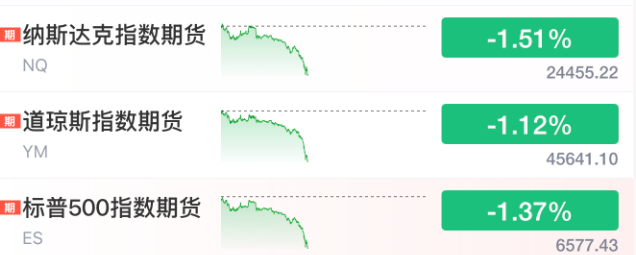
Market Overview - On October 17, global markets experienced a significant downturn, referred to as "Black Friday" [2][4] - Major U.S. stock index futures continued to decline, with Nasdaq 100 futures down 1.5%, S&P 500 futures down 1.4%, and Dow futures down 1% [5] - Japanese stock futures fell approximately 2% after market close, and European markets opened with collective declines [6] A-Share Market Performance - The A-share market opened lower and continued to decline throughout the day, with the Shanghai Composite Index down 1.95%, Shenzhen Component Index down 3.04%, and ChiNext Index down 3.36% [8] - Only 602 stocks rose, while 4,783 stocks fell, indicating a broad market sell-off [10] Key Factors Behind the Market Decline - Concerns over a potential credit crisis were triggered by the significant drop in shares of two U.S. regional banks, Zions Bancorp and Western Alliance Bancorp, due to fraud allegations related to commercial mortgage loans [12] - The KBW Bank Index recorded its largest drop in six months, with a total market value loss exceeding $100 billion across 74 large U.S. banks [13] - Additional worries arose from the potential escalation of U.S.-China trade tensions, highlighted by Micron's decision to halt the supply of server chips to data centers in China [11]

博时基金市场异动陪伴10月17日:沪指跌1.95%,深证成指、创业板指跌超3%
Xin Lang Ji Jin· 2025-10-17 07:42
Market Performance - On October 17, the Shanghai Composite Index fell by 1.95%, while the Shenzhen Component Index and the ChiNext Index both dropped over 3% [1] Analysis of Market Conditions - The decline in the three major indices is attributed to the ongoing risks associated with U.S. regional banks, which have revealed potential losses due to loan issues, raising global concerns about the stability of the financial system. This, combined with uncertainties from U.S.-China trade tensions, has led to a significant tightening of market risk appetite [2] - The rapid increase in gold prices reflects market vigilance towards a potential credit crisis, further suppressing equity asset performance. Additionally, some previously popular sectors in the A-share market have seen substantial gains, prompting profit-taking amid a lack of clear market direction, particularly affecting growth sectors like electric equipment and electronics [2] Domestic Financial Environment - September financial data presents a mixed signal of overall positivity and structural concerns. The M1 growth rate rebounded significantly to 7.2%, indicating enhanced corporate liquidity and improved economic vitality. However, the year-on-year growth of new social financing and credit remains weak, with household loans still lagging and corporate medium to long-term demand needing improvement, suggesting that the recovery of the real economy is not yet solid [2] - A significant decrease in non-bank deposit increments may indicate a slowdown in the willingness of new funds to enter the market, although this could also be related to high year-on-year comparisons and seasonal financial adjustments [2] Market Outlook - In the context of external risks and internal structural transitions, the A-share market may continue to experience a volatile pattern in the short term, with accelerated sector rotation. However, in the medium to long term, the stabilization of the economic fundamentals and deepening capital market reforms are expected to support the recovery of A-share valuations [3] - Defensive sectors such as dividend strategies and essential consumption, which have previously underperformed, may present valuation advantages. Additionally, technology growth sectors like new energy and semiconductors may gradually reveal medium to long-term investment value following recent adjustments. Investors are advised to consider a "core + satellite" strategy, focusing on low-valuation dividend sectors with strong cash flow for core holdings, while opportunistically investing in policy-supported technology leaders for satellite positions [3]

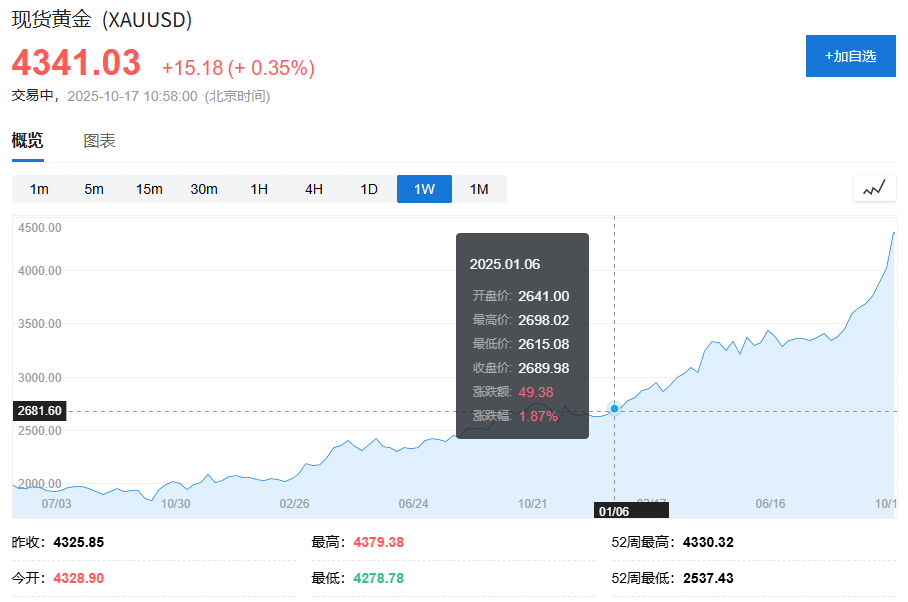
黄金“疯狂上涨”,预示“更大事情”正在发生
Hua Er Jie Jian Wen· 2025-10-17 04:27
Core Insights - The historic rise in gold prices indicates fundamental changes beyond inflation or deflation are brewing [1][4] - As of October 17, gold prices have surged 64% this year, breaking the $4300 mark and nearing $4380 [1][4] Group 1: Gold as a Hedge - Gold is not merely an inflation hedge but also a safeguard against systemic financial risks, including severe credit recessions and large-scale fiscal deficits [4][10] - Holding physical gold is seen as the ultimate collateral since it is not a liability of any entity, making it a preferred asset in times of increasing government and credit risks [4][10] Group 2: Misconceptions about Gold - The market often misunderstands gold as solely an inflation hedge; however, historical data shows gold performs well in both low and high inflation environments [5][6] - If gold were only an inflation hedge, its returns would correlate with rising inflation rates, which is not the case [6][9] Group 3: Credit Market Concerns - Analysts warn of an impending credit crisis, with rising credit spreads indicating increased borrowing costs and risks in the private market [10][11] - Recent events, such as the bankruptcy of First Brands and rising credit spreads, suggest a tightening credit environment [14] Group 4: Government Debt Risks - Governments face unprecedented fiscal deficits, raising concerns about the potential monetization of these debts, which could erode the real value of fiat currencies [17][20] - The market's waning confidence in government collateral is reflected in rising term premiums, contributing to increased yields in developed markets [17][20] Group 5: Future Implications for Gold - Regardless of whether the future shock is inflationary or deflationary, gold is expected to be in high demand [20] - In a credit recession, the need for high-quality collateral will intensify, making gold a valuable asset as traditional collateral may lose value [20]