倚美谋独

Search documents
美方再次亮明弃台主张 民进党当局慌了!
Xin Lang Cai Jing· 2026-01-11 07:55
Group 1 - The core viewpoint of the article is that Trump's recent statement regarding Taiwan, asserting that "the Taiwan issue is China's own matter," has caused significant unrest in Taiwan, indicating a perceived shift in U.S. support for Taiwan [1] - The statement is interpreted by Taiwanese media as a clear indication of the U.S. "abandoning Taiwan" stance, undermining the current administration's reliance on U.S. support for independence [1] - The reaction from the Taiwanese public and media shows a consensus among the blue and white camps, suggesting that Trump's comments resonate with mainstream public opinion in Taiwan [1] Group 2 - The article highlights that the statement from Trump is seen as a blow to the ruling green camp, which is perceived as being overly reliant on U.S. backing for its independence agenda [1] - Commentators in Taiwan suggest that Trump's remarks serve as a wake-up call for the public, emphasizing that true security in the Taiwan Strait is rooted in China's commitment to sovereignty rather than external promises [1]
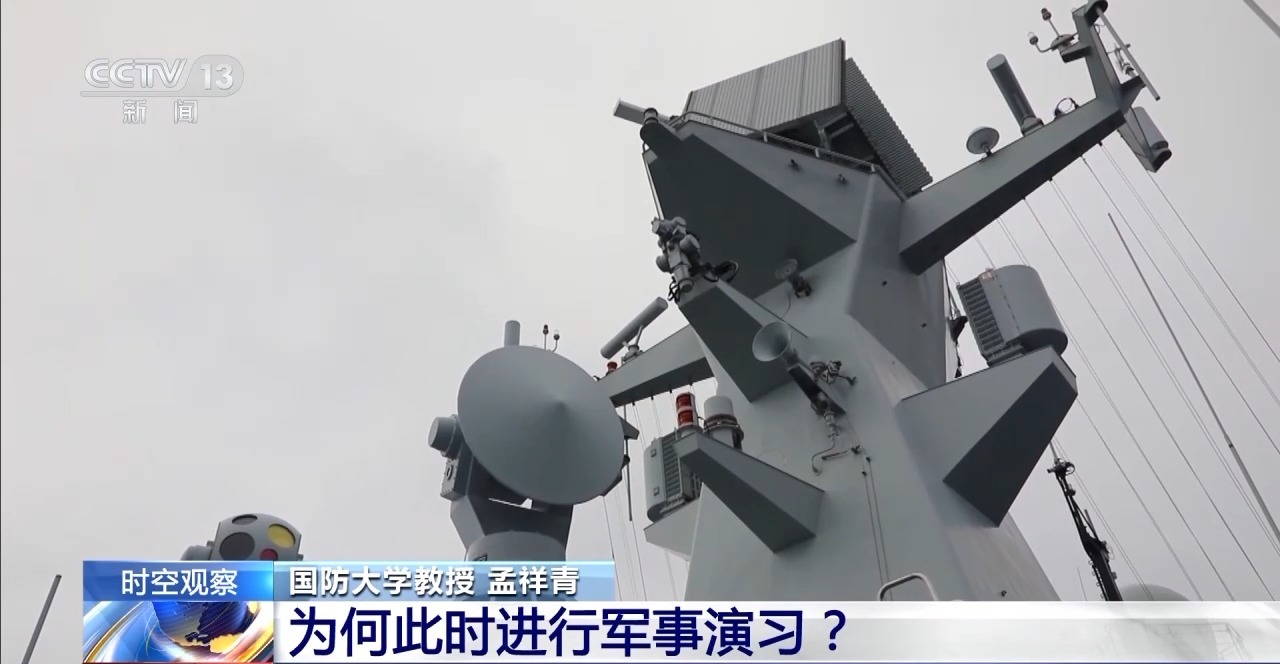
“正义使命-2025”演习向台湾岛内传递什么信号?专家解读
Yang Shi Wang· 2025-12-29 19:37
Group 1 - The military exercise "Mission of Justice-2025" is a response to Taiwan's recent military procurement proposals and actions perceived as provocative by the mainland [1][2] - The U.S. has recently sold $11.1 billion worth of arms to Taiwan, including offensive weapons, marking a significant escalation in military support [4] - The exercise serves as a warning against "Taiwan independence" forces and external interference, emphasizing the commitment to national sovereignty and territorial integrity [6] Group 2 - The exercise conveys a clear message to Taiwan, focusing on punishing "Taiwan independence" actions and deterring foreign intervention, encapsulated in the phrase "punish independence, deter America" [7] - It is emphasized that the military drills are not aimed at the Taiwanese public but specifically target "Taiwan independence" forces, highlighting the incompatibility of "Taiwan independence" with peace [9] - The majority of the Taiwanese population has recognized the futility of "Taiwan independence" and the dangers it poses, understanding that external support is unreliable and primarily serves foreign interests [11][13]

美对台3.3亿美元军售,国台办回应
财联社· 2025-11-19 03:09
Group 1 - The article discusses the recent announcement by the U.S. Department of Defense regarding a military sale to Taiwan valued at approximately $330 million, indicating a commitment to assist Taiwan's military in maintaining its operational readiness [1] - The spokesperson for the Taiwan Affairs Office, Zhu Fenglian, firmly opposes the U.S. providing weapons to Taiwan, urging adherence to the One China principle and the three joint communiqués between China and the U.S., particularly the August 17th communiqué [1] - The article criticizes the Democratic Progressive Party (DPP) for allegedly using military purchases for political gain, describing it as a waste of the Taiwanese people's resources and warning that reliance on external forces for protection will lead to greater danger for Taiwan [1]

向美国缴纳4500亿美元“保护费”?民进党承认,赖清德连任稳了?
Sou Hu Cai Jing· 2025-11-15 10:36
Core Insights - Taiwan has become one of the first economies to negotiate with the U.S. following Trump's initiation of a "reciprocal tariff" war, with the potential for significant "protection fees" involved [1][3] - The Taiwanese government has committed to investing between $350 billion and $550 billion in the U.S., with an estimated average of $450 billion, which is equivalent to four and a half years of Taiwan's fiscal expenditure [3][5] Economic Context - Taiwan's GDP is approximately $800 billion, which means the "protection fee" it needs to pay to the U.S. is disproportionately higher compared to Japan's GDP of about $4 trillion and South Korea's GDP of $1.86 trillion [5] - The political motivations behind these negotiations include the DPP's (Democratic Progressive Party) strategy to rely on the U.S. for independence and the political considerations of Lai Ching-te, who is facing challenges for the 2028 elections [5][7] Defense Spending - Lai Ching-te has publicly committed to increasing Taiwan's defense spending to 5% of GDP by 2023 and has allocated NT$1 trillion for weapon procurement and research [5] - The Nationalist Party (KMT) has expressed concerns about Taiwan's ability to sustain such high defense expenditures, noting that even Israel, under constant threat, has never exceeded 5% of GDP in military spending [5][7] Political Implications - The economic outlook for Taiwan appears grim, as Lai Ching-te aims to significantly increase defense spending while also needing to allocate at least $350 billion to the U.S. [7] - Experts suggest that Taiwan may not have a viable opportunity for the 2028 elections, especially if the KMT wins the upcoming elections and Taiwan does not address the unification issue with the mainland [7]

民进党当局“凯子军购”遭挞伐
Ren Min Ri Bao Hai Wai Ban· 2025-11-13 22:52
Core Points - The Taiwanese government has spent significant amounts on advanced weaponry from the United States, but has faced severe delays in delivery, leading to public criticism of the government's effectiveness [1][2] - The procurement of 66 F-16V fighter jets, originally ordered during Tsai Ing-wen's administration for $8 billion, has yet to deliver any aircraft despite over 80% of the payment being made [2][4] - The Taiwanese defense department has acknowledged serious delays in delivery from the U.S., with other projects like AGM-154 missiles also experiencing similar issues [2][4] - Public sentiment in Taiwan has turned against the government, with many viewing the military purchases as a waste of taxpayer money, often receiving outdated equipment [3][4] - The Taiwanese government plans to increase its defense budget significantly, exceeding 3% of GDP, despite criticism that such spending does not improve security and primarily benefits U.S. arms manufacturers [4][6] - The military purchases are seen as a misguided strategy to seek independence through reliance on U.S. support, which many believe is unreliable [6][7] Summary by Sections Military Procurement - The Taiwanese military's procurement of F-16V jets has faced delays, with no deliveries made as of now, despite substantial payments [2][4] - Other military projects are also experiencing delays, attributed to production line issues and supply chain disruptions [2][4] Public Sentiment and Criticism - There is growing public frustration over the military spending, with many questioning the effectiveness of the purchases and labeling Taiwan as a "sucker" in these transactions [3][4] - Criticism is directed at the government for prioritizing military spending over social welfare for military personnel [4] Budget and Spending - The Taiwanese government plans to increase its defense budget to over 3% of GDP, with future goals of reaching 5% by 2030 [6] - The proposed budget includes a special allocation of 1.3 trillion NTD, which is expected to lead to further delays in weapon deliveries [6] Strategic Implications - The reliance on U.S. military support is viewed as a flawed strategy, with experts suggesting that Taiwan's military capabilities cannot match the strength of the Chinese military [7] - The notion that increased military spending can ensure security is challenged, with calls for improved cross-strait relations as a more viable path to peace [7]
国务院台办:民进党当局 “倚美谋独” 罔顾产业和民生需要
Jing Ji Guan Cha Wang· 2025-11-05 05:06
Core Viewpoint - The Taiwanese semiconductor industry is considered a valuable asset for all Taiwanese people, and the current political actions are seen as detrimental to its future [1] Group 1: Industry Impact - The U.S. President's statement suggests that TSMC's move to the U.S. could lead to the U.S. controlling 50% of the chip market within two years [1] - The Taiwanese government, particularly the Democratic Progressive Party, is criticized for allegedly compromising Taiwan's core industry in favor of U.S. interests, which may harm both the industry and the livelihoods of the people [1] Group 2: Public Sentiment - There is a growing concern among Taiwanese citizens, as reflected in online comments, that Taiwan is losing its competitive edge in the semiconductor industry and lacks leverage in negotiations [1]

国台办:“倚美谋独”“以武谋独”注定是螳臂当车、自取灭亡
Zhong Guo Xin Wen Wang· 2025-10-22 10:50
Core Viewpoint - The Chinese government firmly opposes the sale of weapons by the United States to Taiwan, criticizing the Taiwanese authorities for prioritizing political gains over the welfare of its citizens [1] Group 1: Military Sales and Political Implications - The U.S. and Taiwan recently held a "defense industrial conference," with Taiwan's representative indicating that significant military sales are expected following a special budget for military purchases [1] - The spokesperson emphasized that the Taiwanese government's actions to seek military support from the U.S. will only lead to increased danger and suffering for the Taiwanese people [1] Group 2: Economic Concerns - The spokesperson criticized the Taiwanese authorities for wasting funds that could be used for improving living standards and economic development, instead opting to seek external military support [1] - The statement warns that the approach of relying on the U.S. for military protection is misguided and will ultimately lead to failure [1]
“以武谋独”只会加速自取灭亡 国台办回应赖清德打造所谓“台湾之盾”
Zhong Guo Xin Wen Wang· 2025-10-15 12:41
Core Viewpoint - The Taiwan Affairs Office criticizes Lai Ching-te's proposal to increase Taiwan's defense spending to 3%-5% of GDP, labeling it as a move driven by a separatist agenda that threatens the safety and interests of the Taiwanese people [1] Group 1 - Lai Ching-te's administration is accused of stubbornly adhering to a "Taiwan independence" stance for personal political gain [1] - The proposal to enhance defense spending is seen as a waste of public funds that could be better utilized for improving livelihoods and economic development [1] - The Taiwan Affairs Office warns that such military spending will not bring security but rather escalate tensions and risks of conflict for Taiwan [1] Group 2 - The spokesperson emphasizes that relying on the United States for military support will ultimately lead to failure in achieving independence [1] - The approach of using military means to pursue independence is described as a path to self-destruction [1]
特朗普苦求中国未果,赖清德却选择接盘,为美献上100亿美元大单
Sou Hu Cai Jing· 2025-10-10 04:30
Core Viewpoint - This autumn, U.S. farmers are experiencing a bumper harvest, but they are not celebrating due to a significant drop in soybean orders from China, which has fallen to zero for the first time in nearly 30 years, primarily due to tariffs imposed by the Trump administration [1][3]. Group 1: U.S. Soybean Market - U.S. soybean imports from China have reached a historic low, with the country losing its competitive edge against Brazilian soybeans, which are 10%-15% cheaper due to tariff exemptions [1][3]. - The Taiwanese government announced plans to purchase $10 billion worth of U.S. agricultural products over the next four years, including soybeans, wheat, corn, and beef, in an effort to support U.S. farmers [1][3]. Group 2: Taiwan's Agricultural Impact - The Taiwanese agricultural sector is vulnerable due to limited arable land, and the influx of U.S. agricultural products could severely impact local farmers [3][5]. - The financial burden of the $10 billion procurement translates to nearly 4,000 New Taiwan Dollars per citizen, raising concerns among the local population about the economic implications of such a deal [3][5]. Group 3: Political Dynamics - The Taiwanese administration's decision to purchase U.S. agricultural products is seen as an attempt to curry favor with the Trump administration, hoping to gain political support against mainland China [3][5]. - The ongoing trade war has led to a significant increase in soybean imports from Brazil and Argentina, with Argentina's exports rising by 110% year-on-year [5][7]. Group 4: Public Sentiment - There is growing discontent among the Taiwanese public regarding the government's approach to U.S. relations, with calls for a reassessment of policies that prioritize U.S. interests over local welfare [7].
赖清德当局与美方签了!4年要买3000亿美国农产品,到底换到了什么?
Sou Hu Cai Jing· 2025-09-27 11:35
Economic Situation in Taiwan - Since August, Taiwan's economic difficulties have intensified due to the U.S. "20%+N" tariff policy, leading many businesses to face rising costs and shrinking orders, resulting in reduced working hours and unpaid leave becoming common [1][5] - The Taiwanese government, instead of seeking diverse international economic cooperation, has opted to sign a four-year agreement to purchase 300 billion New Taiwan Dollars (approximately 10 billion USD) worth of agricultural products from the U.S. [1][2] Agricultural Procurement Agreement - The agreement aims to expand Taiwan's agricultural imports from the U.S., including soybeans, corn, and beef, seemingly a straightforward trade deal to enhance economic benefits and trade relations with the U.S. [2][3] - However, this move is perceived as Taiwan "paying the price" for U.S. pressure, particularly as the region faces significant economic challenges due to high tariffs [5][6] Impact on Traditional Industries - Many traditional industries in Taiwan, such as machinery, hardware, and bicycles, are heavily reliant on the U.S. market and are now under immense pressure due to U.S. trade barriers [6][7] - The rise in unpaid leave numbers reflects the economic impact of U.S. tariffs on Taiwanese businesses, with the labor department reporting significant increases in affected workers [6] Political and Economic Implications - Critics argue that the Taiwanese government is using the agricultural procurement agreement to mask its inability to address economic issues, framing external factors as the primary cause of economic troubles [9] - The long-term economic solution for Taiwan may lie in restoring normal economic cooperation with mainland China, as the region has historically depended on external markets, particularly China [9][10] Semiconductor Industry Concerns - Taiwan's high-tech sector, especially TSMC, faces challenges due to U.S. national security investigations, leading to potential tariffs and the need for significant investments in the U.S. [10] - TSMC's cumulative investment in the U.S. has reached 165 billion USD, highlighting the vulnerability of Taiwan's high-tech industry to external policy changes [10] Public Sentiment and Future Directions - Public sentiment in Taiwan is increasingly critical of the government, with many believing that the administration is compromising Taiwan's economic interests by yielding to U.S. demands [12] - The pressing question for Taiwan is whether it can find a path to economic relief by restoring normal relations with mainland China, moving away from a strategy of relying on the U.S. [12]