公募基金降费

Search documents
余额宝10余年来首次降费
Guo Ji Jin Rong Bao· 2025-09-24 02:19
Group 1 - Tianhong Fund announced a reduction in the custody fee for its Tianhong Yu'ebao money market fund from 0.08% to 0.07%, effective September 23 [1] - The management fee remains unchanged at 0.3%, and the sales service fee is still 0.25%, resulting in a total operating fee of 0.62% for the fund [1] - This is the first fee reduction since the fund's inception over 10 years ago, with an estimated cost saving of nearly 80 million yuan for investors due to the 0.01% reduction in custody fees [1] Group 2 - Two other money market funds also announced fee reductions, with Guoxin Guozheng Cash Income reducing its management fee from 0.3% to 0.2% and its custody fee from 0.1% to 0.07%, totaling a fee reduction of 0.13% [2] - E Fund's Guarantee Fund lowered its management fee from 0.2% to 0.15% and its custody fee from 0.08% to 0.05% [2] - The trend of fee reductions has become a prevailing theme in the public fund industry, driven by the low interest rate environment and regulatory changes aimed at reducing sales service fees for money market funds [2]
债基地震!基金C份额“废”了?简评《公募销售费用管理规定》对个人投资者的影响
市值风云· 2025-09-10 10:11
Core Viewpoint - The article discusses the recent regulatory changes in public fund sales fees, emphasizing their significant impact on individual investors and the public fund industry as a whole [3][5]. Summary by Sections Regulatory Changes - The new regulations aim to lower subscription and sales service fees for public funds and redefine redemption fee requirements, mandating a minimum 0.5% redemption fee for investors who redeem before holding for six months [4][6]. Impact on Bond Funds - The introduction of a 0.5% redemption fee for bond funds will discourage individual investors from investing in short-term bond products, as many bond funds have only generated around 0.5% returns this year [7][9]. - Investors are advised to prepare for holding bond funds for at least six months to avoid redemption fees, which may lead to a shift towards bond ETFs for liquidity [9][10]. Changes in Fund Classes - The new rules diminish the advantages of Class C shares, which previously offered lower redemption fees for short-term investors, making Class A shares more appealing for most investors [11][14]. - The article highlights that the previous strategy of using Class C shares for short-term trading will likely become obsolete due to the new regulations [14]. Shift Towards ETFs - The regulatory changes are expected to drive more individual investors towards bond ETFs and other liquid investment products, as public bond funds may lose their role as liquidity management tools [15][18]. - The article notes a growing trend of institutional investors embracing ETFs, indicating a shift in investment strategies within the market [15][16].

爆款单品亮点纷呈 公募积极寻找规模抓手
Zhong Guo Zheng Quan Bao· 2025-09-07 22:29
Core Insights - The public fund management industry is experiencing a fee reduction trend, yet over half of the fund managers achieved year-on-year growth in management fee income in the first half of 2025, indicating a robust performance amidst challenges [1][2][8] - Leading institutions like GF Fund and Fortune Fund have diversified their product offerings and optimized their product structures, resulting in significant scale highlights across various business types [1][3][4] - The success of certain flagship products, such as ETFs and actively managed funds, has contributed to substantial increases in management fees for these institutions [3][6][7] Group 1: Performance and Growth - In the first half of 2025, GF Fund's management fee income from various products, including ETFs and fixed income, increased by over 10 million yuan year-on-year [2][3] - GF Fund's ETFs, such as the GF Nasdaq 100 ETF and GF Hong Kong Innovation Drug ETF, saw significant scale increases, with the latter achieving a return rate close to 90% and a scale increase of over 8.4 billion yuan [3][4] - Fortune Fund's products also performed well, with its Hong Kong Stock Connect Internet ETF becoming the largest in the market, and its management fee income also increasing by over 10 million yuan [4][5] Group 2: Market Trends and Strategies - The trend of multi-point development is evident, with major public fund managers leveraging their diverse product structures to withstand the pressures of fee reductions [2][3] - The rise of passive investment strategies, particularly through ETFs, has allowed fund managers to enhance their competitive edge while maintaining fee income despite overall fee reductions [8][9] - Institutions are advised to enhance their research capabilities, optimize product structures, and improve customer service to strengthen their core competitiveness and achieve sustainable development [1][8][9] Group 3: Product Highlights - Notable products like the Huaan Gold ETF and Tianhong Yu'ebao have attracted significant investor interest, with the former seeing a holder increase of over 210,000 and a scale nearing 60 billion yuan [6][7] - The actively managed funds, such as Yongying Advanced Manufacturing and Penghua Carbon Neutrality, have also seen rapid growth, with both funds surpassing the 10 billion yuan mark in scale [7][8] - The diversification of product offerings and the ability to capitalize on market trends have been crucial for fund managers in maintaining and growing their market positions [5][6][7]
爆款单品亮点纷呈公募积极寻找规模抓手
Zhong Guo Zheng Quan Bao· 2025-09-07 20:52
Core Insights - The public fund industry is experiencing a fee reduction trend, yet over half of the fund managers achieved year-on-year growth in management fee income in the first half of 2025, indicating resilience and adaptation to market pressures [1][2][7] - Leading institutions like GF Fund and Fortune Fund have diversified their product offerings and optimized their product structures, resulting in significant scale highlights across various business types [2][3][4] - The success of specific products, such as ETFs and actively managed funds, has been pivotal in driving growth, with notable increases in assets under management and management fees [3][5][6] Group 1: Fund Performance and Growth - More than half of public fund managers reported a year-on-year increase in management fee income, particularly GF Fund and Fortune Fund, which leveraged their diverse product structures to withstand fee reduction pressures [2][3] - GF Fund's ETFs, including the GF Nasdaq 100 ETF and GF Hong Kong Innovation Drug ETF, saw substantial growth, with the latter achieving a nearly 90% return rate and increasing its scale by over 84 billion [3][4] - Fortune Fund's products, such as the Fortune China Securities Hong Kong Internet ETF, also experienced significant growth, with management fee income increasing by over 10 million [4][5] Group 2: Market Trends and Strategies - The trend of multi-asset allocation is gaining traction, with gold ETFs like Huaan Gold ETF seeing a surge in popularity, contributing significantly to management fee income [5][6] - Active equity funds are also finding success, with products like Yongying Advanced Manufacturing and Penghua Carbon Neutrality achieving remarkable performance and attracting a large number of new investors [6][7] - Industry experts suggest that public fund managers need to enhance their research capabilities, optimize product structures, and improve customer service to maintain competitiveness in a changing market [7][8]
非银金融行业点评报告:公募基金降费第三阶段终落实,预计每年让利300亿,三轮降费合计每年让利500亿
Soochow Securities· 2025-09-07 08:34
Investment Rating - The industry investment rating is maintained as "Overweight" [1] Core Insights - The third phase of public fund fee reduction has been implemented, expected to result in annual savings of 30 billion, with a total of 50 billion saved across three phases [1] - The report outlines the regulatory changes by the China Securities Regulatory Commission (CSRC) regarding the management of sales fees for public funds, which includes lowering subscription and service fees [4] - The fee reduction is expected to significantly impact the banking channels, while third-party and brokerage firms have already been offering lower rates [4] - The overall fee reduction from the third phase is estimated at 30 billion, representing a 34% decrease based on average data from the past three years [4] - The report emphasizes the optimization of the public fund sales ecosystem to encourage long-term holding by investors [4] - The CSRC has approved the operation of a direct sales service platform for institutional investors, which is expected to enhance efficiency and reduce operational costs [4] - The cumulative fee reduction across all three phases is projected to be 50 billion, with the first two phases contributing 14 billion and 6.8 billion respectively [4] Summary by Sections Regulatory Changes - The CSRC has revised the regulations governing public fund sales fees, including reductions in subscription and service fees for various fund types [4] - The maximum rates for subscription and service fees have been lowered significantly, with the aim of promoting investor retention [4] Impact on Industry - The overall impact on brokerage firms is expected to be limited, as the majority of front-end fees are already discounted [4] - The report notes that the reduction in sales service fees will have a minor effect on brokerage revenues, as these fees constitute a small percentage of overall income [4]
A股,下周还能不能涨,关键看什么?
Sou Hu Cai Jing· 2025-09-06 02:58
Group 1 - The regulatory environment is actively implementing previously promised reforms, such as the public fund fee reduction, which is expected to be implemented soon [1] - The maximum subscription and purchase fees for stock funds will be reduced from 1.2% and 1.5% to 0.8%, while mixed fund fees will drop from 1.2% and 1.5% to 0.5%. Bond fund fees will also be cut by 50% [1] - The annual sales service fee for stock and mixed funds will decrease from 0.6% to 0.4%, leading to an estimated annual savings of 50 billion yuan for investors [1] Group 2 - The U.S. non-farm payroll data for August recorded only 22,000 jobs, significantly below the market expectation of 75,000, raising concerns about economic recession [2] - Despite initial positive market reactions, U.S. stock markets experienced a decline, with the Nasdaq initially rising nearly 1% before dropping by 0.8% due to mixed sentiments about interest rate cuts and recession risks [2] - Gold futures saw a rise of 1.29%, reaching $3,653, approaching the analyst's target of $3,700, indicating a potential upward trend towards $4,000 [2] Group 3 - There is a high probability of an interest rate cut in September, which is seen as a potential catalyst for market movements [3] - The recent bullish trend in the A-share market has boosted investor sentiment, with expectations for further upward movement, although caution is advised regarding market sustainability [5] - A daily trading volume threshold of 20 billion yuan is suggested as a critical indicator for market performance, with potential adjustments if this level is not maintained [5] Group 4 - There is a belief that the market adjustment is not yet complete, with potential for further lows before a year-end rally, emphasizing the need for gradual adjustments rather than rapid increases [6] - The media is cautioned against overstating low valuations and bull market conditions, advocating for a more measured approach to market movements [6]
腾安基金积极响应公募基金降费举措
Zheng Quan Ri Bao Wang· 2025-09-05 13:45
Group 1 - The core viewpoint of the article is that the China Securities Regulatory Commission (CSRC) is seeking public opinion on the draft regulations for managing sales expenses of publicly offered securities investment funds, which is part of the initiative to promote high-quality development of public funds [1] - The draft regulations aim to encourage sales institutions to adopt an investor-centric business philosophy, shifting focus from scale to investor returns [1] - The regulations are designed to reduce investor costs and promote the development of equity funds, while guiding sales institutions to enhance their service capabilities [1] Group 2 - Teng'an Fund has implemented a one-fold discount on subscription and purchase fees for all platform fund products since 2019 to alleviate investor costs [1] - Since its establishment, Teng'an Fund has generated over 100 billion yuan in cumulative earnings for its users [1] - The company plans to continue leveraging its financial technology capabilities to provide high-quality products and personalized asset allocation services, enhancing investor satisfaction and contributing to the high-quality development of the public fund industry [1]
关于公募基金降费!证监会发文
Sou Hu Cai Jing· 2025-09-05 12:44
Core Points - The China Securities Regulatory Commission (CSRC) has revised the "Regulations on the Management of Sales Fees for Publicly Offered Securities Investment Funds" to promote high-quality development in the public fund industry and reduce investor costs [1] - The revised regulations include 28 articles across six chapters, focusing on lowering fees, optimizing redemption arrangements, encouraging long-term holding, and enhancing sales fee standards [1] Summary by Sections Fee Reduction - The regulations aim to reasonably lower subscription fees, purchase fees, and sales service fee rates to reduce costs for investors [1] Redemption Arrangements - The new rules clarify that the entire redemption fee for publicly offered funds will be included in the fund's assets [1] Encouragement of Long-term Holding - Investors holding equity funds, mixed funds, and bond funds for over one year will no longer incur sales service fees [1] Sales Fee Standards - The regulations establish a differentiated upper limit for trailing commission payments, reinforcing the development orientation of equity funds [1] Sales Fee Regulation - The regulations address issues such as the allocation of interest from fund sales settlement funds and the dual charging of fund advisory services [1] Direct Sales Platform - A direct sales service platform for institutional investors in the fund industry will be established to provide efficient, convenient, and secure services for fund managers [1]
公募降费进行时:超千只基金年管理费率不超0.15%
Zheng Quan Ri Bao· 2025-05-25 16:19
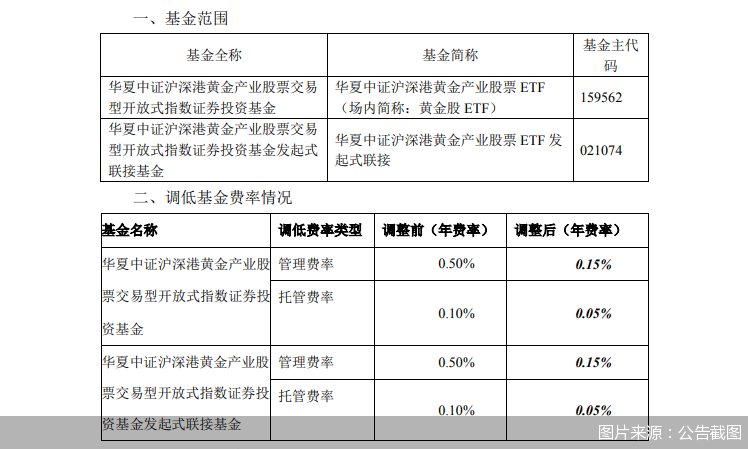
Core Viewpoint - The public fund industry in China is experiencing a steady reduction in management and custody fees, benefiting investors by lowering their investment costs and enhancing their overall experience [1][4][5]. Group 1: Fee Reductions - Multiple leading public fund institutions, including E Fund, Huaxia Fund, and Penghua Fund, have announced reductions in management and custody fees for various fund products since May [1][2]. - Specific examples include E Fund reducing the management fee for its bond funds from 0.30% to 0.15% and from 0.35% to 0.30%, respectively [2]. - The number of products with management fees at or below 0.15% has reached 1009, indicating a significant trend in fee reductions across the industry [4]. Group 2: Impact on Different Fund Types - In addition to bond funds, several ETFs have also reduced their fees, with Penghua Fund lowering its management fee from 0.6% to 0.45% for its technology ETF [3]. - The management fee for Huaxia's gold industry ETF was reduced from 0.50% to 0.15%, showcasing a broader trend of fee reductions across various fund types [3]. Group 3: Industry Dynamics - The fee reduction trend is supported by regulatory guidance aimed at lowering investor costs and enhancing the quality of public fund offerings [5]. - Industry experts suggest that the fee reductions will lead to increased competition among fund managers, particularly affecting smaller firms that may struggle to maintain profitability [5][6]. - The emphasis on research and investment capabilities is seen as crucial for public fund institutions to thrive in a competitive environment, with a focus on delivering strong long-term performance to investors [6].
持续降费!又一只黄金ETF降至最低费率水平
Bei Jing Shang Bao· 2025-05-14 11:50
Core Viewpoint - The recent reduction in management and custody fees for the Huaxia CSI Hong Kong and Shanghai Gold Industry ETF and its connected fund aims to lower investor costs and enhance market competitiveness, with over 80 funds having reduced fees this year [1][3][6]. Fee Reduction Details - Starting from May 15, the management fee for the Huaxia CSI Hong Kong and Shanghai Gold Industry ETF will decrease from 0.50% to 0.15%, and the custody fee will drop from 0.10% to 0.05%, making it the lowest in the market for similar products [3][4]. - As of May 14, over 20% of ETFs have reduced their management and custody fees to the lowest levels of 0.15% and 0.05% respectively [4][6]. Industry Trends - The trend of fee reductions is not limited to gold ETFs; other ETFs such as the Penghua CSI Hong Kong Stock Connect Technology ETF and the Huaxia CSI Dividend Low Volatility ETF have also lowered fees [4][6]. - The overall market still sees more than half of ETFs maintaining management fees at 0.50% and custody fees at 0.10%, with some management fees reaching as high as 1% [4][6]. Regulatory Environment - The China Securities Regulatory Commission (CSRC) initiated a fee reform plan in July 2023, aiming to further reduce fund sales fees starting in 2025, potentially saving investors approximately 45 billion yuan annually [6][7]. - The recent "Action Plan" by the CSRC emphasizes the need to lower investor costs and adjust the assessment criteria for fund managers, aligning their interests with those of investors [6][7].