
原油供应中断

Search documents
油价应声走高!报道:特朗普考虑多种进攻委内瑞拉选项,包括夺取油田
Hua Er Jie Jian Wen· 2025-11-06 08:01
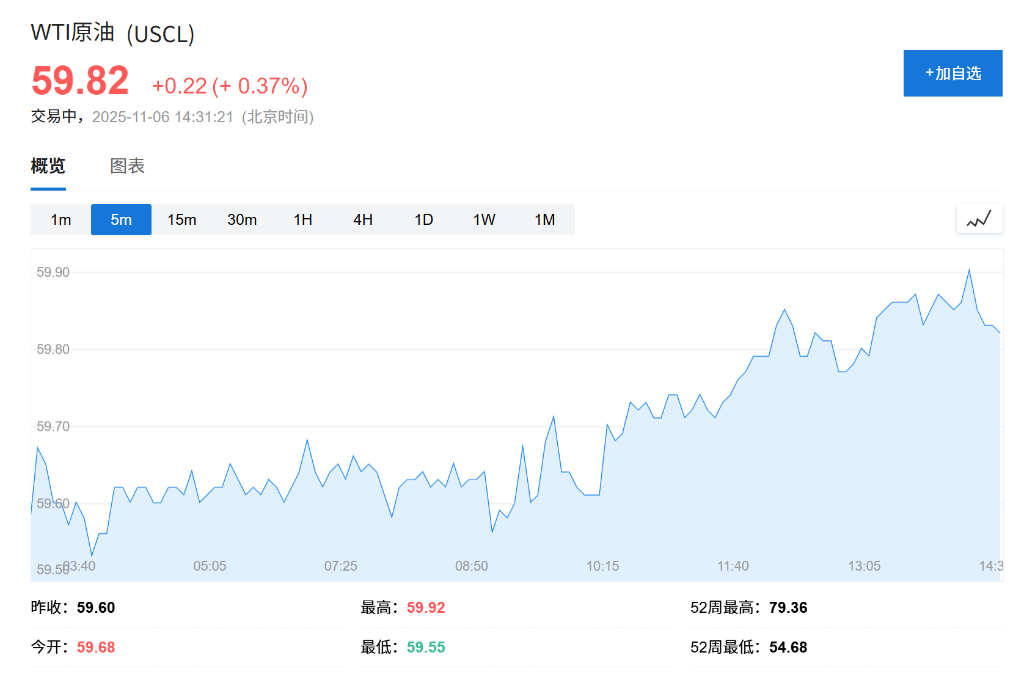
Core Insights - The Trump administration has developed a list of potential military actions against Venezuela, indicating a significant escalation in U.S. policy towards the South American country [1] - Following the news, international oil prices saw a slight increase, with WTI crude rising to $59.82 per barrel and Brent crude reaching $63.75 per barrel [2][5] Military Actions and Legal Framework - U.S. President Trump and senior officials are evaluating military strike options, including special forces targeting Venezuelan government leaders and deploying counter-terrorism units to control oil fields and infrastructure [1] - The U.S. Department of Justice is seeking legal justification for unilateral military action, linking the Maduro government to the "Cartel de los Soles," which is classified as a "drug trafficking terrorist organization" by the U.S. [1][8] Military Deployment and Geopolitical Tensions - The U.S. military has significantly increased its presence in the Caribbean, with 10,000 Army and Marine Corps personnel, 6,000 Navy personnel, and various naval assets being deployed [9] - Recent military actions include 16 airstrikes against Venezuelan maritime targets, resulting in at least 67 deaths, raising concerns about the potential for escalating conflict and its impact on global oil supply [9]

宁证期货今日早评-20251009
Ning Zheng Qi Huo· 2025-10-09 01:41
Report Industry Investment Ratings No relevant content provided. Core Views - Oil prices face medium - term pressure but have short - term support. It is advisable to wait and see or conduct short - term transitional trading [1]. - Do not chase the high price of gold. Observe the further trend of the US dollar index [1]. - For rubber, it is supported by low inventory and low production in the medium term, but the short - term supply - demand drive is weak. Wait and see or conduct short - term trading [3]. - In October, the asphalt market is expected to maintain a low - price stable and high - price pressured trend [4]. - For iron ore, short - term long positions at low prices are recommended [5]. - For coking coal, it is expected to fluctuate in the short term [5]. - For rebar, it is expected to maintain high - level fluctuations. Pay attention to the support levels of the January contracts of rebar and hot - rolled coils [7]. - For silver, observe the market as the follow - up upward momentum is insufficient [7]. - For live pigs, the futures price is expected to fluctuate weakly in the short term [8]. - For palm oil, it is expected to fluctuate strongly in the short term [8]. - For soybeans, the short - term supply is loose, which suppresses the rise of domestic soybean futures prices [9]. - For methanol, the 01 contract is expected to fluctuate in the short term. Wait and see until the price stabilizes after a pullback [11]. - For soda ash, the 01 contract is expected to fluctuate weakly in the short term. Wait and see or conduct short - term long positions after a pullback [12]. - For plastics, the L2601 contract is expected to fluctuate in the short term. Wait and see until the price stabilizes after a pullback [13]. Summary by Variety Oil - On October 5, OPEC+ decided to increase production by only 137,000 barrels per day in November, falsifying the expectation of a large - scale increase. As of the week ending October 3, US crude oil inventories increased by about 2.8 million barrels, far exceeding the market expectation of 2.3 million barrels, while gasoline inventories decreased by 1.3 million barrels and distillate inventories decreased by 1.8 million barrels [1]. - The OPEC production increase cycle suppresses oil prices, but short - term geopolitical factors and OPEC+ policy provide support [1]. Gold - US President Trump is negotiating a Gaza cease - fire agreement, which is close to being reached [1]. - During the holiday, gold and the US dollar index rose simultaneously, but it is not recommended to chase the high price [1]. Rubber - ANRPC's August 2025 report predicts that global natural rubber production in August decreased by 0.7% to 1.379 million tons, and consumption decreased by 1% to 1.256 million tons. In the first 8 months, cumulative production decreased slightly by 0.03% to 8.856 million tons, and cumulative consumption decreased by 0.6% to 10.146 million tons. It is expected that the annual production in 2025 will increase by 0.5% to 14.892 million tons [3]. - In the first 8 months, Vietnam's total exports of natural rubber and mixed rubber were slightly down by 0.1% year - on - year, but exports to China increased by 7.7% [3]. - In September - October, the Southeast Asian main producing areas are in the peak tapping season, with an expected increase in production and exports, and overall limited demand growth [3]. Asphalt - The national petroleum asphalt planned volume in October 2025 was 2.592 million tons, a 0.04% month - on - month decrease and a 22.93% year - on - year increase. During the holiday, the domestic asphalt capacity utilization rate was 36.8%, a 0.2% month - on - month increase [4]. - The "14th Five - Year Plan" for highway construction shows a low growth rate in highway mileage. In October, the demand in the north increased, while that in the south stagnated [4]. Iron Ore - From September 22 - 28, the total arrival volume of iron ore at 47 ports in China decreased by 146,700 tons month - on - month, and at 45 ports decreased by 314,500 tons month - on - month [5]. - Overseas iron ore prices rose slightly during the holiday, and the supply - demand structure improved [5]. Coking Coal - There were supply disturbances such as mine accidents and over - production penalties, and the fourth - quarter long - term contract price of Mongolian coal increased by about $3.8 per ton compared with the third quarter [5]. - Considering the pre - holiday weak market, the impact is expected to be limited, and the post - holiday customs clearance volume is expected to remain high [5]. Rebar - The price of Tangshan billets remained stable at 2,950 yuan per ton, and the spot market was closed with a stable price expectation. During the holiday, there were signs of inventory reduction and then seasonal inventory accumulation [7]. - Pay attention to the demand expectation changes brought by macro variables in October, and the steel price is expected to maintain high - level fluctuations [7]. Silver - The Fed's September meeting minutes show that there is uncertainty about future interest rate cuts. During the holiday, silver followed gold's rise passively, and the follow - up upward momentum is insufficient [7]. Live Pigs - As of October 9, the national live pig price showed a stable - to - weak trend, with most provincial prices falling [8]. - The price during the National Day showed a "off - peak season" downward trend, and the futures price is expected to fluctuate weakly in the short term [8]. Palm Oil - The Indonesian Palm Oil Association requests the government to reconsider the B50 plan in 2024 due to potential insufficient production [8]. - The main producing areas are in the production reduction period, and illegal plantation rectification in Indonesia is beneficial to prices, but weak demand may limit the price rebound [8]. Soybeans - In September, Brazil's soybean export volume was 7.341 million tons, a 20.2% increase in daily export volume year - on - year. The export revenue was $3.11 billion [9]. - New soybeans in Northeast China are on the market in large quantities at low prices, and imported soybeans have sufficient arrivals [9]. Methanol - The market price of methanol in Jiangsu Taicang decreased by 11 yuan per ton to 2,242 yuan per ton. The domestic methanol weekly capacity utilization rate increased by 2.62% to 82.53%, and the downstream total capacity utilization rate increased by 3.83% to 74.62% [11]. - Port and enterprise inventories decreased, and downstream replenishment is expected after the holiday [11]. Soda Ash - The national mainstream price of heavy soda ash is 1,276 yuan per ton, showing a stable - to - weak trend. The weekly production increased by 4.18% to 776,900 tons, and the manufacturer's total inventory decreased by 5.93% [12]. - The float glass start - up rate is stable, and inventory is decreasing, but downstream demand is weak. The soda ash market was stable during the holiday, and downstream replenishment is expected after the holiday [12]. Plastics - The mainstream price of North China LLDPE decreased by 2 yuan per ton to 7,240 yuan per ton. The weekly production decreased by 1.14% to 292,500 tons, and the production enterprise inventory decreased by 18.12% [13]. - The downstream average start - up rate increased, and there is an expectation of replenishment after the holiday [13].
以伊冲突的最坏情况,油价站上200美元?
Hua Er Jie Jian Wen· 2025-06-16 13:49
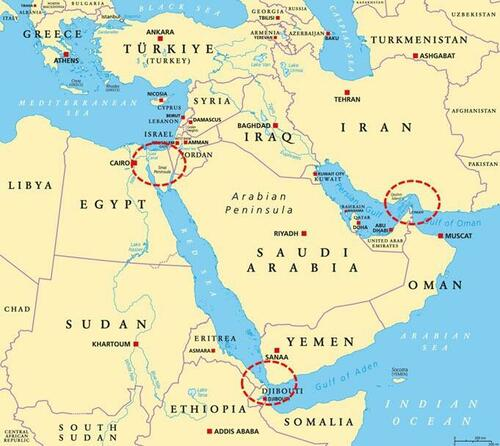
Group 1 - The core viewpoint is that the ongoing tensions in the Middle East, particularly between Israel and Iran, are causing significant uncertainty in the global energy market, with concerns over potential oil supply disruptions [1] - Macquarie's commodity strategist Marcus Garvey warns that in an extreme scenario where Iranian oil supply is completely cut off and the Strait of Hormuz is closed, oil prices could exceed $200 per barrel, compared to the current price around $70 [1][2] - Historical experiences indicate that the market is highly sensitive to large-scale disruptions in oil supply, leading to dramatic price reactions [2] Group 2 - Macquarie's analysis suggests that the current market reflects a moderate increase in risk premium, with Brent crude oil prices potentially rising to over $80 per barrel in the short term, which is $10 higher than recent levels [4] - The market outlook may diverge in the coming weeks; if tensions ease, oil prices may return to fundamentals, while further attacks on Iranian energy infrastructure could push prices towards $100 or higher [4] - Recent attacks on Iranian oil facilities by Israel have already impacted market sentiment, with WTI crude oil experiencing a volatile trading session [4]
以军空袭伊朗引爆恐慌情绪 布油日内涨幅一度扩大至13%
智通财经网· 2025-06-13 03:09
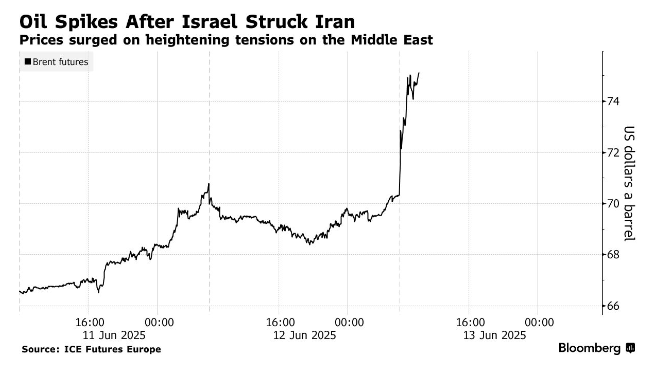
Group 1 - The core concern is the escalation of geopolitical tensions in the Middle East, leading to significant increases in international oil prices, with Brent crude oil futures rising over 13% to surpass $78 per barrel [1][3] - The market is experiencing its largest weekly gain since 2022, recovering losses from earlier in the year due to global trade tensions and OPEC+ production increases [3] - There are fears of potential supply disruptions, with the Brent crude oil spot price structure showing a deepening backwardation, indicating tight short-term supply [3] Group 2 - OPEC+ members, including Saudi Arabia, have considerable idle capacity that could theoretically compensate for any potential loss in Iranian production [4][5] - However, potential retaliatory actions from Iran, such as blocking the Strait of Hormuz, could complicate the utilization of this capacity [5] - The geopolitical risks are prompting the oil market to factor in higher risk premiums for potential supply interruptions [5]
原油价格大涨 伊朗出口受阻 美国制裁加码 市场供应真的要断链?
Jin Shi Shu Ju· 2025-05-21 10:36
Group 1 - Oil prices increased by over 1% due to concerns about potential Israeli strikes on Iranian nuclear facilities, raising fears of supply disruptions in the Middle East [1] - As of the report, Brent crude futures rose by $0.87 (1.3%) to $66.25 per barrel, while WTI futures increased by $0.89 (1.4%) to $62.92 per barrel [1] - Iran's daily crude oil exports exceed 1.5 million barrels, and any disruption could significantly impact oil prices and supply [1] Group 2 - Ongoing negotiations between the U.S. and Iran regarding Iran's nuclear program have not yielded a resolution, with both sides still far apart [2] - Recent data from the American Petroleum Institute (API) indicated an increase in U.S. crude oil inventories, while gasoline and distillate inventories decreased [2] - Investors are awaiting the U.S. Energy Information Administration (EIA) report on crude oil inventory data [3] Group 3 - Kazakhstan's crude oil production increased by 2% in May, contrary to OPEC+ demands for production cuts [3]