全球通胀压力

Search documents
宏观金融数据日报-20260323
Guo Mao Qi Huo· 2026-03-23 03:51
Report Industry Investment Rating - Not provided Core Viewpoints - The stock index is expected to continue its weak oscillation pattern in the short term due to the continuous escalation of the Middle East conflict, which impacts the equity market, squeezes the profit margins of domestic mid - and downstream high - end manufacturing, and restricts the overseas central banks' rate - cut space. In the long run, with the overall economic tone in line with expectations, multiple policies promoting economic growth, ample macro - liquidity, and capital market policies supporting a "slow - bull" market, the stock index is expected to have an upward space and may resume its upward trend as the external geopolitical situation eases and market risk appetite recovers [8] Summary by Relevant Catalogs Money and Bond Market - **Market Data**: DROO1 closed at 1.32 with a 0.03bp increase, DR007 at 1.42 with a 0.62bp decrease, GC001 at 1.10 with a 20.00bp decrease, GC007 at 1.46 with a 2.50bp decrease, SHBOR 3M at 1.52 with a 0.60bp decrease, LPR 5 - year at 3.50 with no change, 1 - year treasury bond at 1.26 with a 0.21bp increase, 5 - year treasury bond at 1.56 with a 0.77bp increase, 10 - year treasury bond at 1.83 with a 1.67bp increase, and 10 - year US treasury bond at 4.39 with a 14.00bp increase [4] - **Market Review**: Last week, the central bank conducted 242.3 billion yuan of reverse repurchase operations. With 176.5 billion yuan of reverse repurchase maturing, there was a net injection of 65.8 billion yuan. Also, 600 billion yuan of 182 - day term repurchase expired, and the central bank carried out 500 billion yuan of 182 - day term repurchase operations and 250 billion yuan of treasury cash fixed - deposit tenders [4] - **Market Outlook**: This week, 242.3 billion yuan of reverse repurchase will mature, with 137.3 billion, 51 billion, 20.5 billion, 13 billion, and 20.5 billion maturing from Monday to Friday respectively. Additionally, 450 billion yuan of MLF will mature on Wednesday [5] Stock Index Futures Market - **Market Data**: The closing prices of major stock indices and their changes are as follows: the CSI 300 closed at 4567 with a 0.35% decrease, the SSE 50 at 2884 with a 1.11% decrease, the CSI 500 at 7760 with a 1.49% decrease, and the CSI 1000 at 7783 with a 1.59% decrease. The closing prices of corresponding stock index futures and their changes are: IF当月 at 4597 with a 0.2% increase, IH当月 at 2898 with a 0.7% decrease, IC当月 at 7844 with a 0.5% decrease, and IM当月 at 7876 with a 0.6% decrease. The trading volume and open interest of stock index futures also changed, with some increasing and some decreasing [7] - **Market Review**: Last week, the CSI 300 fell 2.19% to 4567, the SSE 50 fell 2.47% to 2883.9, the CSI 500 fell 5.82% to 7760, and the CSI 1000 fell 5.25% to 7783.4. Most industries in the Zhongwan primary industry index declined, with only communication (2.1%) and banking (0.4%) rising, while non - ferrous metals (-11.8%), basic chemicals (-10.5%), steel (-10.3%), comprehensive (-8%), and building materials (-7.9%) led the decline. The market sentiment cooled significantly, and A - share trading volume shrank substantially, with the daily trading volume last week being 2339.9 billion yuan, 2224.6 billion yuan, 2061 billion yuan, 2127.3 billion yuan, and 2302.8 billion yuan respectively, and the average daily trading volume decreasing by 244.62 billion yuan compared with the previous week [7] Stock Index Futures Premium and Discount Situation - The premium and discount rates of IF, IH, IC, and IM contracts in different periods are provided, with specific values for the next - month, current - quarter, and next - quarter contracts [9]
不对称的代价!伊朗战争“每持续一天”,对全球经济的伤害“以数月计”
华尔街见闻· 2026-03-21 03:30
Core Viewpoint - The ongoing conflict in the Middle East is causing significant disruptions to global energy markets, with the destruction of oil and gas infrastructure leading to long-term economic damage that could last for months or even years [1][5]. Group 1: Impact of the Conflict on LNG Infrastructure - Qatar's LNG export facilities have been severely damaged by Iranian missile strikes, with repair expected to take three to five years and an annual export loss of approximately 12.8 million tons, translating to a revenue loss of around $20 billion [2][10]. - The LNG market lacks strategic reserves, making it particularly vulnerable to supply shocks; following the news of the attack, European natural gas futures surged by 35%, more than double the levels before the conflict [3][10]. - The damage to Qatar's LNG production capacity is significant, with approximately 17% of total export capacity affected, leading to potential force majeure declarations on long-term contracts with European and Asian customers [10][11]. Group 2: Broader Economic Implications - The conflict's impact extends beyond the energy sector, with a mismatch in the timeline for destruction and reconstruction leading to compounded economic effects; each day of conflict could result in months of global economic repercussions [5][16]. - As LNG supply contracts, inflationary pressures and energy market re-pricing are accelerating, indicating a shift in market dynamics [6][14]. - Morgan Stanley has revised its estimates for Qatar's LNG production capacity utilization down from 90% to 80%, predicting a supply loss of 36 billion cubic meters if the Strait of Hormuz reopens within a month, with further losses for each additional month of delay [13][14]. Group 3: Long-term Market Outlook - Historical data suggests that countries affected by significant supply shocks may still experience substantial production losses years later, with an average of 42% production loss remaining four years post-crisis [16]. - Goldman Sachs warns that if the production potential in Iran and surrounding regions suffers substantial damage, oil prices may remain above $100 for longer than currently anticipated [17]. - The U.S. oil and gas sector is also feeling the impact, with operators hesitant to increase production despite rising prices, reflecting a shift towards capital discipline following past market cycles [19][21].


美国出手当日,中方强势反击,一模一样的手段,没给美国喘息机会
Sou Hu Cai Jing· 2025-10-14 16:54
Group 1 - The U.S. President Trump threatened to impose up to 100% tariffs on Chinese goods, prompting China to respond with significant news, indicating a strategic confrontation with the U.S. [1][3] - China's announcement coincided with the U.S. implementing new export restrictions on rare earth materials, showcasing a calculated timing in their response [3][4] - The U.S. plans to impose a "special port fee" on Chinese vessels starting October 14, 2025, as part of its Section 301 measures against China's maritime, logistics, and shipbuilding industries [6][8] Group 2 - China's countermeasure involves imposing a similar fee structure on U.S. vessels, marking a tit-for-tat response in the maritime sector, with October 14 being labeled as a "decisive day" in U.S.-China economic relations [7][10] - The U.S. shipbuilding industry faces challenges, as the number of vessels operated or owned by U.S. companies in China is substantial, despite fewer ships being built in the U.S. [8][9] - The mutual imposition of fees is expected to significantly increase global shipping costs, potentially exacerbating inflationary pressures worldwide [10][11]
地缘动荡叠加政策转向 黄金酝酿大变局
Jin Tou Wang· 2025-06-23 09:13
Group 1 - The core viewpoint of the articles highlights the rising tensions in the Middle East, particularly following the U.S. military action against Iranian nuclear facilities, which has escalated the geopolitical risks and driven investors towards safe-haven assets like gold [3] - Gold prices experienced significant fluctuations, opening near the $3400 mark and briefly rising by nearly $30 (0.8%) before retreating to around $3365.62, reflecting the impact of heightened geopolitical risks on market sentiment [1][3] - The current market dynamics are reminiscent of the early stages of the 2014 Russia-Ukraine conflict, where initial optimism was followed by prolonged geopolitical instability, suggesting that the situation may evolve similarly [3] Group 2 - Support levels for gold are identified at $3360, $3350, and $3340, with potential declines below these levels leading to further drops to $3330 and $3320 [4] - Resistance levels are noted at $3370, $3380, and $3390, with a significant psychological barrier at $3400, which, if breached, could lead to targets of $3420 and $3430 [4] - The uncertainty surrounding the Federal Reserve's monetary policy, particularly regarding interest rate decisions, is creating additional market variables that could influence gold prices [3]
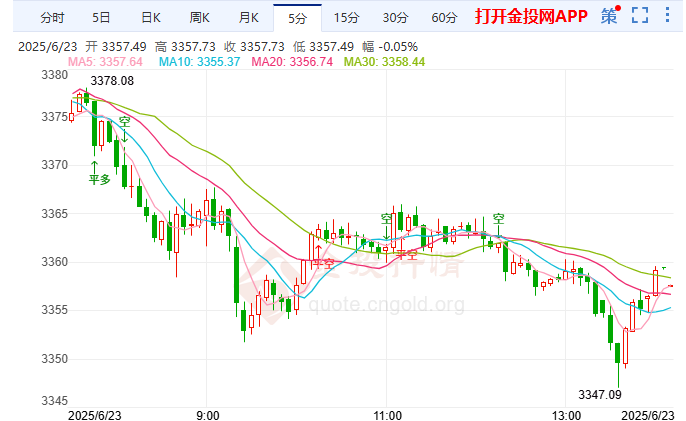
金晟富:6.23黄金高开低走意欲何为?日内黄金行情分析参考
Sou Hu Cai Jing· 2025-06-23 02:22
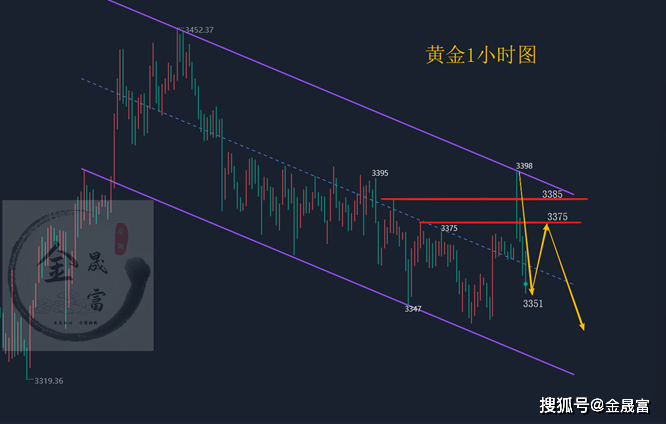
Group 1 - The recent geopolitical tensions in the Middle East, particularly the U.S. airstrikes on Iranian nuclear facilities, have heightened market volatility and increased demand for safe-haven assets like gold and oil [1][2]. - Gold prices experienced fluctuations, opening near $3400 and reaching a peak of $3398.02 before settling at $3365.62, reflecting a 0.2% increase amid rising risk aversion [1]. - The U.S. dollar index rose to a near three-week high of 99.23, driven by safe-haven flows, while U.S. stock index futures initially fell by nearly 1% [1][2]. Group 2 - Central banks globally continued to purchase gold in the first half of 2025, supporting the bullish trend in gold prices despite geopolitical tensions and economic concerns [2]. - The Federal Reserve's potential interest rate cuts later in the year are expected to maintain a favorable environment for gold prices, with expectations of two rate cuts in the second half of the year [2]. - The ongoing conflict in the Middle East, particularly the risks associated with the Strait of Hormuz, could lead to further increases in oil prices and inflationary pressures globally [2]. Group 3 - Technical analysis indicates that gold is currently in a bearish trend, with resistance levels identified at $3375 and potential support around $3340 [3][5]. - Short-term trading strategies suggest a focus on selling at higher levels, particularly around $3375-$3380, while considering buying opportunities near $3340-$3345 [5]. - The market is expected to remain volatile, with traders advised to monitor key economic indicators such as U.S. PCE data and PMI figures from Europe and the U.S. [2][5].
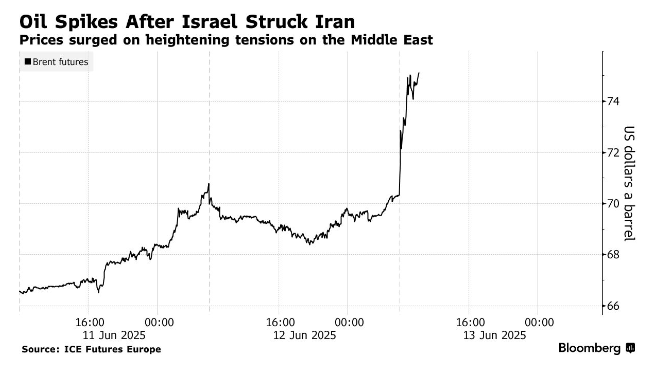
以军空袭伊朗引爆恐慌情绪 布油日内涨幅一度扩大至13%
智通财经网· 2025-06-13 03:09
Group 1 - The core concern is the escalation of geopolitical tensions in the Middle East, leading to significant increases in international oil prices, with Brent crude oil futures rising over 13% to surpass $78 per barrel [1][3] - The market is experiencing its largest weekly gain since 2022, recovering losses from earlier in the year due to global trade tensions and OPEC+ production increases [3] - There are fears of potential supply disruptions, with the Brent crude oil spot price structure showing a deepening backwardation, indicating tight short-term supply [3] Group 2 - OPEC+ members, including Saudi Arabia, have considerable idle capacity that could theoretically compensate for any potential loss in Iranian production [4][5] - However, potential retaliatory actions from Iran, such as blocking the Strait of Hormuz, could complicate the utilization of this capacity [5] - The geopolitical risks are prompting the oil market to factor in higher risk premiums for potential supply interruptions [5]
市场对全球贸易冲突的担忧降温 COMEX黄金保持跌势
Jin Tou Wang· 2025-05-26 08:11
Core Viewpoint - The postponement of high tariffs on the EU by President Trump has eased market concerns over global trade conflicts, reducing demand for gold as a safe-haven asset. However, multiple macroeconomic risks continue to limit the downside potential for gold prices [1]. Group 1: Market Dynamics - COMEX gold is currently trading at $3338.20 per ounce, down 0.58%, with a daily high of $3356.00 and a low of $3329.30 [2]. - The opening price today was $3355.60, indicating a downward trend in the short term [1][2]. Group 2: Influencing Factors - The downgrade of the U.S. credit rating by Moody's from "AAA" to "AA1" has increased the attractiveness of gold as a safe-haven asset, putting pressure on the dollar [1]. - Concerns over global inflation and the U.S. fiscal outlook are expected to support gold prices despite short-term declines [1]. Group 3: Future Outlook - Analysts predict that gold prices will continue to rise by June 2025 due to factors such as the U.S. rating downgrade, ongoing gold purchases by Asian countries, and trade tensions [1]. - Key risk factors to monitor include the upcoming FOMC meeting minutes, trade negotiations between the U.S. and other major economies, and changes in market expectations regarding the dollar [1].
黄金略有承压贸易冲突担忧降温
Jin Tou Wang· 2025-05-26 05:00
Core Viewpoint - Gold prices are experiencing slight pressure due to a delay in high tariffs on the EU announced by President Trump, which has reduced market concerns over global trade conflicts and subsequently weakened demand for gold as a safe-haven asset [2] Group 1: Market Dynamics - As of May 26, gold prices reported at $3347.54 per ounce, with a decline of 0.28%, reaching a high of $3356.32 and a low of $3331.05 during the session [1] - The overall trend for gold last week was a volatile upward movement, with a weekly low of $3204 and a high of $3365, closing the week at $3359 [2] Group 2: Influencing Factors - The delay in tariff implementation has temporarily pressured gold prices, but concerns over global inflation and the U.S. fiscal outlook continue to support gold's value [2] - Moody's downgrade of the U.S. long-term credit rating from "AAA" to "AA1" has increased the attractiveness of gold as a safe-haven asset, putting additional pressure on the dollar [2] - Analysts predict that gold prices will continue to rise, influenced by the U.S. rating downgrade, ongoing gold purchases by major Asian countries, and trade-related anxieties [2]
比特币交易行情震荡调整,XBIT平台助力投资者把握市场脉动?
Sou Hu Cai Jing· 2025-04-28 08:58
Market Overview - The global cryptocurrency market is experiencing volatility, with Bitcoin (BTC) currently priced at approximately $94,450, reflecting a decline of about 0.66% from the previous trading day [1] - After surpassing the $100,000 mark, Bitcoin has entered a correction phase, influenced by cautious market sentiment and profit-taking by some investors [3] - Macroeconomic factors such as expectations of interest rate hikes in the U.S. and global inflation pressures are impacting Bitcoin's price [3] Long-term Outlook - Despite short-term adjustments, the long-term outlook for Bitcoin remains optimistic, with predictions suggesting a potential price of $200,000 by the end of 2025, driven by continued institutional investment and a reduction in Bitcoin supply [3] XBIT Platform Features - XBIT decentralized exchange offers a secure and stable trading environment, utilizing advanced technology and stringent security measures to protect user assets [3][7] - The platform provides comprehensive market data and analytical tools, enabling users to make informed trading decisions [5] - XBIT supports various trading strategies and continuously introduces new features such as leveraged trading and options trading to enhance user experience [5] Investment Strategy - Investors are advised to approach market fluctuations rationally, avoiding impulsive decisions and instead developing reasonable investment strategies based on their risk tolerance [5] - It is recommended to monitor market dynamics closely and adjust investment portfolios accordingly to adapt to market changes [5]