
反向旅游

Search documents
新消费2025:十大关键词,一个新江湖
3 6 Ke· 2026-01-04 02:36
Core Insights - The article highlights significant changes in the consumer market in 2025, emphasizing the emergence of new consumption patterns and the evolution of various sectors within the industry [2]. Instant Retail - Instant retail is recognized as the "explosion year" in 2025, expanding beyond food delivery to encompass a wide range of products [3]. - Major players like JD.com and Alibaba have entered the market, leading to intense competition and a subsidy war among platforms [4]. - The industry is shifting towards a more sustainable model, focusing on long-term ecological coexistence rather than short-term gains [4]. Emotional Consumption - Emotional consumption has become a key trend, driven by the desire for psychological comfort and social recognition among consumers [5]. - The market for emotional consumption in China reached 2.3 trillion yuan in 2024, with projections to exceed 4.5 trillion yuan by 2029 [5]. - Various segments, including healing products and immersive experiences, are gaining popularity, reflecting a shift in consumer preferences [6]. Reverse Tourism - There is a notable increase in tourism orders in county-level areas, with local entrepreneurs capitalizing on unique cultural experiences [7]. - The focus has shifted from traditional sightseeing to immersive local experiences, appealing to younger demographics [7]. Consumption Downward - Lower-tier cities are experiencing a surge in consumer activity, with significant growth in orders during events like Double 11 [8]. - Brands are increasingly targeting these markets, with local players gaining traction through culturally resonant products [8]. Hard Discounts - The hard discount retail sector is expanding, challenging the perception that low prices equate to low quality [11]. - Major internet companies are driving this trend, with new store formats and streamlined supply chains enhancing efficiency [11]. Light Health - Health-conscious products are becoming popular among younger consumers, with a focus on convenience and effectiveness [13]. - The market is evolving to include innovative health products that cater to the busy lifestyles of young professionals [14]. Circular Economy - The circular economy is gaining traction, with a shift in consumer attitudes towards second-hand goods and sustainability [16]. - Platforms like Xianyu and Zhuanzhuan are adapting their strategies to enhance trust and user experience in the second-hand market [17]. Pet Economy - The pet economy is experiencing rapid growth, with a market size exceeding 811.4 billion yuan and a 25.4% annual growth rate [18]. - There is a diversification of products and services catering to pet owners, reflecting a shift towards more personalized and premium offerings [18]. Value Export - Chinese brands are increasingly focusing on global markets, leveraging cultural resonance and operational efficiency to build brand loyalty [19]. - The strategy of value export is reshaping perceptions of "Made in China" and driving foreign trade growth [19]. Prepared Dishes - The prepared dishes industry is moving towards standardization and innovation, addressing consumer trust issues through transparency [20]. - Technological advancements in preservation and quality control are enhancing product offerings in this sector [20].
神州租车发布2025年度自驾出行大数据 跨城自驾成主流
Zheng Quan Ri Bao Wang· 2025-12-31 07:45
Core Insights - In 2025, Shenzhou Car Rental reported a significant double-digit growth in both rental orders and user numbers, indicating a vibrant rental market driven by a strong desire for travel and exploration [1][2][3] Group 1: Market Trends - The self-driving rental market in 2025 experienced unprecedented activity, with high-frequency users (those renting more than five times a year) growing nearly 10% year-on-year, and long-distance rentals (over 800 kilometers) becoming increasingly popular [1] - Cross-city self-driving rentals saw a remarkable 240% increase in order volume, with nearly one million users experiencing the convenience of returning vehicles in different locations [2] - The trend of "reverse tourism" emerged, with lesser-known destinations like Delingha and Jinchang witnessing the fastest order growth, as travelers sought unique experiences away from traditional tourist spots [2] Group 2: Company Developments - Shenzhou Car Rental expanded its network by opening over a thousand new rental locations across the country, focusing on both major cities and high-growth potential areas to enhance user accessibility [3] - The company reported a 50% year-on-year increase in users with international passports, indicating its role as a primary choice for global travelers exploring China [3] - The fleet size reached nearly 200,000 vehicles, with half of the 100,000 new cars added being electric vehicles, aligning with the growing demand for sustainable and high-performance options [3][4] Group 3: Consumer Preferences - Electric vehicles gained popularity among consumers, with models like BYD's Qin Plus and Xiaopeng P7+ becoming top choices for families and young travelers [4] - The introduction of autonomous driving rental services, such as the Yichi 06, marks a significant step towards a more intelligent and convenient self-driving experience [4] - The evolving self-driving rental market reflects a shift in consumer behavior, where renting a vehicle is seen as a means to connect with diverse landscapes and enrich life experiences [4]
神州租车:今年租车市场订单量和用户数两位数增长
Zheng Quan Shi Bao Wang· 2025-12-30 06:30
Core Insights - The car rental market is experiencing significant growth driven by cross-city self-driving trends, the popularity of new energy vehicles, and a new generation's approach to holiday travel [1][2][3] Group 1: Market Growth - In 2025, both rental order volume and user numbers are projected to achieve double-digit growth, indicating strong market vitality [1] - High-frequency users, those renting cars more than five times a year, have increased by nearly 10% year-on-year, with longer trips (over 800 kilometers) becoming more common [1] - Cross-city travel orders have surged by 240% year-on-year, with nearly one million users experiencing the convenience of returning cars in different locations [1][2] Group 2: User Demographics - The market is seeing a significant influx of new users, including over 50,000 individuals who have just obtained their driver's licenses, contributing to a double-digit growth in total rental customers [2] - The post-2005 generation is emerging as the fastest-growing demographic, with a 250% increase in rental users from this group [2] - Frequent renters from this demographic, who rent cars more than seven times a year, have also seen a growth of over 200% [2] Group 3: Fleet Expansion and Vehicle Trends - The fleet size of the company has reached nearly 200,000 vehicles, with half of the 100,000 new cars added this year being new energy vehicles [3] - Popular models among users include BYD Qin Plus, AITO M7, AITO M9, and XPeng P7+, which combine smart technology with comfort [3] - The introduction of autonomous driving rental services, such as the Yichiji 06, indicates progress in innovative rental solutions [3] Group 4: Changing Travel Preferences - There is a notable trend towards "reverse tourism," with increasing orders for less crowded, regionally unique destinations [2] - Major cities continue to serve as key hubs for the rental market, leveraging their robust transportation networks and tourism resources [1][2]
神州租车2025年度数据发布:订单量和用户数实现两位数增长,跨城自驾成出行新常态
Huan Qiu Wang· 2025-12-30 04:37
Core Insights - The car rental market in China is experiencing unprecedented growth in 2025, with both rental order volume and user numbers achieving double-digit growth, reflecting a strong release of user travel intentions [2][4] Group 1: Market Trends - The demand for cross-city and in-depth travel has surged, with cross-city travel orders increasing by 240% year-on-year, indicating a shift towards longer journeys and more adventurous travel experiences [2][3] - High-frequency users, those renting cars more than five times a year, have seen a nearly 10% increase, with longer rental periods averaging around four days [2] Group 2: Destination Choices - The rental market is witnessing a "dual-direction" travel trend, with traditional first-tier cities like Beijing, Guangzhou, and Shanghai remaining key hubs, while lesser-known destinations are gaining popularity [3] - Emerging destinations such as De Lingha in Qinghai and Hami in Xinjiang are experiencing rapid order growth, as travelers seek unique and less crowded locations [3] Group 3: User Demographics - The demographic of car rental users is evolving, with nearly a million first-time renters entering the market, and the post-2005 generation showing a significant increase in rental frequency [4] - Users from the post-2005 generation have seen a 250% increase in rental numbers, with many participating in holiday travel, indicating a shift in consumer behavior towards more frequent and social travel experiences [4] Group 4: Vehicle Trends - The penetration rate of new energy vehicles (NEVs) in the rental fleet has significantly increased, with half of the 100,000 new vehicles added in 2025 being NEVs, aligning with the demand for high-quality and environmentally friendly travel options [5][6] - Popular models among renters include BYD Qin Plus and Xiaopeng P7+, showcasing a trend towards smart and comfortable vehicles [6] Group 5: Company Strategy - The company is expanding its rental network, opening over a thousand new locations to meet growing user demand and enhance service accessibility across the country [3] - The focus on user needs will continue to drive the company's strategy, including optimizing vehicle offerings and enhancing technological experiences to support the evolving travel landscape [6]
同程旅行发布2025年度旅行榜:长线出行北上广至川藏航线热度居首
新华网财经· 2025-12-19 09:28
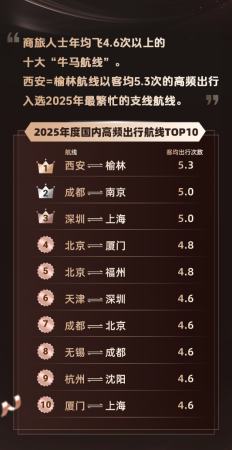
Core Insights - The article highlights the booming travel demand in 2025, characterized by longer distances, higher frequency, and upgraded quality of travel experiences, particularly among non-first-tier cities [1][6][10]. Group 1: Travel Trends - In 2025, there was a strong growth in domestic travel demand, especially for trips over 1,200 kilometers, with popular routes showing an average frequency of over 4.6 trips per passenger [1][3]. - The busiest route was between Xi'an and Yulin, with an average frequency of 5.3 trips per passenger, indicating a significant trend in business travel and regular commuting [5][6]. - Non-first-tier cities accounted for nearly 90% of new users on the platform, reflecting a notable upgrade in travel consumption among these regions [6][11]. Group 2: Popular Destinations - In 2025, five destinations from Xinjiang ranked among the top ten for overnight visitor growth, with booking rates for hotels and homestays increasing by over 45%, and some destinations exceeding 60% [8][21]. - The "奔县游" (County Travel) trend saw counties like Changsha County and others gaining popularity, driven by social media promotion of local attractions and cuisine [14][15]. - The top ten scenic spots in terms of popularity included Jiuzhaigou and other mountainous areas, indicating a strong preference for nature-based tourism [22]. Group 3: International Travel - Southeast Asia remained the top choice for outbound travel, with Malaysia and Singapore leading the list of popular destinations, benefiting from visa-free policies [25][26]. - European destinations like Belgium and Spain showed significant growth in popularity among Chinese tourists, reflecting a diversification in travel preferences [26]. Group 4: Consumer Behavior - The trend of "反向旅游" (reverse tourism) continued to thrive, with younger consumers actively seeking out lesser-known destinations [15]. - The use of AI in travel planning has increased, with users expressing gratitude towards AI tools, indicating a shift towards viewing AI as a travel companion rather than just a tool [28][30].


同程旅行发布2025年度旅行榜:长线出行北上广至川藏航线热度居首
Zhi Tong Cai Jing· 2025-12-19 07:56
Core Insights - The 2025 travel consumption trends indicate a strong demand for domestic tourism, characterized by longer distances, higher frequency, and quality upgrades, particularly in non-first-tier cities [1][4][7] Group 1: Domestic Travel Trends - In 2025, there is a significant increase in travel demand for routes over 1200 kilometers, with some popular routes showing an average frequency of over 4.6 trips per passenger [1] - The busiest domestic route is between Xi'an and Yulin, with an average frequency of 5.3 trips per passenger, highlighting the importance of business travel and periodic commuting [4] - Non-first-tier cities are driving the growth in travel consumption, with nearly 90% of new users for domestic flights coming from these areas [4] Group 2: Popular Destinations - Five destinations from Xinjiang are among the top ten in overnight visitor growth, with hotel and accommodation bookings increasing by over 45% [5] - The "奔县游" (County Travel) trend is gaining traction, with Changsha County ranking first among popular county destinations, driven by social media promotion of lesser-known attractions [9][11] Group 3: International Travel Trends - Malaysia ranks as the top international travel destination for 2025, with a focus on Southeast Asian countries within a five-hour flight radius and visa-free travel options [14] - Other notable international destinations include Singapore and Indonesia, with European countries like Belgium and Spain also showing significant growth in visitor numbers [14] Group 4: Accommodation and Spending Patterns - There is a notable increase in mid-to-high-end accommodation spending in non-first-tier cities, with Chengdu and Chongqing leading in this category [7] - The average length of stay for visitors has increased, particularly in ecologically favorable vacation spots, with many destinations seeing average stays exceeding 2.5 nights [7] Group 5: AI and Travel Experience - The use of AI in travel planning has seen a tenfold increase in user engagement, with travelers increasingly viewing AI as a travel companion rather than just a tool [16]
聚人气,网红变长红(新视窗·培育服务消费新增长点)
Ren Min Ri Bao· 2025-12-16 22:30
Core Viewpoint - The "Guangde Three-piece Set," consisting of hot pot, milk tea, and peach crisp, has gained immense popularity, attracting a significant number of tourists to Guangde City, showcasing the successful integration of culture and tourism in a small county city [1][8]. Group 1: Popularity and Visitor Statistics - The "Guangde Three-piece Set" has seen over 5 billion views online, with 4.17 million visitors recorded in Guangde [1]. - Tourists from the Yangtze River Delta region make up the majority of visitors, benefiting from Guangde's strategic location [2]. - The local tourism has led to a significant increase in business, with daily customer numbers in hot pot restaurants rising to over 30,000, and the number of restaurants increasing from 20 to nearly 40 [4]. Group 2: Economic Impact and Local Development - The average daily revenue for hot pot restaurants has surged to 3,000 to 4,000 yuan, compared to a previous monthly average of 10,000 yuan [4]. - The local economy is experiencing a ripple effect, with hotel occupancy rates exceeding 95%, a 25% increase from before [4]. - Local suppliers of ingredients like bamboo shoots and chestnuts are benefiting from the tourism boom, creating a positive cycle of income for local farmers [5]. Group 3: Strategic Initiatives and Visitor Experience - Guangde has implemented a "Leave Customer Project" to enhance visitor experience, including free hand-drawn maps and a dedicated bus service connecting major attractions [6][7]. - The city has introduced measures to improve service quality, such as free parking for visitors and a commitment from local businesses to ensure fresh ingredients [7]. - Future plans include developing unique local food products and integrating cultural experiences with tourism offerings [8].
存量博弈 消费破局新十年
Mei Ri Jing Ji Xin Wen· 2025-12-14 12:57
Core Insights - The report emphasizes that the future of economic development will focus on quality improvement and resource optimization rather than mere expansion, highlighting the importance of innovation and long-term vision in navigating the current economic landscape [1] Group 1: Market Trends - The consumption industry is experiencing a clear trend of differentiation under the backdrop of stock competition, with the coffee and tea sectors becoming focal points for capital investment [3] - The domestic tourism industry is thriving, with nearly 5 billion domestic trips recorded in the first three quarters of the year, marking an 18% year-on-year increase [3] Group 2: Capital Dynamics - Foreign brands in the coffee and tea market are shifting from a global expansion model to a localized strategy, with significant investments from local partners, exemplified by Starbucks' collaboration with local capital [4] - The upcoming IPO wave in the new tea beverage sector is expected to enhance the supply chain and digital capabilities of various brands, leading to a pronounced "Matthew Effect" in the industry [5][6] Group 3: Global Expansion - New tea brands are poised for international expansion, leveraging their strong domestic market presence and operational capabilities, with a focus on regional management and product health [7] Group 4: Competitive Landscape - Major platforms like JD and Taobao are engaging in a fierce subsidy battle in the instant retail market, with total subsidies reaching approximately 65 billion to 90 billion yuan in the first half of 2025 [8] - The intense competition in the tea and coffee sectors has led to a paradox where increased orders do not necessarily translate to higher profits, as many brands struggle with low-margin orders [9] Group 5: Industry Evolution - The restaurant chain penetration rate in China has reached 25%, with a significant increase in new stores in lower-tier markets, indicating a shift in consumer demand towards branded and standardized dining experiences [10] - The rise of "small town tourism" reflects a changing consumer preference, with travelers seeking value and emotional resonance rather than just popular destinations [18][20] Group 6: Policy and Consumer Behavior - The cross-border tourism market in China is experiencing a dual prosperity driven by favorable policies and enhanced supply capabilities, with inbound tourism showing a 14.9% year-on-year increase [11][12] - The growth of tax refund stores and payment channels is stimulating outbound shopping, with tax refund sales increasing by 97.5% year-on-year [16] Group 7: New Service Models - The emergence of new service roles like "accompanying tours" reflects a shift in tourism services from functional to emotional, catering to consumers' desire for deeper experiences [24] Group 8: Cultural Integration - The integration of sports events with tourism is creating new consumption scenarios, as seen in the Jiangsu Super League, which has successfully linked sports with local tourism [21][22][23] Conclusion - The Chinese consumption market is navigating a path of quality enhancement and diversified breakthroughs, with the tea and coffee sectors undergoing significant transformations and the tourism industry capitalizing on policy advantages and changing consumer preferences [26]

存量博弈 消费破局新十年——十个关键词,看懂中国消费存量竞争
Mei Ri Jing Ji Xin Wen· 2025-12-13 00:33
Core Insights - The consumption market in China is entering a golden period characterized by innovation resilience and value insight, despite ongoing economic challenges [1] - The "14th Annual Development Conference of Listed Companies" highlighted the shift from resource expansion to quality improvement and the importance of optimizing existing resources in the context of stock competition [5][4] Group 1: Economic Trends - The "14th Five-Year Plan" emphasizes high-quality development, focusing on optimizing increments and revitalizing existing resources [4] - In 2025, Hainan's retail sales of consumer goods reached 222.67 billion yuan, a year-on-year increase of 7.8%, significantly outperforming the national growth rate of 4.3% [5] Group 2: Industry Dynamics - The coffee and tea beverage sector is becoming a focal point for capital, with increased IPO and merger activities in 2025, indicating a trend towards resource integration and industry upgrading [7] - The domestic tea beverage market is projected to reach 374.9 billion yuan by 2025, with a compound annual growth rate exceeding 16% from 2023 to 2028 [14] Group 3: Capital and Market Strategies - Starbucks is shifting its strategy in China by forming a joint venture with Boyu Capital, allowing for localized operations and a projected retail business value exceeding 13 billion dollars [10] - The trend of "capital localization" is becoming crucial for foreign brands to adapt to the competitive landscape in China, as evidenced by Starbucks' partnership [12] Group 4: Consumer Behavior and Preferences - The demand for travel and tourism is robust, with nearly 5 billion domestic trips taken in the first three quarters of 2025, reflecting an 18% year-on-year increase [7] - The rise of "reverse tourism" indicates a shift in consumer preferences towards less crowded, value-oriented destinations, with significant growth in county-level tourism [29] Group 5: Digital and Supply Chain Innovations - New tea beverage brands are focusing on digital capabilities and supply chain enhancements post-IPO, aiming to optimize product development and operational efficiency [15] - The integration of digital and intelligent operations is becoming essential for brands to improve efficiency and user experience in the competitive landscape [19] Group 6: Cultural and Emotional Engagement - The emergence of "accompanying services" in tourism reflects a shift towards emotional and experiential value, indicating a growing market potential in the "accompanying economy" [38] - The integration of sports events with tourism is creating new consumption scenarios, as seen with the "Su Super" football league, which significantly boosted local tourism and spending [32][40] Group 7: Future Outlook - The competition in the consumption market will increasingly focus on supply chain depth, digital precision, emotional value, and IP collaboration, as brands seek to navigate the new economic landscape [42] - The resilience and vitality of China's consumption market will continue to be released through innovative strategies and a deep understanding of user demand changes [42]
西部旅游热释放什么信号
Jing Ji Ri Bao· 2025-12-04 01:00
Core Insights - The latest data from the Civil Aviation Administration of China indicates a 4.4% year-on-year increase in domestic passenger transport in October, driven significantly by the tourism boom in third- and fourth-tier cities in the western region [1] - The shift in tourism consumption from traditional sightseeing to deeper experiences is evident, with destinations like Dunhuang, Tengchong, and Kashgar gaining popularity due to their unique natural landscapes and cultural richness [1] - Continuous improvements in infrastructure and the use of digital technology have enhanced accessibility to aviation services, effectively connecting resources and markets, which has resulted in increased passenger flow to western cities [1] Industry Trends - The rising popularity of third- and fourth-tier cities in the western region reflects a broader trend where aviation passenger flow acts as a precursor to the movement of capital, information, and technology, thereby stimulating local service industries such as dining, accommodation, and transportation [1] - Local governments are challenged to enhance their governance capabilities to seize new development opportunities, focusing on both hard infrastructure and soft power improvements to foster a positive interaction between tourism and regional development [2] - Aviation and tourism enterprises are encouraged to actively develop "aviation + cultural tourism" integrated products and explore diverse service models like air-rail intermodal transport to better meet the evolving market demands [2]