
合规文化

Search documents
中国太保寿险山东分公司全面启动“2025年金融教育宣传周”活动
Qi Lu Wan Bao· 2025-09-16 07:16
Core Viewpoint - The company is launching a series of activities for the "2025 Financial Education Promotion Week" to enhance financial knowledge and consumer rights protection, aligning with the national regulatory authority's directives [1]. Group 1: Event Overview - The event is themed "Protecting Financial Rights, Supporting a Better Life" and aims to deepen financial knowledge dissemination and strengthen consumer rights protection [1]. - The activities will take place from September 15 to September 21, focusing on four core areas: cultural guidance, grassroots engagement, collaborative governance, and practical benefits for the public [1]. Group 2: Cultural Guidance - The company integrates its unique compliance culture with consumer protection culture through various promotional activities, emphasizing the importance of integrity and compliance [8]. - Senior management will lead initiatives such as "Senior Executives Discuss Consumer Protection" to educate consumers on insurance principles and credit knowledge [8]. Group 3: Grassroots Engagement - The company utilizes a grassroots "Community Party Building + Financial Education" model to spread financial knowledge through activities in rural areas, communities, schools, enterprises, and business circles [11]. - Collaborations with local government units and community organizations will facilitate ongoing financial education initiatives, making financial knowledge accessible [11]. Group 4: Practical Benefits - The company focuses on enhancing customer service in key areas such as claims and policy management, implementing measures like "sleeping policy" cleanup and dividend report interpretation [24]. - During the Financial Education Promotion Week, the company will continue to address community financial knowledge needs through various initiatives led by party members and enhanced service offerings [24].


启东农商银行:以赛促学强合规 筑牢防线护发展
Zhong Zheng Wang· 2025-08-19 09:42
Core Viewpoint - The article emphasizes the importance of compliance culture in the banking sector, particularly through the initiatives taken by Qidong Rural Commercial Bank to enhance compliance management and mitigate financial risks [1][2]. Group 1: Compliance Initiatives - Qidong Rural Commercial Bank has launched a series of competitions titled "Compliance is Everyone's Responsibility" to promote compliance culture across its seven regions, involving over 50 employees [1]. - The activities aim to strengthen the foundation of the bank's compliance culture by emphasizing leadership in compliance and fostering a collective understanding that compliance is a shared responsibility [1][2]. Group 2: Competition Structure - The competition consists of three main events: a compliance knowledge quiz, a compliance-themed speech, and a compliance case video contest, designed to balance professionalism with practical application [2]. - The compliance knowledge quiz tests participants on financial regulatory policies, industry standards, and internal bank regulations, assessing their professional capabilities and knowledge reserves [2]. - The compliance-themed speech allows participants to share real-life examples of compliance in practice, highlighting the importance of compliance in service delivery [2]. - The compliance case video contest uses real risk events to visually demonstrate compliance points and risk prevention techniques, enhancing the risk identification skills of all employees [2]. Group 3: Future Directions - Qidong Rural Commercial Bank plans to leverage the "Compliance Management Enhancement Year" as an opportunity to deepen compliance culture and implement effective measures that root compliance concepts in daily operations [2]. - The bank aims to provide safer and higher-quality financial services to support local economic development through these initiatives [2].
监控时代:通过创新推动变革
Refinitiv路孚特· 2025-08-19 06:03
Core Viewpoint - The global trade monitoring sector is undergoing significant transformation, evolving from a compliance-driven function to a dynamic, data-driven discipline that impacts business operations [1][2]. Group 1: Evolution of Compliance and Monitoring - Compliance and monitoring functions are transitioning into strategic advisors for risk management, becoming integral to understanding markets, managing data, and controlling risks [2]. - Nearly half of forex companies view trade monitoring and preventing market abuse as key areas for managing or reducing risk exposure, indicating a shift in compliance's role within organizations [2]. - Compliance is now embedded in various business functions, with professionals at all levels taking on more monitoring and risk responsibilities [2][3]. Group 2: Influence of Compliance in Decision-Making - A survey during the LSEG webinar revealed that most participants believe compliance teams now have greater influence in corporate decision-making processes, reflecting a cultural shift where compliance is seen as a driver of business development rather than a hindrance [3][6]. Group 3: Key Drivers of Monitoring Landscape - The monitoring landscape is influenced by three key drivers: 1. Explosive growth in data volume, with market trading volumes and reporting expected to reach historical highs by 2025 [7]. 2. Evolving regulatory requirements, with stricter expectations from regulators regarding data governance and operational resilience [9]. 3. Increasing complexity of market structures, necessitating advanced analytical technologies and unified data sources for effective monitoring [10]. Group 4: Challenges in Trade Monitoring - A significant challenge in trade monitoring is the prevalence of false positives generated by monitoring tools, which can overwhelm teams with irrelevant information [12]. - Companies are encouraged to adopt a tactical approach by utilizing regulatory datasets designed for market abuse detection and calibrating alert mechanisms to capture extreme behaviors [12][13]. Group 5: Role of AI and Innovation - Advances in AI and natural language processing are enabling companies to shift from reactive detection to proactive prevention, allowing for real-time behavior correction [15][16]. - Some companies are deploying AI solutions to educate employees in real-time during potentially inappropriate conversations, marking a new phase in monitoring that emphasizes proactive compliance [16]. Group 6: Integration of Trade and Communication Monitoring - The integration of trade monitoring with communication monitoring is becoming increasingly important, as communication can reveal intentions not reflected in trade data [17]. - LSEG collaborates with Global Relay to provide a unified compliance archiving solution that integrates communication monitoring data from various sources, enhancing the ability to respond to regulatory inquiries [17][18]. Group 7: Conclusion on Monitoring's Role - Monitoring has evolved from a backend burden to a forefront discipline in risk management and organizational culture, offering significant competitive advantages when leveraged effectively [18].

十年旧案“炸雷”!东海证券吃6000万罚单,投行业务腰斩、IPO添堵
Sou Hu Cai Jing· 2025-08-05 14:26
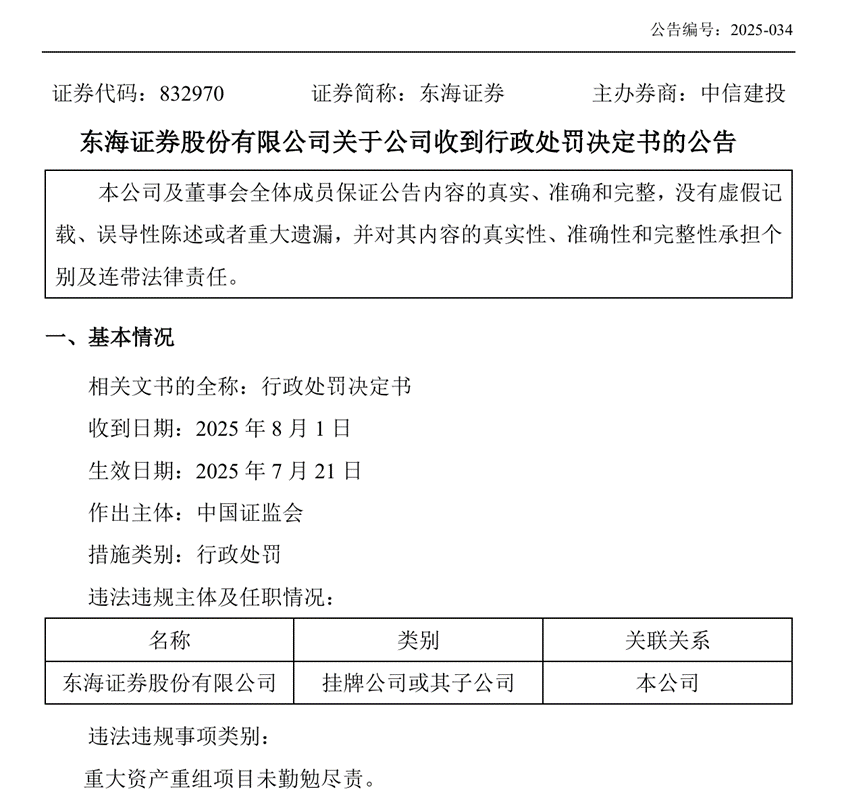
新三板挂牌的东海证券近日公告,公司8月1日收到证监会《行政处罚决定书》,东海证券在担任金洲慈航集团股份有限公 司2015年重大资产重组独立财务顾问的项目中,出具的相关文件存在重大遗漏、虚假记载,在独立财务顾问业务中未勤勉 尽责,被证监会责令改正,没收业务收入1500万元,并处以4500万元的罚款,合计罚没6000万元。 | 名称 | 类别 | 关联关系 | | --- | --- | --- | | 东海证券股份有限公司 | 挂牌公司或其子公司 | 本公司 | 这场并购的溃败,不仅让上市公司走向末路,也使东海证券陷入合规困境,面临"没一罚三"的顶格处罚。值得注意的是, 此次6000万元的处罚金额,相当于公司2024年归母净利润的2.5倍。 另据东海证券2025年半年报显示,在上半年的营业外支出中,该公司已计提上述行政处罚带来的5406.92万元损失。 | 项目 | 本期发生额 | 上期发生额 | 计入当期非经常 | | --- | --- | --- | --- | | | | | 性损益的金额 | | 行政罚款、滞纳金 | 54,069,168.83 | 3,753.15 | 54.069.168.83 | ...
“鲸”彩绽放:建设银行威海经发支行以“鲸”文化品牌书写中国特色金融文化实践新篇
Qi Lu Wan Bao· 2025-06-25 12:05
Core Viewpoint - The article highlights the innovative financial culture practices of the Bank of China in Weihai, which has adopted a "whale" cultural brand to embody the essence of Chinese financial culture and has been recognized as a model for financial cultural innovation by 2025. Group 1: Cultural Branding - The bank's "whale" cultural brand is centered around the principles of "sincerity, wisdom, virtue, and stability," which are translated into practical applications in financial services [1][14]. - The bank has successfully integrated the "Five Musts and Five Must Nots" of Chinese financial culture into its operations, leading to its selection as a case study for financial cultural brand innovation [1][14]. Group 2: Service Innovation - The bank has established a unique service brand called "Precise Aging Services," which includes specialized services for elderly clients, contributing to 35% of personal deposits and 41% of fixed deposits from this demographic [3][4]. - The bank has created a comprehensive service system that includes a "Silver Age Window," specialized personnel, and educational programs to enhance customer experience for older clients [3][4]. Group 3: Financial Innovation - The bank has introduced innovative financial products tailored to various sectors, such as "Yunong Quick Loan" for agricultural enterprises and "Technology Finance + Equity Financing" for tech companies, addressing financing challenges [8][9]. - As of Q1 2025, the bank reported a general deposit balance of 9.01 billion and a loan balance of 8.32 billion, leading the local market [8][9]. Group 4: Social Responsibility - The bank promotes a culture of social responsibility through its "Love Service Month," providing community support and engaging in various charitable activities, including serving breakfast to sanitation workers [10][14]. - The bank has been recognized as a top taxpayer in the region, contributing over 10 million in new taxes over the past three years, reflecting its commitment to social responsibility [10][14]. Group 5: Compliance and Risk Management - The bank has implemented a comprehensive compliance management system, ensuring a "zero non-performing loan" record and maintaining safety in operations [13][14]. - Regular training and emergency drills are conducted to reinforce compliance and risk management among employees, contributing to the bank's reputation as a regional benchmark for financial risk control [13][14].


合规护航:中国企业在全球化浪潮中的安全航标- 从本土合规到全球治理的进阶挑战
Sou Hu Cai Jing· 2025-06-12 05:11
Group 1 - Compliance management is essential for modern enterprises as it serves as a self-diagnostic and defense system to identify and analyze applicable laws and regulations, ensuring adherence and continuous monitoring [2][3] - A robust compliance management system can effectively prevent negative impacts from violations, such as hefty fines and reputational damage, thereby safeguarding long-term interests [2][3] - The importance of compliance management is heightened for Chinese enterprises due to increasing anti-corruption efforts and a complex global regulatory environment [2][8] Group 2 - The compliance management system is a continuous improvement process rather than a one-time task, requiring ongoing monitoring and adjustments to adapt to new risks [4][6] - Effective compliance management typically includes eight core components, such as leadership commitment, risk assessment, operational controls, and training [5][6] - ISO 37301 is a globally recognized standard for compliance management, providing clear requirements for enterprises to enhance their credibility and competitiveness in international markets [7][6] Group 3 - Chinese enterprises must understand the unique political and legal environment to effectively manage compliance, as recent policies have led to stricter regulations and enforcement [8][9] - The enterprise social credit system in China integrates compliance management with market behavior, imposing penalties on non-compliant firms, which can affect both the company and its executives [10][9] - Industry-specific regulations require tailored compliance strategies, as a one-size-fits-all approach may not effectively mitigate regulatory risks [11][9] Group 4 - As Chinese enterprises globalize, they face legal compliance challenges that necessitate adherence to international regulatory frameworks and understanding local laws in target markets [12][15] - Key areas of concern include international tax compliance, data security, anti-bribery measures, intellectual property protection, labor laws, and management of business partners [15][17][18][19][20] - Cultural differences can significantly impact compliance practices, necessitating adjustments in corporate behavior and communication strategies to mitigate legal risks [21][20] Group 5 - A comprehensive and flexible compliance framework is crucial for Chinese enterprises to navigate the evolving regulatory landscape effectively [23][24] - Cultivating a strong compliance culture that starts from leadership and permeates the organization is vital for building trust and credibility in international markets [24][25] - Utilizing technology to enhance compliance management efficiency through automation and real-time monitoring is increasingly important [25][26] Group 6 - Regular risk assessments and audits are essential for identifying and addressing potential compliance issues before they escalate [26][27] - Continuous improvement of the compliance management system is necessary to adapt to changing regulations and emerging risks [27][28] - Future compliance management trends include a shift from passive adherence to compliance culture as a core competitive advantage [32][33] Group 7 - The integration of compliance management with business strategy is becoming increasingly important, as it can drive business development and mitigate risks [34][35] - Chinese enterprises must establish a dynamic compliance management mechanism to respond swiftly to regulatory changes and maintain compliance [33][34] - The evolution of compliance management from a regulatory burden to a strategic asset is essential for sustainable growth in the global market [35]

农业银行推进合规建设提质创优
Xin Hua Wang· 2025-03-26 02:29
Core Viewpoint - Agricultural Bank is actively enhancing its compliance culture to support high-quality business development in response to changing internal and external conditions [1][2]. Group 1: Compliance Management Upgrade - Since the 20th National Congress of the Communist Party, financial regulatory reforms have been implemented, emphasizing the need for banks to transition from passive compliance to proactive governance [2]. - The introduction of the "Compliance Management Measures for Financial Institutions" marks a new phase in compliance management, requiring banks to shift focus from rule-based to risk-based compliance [2][3]. - Agricultural Bank has initiated various activities such as "Compliance Education Year" and "Compliance Benchmark Construction Year" to strengthen compliance culture and infrastructure [2][3]. Group 2: Quality Improvement Activities - The "Quality Improvement and Excellence" initiative aims to deepen previous compliance culture efforts and adapt to changing circumstances [3]. - The 2024 theme focuses on cultivating a unique Chinese financial culture and enhancing regulatory compliance capabilities [3]. - Agricultural Bank promotes compliance from the top down, organizing leadership discussions on compliance and regular training for employees [3][4]. Group 3: Integration of Compliance Management - The bank integrates compliance culture with daily management, emphasizing modernization in compliance governance [4][6]. - New regulatory requirements are being communicated effectively, and the bank is advancing digital and intelligent compliance supervision [4][6]. - A structured approach to compliance self-assessment and governance is being implemented to ensure tangible results [4][6]. Group 4: High-Quality Compliance for Development - Agricultural Bank aims to innovate its compliance culture while continuing to build the "Quality Improvement and Excellence" brand through 2025 [5]. - The bank is committed to a long-term strategy of enhancing compliance management, aligning it with national security and high-quality development goals [6]. - Continuous tracking of compliance risk changes and proactive adjustments to compliance governance are prioritized to enhance overall compliance efforts [6].
