
太空安全

Search documents
仅200米 中美卫星惊险“擦肩”!SpaceX高管指责中国企业 中企反驳 究竟谁在碰瓷?
Mei Ri Jing Ji Xin Wen· 2025-12-15 13:49
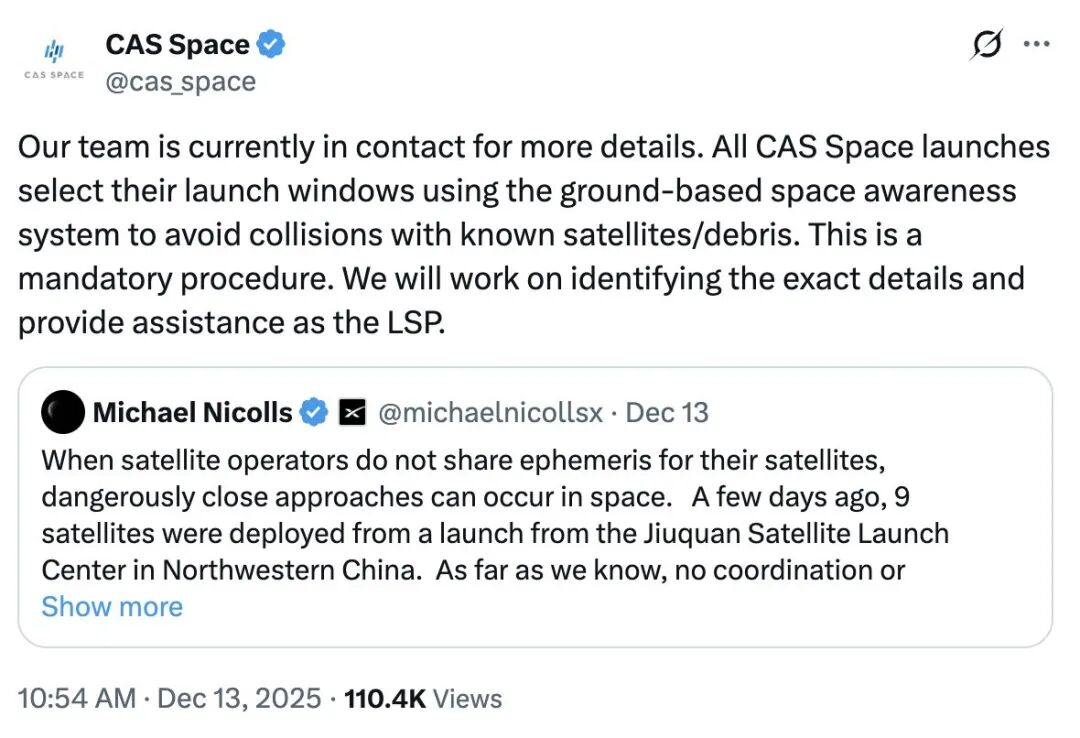
Core Viewpoint - SpaceX's Starlink program has raised concerns regarding satellite collision risks, particularly following a recent incident where a Chinese satellite came within 200 meters of a Starlink satellite, leading to a dispute between SpaceX and China Aerospace Corporation over collision avoidance protocols [1][4]. Group 1: Incident Details - Michael Nichols, Vice President of SpaceX's Starlink program, reported a close approach incident involving a Chinese satellite and a Starlink satellite, which occurred without prior coordination [1]. - China Aerospace Corporation responded, asserting that all their launch missions utilize ground-based space awareness systems to select launch windows and avoid collisions with known satellites or debris, emphasizing this as a mandatory procedure [1][4]. Group 2: Starlink Operations and Challenges - Starlink has faced multiple collision threats, including two incidents in 2021 where Starlink satellites came close to the Chinese space station, prompting emergency collision avoidance maneuvers [4]. - As of February 2025, Starlink has over 6,750 satellites in orbit, with plans to expand to a constellation of 12,000 and eventually 42,000 satellites [4]. Group 3: Maneuvering and Collision Avoidance - From December 2024 to May 2025, Starlink satellites executed over 140,000 maneuvers to avoid collisions, which is 2.8 times more than the previous six months, complicating collision predictions for other organizations [5]. - Starlink satellites are designed to frequently adjust their orbits using electric propulsion systems, which is necessary due to their lightweight design and large solar panel area, making them susceptible to atmospheric drag [5]. Group 4: Coordination and Communication - Experts emphasize the need for responsible spacefaring nations to notify relevant parties when satellites change orbits to prevent collisions, particularly among operational satellites [6]. - Nichols highlighted that the lack of coordination among satellite operators poses significant risks, advocating for the sharing of satellite ephemeris data to enhance safety in space operations [7].

仅200米,中美卫星惊险“擦肩”!SpaceX高管指责中国企业,中企反驳,究竟谁在碰瓷?航天专家解读→
Mei Ri Jing Ji Xin Wen· 2025-12-15 12:24
Group 1 - SpaceX's Starlink program faced criticism from China Aerospace Corporation after a recent satellite launch resulted in a close approach of 200 meters with a Starlink satellite, which was not coordinated [1][3] - China Aerospace Corporation emphasized that all its launch missions utilize ground-based space awareness systems to select launch windows and avoid collisions with known satellites or debris, highlighting this as a mandatory procedure [1][3] - The close approach incident, if confirmed, occurred 48 hours after the satellite payload separation, indicating that the launch mission had already concluded [3] Group 2 - Starlink has previously faced collision threats, including two incidents in 2021 where Starlink satellites came close to the Chinese space station, prompting emergency collision avoidance maneuvers [3] - As of February 2025, Starlink has over 6,750 satellites in orbit, with plans to expand to a constellation of 42,000 satellites [3] - International space experts noted that while the number of Starlink satellites is significant, the primary threat to space safety comes from the larger quantity of space debris, rather than the satellites themselves [3][5] Group 3 - From December 2024 to May 2025, Starlink satellites executed over 140,000 maneuvers to avoid collisions, which is 2.8 times more than the previous six months, complicating collision predictions for other organizations [5] - Starlink satellites are designed to be lightweight with large solar panels, making them susceptible to atmospheric drag, necessitating frequent orbit maintenance [5] - The need for frequent maneuvers is also driven by the requirement to maintain a uniform spatial distribution of the satellite constellation for consistent service [5] Group 4 - Experts highlighted the importance of satellite operators sharing trajectory data to prevent collisions, as uncoordinated maneuvers can lead to dangerous close approaches in space [6] - Michael Nichols from SpaceX stated that the lack of coordination among satellite operators is a significant risk factor in space operations, calling for improved collaboration [6][7] - China Aerospace Corporation acknowledged the need to establish cooperative relationships between the two emerging space ecosystems [7]
156星组网!太空碰撞风险加剧,太空感知星座计划发布
Guan Cha Zhe Wang· 2025-11-27 07:29
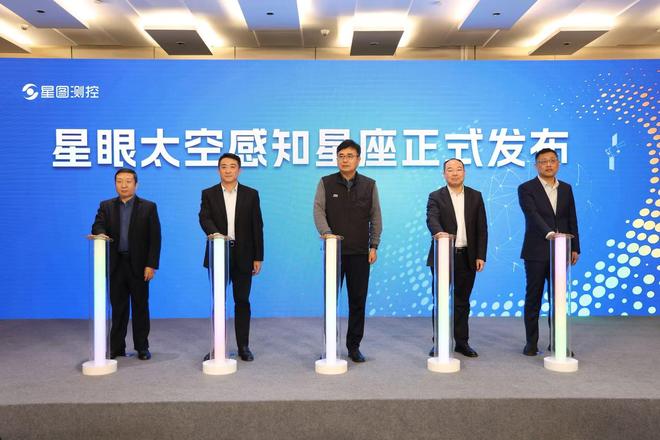
Core Viewpoint - The launch of the "Star Eye" space perception constellation by Xingtong Measurement and Control aims to provide new solutions for space traffic management amidst increasing satellite launches and collision risks in space [1][5]. Group 1: Industry Context - The global satellite launch frequency is rapidly increasing, with large-scale constellation deployments becoming mainstream, marking a robust development phase for commercial space [3]. - The space environment faces unprecedented challenges, with over 50,000 pieces of debris larger than 10 cm and approximately 1.2 million pieces between 1 cm and 10 cm, posing significant risks to operational satellites [3]. Group 2: Incident Background - Several incidents of space collisions have occurred, including damage to the Shenzhou-20 spacecraft and the Tianhe space station due to space debris, highlighting the urgent need for improved space safety measures [4]. Group 3: Government Initiatives - The national government emphasizes space safety through the "Action Plan for Promoting High-Quality and Safe Development of Commercial Space (2025-2027)," integrating commercial space into the overall national space development strategy [5]. Group 4: "Star Eye" Constellation Details - The "Star Eye" constellation consists of 156 satellites designed to create a global, responsive near-Earth orbit monitoring network, utilizing the "Observer" space information analysis platform for tracking and collision risk prediction [5][6]. - The constellation will be built in two phases: the first phase includes 12 high-performance satellites, while the second phase will add 144 low-cost satellites to enhance monitoring capabilities [6]. Group 5: Commercial Applications - The "Star Eye" constellation is positioned as a critical infrastructure for the commercial space era, providing a complete ecosystem for monitoring, early warning, and services, including space traffic management and collision risk assessment [7]. - Compared to ground-based observation methods, space-based perception offers significant advantages in coverage and detection efficiency, with ongoing developments from both domestic and international companies [7]. Group 6: Future Development Plans - Xingtong Measurement and Control plans to enhance space management service capabilities through increased R&D investment and collaboration with industry partners, contributing to a safer and more orderly space environment [8].
156星组网!太空碰撞风险加剧,星图测控太空感知星座计划发布
Guan Cha Zhe Wang· 2025-11-27 07:28
Group 1 - The "Star Eye" space perception constellation plan was officially launched by Xingtong Measurement and Control, aiming to provide new solutions for space traffic management [1] - The global satellite launch numbers are rapidly increasing, with large-scale constellation deployments becoming mainstream, leading to unprecedented challenges in the space environment [2] - The European Space Agency reported over 50,000 pieces of space debris larger than 10 cm, approximately 1.2 million pieces between 1 cm and 10 cm, and about 140 million pieces between 1 mm and 1 cm, posing significant collision risks [2] Group 2 - The "Star Eye" constellation consists of 156 satellites designed to create a global, responsive near-Earth orbit monitoring network, capable of tracking, cataloging, and analyzing satellite orbital data [4] - The construction of the constellation is divided into two phases: the first phase will establish a high-performance perception backbone with 12 satellites, while the second phase will add 144 satellites for enhanced low-cost perception [5] - The "Star Eye" constellation is positioned as a key infrastructure for the commercial space era, creating a complete ecosystem of monitoring, early warning, and service [6] Group 3 - Internationally, companies like NorthStar Earth & Space and Turion Space are developing their own satellite constellations for space situational awareness, while domestically, Xingtong Measurement and Control plans to launch experimental satellites by mid-2026 [7] - The development of space perception capabilities is crucial for collision warning and active avoidance, marking a step towards China becoming a space power and participating in future international space governance [7]
构筑太空安全新防线 星图测控“星眼”太空感知星座正式发布
Zheng Quan Shi Bao Wang· 2025-11-27 05:45
Core Insights - The "Star Eye" space perception constellation plan was officially launched by Xingtong Measurement and Control, aiming to create an innovative path for space traffic management and establish a new model for space management services [1][2] - The current space environment faces unprecedented challenges, with an increasing number of satellites in orbit leading to heightened collision risks, threatening the sustainable development of space [1] - The National Space Administration has recently released a plan emphasizing the integration of commercial space into the overall national space development layout, highlighting the growing importance of space situational awareness for national security [1] Company Developments - The "Star Eye" constellation will consist of 156 satellites, designed to create a global, responsive near-Earth orbit monitoring network [2] - The constellation will utilize the self-developed "Observer" space information analysis platform and the space management service platform "Space Cloud" to track, orbit, and catalog satellites, monitor space debris, and analyze satellite orbit data [2] - Xingtong Measurement and Control aims to become a global leader in space management services, focusing on enhancing its capabilities and increasing R&D investment to contribute to a safer and more orderly space environment [2]
德国发布首个国家太空安全战略
Xin Hua She· 2025-11-19 15:19
Core Viewpoint - The German government has released its first national space security strategy, designating space security as one of its "core political tasks" [1] Summary by Relevant Sections Action Areas - The strategy includes three action areas: identifying space dangers and threats, promoting international cooperation and maintaining space order, and establishing deterrence and strengthening defense capabilities [1] Strategic Context - The preface of the strategy states that space is no longer solely for peaceful research but is becoming a stage for conflict, strategic competition, and global power projection. The increasing dependence of socio-economic activities on space services has made space security a "core political task" [1] Objectives and Funding - The strategy aims to ensure that Germany maintains its civil and military space operational capabilities during peacetime, crises, and defense states. This is seen as a crucial measure for protecting national interests and solidifying Germany's position as a "responsible space actor." Close cooperation with NATO allies and international partners is considered a core pillar of the strategy [1] - The German Ministry of Defense plans to allocate €35 billion from its defense budget for space and space security by 2030 [1]
为太空筑路 开运集团“星汉计划”构建太空秩序
Xin Jing Bao· 2025-11-14 11:15
Core Insights - The company is a national-level specialized and innovative "little giant" enterprise deeply engaged in the space sector, recognized as one of China's top 30 commercial aerospace companies [1] - It has established the country's first credible space data platform and space data operation center [1] - The company focuses on space safety and has built a comprehensive space target observation network by constructing 30 ground observation stations globally and launching 108 space-based observation satellites [1] - This network provides support for satellite orbit calculations, predictions, and related industrial applications [1]
法国发布新版国家太空战略,马克龙发声
Huan Qiu Shi Bao· 2025-11-13 22:45
Core Points - France is unveiling a new national space strategy with a focus on enhancing security and competitiveness in the space sector, responding to increasing threats [1] - An additional investment of €4.2 billion will be made on top of the existing €6 billion military space budget by 2030 [1] - The civilian space sector will receive over €16 billion in investments, including dual-use projects [1] - Emphasis will be placed on the development of next-generation reusable launch vehicles, focusing on reusability, low power costs, and high thrust [1] - Macron highlighted the importance of preparing for space as a battlefield, asserting that reliance on a major power or space tycoon is unacceptable [1] Industry Context - France is at a critical turning point in its space ambitions, with public financial constraints potentially limiting progress [2] - Historically, France has been the largest contributor to multiple European Space Agency projects, but its funding capacity may decline compared to Germany and Italy [2] - Germany plans to invest €35 billion in the space sector by 2030, significantly exceeding France's investment goals [2] - Macron expressed concerns that if investments flow into existing American solutions, it would not contribute to building a more sovereign European space system [2]
法国大幅增加太空国防预算以应对新安全挑战
Xin Hua She· 2025-11-13 05:17
Core Points - French President Macron announced an additional investment of €4.2 billion in space defense by 2030 to address increasing space security threats and enhance France and Europe's security and competitiveness in the space sector [1] - The new funding will be added to the existing €6 billion military budget for space, aimed at countering threats such as espionage satellite activities and large-scale GPS signal disruptions [1] - In the civilian space sector, France will invest over €16 billion, which includes dual-use projects, and will focus on the development of next-generation reusable launch vehicles with an emphasis on "reusability, low power costs, and high thrust" [1]
德国拟投入350亿欧元加强太空安全
Zhong Guo Xin Wen Wang· 2025-09-26 15:56
Core Points - Germany plans to invest €35 billion in building a space security architecture by 2030, which includes satellite constellations, ground stations, and secure launch capabilities [1] - The German Defense Minister emphasized that space is becoming a critical area for economic and social development, facing complex security threats [1] - Space systems are integral to Germany's critical infrastructure, forming the foundation of its current and future economic strength and prosperity [1] Investment Plans - The investment will focus on developing early warning and monitoring systems, constructing multi-layered satellite networks, and enhancing anti-jamming capabilities [1] - The planned investment of approximately €35 billion reflects Germany's commitment to securing its interests in space [1] Strategic Importance - Future conflicts are expected to extend beyond Earth to orbital space, highlighting the need for a collaborative approach involving politics, industry, research, and military [1] - The Defense Minister called for accelerated efforts, a national strategy, innovation, and deepened international cooperation to effectively address challenges in space security [1]