太空安全

Search documents
【投融资动态】星地探索天使轮融资,融资额千万级人民币,投资方为涌铧投资
Sou Hu Cai Jing· 2026-02-26 11:28
Group 1 - The core point of the article is that Beijing Xingdi Exploration Technology Co., Ltd. has completed an angel round of financing amounting to tens of millions of RMB, with participation from Yonghua Investment [1] - Beijing Xingdi Exploration Technology Co., Ltd. focuses on satellite security and space safety, positioning itself as an innovative technology enterprise [1] - Since its establishment in June 2023, the company has relied on a top-tier expert team, deep technological accumulation, and core product innovation to provide efficient and reliable safety products and solutions for the aerospace industry [1]


“中美卫星险相撞,星链后怕不已”
Guan Cha Zhe Wang· 2026-01-28 02:27
Core Viewpoint - The rapid expansion of SpaceX's Starlink has raised safety concerns, particularly regarding its proximity to Chinese space operations, prompting adjustments to its satellite constellation to mitigate collision risks [1][5][8]. Group 1: Safety Concerns and Adjustments - Chinese representatives have publicly criticized Starlink for its rapid expansion and the associated safety risks, citing incidents where Starlink satellites nearly collided with the Chinese space station [1][8]. - In response to a near-collision incident in December, SpaceX announced plans to lower the operational altitude of over 4,400 satellites from approximately 550 kilometers to about 480 kilometers to reduce collision probabilities [2][3]. - A report from Chinese researchers indicated that the collision risk was exacerbated by a newly launched satellite, which SpaceX failed to detect in time, highlighting the need for better tracking and operational safety measures [5][7]. Group 2: Technical and Operational Implications - Lowering the operational altitude is expected to improve signal strength and reduce latency; however, it will also increase atmospheric drag, leading to faster orbital decay and potentially higher operational costs due to increased fuel consumption [5][7]. - The report warns against simultaneously lowering all 4,400 satellites, as this could lead to unprecedented operational maneuvers and heightened collision risks [5][7]. - The adjustments made by Starlink are seen as a way to address international criticism, occupy frequency resources, and enhance the company's standing in the industry [7]. Group 3: International Regulatory Context - Concerns about the safety risks posed by large satellite constellations like Starlink have been growing, with calls for better regulation of commercial space activities to ensure compliance with international treaties [8]. - Chinese officials have highlighted the lack of effective oversight over commercial satellite expansions, which they argue poses significant safety challenges, particularly for developing countries lacking tracking capabilities [8].
股市必读:旋极信息(300324)12月31日董秘有最新回复
Sou Hu Cai Jing· 2026-01-04 17:31
Core Viewpoint - The company is actively involved in the aerospace sector, providing products and solutions related to safety and intelligence, particularly in the context of increasing global interest in space security and satellite safety [2][3]. Group 1: Company Performance - As of December 31, 2025, the company's stock price closed at 5.98 yuan, down 0.17%, with a turnover rate of 4.09%, a trading volume of 698,600 shares, and a transaction value of 416 million yuan [1]. - On the same day, the net outflow of main funds was 38.29 million yuan, accounting for 9.2% of the total transaction value [4][5]. Group 2: Company Technology and Services - The company has accumulated years of experience in trusted security technology and has numerous case studies, providing comprehensive security solutions for satellites, ground stations, and satellite terminals [2]. - The company has participated in significant national projects such as manned spaceflight, lunar exploration, and the C919 aircraft, receiving recognition from relevant authorities for its contributions [3]. Group 3: Market Trends and Future Outlook - The company is focusing on digitalization and intelligent data solutions for various industries, including aerospace, and is exploring new application markets in the field of trusted security [2]. - The company does not currently engage in digital currency-related services, and future developments will be communicated through official announcements [3].

4400颗卫星集体降低轨道,危险接近中国空间站,马斯克这招太狠,太空安全再敲警钟
Sou Hu Cai Jing· 2026-01-04 08:57
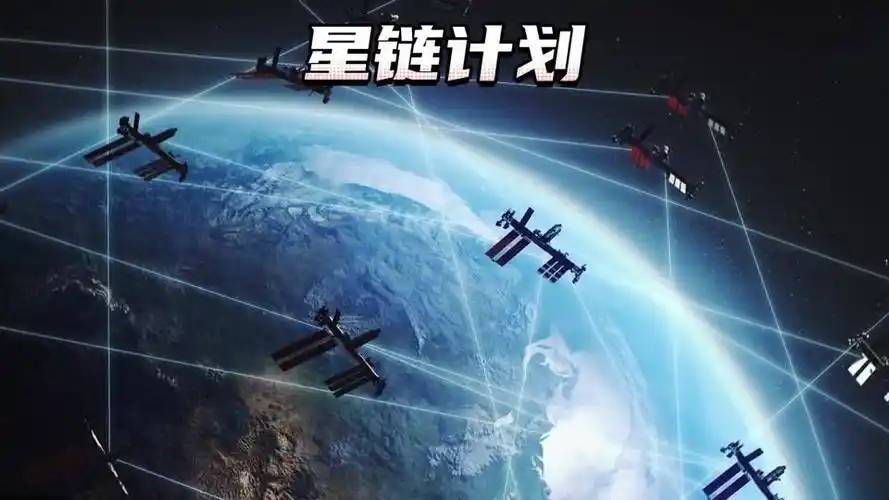
Core Viewpoint - The recent decision by the U.S. to lower the orbital altitude of its Starlink satellites to 480 kilometers is presented as an environmental measure, but it also reflects deeper geopolitical strategies, particularly in relation to China's space activities [1][3][5]. Group 1: U.S. Starlink Initiative - The Starlink program, initiated by SpaceX, aims to deploy a massive network of satellites, originally planned for 12,000 units and later increased to 42,000, with over 10,000 currently in orbit, representing about 60% of active spacecraft globally [1][3]. - The U.S. has decided to lower the orbits of 4,400 satellites from 550 kilometers to 480 kilometers, which significantly reduces the distance to China's space station operating at 390 to 400 kilometers, increasing the risk of potential conflicts [3][5]. - The frequent maneuvering of Starlink satellites adds uncertainty to the already crowded low Earth orbit, raising concerns about collision risks with other spacecraft [3][5]. Group 2: Geopolitical Implications - The lowering of satellite orbits is not merely an environmental initiative but a strategic move that could enhance U.S. military capabilities and influence in global communications, especially highlighted by its role in the Ukraine conflict [5][7]. - The U.S. aims to leverage its low-cost satellite network to gain a stronger voice on the international stage and potentially control the communication infrastructure of other nations [5][7]. - The situation raises concerns about the blending of commercial activities with military intentions, posing challenges for global stability and cooperation in space [5][7]. Group 3: China's Response - In response to the heightened risks in space, China is actively enhancing its defensive measures by deploying a network of space telescopes to monitor satellite activities in near-Earth orbit, improving its accident warning capabilities [7]. - China is also advocating for the establishment of international rules regarding space safety to mitigate risks and enhance transparency and accountability among space-faring nations [7]. - The evolving space environment is increasingly viewed as a new battleground for territorial disputes, necessitating a balance between cooperation and competition to ensure peaceful utilization of space [7].
SpaceX称4400颗“星链”卫星今年将降轨,引发各国天文学家不满
Huan Qiu Wang Zi Xun· 2026-01-03 22:21
Core Viewpoint - SpaceX's Starlink satellite constellation is set to approach 10,000 satellites in orbit by the end of 2025, leading to increasing controversy regarding space safety and regulation [1][2]. Group 1: Satellite Operations and Safety Measures - SpaceX plans to lower the operational altitude of approximately 4,400 Starlink satellites from 550 kilometers to about 480 kilometers by 2026 to enhance space safety [1]. - The restructuring aims to reduce the time it takes for defunct satellites to re-enter the atmosphere and decrease the likelihood of collisions with other satellites and space debris [1][2]. - The current solar activity cycle will affect atmospheric drag, potentially extending the re-entry time for satellites at higher altitudes to over four years, while lower altitudes would allow for re-entry in a few months [1][2]. Group 2: Collision Risks and Regulatory Concerns - The increasing number of satellites, particularly from Starlink, has raised concerns about collision risks and the accumulation of space debris, with approximately 1.4 million pieces of debris estimated in orbit [2]. - A recent incident involved a Starlink satellite nearly colliding with nine Chinese satellites, highlighting the risks associated with uncoordinated maneuvers by satellite operators [2]. - China's representatives have criticized the unchecked expansion of commercial satellite constellations, citing significant safety challenges and resource congestion in frequency bands [2]. Group 3: User Experience and Astronomical Impact - Lowering the operational altitude of Starlink satellites is expected to improve internet latency, enhancing user experience by allowing for a denser user service with smaller beam diameters [3]. - However, this change has faced opposition from astronomers, as the increased brightness of satellites at lower altitudes could interfere with deep-space observations and long-exposure imaging [3].
“中国点名安全风险之际,星链宣布重大调整”
Guan Cha Zhe Wang· 2026-01-02 14:20
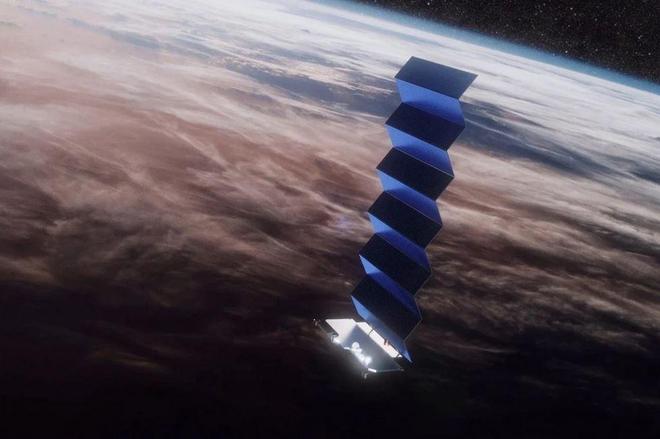
Core Viewpoint - SpaceX plans to restructure its Starlink satellite constellation by lowering the altitude of over 4,400 satellites to enhance space safety and reduce collision risks [1][3]. Group 1: Satellite Reconfiguration - The reconfiguration will lower Starlink satellites from approximately 550 kilometers to about 480 kilometers, which is expected to increase the density of the orbital space and reduce the overall collision probability due to fewer space debris and planned satellite constellations below 500 kilometers [3][4]. - This adjustment is also anticipated to decrease the time it takes for satellites to deorbit during the upcoming solar minimum period, expected around 2030, by over 80% [3][4]. Group 2: Safety and Coordination - SpaceX emphasizes that the restructuring will be coordinated closely with regulatory bodies, other operators, and the U.S. Space Command to enhance the safety of the satellite constellation, particularly in response to uncoordinated maneuvers and launches by other satellite operators [4]. - The reliability of Starlink satellites is highlighted, with only two out of over 9,000 operational satellites having failed, although the company aims for any malfunctioning satellites to deorbit quickly [4]. Group 3: International Concerns - A Chinese representative raised concerns at a UN Security Council meeting about the unchecked expansion of commercial satellite constellations, specifically mentioning Starlink's proximity to the Chinese space station and incidents of debris generation [5][6]. - The representative called for adherence to the Outer Space Treaty and increased regulation of national commercial space activities to mitigate safety challenges posed by satellite constellations like Starlink [6][5]. Group 4: Future Developments - Starlink aims to deploy over 42,000 satellites upon full completion of its network, with each satellite designed for a lifespan of five years before being deorbited [7]. - China is also developing its own satellite constellations, including the Guowang and Qianfan constellations, with plans to deploy over 10,000 satellites [7].
特朗普签令:要求美国人到2028年重返月球,指示在月球和轨道上部署核反应堆
Zhong Guo Xin Wen Wang· 2025-12-19 00:49
Core Viewpoint - The executive order signed by President Trump on December 18 aims to establish a vision for a "America First" space policy, ensuring U.S. leadership in space exploration, security, and commercial sectors [1][4]. Group 1: Moon Mission Objectives - The order mandates a return to the Moon by 2028 and the establishment of initial facilities for a permanent lunar outpost by 2030 [3][6]. - It includes directives for deploying nuclear reactors on the Moon and in orbit to support these objectives [3][6]. Group 2: Infrastructure and Innovation - The order emphasizes upgrading launch infrastructure and developing commercial pathways to replace the International Space Station by 2030, aimed at stimulating private sector innovation and investment [3][6]. - It instructs the President's science and technology advisor to coordinate national space policy efforts and directs federal departments and agencies to implement the order, including streamlining procurement processes and ensuring adequate human resources [3][6].
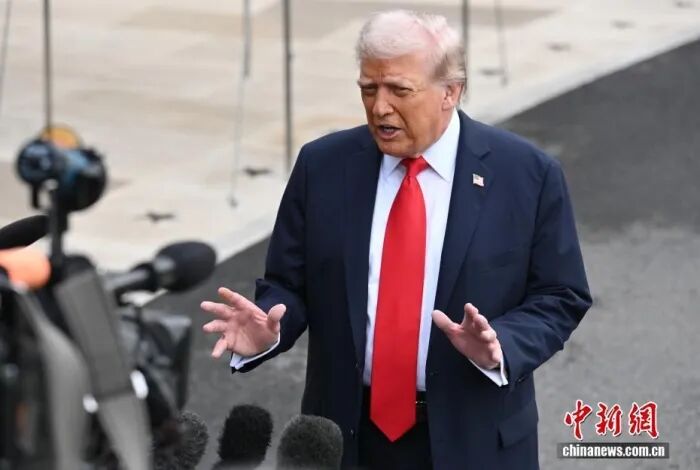
特朗普行政令确认2028年登月目标并取消国家太空委员会
Di Yi Cai Jing· 2025-12-18 23:16
Core Viewpoint - The article discusses President Trump's signing of an executive order to return humans to the Moon by 2028, which is now part of the U.S. national space policy [1] Group 1: Policy Changes - The executive order cancels the White House National Space Council, integrating its functions into a policy coordination mechanism led by the President's chief science advisor [1] - The document emphasizes the importance of enhancing space security and supporting the development of commercial space ventures [1] Group 2: Strategic Goals - The order reaffirms the goal of maintaining U.S. leadership in global space competition [1]
太力科技:目前,航天相关业务在公司整体营收中占比有限
Mei Ri Jing Ji Xin Wen· 2025-12-16 03:44
Core Viewpoint - The company, Taili Technology, has been providing aerospace products and technical support to the Astronaut Center since 2008, with its products having entered space 29 times, supporting national space missions [1] Group 1: Company Orders and Business Focus - The company stated that its aerospace-related business currently accounts for a limited proportion of overall revenue [1] - The company is committed to enhancing its core technology research and development in the aerospace field to support the high-quality development of national and commercial space endeavors [1] Group 2: Product Quality and Industry Position - Through the development of aerospace products, the company has implemented high standards and requirements into its civilian products, achieving industry-leading product quality [1]
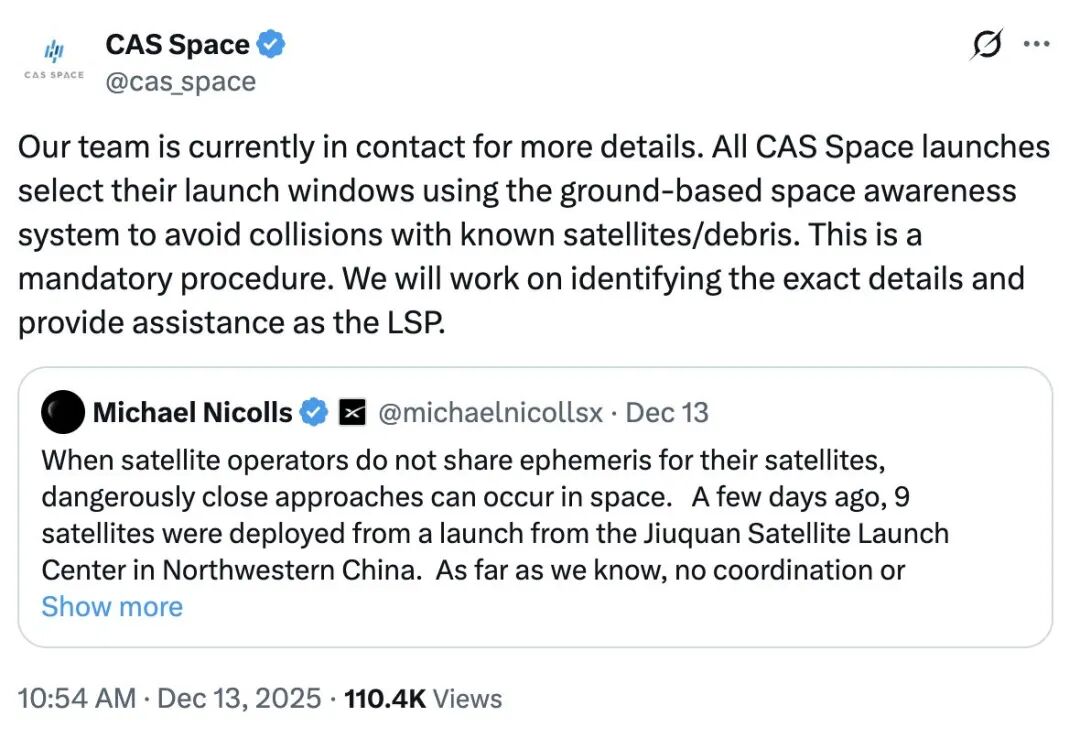
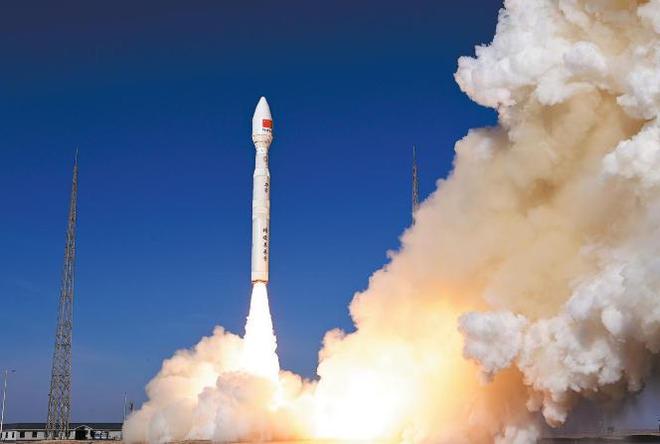
仅200米,中美卫星惊险“擦肩”,SpaceX高管指责中国企业,中企反驳,究竟谁在碰瓷?航天专家解读→
3 6 Ke· 2025-12-16 01:11
Core Viewpoint - The recent close approach of a Chinese satellite to a SpaceX Starlink satellite has raised concerns about space safety and coordination among satellite operators [1][3]. Group 1: Incident Details - SpaceX's Starlink Vice President Michael Nichols reported a 200-meter close approach between a Chinese satellite and a Starlink satellite, claiming no coordination was made for the launch [1]. - China Aerospace Science and Technology Corporation (CASC) responded, stating that all their launches use ground-based space awareness systems to avoid collisions, emphasizing this is a mandatory procedure [1][3]. - CASC clarified that if the close approach event is confirmed, it occurred 48 hours after the satellite payload separation, indicating the launch mission had already concluded [3]. Group 2: Starlink Operations and Challenges - Starlink has faced multiple collision threats, including two incidents in 2021 where Starlink satellites came close to the Chinese space station, prompting emergency collision avoidance maneuvers [3]. - As of February 2025, Starlink has over 6,750 satellites in orbit, with plans to expand to a constellation of 42,000 satellites [3]. - International space experts noted that while the number of Starlink satellites is significant, the greater threat to space safety comes from the larger quantity of space debris [3]. Group 3: Maneuvering and Coordination Issues - From December 2024 to May 2025, Starlink satellites executed over 140,000 maneuvers to avoid collisions, which is 2.8 times more than the previous six months [4]. - The frequent maneuvers complicate collision predictions for other organizations, as the operational status of satellites can change rapidly [4]. - Experts emphasized the need for responsible spacefaring nations to notify relevant parties when satellites change orbits to prevent collisions, especially for operational satellites [5]. Group 4: Call for Improved Coordination - Nichols highlighted that the lack of coordination among satellite operators poses risks for close approaches in space, calling for a change in this practice [6]. - CASC indicated that a new cooperative relationship is needed between the two emerging space ecosystems to enhance safety and coordination [6].