太空能源

Search documents
解码现役太空能源主力技术 砷化镓太阳能电池片产线实探
Zhong Guo Zheng Quan Bao· 2026-01-27 21:48
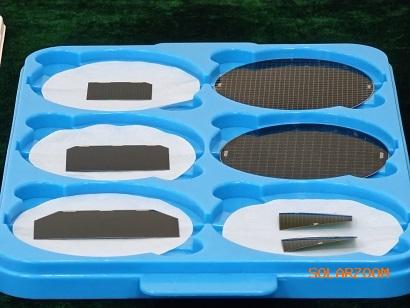
Core Insights - The space energy system, particularly gallium arsenide (GaAs) solar cells, is becoming a key competitive track in the commercial aerospace industry, with GaAs solar cells dominating the market due to their superior performance [1][3] Performance and Technology - GaAs is recognized as a second-generation semiconductor with high electron mobility, allowing for better matching with the solar spectrum and lower energy loss compared to traditional silicon-based cells [3] - The efficiency of GaAs solar cells has seen significant improvements, with three-junction cells achieving a conversion efficiency of 30% in 2014, increasing to 31.5% in 2017, and further advancements leading to efficiencies of 34.5% for four-junction and five-junction cells by 2025 [3][4] Cost Challenges - Despite their high efficiency, GaAs solar cells are significantly more expensive than silicon cells, primarily due to the scarcity of raw materials like germanium and gallium, and the complex manufacturing processes involved [4] - The production of GaAs solar cells involves numerous intricate steps, including precise control during crystal growth and advanced processing techniques like photolithography and etching [4] Innovations and Alternatives - The industry is exploring flexible solar cell technology to reduce the size and weight of solar wings on spacecraft, which can lower launch costs; flexible three-junction GaAs cells have achieved efficiencies exceeding 33% [5] - There is ongoing research into perovskite solar cells, which hold promise for high theoretical efficiency and lower costs, although challenges in mass production stability remain [5] Market Potential - The commercial aerospace sector is projected to drive significant growth in the space solar cell market, with sales expected to exceed $605 million by 2025 and reach $1.02 billion by 2032, reflecting a compound annual growth rate of 7.9% [6] - Increased demand from the aerospace industry has led to a surge in inquiries for production capacity, with the company having acquired over 120 MOCVD devices, indicating a strong scale cost advantage [6] Industry Position - The company is a key player in the GaAs solar cell market, supplying multiple domestic and international clients, with international sales currently surpassing domestic sales [6] - Another significant supplier in the field, 电科蓝天, is set to launch on the Sci-Tech Innovation Board, with a projected domestic market coverage of over 50% for its aerospace power products in 2024 [7]


太空光伏或成下一个增长蓝海!光伏ETF华夏(515370)太空光伏含量指数维度全市场第一
Mei Ri Jing Ji Xin Wen· 2026-01-27 03:15
近日备受关注的科技巨头太空光伏项目一期预计规模达10GW,后续总规划产能合计高达50GW左右。 更关键的是时间表:项目预计第二季度完成定型,设备有望在1年内运抵美国。这意味着一个全新的万 亿级赛道——太空能源,正在从概念快速走向设备采购和实质性建设阶段,为地面光伏设备、特种材 料、航天运输等产业链环节带来了明确且巨大的增量订单预期。 中信建投证券认为,技术路线将呈现三阶段演进,短期内,三结砷化镓电池主导高价值通信卫星、深空 探测等场景,但面临成本与产能约束,难以在低轨场景下放量;近五年,P型HJT电池在现有量产技术 中抗辐射、轻量化性能更优,有望逐步渗透低轨短期任务;未来,钙钛矿叠层电池凭借高比功率优势加 快技术突破,在实现较高发电效率的同时轻量化特性也较为突出,应用场景从当前的航天器供电,逐步 拓展至2030年的空间太阳能电站定向输电,最终支撑2035年后GW级太空数据中心规模化部署。 光伏ETF华夏(515370)及其联接基金(012885/012886)跟踪中证光伏产业指数,涉及光伏产业链 上、中、下游企业,包括硅片、多晶硅、电池片、电缆、光伏玻璃、电池组件、逆变器、光伏支架和光 伏电站等,能够更好的反 ...
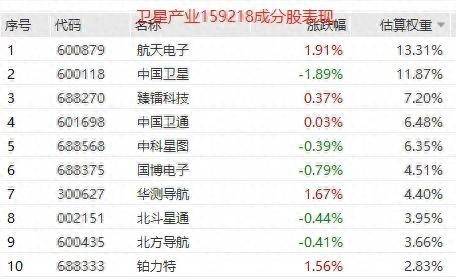
太空光伏蓝图加速落地!10GW规划出炉,卫星产业ETF(159218)盘中拉升1.17%
Sou Hu Cai Jing· 2026-01-27 03:10
未来展望:叙事深化与业绩验证并行 当前,卫星产业的叙事已从"组网"深化至 "太空能源"与"空天智能" 两大更具变革性的方向。随着规划 逐步转化为具体招标与采购,能够切入核心供应链、技术壁垒高的公司将持续获得资金关注。投资者在 关注宏大叙事的同时,更应密切跟踪星网招标、可回收火箭试飞、龙头公司IPO及上述前沿项目的设备 订单等实质性进展,利用板块波动,聚焦真正受益的核心环节进行长期布局。卫星产业ETF作为一揽子 投资工具,仍是参与这场宏大变革的高效选择。 根据卖方研究信息,备受关注的科技巨头太空光伏项目一期预计规模达10GW,后续总规划产能合计高 达50GW左右。更关键的是时间表:项目预计第二季度完成定型,设备有望在1年内运抵美国。这意味 着一个全新的万亿级赛道——太空能源,正在从概念快速走向设备采购和实质性建设阶段,为地面光伏 设备、特种材料、航天运输等产业链环节带来了明确且巨大的增量订单预期。 2. 具身智能星座:"三体计算"开启空天AI新纪元 之江实验室披露了更具颠覆性的规划:计划于2026年部署10颗具身智能卫星,并在2027年建成由100颗 卫星组成的"三体计算星座"。这标志着卫星网络的功能将从传统的 ...
解码太空能源主力技术 砷化镓太阳能电池片产线实探
Zhong Guo Zheng Quan Bao· 2026-01-26 21:00
性能决定主流选择 成本困局待破 与卓越性能相伴的,是砷化镓电池居高不下的成本。马斯克"星链"项目采用转换效率仅20%左右的晶硅 电池片,核心原因就是成本控制。"三结砷化镓太阳能电池片的转换效率普遍超30%,但成本却是晶硅 电池的数倍。"蔡坤煌表示。 ● 本报记者杨洁 商业航天大幕持续拉开,航天器的"能量心脏"——太空能源系统成为产业链竞争的关键赛道,其中砷化 镓(GaAs)太阳能电池凭借卓越性能目前占据市场主流。砷化镓太阳能电池技术在光电转换效率、极端环 境适应性上远超传统硅基电池,但也由于材料稀缺、制造工艺复杂而成本高昂。近日,中国证券报记者 走进三安光电(600703)砷化镓太阳能电池片产线一线,探寻太空能源核心技术的现状与未来。 "砷化镓是第二代半导体的代表,最显著的优势就是电子迁移率高。"三安光电砷化镓事业部总经理、天 津三安总经理蔡坤煌向记者解释,砷化镓系列材料的禁带宽度能与太阳光谱高度匹配,且作为直接带隙 材料,光子能量可直接激发电子跃迁,能量损耗远低于传统硅基电池。更关键的是,其在高低温交替变 更、强辐射的太空极端环境中能稳定运行,效率衰减慢、使用寿命长,成为航天器能源系统的首选。 作为国内较早 ...
商业火箭、商业卫星“钩织”锂电新需求
高工锂电· 2026-01-26 10:23
Core Viewpoint - The article discusses the emerging competition in the energy sector, particularly focusing on space-based solar energy initiatives led by Elon Musk, which could significantly impact the solar energy and lithium battery industries [3][4]. Group 1: Space Solar Energy Initiatives - Elon Musk announced plans to establish 200GW of solar energy capacity, with 100GW sourced from space solar energy, aimed at supporting low Earth orbit satellites and space AI data centers [3]. - Musk's vision includes launching numerous solar energy satellites annually to create a large-scale solar energy collection network in space, requiring the deployment of 500,000 Starlink satellites and over 8,000 Starship flights [3]. Group 2: Impact on Solar and Lithium Battery Industries - The announcement of Musk's space energy vision led to a surge in domestic solar stocks, with leading companies like Longi Green Energy and JinkoSolar seeing stock increases of over 10% [4]. - The concept of space solar energy has sparked interest in the lithium battery supply chain, particularly regarding the need for energy storage solutions to balance solar panel operations in space [4]. - SpaceX has signed a $500 million order with a photovoltaic company for HJT equipment to build solar satellite arrays, corresponding to an annual production capacity of approximately 7GW [5]. Group 3: Developments in Commercial Aerospace - LG has reportedly secured an order for cylindrical lithium batteries from SpaceX for main and backup power systems, although the scale and value of this order remain undisclosed [6]. - Domestic commercial aerospace companies, such as Blue Arrow Aerospace and Zhongke Aerospace, are making advancements in reusable rocket technology and space transportation [6]. - EVE Energy has indicated its commitment to providing comprehensive lithium battery solutions for aerospace applications, having established partnerships with leading commercial rocket and satellite companies [7]. Group 4: Future of Battery Technology - The industry anticipates that solid-state batteries will meet future commercial aerospace battery demands due to their high energy density, long cycle life, and enhanced safety features, which are critical for high-value satellites and manned space missions [8].

太空能源打开应用场景-光伏及锂电迎产业新机遇
2026-01-26 02:49
Summary of Key Points from Conference Call Industry Overview - The space energy sector is expected to benefit from breakthroughs in reusable rocket technology and ITU frequency allocation rules, leading to a projected 30%-50% growth in global rocket and satellite launches over the next 3 to 5 years, with annual satellite launches potentially exceeding 10,000 by 2027 or 2028 [1][5] Core Insights and Arguments - **Rocket Launch Projections**: By 2025, global rocket launches are expected to reach 392, a 25% increase year-over-year, while satellite launches are projected to hit 4,522, marking a 58% increase. China's satellite launches are anticipated to reach 371, a 40% increase [2] - **Reusable Rocket Technology**: 2026 is expected to be a pivotal year for China's reusable liquid rocket technology, with multiple test flights planned for the Long March 12A. Other companies are also expected to launch their reusable rockets, significantly reducing satellite launch costs [3] - **SpaceX Developments**: SpaceX's Starship is projected to conduct four launches in 2026, each carrying 60 V3 satellites, which will increase demand for solar wings due to their enhanced power output of 50-60 kW [4] - **ITU Frequency Allocation**: China has applied for 203,000 satellite frequency resources, with a total of 250,000 applications. These resources must be deployed within 14 years, leading to exponential growth in deployment rates [5] Important but Overlooked Content - **Solar Wing and Battery Market**: The space energy system constitutes 20%-30% of satellite value, with solar wings being the most valuable component, accounting for over half of the cost. The cost of P-type crystalline silicon has significantly decreased, while the high cost of triple-junction gallium arsenide remains a barrier [6][7] - **Investment Opportunities**: Companies such as Maiwei, Jiejia Weichuang, and Aotwei are positioned to benefit from the growth in the photovoltaic industry. In the solar wing and space photovoltaic battery sector, recommended companies include Dongfang Risheng, Junda Co., and Mingyang Smart Energy [10][11] - **Lithium Battery Applications**: Lithium batteries are crucial for rocket and satellite operations, providing high power for flight control systems and emergency backup power for navigation systems [12] - **Market Opportunities for Lithium Batteries**: As the market expands, companies like Weilan Lithium and Yiwei are well-positioned to capture supply chain opportunities, with Weilan collaborating with Taiwan Energy, a direct supplier to SpaceX [13]
全球前三!东方日升HJT强势引领太空能源新纪元
Zhong Guo Neng Yuan Wang· 2026-01-23 07:59
Group 1 - The core viewpoint of the articles highlights the significant achievements of Dongfang Risheng in the solar module industry, particularly with its Vuxi Pro HJT module, which has set a record for the highest power output in the TaiyangNews TOP SOLAR MODULES list with a production power of 740Wp and a conversion efficiency of 23.8% [1] - The TOP SOLAR MODULES list emphasizes the importance of module efficiency as a key competitive factor in the increasingly competitive global photovoltaic market, with strict criteria for inclusion, requiring a conversion efficiency of at least 21.5% for mass-produced products [1] - Dongfang Risheng's Vuxi Pro module incorporates advanced technologies such as 0BB busbar-free design, stress-free interconnection, and ultra-thin silicon wafers, significantly enhancing product performance and cost-effectiveness, with a high bifaciality rate of 90%±5% and a low temperature coefficient of -0.24%/℃ [1] Group 2 - The company is also making strides in the space economy with its independently developed 50μm ultra-thin p-type HJT cells, which have been successfully delivered in bulk and are well-suited for low Earth orbit satellite internet energy systems due to their lightweight and radiation resistance [2] - The compatibility of HJT technology with perovskite tandem technology has led to the development of a perovskite/silicon heterojunction solar cell with a conversion efficiency of 30.99%, indicating significant potential for future advancements in space photovoltaic efficiency [2] - Dongfang Risheng is reshaping the energy landscape through technological innovation, transitioning from ground-based power stations to space applications, thereby laying a solid technological foundation for humanity's advancement towards an interstellar energy era [2]

马斯克在达沃斯放出2026时间表:AI超人类、机器人开售、自动驾驶普及
Xin Lang Cai Jing· 2026-01-23 04:26
Core Insights - Elon Musk emphasizes the importance of optimism in predictions, acknowledging his history of missed deadlines while holding significant stakes in companies like Tesla and SpaceX [2][3] AI Development - Musk predicts that AI systems may surpass human intelligence by 2026, with a possibility of achieving this by 2027, and that by 2030, AI's overall capabilities could exceed that of all humanity combined [4] - The development of the Optimus humanoid robot is progressing, with expectations to complete complex tasks by the end of 2026 and to be available for public sale by 2027, contingent on meeting high safety standards [4] - Musk introduces a formula for economic output based on robot productivity and quantity, forecasting that humanoid robots will outnumber humans within 3-5 years, potentially addressing labor shortages due to aging populations [4] Risks and Economic Impact - Musk warns of potential risks associated with AI and robotics, stressing the need to avoid dystopian scenarios while highlighting the potential for a significant economic expansion if AI becomes widely accessible and affordable [5] Energy Supply Challenges - Musk identifies energy supply as a critical bottleneck for AI expansion, noting that global electricity supply growth rates (4%-10%) lag behind the exponential growth of chip production [6] - He highlights China's advancements in renewable energy, particularly solar power, and contrasts it with the slower energy transition in the U.S. due to tariffs on Chinese solar components [6] - Tesla and SpaceX are collaborating on solar projects aiming for an annual production capacity of 100 gigawatts in the U.S. within three years to alleviate energy constraints [6] - Musk discusses a space-based solar energy initiative that could achieve five times the efficiency of ground-based systems, with a goal to realize this within 2-3 years [6] Autonomous Driving - The rollout of autonomous taxis in Austin is set for June 2025, with widespread deployment expected by the end of 2026, as regulatory approvals in Europe and China progress [7] - Tesla's autonomous driving technology has received high safety ratings from multiple insurance companies, which will also benefit the Optimus robot's commercialization [7] Space Exploration - SpaceX aims to achieve fully reusable rockets by 2026, with the Starship project expected to validate this capability, significantly reducing costs for space exploration and satellite launches [8] - Musk compares the cost of reusable rockets to fuel costs, predicting a 100-fold reduction in space exploration costs, making projects like space solar power feasible [8] Challenges Ahead - Despite Musk's optimistic outlook, Tesla faces challenges, including declining electric vehicle deliveries and slow production rates for the Optimus robot and Cybertruck [9] - Regulatory scrutiny is increasing for Musk's social media platform X and AI assistant Grok due to concerns over inappropriate content generation [9]


转换效率跻身全球前三 东方日升HJT技术强势领跑太空能源赛道
Quan Jing Wang· 2026-01-23 01:08
Core Insights - The article highlights that Dongfang Risheng's HJT module, Vuxi Pro, has achieved a significant milestone by ranking among the top three globally in the TaiyangNews TOP SOLAR MODULES list, with a production power of 740Wp and a conversion efficiency of 23.8%, marking the highest power record in the history of the list [1] - The global photovoltaic module industry is transitioning from scale expansion to a focus on quality and efficiency, with conversion efficiency becoming a key competitive factor that directly influences market share and profitability [1] - The TOP SOLAR MODULES list employs strict criteria for inclusion, ensuring that only high-quality products with a conversion efficiency of at least 21.5% are considered, thus providing a reliable benchmark for assessing core competitiveness in the industry [1] Company Performance - Dongfang Risheng's Vuxi Pro module integrates key technologies such as 0BB busbarless design, stress-free interconnection, and ultra-thin silicon wafers, achieving both performance and cost-effectiveness improvements [2] - The company has demonstrated a high bifacial rate of 90%±5% and a low temperature coefficient of -0.24%/°C, leading the industry in various application scenarios, showcasing its product adaptability and reliability [2] - By the end of 2025, the cumulative shipment of the Vuxi series HJT products is expected to exceed 12GW, with sales in over 80 countries, reflecting strong market recognition and global competitiveness [2] Strategic Expansion - Dongfang Risheng is expanding its strategic vision to include the space sector, aiming for a dual-track development approach of "ground + space," which is expected to uncover new growth opportunities for the company [2] - The company's strategic move into the space sector is supported by its advanced technology reserves and commercialization capabilities, including the mass delivery of a 50μm ultra-thin p-type HJT battery, which is highly compatible with flexible solar wings for low Earth orbit satellite internet energy systems [3] - The development of perovskite/silicon heterojunction stacked solar cells with a conversion efficiency of 30.99% lays a solid foundation for future breakthroughs in space photovoltaic efficiency [3] Industry Trends - The commercial space sector is gaining significant attention in global capital markets, with companies like SpaceX advancing their IPO plans, indicating a robust market environment for related industries [3] - Domestic policies are increasingly supportive of the aerospace sector, with the "14th Five-Year Plan" emphasizing the cultivation of strategic emerging industries, which is expected to accelerate the commercialization of frontier scenarios like space data centers [3][4] - Dongfang Risheng's strategic partnership with Shanghai Port focuses on the research, validation, and industrialization of perovskite + p-type heterojunction battery stacking technology in the space energy field, aligning with national aerospace strategies and capitalizing on the explosive growth of the commercial space industry [4]
未知机构:天风电新太空能源SpaceX主线看好设备先行0120-20260120
未知机构· 2026-01-20 02:10
Summary of Conference Call Notes Industry Overview - The focus is on the solar energy sector, particularly the developments related to companies T and S, which are planning to expand their photovoltaic production capacity [1][1]. Key Points and Arguments 1. **Separate Teams for Production Planning**: Companies T and S are operating as independent teams to plan their photovoltaic production capacity, with T taking the lead and S expected to follow before the Spring Festival [1]. 2. **Technology Pathways**: Company S is pursuing a space technology route using P-type HJT (Heterojunction Technology), while Company T is focusing on ground applications, likely utilizing TOPCon technology due to patent considerations [1]. 3. **Super Factory Plans**: Company T is considering the establishment of a 10GW integrated super factory, with an initial phase potentially reaching 1GW and a long-term capacity target of 50GW [1]. 4. **Capacity Planning**: The combined capacity planning for T and S is approaching 100GW, with T targeting 50GW for ground applications and S aiming for 40GW for space applications, which exceeds initial expectations [1]. 5. **Ongoing Factory Audits**: The factory audit for Company T is just the first round, with potential for additional rounds, indicating that the equipment sector will undergo repeated trading activities [1]. 6. **Systematic Revaluation**: The planning by T and S is seen as exceeding expectations, suggesting that the equipment sector will experience a systematic revaluation beyond just marginal changes from factory audits [1]. Additional Insights - **Investment Recommendations**: The focus is on companies with high value and good market positioning within the solar equipment sector, specifically recommending: - High-value segments: Silicon wafers and battery equipment, with strong endorsements for Liancheng CNC and Laplace, as well as Aotewi, which has a presence in silicon, battery, and module equipment [3]. - Well-positioned segments: Slicing machines and reduction furnaces, with key recommendations for Gaoce Co. and Shuangliang Energy [3]. - **Potential of Space Technology**: The most promising outlook remains with companies like Maiwei Co., which are focused on defining space technology routes that hold the highest value and imaginative potential [2].