存储市场

Search documents
小摩唱多阿斯麦(ASML.US):Q3绩后市场焦点将转向2027财年 建议“逢低买入”
Zhi Tong Cai Jing· 2025-10-10 08:21
Core Viewpoint - Morgan Stanley expresses optimism regarding ASML's upcoming Q3 2025 earnings report, suggesting that opportunities post-earnings will outweigh risks, with market focus likely shifting to FY27 after the report [1][2] Earnings Risks - ASML's stock has declined by 43% since the last earnings call, where the company indicated uncertainty regarding growth for 2026 [2] - Two main risks for the upcoming earnings include lower-than-expected order volume for Q3 2025 and guidance for FY26 falling below market expectations [2] - The firm has a conservative outlook on Q3 2025 orders due to ASML's cautious tone, although strong orders from TSMC in the latter half of the quarter could exceed expectations, contingent on Samsung's actions [2] Market Sentiment and Recommendations - Despite potential short-term risks, the firm maintains a positive outlook on ASML's stock, suggesting that if guidance for FY26 is weak, it could be a buying opportunity [3] - Conversely, strong order volume and positive guidance for FY26 would likely boost the stock price [3] - The firm reiterates its "overweight" rating and "preferred stock" status for ASML, indicating confidence in the company's long-term prospects [3] Q3 2025 Earnings Expectations - ASML is expected to report revenues of €7.568 billion for Q3 2025, reflecting a 1.6% quarter-over-quarter decline but a 1.3% year-over-year increase, slightly below market consensus [4] - Order volume is anticipated to reach €3.92 billion, which is 21.1% lower than Bloomberg consensus, reflecting a conservative stance [4] - Projected gross margin is 51.1%, aligning with market expectations, while EBIT is expected to be €2.331 billion, 3.4% below consensus [4] - The company is expected to provide guidance for FY26, which is anticipated to be more positive than previous statements due to improvements in the storage market [4]

江波龙:截止至7月底主控芯片全系列产品累计实现超8000万颗的批量部署
Ge Long Hui A P P· 2025-09-17 11:25
Core Viewpoint - The company anticipates a comprehensive price increase in the storage market in Q4 due to rising demand for NAND in the server market driven by the expansion of AI server shipments and new smartphone releases [1] Group 1: Market Trends - The NAND market is expected to see increased inventory demand in the second half of the year as AI server shipments continue to grow [1] - The release of new smartphones is expected to trigger a new wave of replacement demand [1] - The supply strategy of storage wafer manufacturers, balancing input-output ratios, will also influence market dynamics [1] Group 2: Company Performance - As of the end of July, the company has achieved over 80 million units of its main control chip series in mass deployment, with the deployment scale continuing to grow rapidly [1] - The self-developed UFS4.1 product is currently undergoing validation with multiple Tier 1 manufacturers [1] - The company expects significant growth in the deployment scale of its self-developed main control chips throughout the year [1]
存储器市场跟踪
傅里叶的猫· 2025-05-28 14:42
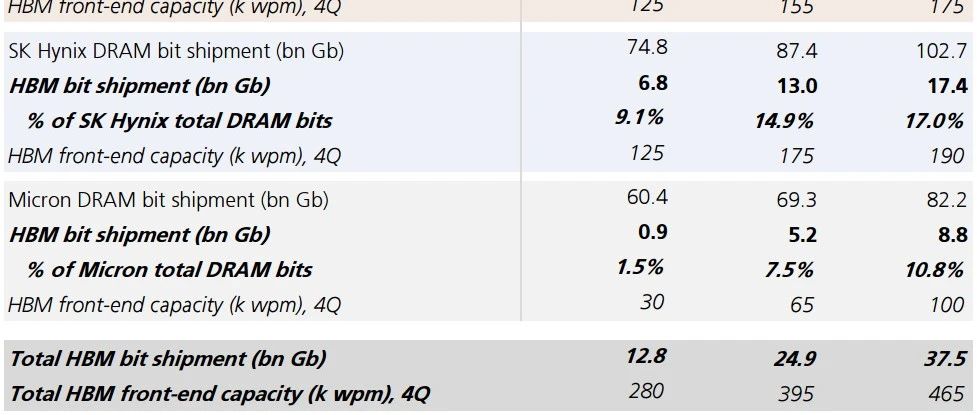
Core Viewpoint - The article discusses the current trends and forecasts in the memory market, particularly focusing on NAND and DRAM, highlighting the demand dynamics and inventory levels of major players like Samsung and SK Hynix [1][2][3]. Summary by Sections Market Overview - The article references UBS research, indicating that Samsung and SK Hynix expect a modest increase in DRAM shipments for Q2 2025, with Samsung projecting less than 10% growth and SK Hynix over 20% for NAND [2]. - UBS has adjusted its NAND price forecast for Q2 from +5% to +3%, citing resistance from customers against rising SSD prices [2]. Demand and Inventory - As of Q1 2025, DRAM inventory levels are decreasing faster than expected, with smartphone customers holding about 10 weeks of inventory and PC manufacturers around 12 weeks [3]. - For NAND, smartphone manufacturers have approximately 9 weeks of inventory, while SSD inventory stands at 11 weeks [3]. HBM Demand Forecast - UBS has revised its HBM demand forecast for 2025 down from 203 billion Gb to 189 billion Gb, reflecting a year-on-year growth of 105%, and for 2026 from 303 billion Gb to 291 billion Gb, with a growth rate of 54% [3][24]. - The demand for ASICs is expected to outpace GPUs, with ASICs accounting for 54% of total HBM demand by 2026, up from 41% in 2025 [3]. Supplier Insights - Samsung's HBM bit shipments are projected to increase from 5.1 billion Gb in 2024 to 11.2 billion Gb by 2026, representing 8.1% of its total DRAM bits [9]. - SK Hynix is expected to grow its HBM shipments from 6.8 billion Gb in 2024 to 17.4 billion Gb by 2026, which will account for 17% of its total DRAM bits [9]. Production Capacity - Longxin's wafer production capacity is expected to reach 170,000 wafers per month by the end of 2024, with plans to increase to 230,000 wafers per month by the end of 2025 [24]. - Yangtze Memory Technologies Company (YMTC) is also expanding its production capacity, aiming for 160-layer technology despite facing challenges due to U.S. restrictions [25]. Competitive Landscape - The article highlights the competitive dynamics among major players, with Samsung and SK Hynix leading in HBM production, while Micron is also increasing its HBM output significantly [9][24]. - The market share of DRAM suppliers is detailed, showing Samsung at 39.5%, SK Hynix at 28.9%, and Micron at 22.9% for 2025 [27]. Future Outlook - The article concludes with a cautious outlook for the memory market, emphasizing the uncertainty due to tariff issues and potential specification downgrades in NAND demand [2][24].


2024-2025年全球存储市场趋势白皮书解读(57页附下载)
Sou Hu Cai Jing· 2025-05-28 12:37
Core Insights - The white paper highlights significant transformations in the global memory market driven by advancements in AI technology, increasing server storage demands, and upgrades in consumer storage products [19] Group 1: Global Memory Market Changes and Technological Developments - High-density 3D NAND Flash storage is continuously improving, with advancements in read/write performance, power consumption, durability, and cost [2][36] - The complexity of etching and deposition processes increases with the number of layers in NAND Flash, leading to challenges that manufacturers are overcoming through various techniques [2][41] - Major manufacturers like Samsung and SK Hynix are focusing on mass production plans for NAND Flash with over 300 layers, utilizing Wafer-to-Wafer bonding technology [2][41] Group 2: Server NAND and DRAM Application Growth - The expansion of global data center infrastructure and increased investment in AI infrastructure are driving the growth of server storage demand [3][9] - In 2024, the application shares of NAND in servers, mobile devices, and PCs are projected to be 30%, 31%, and 14% respectively, with server NAND application share expected to rise to 30% by 2025 [4][43] - For DRAM applications, the shares in servers, mobile devices, and PCs are expected to be 34%, 32%, and 14% in 2024, with server DRAM application share anticipated to grow to 36% by 2025 [5][47] Group 3: Storage Technology and Application Outlook - QLC NAND is improving in performance and reliability, making it suitable for read-intensive applications, particularly in computing centers [6][51] - The rise of AI PCs is driving the growth of PCIe 4.0/5.0 SSD applications in the consumer market, with an expected penetration rate of 35% by 2025 [7][58] - Manufacturers are actively expanding into overseas markets, particularly in Southeast Asia, Latin America, and Africa, where the SSD market holds significant potential [8][71] Group 4: AI Server Storage Demand - There is a surge in capital expenditure for AI infrastructure, significantly increasing the demand for AI servers [9][72] - The global HBM market is projected to reach $16 billion in 2024 and grow to $30 billion by 2025, accounting for 28% of the global DRAM market [11] - The demand for enterprise-grade PCIe 5.0 SSDs is rapidly increasing, with an expected shipment share of 30% by 2025 [12][50] Group 5: Consumer Storage Product Applications and Developments - Global PC shipments are expected to see a slight increase of 3% in 2025, with AI PC penetration reaching 35% [13][58] - The global smartphone shipment volume is projected to reach approximately 1.184 billion units in 2024, with NAND capacity expected to exceed 220GB by 2025 [15][16] - AI glasses are emerging as a significant consumer electronics product, with shipments expected to rise from 2 million units in 2024 to 10 million units in 2025 [17][18]