
家电以旧换新政策

Search documents
释放家电以旧换新政策效应
Jing Ji Ri Bao· 2025-08-14 22:08
Core Insights - The Ministry of Commerce reported that over 66 million consumers have purchased more than 109 million units of 12 categories of home appliances through the "old-for-new" program this year, highlighting the significant role of home appliance consumption in driving domestic demand in China [1] - The "old-for-new" policy is not just a simple replacement of similar products but encourages the adoption of higher-end, smart, and environmentally friendly products, promoting green and intelligent technology into households [1][2] - The government has increased the categories eligible for subsidies from 8 to 12 this year, further unlocking the consumption potential in the home appliance market [2] Group 1: Policy and Market Impact - The central government allocated 150 billion yuan in special long-term bonds last year to support local implementation of the "old-for-new" policy, resulting in significant sales and consumption boosts [1] - In the previous year, the "old-for-new" program led to the sale of over 62 million units of eight major appliance categories, directly driving consumption by nearly 270 billion yuan, with a retail sales growth of 12.3% in home appliances [1] - The recycling and dismantling of old appliances have also seen growth, with a 14.83% increase in the recovery of waste appliances and a 20% increase in the number of properly dismantled appliances [1] Group 2: Challenges and Recommendations - Despite the positive effects, challenges remain, such as the incomplete release of consumption potential and financial pressures on small and medium-sized appliance dealers [2][3] - There is a need for better promotion and understanding of the current subsidies among consumers to convert potential demand into actual purchases [3] - Recommendations include optimizing the "old-for-new" process to reduce costs and improve consumer experience, as well as encouraging local governments to develop tailored solutions based on their specific circumstances [3] Group 3: Waste Management and Sustainability - The "old-for-new" policy also emphasizes the importance of managing the recycling of old appliances, aiming to maximize their value and promote a modern recycling system [4] - Encouragement for appliance manufacturers to establish a comprehensive recycling system that includes recovery, dismantling, and reuse is essential for achieving green and low-carbon development [4] - The establishment of standardized processes for waste appliance handling and the use of digital platforms for tracking the entire lifecycle of appliances are crucial to prevent fraud and ensure efficient recycling [4]
家电行业周报(25年第30周):8月空调排产同比下降7%,第三批国补资金下达-20250728
Guoxin Securities· 2025-07-28 09:32
Investment Rating - The report maintains an "Outperform the Market" rating for the home appliance industry [4][5][58]. Core Insights - The home appliance sector is expected to benefit from the third batch of 690 billion yuan in national subsidies aimed at promoting consumption through old-for-new programs, which is anticipated to sustain robust demand growth [2][20]. - In August, air conditioner production saw a year-on-year decline of 7.1%, with domestic sales decreasing by 5.3% and exports down by 9.5%. This decline is attributed to the seasonal slowdown and increased inventory levels [1][17]. - The second quarter saw a decrease in the proportion of heavy holdings in home appliance stocks, with a notable increase in black electrical appliances, indicating a shift in investment focus [3][22]. Summary by Sections 1. Investment Recommendations - Key recommendations include Midea Group, Gree Electric, Haier Smart Home, TCL Smart Home, and Hisense Home Appliances in the white goods sector, and Boss Electric in kitchen appliances [3][12][15]. 2. Market Trends and Production Insights - August marked the beginning of the air conditioning off-season, leading to a production slowdown. Domestic production decreased by 5% while export production fell by 10% [1][17]. - The third batch of national subsidies is expected to provide a significant boost to domestic demand, with over 2.8 billion people applying for the old-for-new subsidies, resulting in sales exceeding 1.6 trillion yuan [2][20]. 3. Heavy Holdings and Market Performance - The proportion of heavy holdings in home appliance stocks decreased to 3.3% in Q2, with white goods seeing the largest decline. However, the sector remains overweight compared to the overall market [3][22]. - The home appliance sector experienced a relative loss of 1.65% this week compared to the broader market [30]. 4. Key Data Tracking - Raw material prices have shown an upward trend, with LME copper and aluminum prices increasing by 1.2% and 2.3% respectively [32]. - The shipping index for exports has decreased, with significant drops in rates for routes to the US West and East coasts [42]. 5. Company Earnings Forecasts - Earnings per share (EPS) forecasts for key companies include Midea Group at 5.62 yuan for 2025, Gree Electric at 6.34 yuan, and Haier Smart Home at 2.26 yuan [4][55].





国联民生证券:家电业务多元化削弱报表端影响 维持行业强于大市评级
Zhi Tong Cai Jing· 2025-07-17 02:43
Group 1 - The core viewpoint of the report is that the home appliance industry is expected to outperform the market, with positive expectations for major white goods companies in Q2 2025 due to the effective use of subsidy funds and a seasonal increase in demand [1] - Key recommendations include leading white goods companies such as Midea Group, Gree Electric Appliances, Haier Smart Home, and Hisense Visual Technology, along with a focus on TCL Electronics and companies like Bear Electric and Roborock that show potential for operational improvement [1] - The report highlights that the previous phase of subsidy withdrawal saw a resilient growth pattern in the industry, with core product categories maintaining positive revenue growth despite challenges [2] Group 2 - The impact of policy changes on the industry was concentrated in the earlier stages, with a notable adjustment in performance metrics during 2011, followed by a recovery phase where the white goods index outperformed the market [3] - The report draws parallels with the U.S. market, indicating that commercial HVAC systems have shown better performance compared to consumer appliances during economic downturns, suggesting a shift in demand dynamics [4] - Companies like Whirlpool have implemented price increases and enhanced dividend payouts to mitigate the impact of rising costs and maintain stable return on equity (ROE) amidst challenging market conditions [5] Group 3 - The anticipated impact of the old-for-new policy on overall white goods sales is estimated to be around 9% of the 2023 sales volume, indicating a limited effect on the overall market dynamics [6] - The diversification of leading home appliance companies is expected to further dilute the impact of policy changes on financial statements, suggesting a strategic advantage in navigating market fluctuations [6]

商务部:家电类商品零售额连续8个月保持两位数增长
news flash· 2025-05-22 07:40
Core Insights - The retail sales of home appliances have maintained double-digit growth for eight consecutive months from September 2024 to April 2025, indicating strong consumer demand in this sector [1] - In April, the retail sales of home appliances and audio-visual equipment from above-designated size enterprises increased by 38.8% year-on-year, ranking first among 16 major categories of consumer goods [1] - The Ministry of Commerce, in collaboration with relevant departments, has expanded and improved the "old for new" appliance exchange policy, which has shown continuous positive results [1]
东皋沂评 | 家电以旧换新:提振消费的有力引擎
Sou Hu Cai Jing· 2025-05-08 17:23
Group 1 - The home appliance trade-in policy has been strengthened and expanded this year, optimizing the subsidy range and policy process, leading to sales of 124.74 billion yuan by April 12 from 12 categories of home appliances [1] - The policy has provided tangible benefits to consumers, expanding the subsidy range and offering more choices for upgrading appliances at favorable prices, thus stimulating consumer demand for quality living [4] - For home appliance companies, the policy presents a significant development opportunity, increasing market demand and encouraging R&D investment to launch new products that meet consumer needs [4] Group 2 - From a macroeconomic perspective, the home appliance trade-in policy plays a crucial role in boosting consumption and driving economic growth, impacting various related industries such as production, logistics, and after-sales services [5] - There are challenges in the implementation of the policy, including insufficient consumer awareness and a lack of standardized recycling processes, which can hinder the effectiveness of the policy [5] - To address these issues, collaboration between the government and enterprises is essential to enhance promotion and improve the recycling system, ensuring effective policy implementation nationwide [7][8]

【财经分析】海信家电一季度净利润创出24年来最佳 四大动力推动增长
Xin Hua Cai Jing· 2025-05-06 02:51
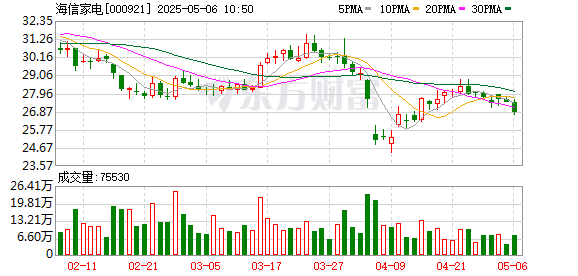
Core Viewpoint - Hisense Home Appliances reported strong Q1 2025 results, achieving revenue of 24.838 billion yuan, a year-on-year increase of 5.76%, and a net profit attributable to shareholders of 1.127 billion yuan, up 14.89% year-on-year, marking the best performance for the same period since Q1 2002 [2] Financial Performance - Revenue for Q1 2025 reached 24.838 billion yuan, with a net profit of 1.127 billion yuan and a non-recurring net profit of 1.008 billion yuan, reflecting year-on-year growth of 14.89% and 20.27% respectively [2] - The company's return on equity (ROE) for 2024 was reported at 23.27%, outperforming competitors such as Haier Smart Home (17.70%), Midea Group (21.29%), and Gree Electric (25.42%) [5] Market Position and Product Performance - Hisense's multi-split air conditioning systems captured over 20% market share, while the company maintained the top position in the fresh air air conditioning category with a sales share of 42.8% [3] - The refrigerator segment saw an increase in market share by 2.6 percentage points, with the Rongsheng brand also experiencing a 2.3 percentage point increase [3] - The washing machine business improved user experience, resulting in a 0.7 percentage point increase in offline market share [3] Growth Drivers - The growth in Q1 performance is attributed to several factors: recovery in central air conditioning sales, strong growth in home air conditioning, high single-digit growth in refrigeration and washing machine segments, and significant orders in the HVAC sector for new energy vehicles [4] - Domestic and international sales trends indicate a positive outlook, with exports expected to grow over 20% year-on-year [4] Financial Stability - The company reported a total debt of 52 billion yuan, with non-interest-bearing liabilities accounting for 92% of total debt, indicating strong bargaining power within the appliance supply chain [6] - The liquidity surplus after settling all payables and interest-bearing debts is 21.8 billion yuan, showcasing financial stability [5]
面向中国的Mini LED电视出货量增至2倍
日经中文网· 2025-04-30 06:10
Core Viewpoint - The demand for Mini LED TVs is rapidly increasing in China, driven by government subsidy policies and a significant rise in shipments, which are expected to impact global pricing and market dynamics [2][6][9]. Group 1: Market Dynamics - Mini LED TVs have a global market share of 3% as of 2024, while traditional LCD TVs dominate at 94% [6]. - The average price of a 55-inch Mini LED TV is $901, positioned between LCD TVs at $501 and OLED TVs at $1,317 [6]. - In the last quarter of 2024, shipments of Mini LED TVs to China reached 2.02 million units, a 2.3-fold increase compared to the previous quarter, accounting for 65% of global shipments [6][9]. Group 2: Government Policies and Consumer Behavior - China's subsidy policy for replacing old appliances has significantly boosted the sales of Mini LED TVs, with subsidies ranging from 15% to 20% of the purchase price [6][9]. - Larger screen sizes, such as 85-inch and 98-inch TVs, receive higher subsidies, leading to increased sales and potential supply shortages for certain components [7]. Group 3: Competitive Landscape - Prior to 2023, the Mini LED TV market was largely dominated by Samsung, but Chinese companies like TCL and Hisense have rapidly gained market share, reaching 25% and 24% respectively in 2024, surpassing Samsung's 20% [9]. - Sony is increasing its supply of Mini LED TVs in Japan, with plans to boost production significantly, while reducing OLED TV supply [13]. Group 4: Pricing Trends - The price of 98-inch Mini LED TVs has decreased by 49% year-on-year, dropping to $3,374 in the last quarter of 2024, indicating a trend of declining prices in the segment [11][12]. - The shift towards larger TVs is leading to a commoditization of the market, with expectations of continued price reductions [12].

中国家电以旧换新购买量突破1亿台
Chang Jiang Shang Bao· 2025-04-13 23:59
Core Insights - The Chinese home appliance market is experiencing significant growth, driven by government policies promoting the trade-in of old appliances for new ones, with over 100.35 million units sold since the policy's implementation in August 2024 [1][2] Group 1: Market Growth and Policy Impact - The retail sales of home appliances and audio-visual equipment in China reached 1,030.7 billion yuan in 2024, marking a 12.3% increase from the previous year and surpassing the historical peak of 945.4 billion yuan in 2017 [1] - The State Council's action plan released in March 2024 aims to stimulate investment and consumer spending by providing subsidies for purchasing energy-efficient appliances, with 20% off for first-level efficiency products and 15% off for second-level products [2] - The expansion of the trade-in policy will increase the number of subsidized appliance categories from 8 to 12 and allow consumers to receive subsidies for up to three air conditioners [2] Group 2: Consumer Behavior and Market Trends - The necessity for appliance upgrades is highlighted by the fact that the total number of major household appliances in China exceeds 3 billion units, many of which are reaching the end of their safe usage period [3][4] - A survey indicates that 68% of appliance companies expect revenue growth in the first half of 2024, with 50.7% anticipating profit increases, reflecting optimism in the market [4] - Retail sales of televisions and refrigerators saw year-on-year increases of 29.3% and 38.4%, respectively, in the first quarter of 2024, driven by the trade-in policy [4] Group 3: Shift Towards Green and Smart Appliances - There is a growing preference for energy-efficient and smart appliances among consumers, with over 90% of sales in the eight major appliance categories being for first-level energy efficiency products [5] - The trend towards green and intelligent appliances is evident, with nearly 60% of consumers favoring energy-efficient products and over half preferring smart appliances [5] - The expected replacement of high-energy appliances with efficient models is projected to save over 10 billion kilowatt-hours of electricity annually [5]
海尔智家股份有限公司2024年年度报告摘要
Shang Hai Zheng Quan Bao· 2025-03-27 19:29
Group 1 - The company plans to distribute cash dividends of RMB 9.65 per 10 shares, amounting to a total of RMB 8,996,688,692.76, which corresponds to 48.01% of the net profit attributable to shareholders [2][38][39] - The company achieved a net profit of RMB 18,741,120,122.93 for the year 2024, with a parent company net profit of RMB 10,171,484,335.04 [38][39] - The company will not conduct capital reserve transfers to increase share capital or issue bonus shares this year [39] Group 2 - The domestic home appliance market in China saw a retail sales growth of 6.4% year-on-year, reaching RMB 907.1 billion in 2024 [3][12] - The air conditioning sector experienced a retail volume decline of 1.8% to 59.78 million units, with a retail scale of RMB 207.1 billion, down 2.2% [3] - The refrigerator industry achieved a retail volume of 40.19 million units, growing by 4.9%, and a retail value of RMB 143.4 billion, up 7.6% [4] Group 3 - The washing machine sector recorded a retail volume of 42.97 million units, increasing by 7.3%, with a retail value of RMB 101.4 billion, up 7.6% [7] - The kitchen appliance market, including range hoods and gas stoves, saw retail sales of RMB 36.2 billion and RMB 20.4 billion respectively, with growth rates of 14.9% and 15.7% [8] - The water heater market reached a retail value of RMB 53.2 billion, growing by 5.3%, with electric water heaters accounting for RMB 23.6 billion and gas water heaters for RMB 29.6 billion [10] Group 4 - The company has maintained its position as the global leader in large home appliance retail volume for 16 consecutive years, with a market share of 25.9% in Asia and 24.5% in North America [23][30] - The company has expanded its global market presence through acquisitions, including the recent purchase of Kwikot in South Africa, enhancing its water heater business [30][29] - The company is recognized for its innovative smart home solutions, focusing on customized platforms and integrated smart home experiences [24][25]