
差异化发展

Search documents
要有“舍小取大”的大智慧
Xin Hua Ri Bao· 2026-02-04 21:46
Core Insights - The article discusses the transformation of the traditional tourism model in the context of the Dangkou Ancient Town, emphasizing the shift from a ticketed "scenic area" to a free-access "street area" to revitalize cultural tourism [1][2][3] Group 1: Transformation of Tourism Model - The cancellation of entrance fees at Dangkou Ancient Town represents a fundamental shift in development strategy, moving from a passive approach of waiting for visitors to an active strategy of inviting them [1] - The reopening of Dangkou as a free-access area led to a significant increase in visitor numbers, demonstrating that charging fees can act as a barrier rather than a protective measure [1] - By 2025, revenue from cultural and handmade products in Dangkou is projected to grow by 50% year-on-year, indicating the effectiveness of transforming the tourism focus from mere sightseeing to immersive consumer experiences [1] Group 2: Evolving Visitor Expectations - Modern tourists seek immersive experiences rather than just superficial visits, with a preference for "slow travel" and genuine interactions [2] - The unique charm of ancient towns lies in their authentic local life and historical narratives, which should be preserved rather than artificially recreated [2] - Differentiation in the tourism market is crucial, with a focus on local culture, historical significance, and unique activities to meet the increasingly segmented demands of visitors [2] Group 3: Community Engagement and Economic Impact - The transformation from "scenic area" to "street area" fosters community involvement, with local residents becoming active participants in tourism development rather than being displaced [3] - Residents are investing in hospitality and retail businesses, contributing to the local economy and sharing in the benefits of tourism growth [3] - The implementation of a free-access policy enhances the sense of community and participation among locals, leading to a more sustainable and inclusive economic model [3]

非上市人身险公司2025年赚超670亿元,泰康人寿、中邮人寿狂飙
Bei Jing Shang Bao· 2026-02-03 13:38
Core Insights - The domestic non-listed life insurance industry demonstrated resilience and vitality with impressive performance in the fourth quarter of 2025, achieving a total net profit of approximately 67.39 billion yuan and insurance business revenue exceeding 1.2 trillion yuan [1][3]. Group 1: Industry Performance - A total of 57 non-listed life insurance companies reported insurance business revenue of 1.2 trillion yuan, marking a growth of approximately 12.3% [3]. - Leading companies, Taikang Life and China Post Life, entered the "billion" club with revenues of 238.66 billion yuan and 159.17 billion yuan, respectively [3]. - The third-ranked company, ICBC-AXA Life, reported insurance business revenue of 50.86 billion yuan, indicating a significant gap compared to the top two [3]. Group 2: Profitability and Net Profit - The net profit of the 57 non-listed life insurance companies totaled 67.39 billion yuan, reflecting a growth rate of 170.66% [5]. - Taikang Life led the profitability rankings with a net profit of 27.16 billion yuan, growing over 80%, followed by China Post Life and China CITIC Insurance with profits of 8.35 billion yuan and 5 billion yuan, respectively [5]. Group 3: Investment Performance - Investment income significantly contributed to the profit growth, with many companies reporting increased investment yields; the highest being Junlong Life with an investment yield exceeding 10% [8]. - The favorable investment environment in 2025, characterized by a "slow bull" market in stocks and stable bond yields, provided a conducive backdrop for insurance companies to enhance their investment returns [8]. Group 4: Challenges for Smaller Insurers - Smaller insurers are advised to pursue "differentiated" and "specialized" development paths, focusing on niche markets and customized products to compete effectively against larger firms [4]. - Some companies, such as Huahui Life and Changsheng Life, faced significant declines in insurance business revenue, with Huahui Life reporting a negative growth of 60.89% [4].


银行业韧性凸显 增长可期
Jin Rong Shi Bao· 2026-02-03 01:49
Core Viewpoint - The performance reports of listed banks for 2025 reveal a resilient banking sector, with significant growth in profitability, particularly among small and medium-sized banks, providing insights for predicting the industry's trajectory in 2026 [1][2]. Group 1: Profitability and Growth - All ten listed banks reported positive growth in net profit, with nine achieving increases in both operating income and net profit [2]. - City commercial banks led the profitability growth, with Qingdao Bank showing a 21.66% increase in net profit, while Hangzhou Bank, Ningbo Bank, and Nanjing Bank reported growth rates of 12.05%, 8.13%, and 8.08% respectively [2]. - National joint-stock banks exhibited steady growth, with Shanghai Pudong Development Bank leading at 10.52% net profit growth, followed by CITIC Bank, China Merchants Bank, and Industrial Bank with growth rates of 2.98%, 1.21%, and 0.34% respectively [2]. Group 2: Revenue Structure Optimization - Revenue structure optimization was a key driver for many banks' performance, with Ningbo Bank's net fee and commission income reaching 6.085 billion yuan, a 30.72% year-on-year increase [3]. - Shanghai Pudong Development Bank improved its asset-liability management and reduced funding costs, stabilizing its net interest margin [3]. - Asset expansion was notable, with China Merchants Bank surpassing 13 trillion yuan in total assets, and several small and medium-sized banks showing significant growth rates in total assets, such as Qingdao Bank at 18.12% [3]. Group 3: Credit Growth and Asset Quality - Accelerated credit issuance was identified as a core driver for asset expansion among small banks, with strong demand in quality regions supporting growth [4]. - Asset quality remained stable, with five banks reporting a decrease in non-performing loan ratios, and overall fluctuations were kept within single-digit basis points [5][6]. - Notably, CITIC Bank and China Merchants Bank saw their non-performing loan ratios decrease by 1 basis point to 1.15% and 0.94% respectively, while the provisioning coverage ratios for several banks remained well above regulatory requirements [6]. Group 4: Future Outlook and Strategic Focus - Analysts predict a positive outlook for the banking sector in 2026, emphasizing the importance of loan growth, particularly in corporate lending, and the stability of asset quality [8]. - Major state-owned banks are focusing on developing differentiated strategies and enhancing operational efficiency as part of their 2026 goals [9][10]. - National joint-stock banks and local small and medium-sized banks aim to optimize their business structures and diversify income sources to improve profitability stability [10].
从三场记者招待会,看市县发展新动向
Hai Nan Ri Bao· 2026-02-01 02:41
Core Viewpoint - The year 2026 marks the beginning of the "14th Five-Year Plan" and the full implementation of the Hainan Free Trade Port's closure operations, with local governments showcasing confidence and commitment to development [1] Group 1: Economic Performance - During the "14th Five-Year Plan" period, Hainan's GDP crossed three trillion yuan thresholds, with per capita GDP reaching 76,000 yuan by 2025, reflecting collaborative efforts in the construction of the Free Trade Port [2] - Key industries in Haikou have seen their value-added exceed 70% of GDP, with significant projects like the semiconductor industry coming to fruition, and the marine economy reaching a trillion yuan level [2] - Sanya welcomed 36.15 million tourists, generating total spending of 103.2 billion yuan, while Lingshui launched the world's first underwater intelligent computing center [2] Group 2: Innovation and Development - Sanya's Yazhou Bay National Laboratory has made significant progress, and the Yazhou Bay Science and Technology City has gathered over 52 provincial and ministerial-level innovation platforms [3] - Danzhou's Yangpu has achieved a new level of high-quality integrated development, becoming the first digital processing trade zone in the country [3] - Various counties are focusing on improving living standards by increasing quality educational resources, enhancing healthcare access, and promoting rural beautification projects [3] Group 3: Strategic Direction for 2026 - The construction of the Hainan Free Trade Port requires a coordinated approach across the province, with each county identifying its unique strengths to contribute to overall development [4][5] - Haikou is positioned as the core leading area of the Free Trade Port, while Sanya focuses on deep-sea technology and agricultural innovation, and Danzhou aims to enhance industrialization [6] Group 4: Differentiated Development Paths - Counties are encouraged to develop unique industries based on local resources, such as Wenchang's focus on commercial aerospace and Ding'an's emphasis on new beverage industries [8] - Tourism development is diversifying, with different counties promoting unique attractions, such as surfing in Wanning and medical tourism in Qionghai [8] Group 5: Promotion and Engagement - Various counties are actively promoting their local events and attractions, such as the upcoming Asian Table Tennis Championships in Haikou and cultural festivals in Sanya [9] Group 6: Overall Vision - The development blueprint for the Hainan Free Trade Port will be realized through the efforts of individual counties, showcasing a vibrant and ambitious future for Hainan [10]
广东中小银行“减量提质”加速:兼并重组潮起,差异化谋突围
2 1 Shi Ji Jing Ji Bao Dao· 2026-01-27 05:25
Core Viewpoint - The banking sector in Guangdong is undergoing significant structural adjustments, with a focus on mergers and acquisitions among small and medium-sized banks to enhance financial stability and service capabilities [1][2]. Group 1: Mergers and Acquisitions - Shunde Rural Commercial Bank has been approved to acquire Shenzhen Longhua Xinhua Village Bank, while Guangzhou Rural Commercial Bank will absorb Shenzhen Pingshan Zhujiang Village Bank, extending their service networks into Shenzhen [1]. - Since 2024, over 10 village banks in Guangdong have completed mergers and entered dissolution procedures, indicating a trend towards consolidation in the banking sector [1][3]. - The integration of village banks is seen as a key strategy for reforming small and medium-sized banks, with Guangdong's pace of integration aligning with national trends and accelerating since 2024 [2][3]. Group 2: Financial Health and Capital Adequacy - Capital adequacy is crucial for banks to withstand risks and achieve sustainable development, with Guangdong's small and medium-sized banks enhancing their capital base through various channels, including issuing special bonds [4][5]. - Guangdong has issued a total of 200 billion yuan in special bonds to support small and medium-sized banks, with the latest issuance in July 2023 aimed at bolstering South Guangdong Bank's capital [5]. - As of June 2025, the average core Tier 1 capital adequacy ratio for five city commercial banks in Guangdong was 9.81%, while rural commercial banks averaged 17.4%, both exceeding regulatory requirements [6]. Group 3: Regulatory Environment and Future Directions - The "14th Five-Year Plan" emphasizes the need for small financial institutions to reduce risks and improve quality, with ongoing regulatory support for the restructuring of high-risk institutions [7]. - Experts suggest that the focus on "reducing" high-risk institutions through market-driven mergers and "improving" governance and service capabilities is essential for the sector's development [7]. - Moving forward, small and medium-sized banks in Guangdong are encouraged to leverage regional economic characteristics and innovate in areas like inclusive finance and supply chain finance to avoid homogenized competition [8].
券商资管公司公募管理规模去年增长显著 千亿元级阵营扩容至5家
Zheng Quan Ri Bao· 2026-01-26 16:54
Group 1 - The public fund market has seen rapid growth, with total net asset value reaching 37.49 trillion yuan as of January 26, 2025, a 14.03% increase compared to the same period in 2024 [2] - Five brokerage asset management companies have surpassed 100 billion yuan in public fund management scale by the end of 2025, with Dongfanghong Asset Management leading at 216.27 billion yuan, a 30.05% increase from 2024 [2] - Several smaller brokerage asset management firms have shown significant growth, with Changjiang Asset Management and Shanzheng Asset Management increasing their management scales by 47.39% and 49.04%, respectively [2][3] Group 2 - Different institutions have distinct product structures, with non-monetary market funds dominating the management products of Dongfanghong Asset Management, Zhongyin Securities, and Caitong Asset Management, while Huatai Securities has over 85% of its products in monetary market funds [3] - Brokerages are actively exploring differentiated development paths in the public fund sector, with some increasing their stakes in public fund companies to enhance control and improve business synergy [4] - Companies are focusing on expanding their product lines and enhancing their capabilities in active equity products, with a particular emphasis on technology themes and the STAR Market [4][5]





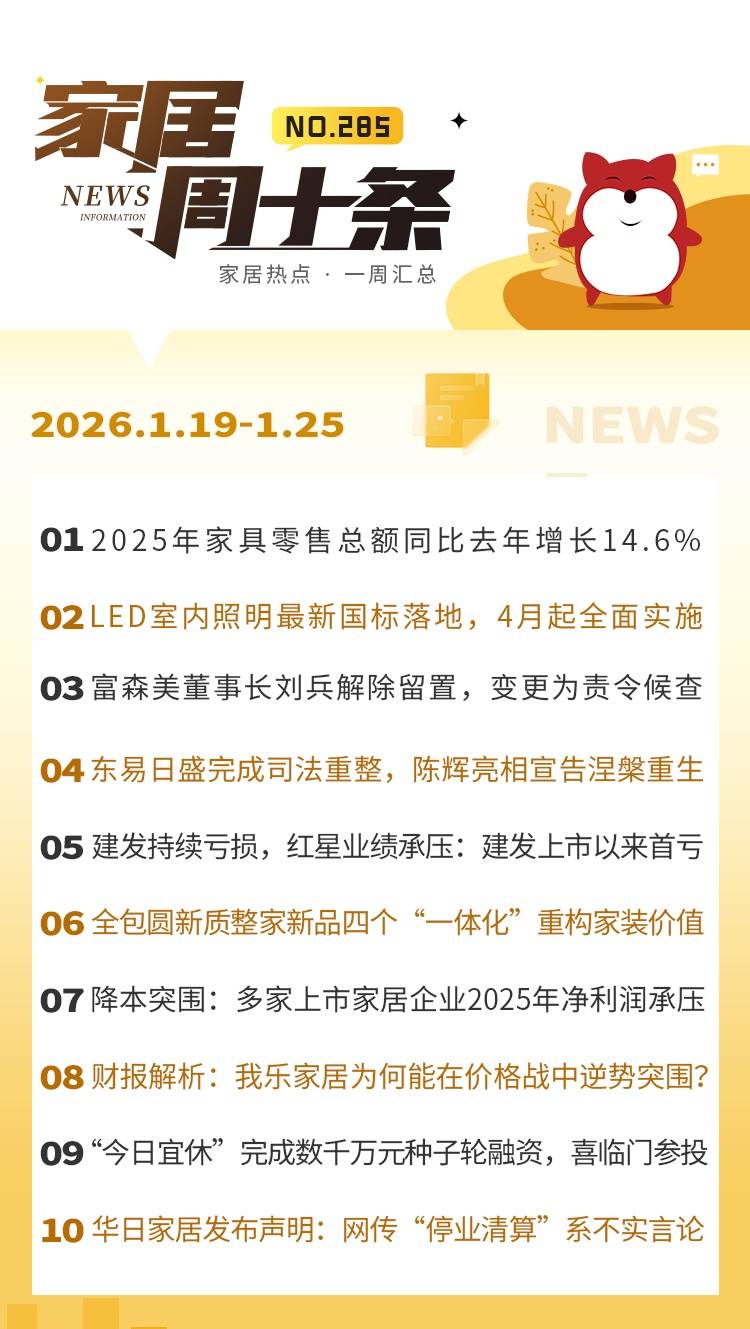
家居周十条 | 2025年家具零售总额增长14.6%、富森美董事长刘兵解除留置、多家上市家居企业2025年净利润承压 …
Sou Hu Cai Jing· 2026-01-26 07:03
Group 1: Furniture Retail and Market Trends - In 2025, the total retail sales of furniture in China increased by 14.6% year-on-year, reflecting a strong demand in the sector [1] - The overall retail sales of social consumer goods reached 501,202 billion yuan, with a growth of 3.7% compared to the previous year [1] - The per capita disposable income of residents in 2025 was 43,377 yuan, showing a nominal growth of 5.0% [1] Group 2: Industry Standards and Regulations - The new national standard for LED indoor lighting, GB/T 31831-2025, will be implemented starting April 1, 2026, replacing the 2015 version [2] - The updated standard includes significant improvements in energy efficiency, health lighting, and smart control features [2] Group 3: Company Performance and Developments - Fujian's company, Jindong, announced its first-ever annual loss since its listing, primarily due to pressures in its real estate and home operation businesses [3] - Dongyi Risheng, a prominent home decoration company, has completed its judicial reorganization, marking a significant recovery after facing debt issues [4] - Iole Home is projected to see a net profit increase of 72.73% to 95.76% in 2025, attributed to its focus on design and experience upgrades amidst industry challenges [5][6] Group 4: Financing and Investments - "Today Yixiu," a new company founded by former Xiaomi executive Wang Teng, has completed a seed round financing of several million yuan, with plans to launch a series of sleep-related smart products [7] Group 5: Market Reactions and Miscommunications - Huari Home's CEO addressed rumors regarding the company's alleged liquidation, clarifying that the auction of receivables is related to historical debts and does not affect current operations [8]

自营理财逆势压降,中小银行提速差异化发展
Xin Lang Cai Jing· 2026-01-23 10:03
Core Insights - The banking wealth management market is expanding, while banks without wealth management subsidiaries are systematically reducing their self-managed wealth management scale [1][2][3] - Recent reports from four small banks indicate a significant decline in their self-managed wealth management products, reflecting a broader industry trend influenced by regulatory guidance [2][10] Group 1: Market Trends - Four small banks reported a combined reduction of over 7 billion yuan in self-managed wealth management products, with total scale dropping from 31.87 billion yuan at the end of 2024 to 24.52 billion yuan by the end of 2025 [2][9] - The regulatory environment encourages banks to establish wealth management subsidiaries, leading to a focus on reducing self-managed wealth management and transitioning to agency sales [10][11] - By mid-2025, banks without wealth management subsidiaries had a self-managed wealth management scale of only 3.19 trillion yuan, accounting for about 10% of the total, with a year-on-year decline exceeding 24% [10] Group 2: Industry Growth - The overall scale of the banking wealth management industry reached a historical peak of 34 trillion yuan by November 2025, increasing by over 4 trillion yuan since the beginning of the year [4][12] - As of the end of the third quarter of 2025, there were 181 banks and 32 wealth management companies with active products, totaling 43,900 products and a scale of 32.13 trillion yuan, marking a year-on-year increase of 9.42% [12][13] - Fixed income products dominate the wealth management market, with a scale of 31.21 trillion yuan, representing 97.14% of the total [13] Group 3: Future Outlook - The market is expected to continue a "stronger gets stronger, weaker must transform" dynamic, with a projected increase in wealth management scale to over 36 trillion yuan in 2026 [6][14] - Wealth management subsidiaries are anticipated to leverage professional research and product innovation to expand into high-value categories such as ESG and retirement planning [14] - Small banks are advised to focus on differentiated and light-capital development paths, enhancing customer service and product offerings to avoid homogenization in competition [7][15]
激活县域消费新动能(有所思)
Ren Min Ri Bao· 2026-01-22 21:55
Group 1 - The core viewpoint emphasizes the potential of county-level consumption as a significant driver of China's economic growth, highlighting the transformation from survival-oriented to enjoyment-oriented consumption patterns [1] - Counties are experiencing a consumption upgrade with diverse offerings such as night markets, cafes, and entertainment venues, moving away from traditional retail models [1] - The article notes that the continuous improvement of commercial systems and innovative retail models like instant retail and community group buying are crucial for stimulating county-level consumption [1] Group 2 - The article stresses the importance of tailored strategies for county-level commercial development, advocating against a one-size-fits-all approach that leads to homogenization [2] - Successful examples of unique county-level initiatives demonstrate the effectiveness of understanding local resources and developing distinctive commercial identities [2] - The potential for over 2,800 county-level administrative regions to collectively boost domestic demand and embrace new consumption opportunities is highlighted as a pathway for vibrant county-level markets [2]
政府投资基金新规落地 地方“操盘手”迎来关键节点
Jing Ji Guan Cha Wang· 2026-01-16 23:52
Core Viewpoint - The new regulations aim to enhance the clarity and effectiveness of government investment funds, addressing issues such as misalignment with local resources and industry foundations, unclear fund positioning, and homogenized investment directions [2][3] Group 1: Regulatory Framework - The newly released "Work Method" provides a systematic framework for the layout and direction of government investment funds at the national level, emphasizing the need for funds to align with national major plans and industry directories [1][2] - The "Evaluation Management Method" establishes a comprehensive evaluation system covering the entire fund operation process, linking results to budget arrangements and fund adjustments [1][2] - Key aspects of the new regulations include clear investment directions, standardized investment methods focusing on early, small, long-term, and hard technology investments, and a robust evaluation mechanism [2][3] Group 2: Local Government Response - Local government investment fund managers have begun to adjust their strategies in response to the new regulations, with a focus on optimizing layouts and encouraging integration of existing funds [3][5] - The establishment of secondary funds (S Funds) has accelerated, with local governments seeking to revitalize existing fund assets in line with the new policy guidelines [3][5] - Local governments are rapidly developing "key investment area lists" to align with the new regulatory framework [5][6] Group 3: Industry Impact - Early-stage technology companies are encouraged by the new focus on long-term investment in hard technology, signaling stronger government support for genuine innovation [5][6] - Investment management institutions are recalibrating their strategies to align with the new regulations, focusing on long-term value rather than short-term pressures [5][6] - The new regulations are prompting a comprehensive "benchmarking" and "calibration" process across various stakeholders involved in government investment funds [6] Group 4: Challenges and Concerns - There are ongoing tensions between policy objectives and market-driven operations, necessitating a balance between policy goals and financial returns [7][8] - The new emphasis on early-stage investments raises concerns about risk management and the establishment of appropriate evaluation mechanisms [8][9] - The integration of existing funds poses complex challenges due to diverse funding sources and the need for careful negotiation and restructuring [11][12] Group 5: Future Directions - The new regulations mark a critical policy juncture, prompting a reevaluation of the roles and values of government investment funds within the ecosystem [12][13] - The focus on differentiated development paths for local funds encourages deeper industry research and alignment with local strengths [13][14] - The shift from mere financial management to becoming "industry partners" reflects a deeper collaboration model, enhancing the support provided to invested enterprises [14][15]