慢牛格局

Search documents
非银金融行业周报:融资新规夯实“慢牛”根基,险企渠道深度重塑
东方财富· 2026-01-21 00:25
Investment Rating - The report maintains an "Outperform" rating for the non-bank financial sector, indicating a positive outlook for investment opportunities in this industry [2]. Core Insights - The report highlights the strengthening of the "slow bull" market foundation due to new financing regulations, which are expected to stabilize the capital market and promote long-term healthy development [12][13]. - The insurance sector is undergoing a significant transformation, with a notable trend of branch institution exits, indicating a shift from extensive expansion to a more concentrated and quality-focused approach [42][43][44]. Summary by Sections 1. Securities Business Overview and Weekly Review - The financing margin ratio has been raised to 100%, reinforcing the foundation of a "slow bull" market. This adjustment aims to lower market leverage and protect investor rights, promoting long-term stability [12]. - The China Securities Regulatory Commission (CSRC) emphasizes risk prevention, strong regulation, and high-quality development as the main themes for 2026, aiming to enhance the capital market's stability and service to the real economy [13][14]. - CITIC Securities reported a net profit of 30.05 billion CNY for 2025, marking a 38.46% year-on-year increase, reflecting a recovery in the securities industry amid a rising market [15][17]. 2. Insurance Business Overview and Weekly Review - The insurance industry has seen over 3,100 institutions exit in 2025, the highest in six years, indicating a long-term structural adjustment away from extensive physical network expansion [42]. - The exit trend is primarily driven by life insurance companies, focusing on optimizing low-efficiency branches, particularly in third and fourth-tier cities [43]. - This transformation is pushing insurance companies towards digitalization and intelligent management, redefining the role of physical branches to focus on complex business consultations and service integration [44]. 3. Market Liquidity Tracking - The central bank's net injection in the open market was 1,112.8 billion CNY, with significant reverse repos contributing to liquidity [49]. - The interbank lending rates showed mixed performance, with the weighted average rate for interbank lending at 1.33% [54].

非银金融行业周报:融资新规夯实“慢牛”根基,险企渠道深度重塑-20260120
East Money Securities· 2026-01-20 13:47
Investment Rating - The report maintains an "Outperform" rating for the non-bank financial sector, indicating a positive outlook for investment opportunities in this industry [2]. Core Insights - The report highlights the strengthening of the "slow bull" market foundation due to new financing regulations, which aim to stabilize market operations and protect investor rights. The increase in financing margin requirements to 100% is seen as a measure to prevent excessive leverage and ensure long-term market stability [12][13]. - The insurance sector is undergoing a significant transformation, with a notable trend of branch exits, indicating a shift from extensive expansion to a more concentrated and quality-focused approach. This is driven by cost reduction demands, digital transformation, and regulatory guidance [42][43][44]. Summary by Sections 1. Securities Business Overview and Weekly Review - The financing margin ratio has been raised to 100%, reinforcing the foundation of a "slow bull" market. This adjustment is aimed at reducing market leverage and ensuring investor protection [12]. - The China Securities Regulatory Commission (CSRC) emphasizes a focus on risk prevention, strong regulation, and promoting high-quality development in the capital market for 2026 [13]. - The report notes that CITIC Securities achieved a record net profit of 30.05 billion CNY in 2025, reflecting a 38.46% year-on-year increase, indicating a recovery in the securities industry [15][17]. 2. Insurance Business Overview and Weekly Review - The insurance industry is experiencing a significant net exit of branches, with over 3,100 institutions exiting in 2025, marking a six-year high. This trend reflects a strategic shift towards high-value areas and a reduction in reliance on extensive physical networks [42][43]. - The restructuring is primarily driven by life insurance companies, which account for over 70% of the exits, indicating a transition towards bank cooperation channels and a focus on efficiency [43]. - The ongoing exit process is expected to lead to a fundamental reshaping of the insurance industry's operational logic, moving towards digitalization and a more refined management approach [44]. 3. Market Liquidity Tracking - The report indicates that the central bank conducted a net injection of 111.28 billion CNY in the open market during the week, with significant reverse repurchase operations contributing to liquidity [49].
中信建投:证券板块处于基本面强支撑的底部区间 慢牛格局下存在两条上行路径
智通财经网· 2026-01-19 23:57
Core Viewpoint - The recent pullback in the securities sector does not indicate the end of the market trend, as the sector is currently at a strong fundamental support level, suggesting potential for upward movement in the near future [1][2]. Group 1: Market Dynamics - The recent market adjustment is viewed as a healthy correction rather than a trend reversal, which will lead to a gradual transition towards a slow bull market, with the securities sector remaining active in this process [2]. - The activity level in the stock market serves as a synchronous indicator for the valuation and performance of the securities industry, determining the lower limit of the sector's valuation [2]. Group 2: Valuation Insights - As of January 16, 2026, the total market capitalization of the sample securities firms is approximately 39,901 billion, with a PB(LF) of only 1.34 times, which is below the estimated valuation lower limit [3]. - If the average daily trading volume in the stock market stabilizes and increases, the sector is expected to initiate a rebound, aligning valuations closer to the estimated range of 1.36 to 1.50 times PB [3]. Group 3: Policy Impact - The potential for unexpected financial policy changes is identified as a key variable for unlocking the upper limit of valuations, which could lead to higher valuation premiums based on policy-driven growth logic [3]. - If such unexpected financial policies emerge, the sector's valuation elasticity may rival previous market cycles, potentially exceeding the current valuation range [3].

中信建投:慢牛背景下,券商板块行情会缺席吗?
Xin Lang Cai Jing· 2026-01-19 23:37
中信建投研报指出,近期证券板块虽冲高回落,但短期调整并非意味着行情终结。从估值维度看,板块 当前处于基本面强支撑的底部区间。经定量测算,在慢牛格局下,证券板块存在两条上行路径:一是依 托交易量企稳逻辑,逐步实现估值抬升与补涨;二是借力超预期金融政策催化,突破估值上限打开上涨 空间。两种情形均指向券商行情不会缺席,逢低左侧布局窗口已经渐行渐近。 ...
A股市场波动上行
Tebon Securities· 2026-01-19 12:33
Market Overview - The A-share market experienced upward volatility on January 19, 2026, with a slight decrease in trading volume, closing at 4114 points for the Shanghai Composite Index, up 0.29% [6][8] - The total trading volume for A-shares was 2.73 trillion yuan, down from 3.06 trillion yuan the previous day [6][8] - The technology sector showed continued rotation, with strong performance in specific sectors such as ultra-high voltage and aerospace [7][8] Bond Market Analysis - The government bond futures market mostly declined, with the 30-year main contract down 0.22% to 110.920 yuan [10] - The People's Bank of China (PBOC) conducted a 7-day reverse repo operation of 158.3 billion yuan at an interest rate of 1.40%, resulting in a net injection of 72.2 billion yuan [10] - The release of key economic data, including GDP figures, is expected to influence bond market prices, with a potential for further interest rate cuts in 2026 [10][13] Commodity Market Insights - The commodity market saw a majority decline, with notable drops in base metals, particularly tin, which fell by 5.98% [10] - Precious metals, particularly gold, reached new highs due to ongoing geopolitical tensions and expectations of further interest rate cuts by the Federal Reserve [10][11] - The recent adjustments in tin futures margin policies and ongoing conflicts in the Democratic Republic of the Congo are contributing to supply concerns, potentially keeping tin prices strong [10][11] Investment Themes and Opportunities - Key investment themes include AI applications, commercial aerospace, nuclear fusion, quantum technology, brain-computer interfaces, robotics, and consumer upgrades, all supported by government policies [11][13] - The brokerage sector is expected to benefit from increased trading volumes in the A-share market, which recently surpassed 3 trillion yuan [11][13] - The precious metals sector is likely to remain strong due to central bank purchases and geopolitical risks [11][13]
A股:16亿元铂金级肉签上市交易,雨露均沾奖,股民中签开奖了!
Sou Hu Cai Jing· 2026-01-14 01:06
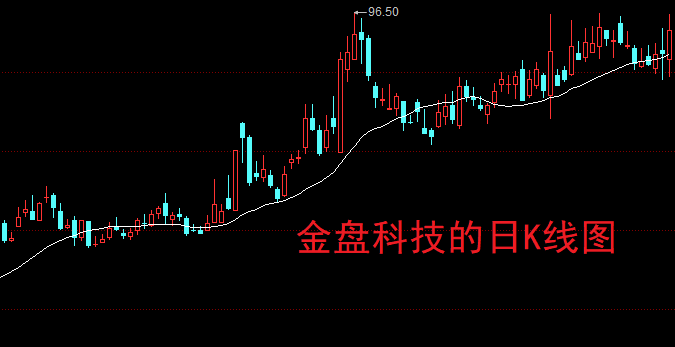
Group 1 - The core point of the news is the listing of Jinpan Technology's convertible bond, Jin 05 Convertible Bond, with a large issuance scale of 1.672 billion yuan and a high conversion value, attracting significant interest from investors [1] - The current stock price of Jinpan Technology is 92.95 yuan, with a conversion price of 89.28 yuan and a conversion value of 104.11, indicating a favorable investment opportunity [1] - The total market capitalization of Jinpan Technology is 42.74 billion yuan, with a dynamic price-to-earnings ratio of 66 times and a price-to-book ratio of 9.06 times, reflecting a high valuation [3] Group 2 - The stock price of Jinpan Technology has shown a strong correlation with the overall market, but investor sentiment has turned cautious due to recent market highs, leading to a potential shift in investment strategies [4] - Despite the market's strong performance, many individual stocks remain undervalued and overlooked, presenting future investment opportunities [4][6] - A rotation of funds from high-performing stocks to undervalued sectors is occurring, which may alleviate overall market valuation pressure and create opportunities for more stocks to participate in the upward trend [6][8]

但斌、王庆最新发声:“从‘924’到现在肯定是个牛市”,看好低估值价值股表现
Di Yi Cai Jing· 2026-01-11 12:12
Group 1 - The current market environment is characterized by a slow bull market, with the Shanghai Composite Index recently reaching 4120.43 points and trading volume exceeding 30 trillion yuan [1][5] - Analysts believe that the market's risk appetite has normalized since the "924" rally, leading to a revaluation of undervalued value stocks [2][3] - International investors are increasingly interested in Chinese assets, with a shift in sentiment attributed to successful investments like CATL's IPO, which boosted confidence [5][6] Group 2 - The market is experiencing a structural trend, with opportunities arising in sectors driven by technological advancements, particularly in AI [3][4] - There is a call for improving the quality of listed companies and enhancing their competitive advantages to better face challenges [4] - The outlook for the Chinese stock market is optimistic, with expectations of improved profitability and shareholder returns as competition in various industries optimizes [5][6]
华西证券刘郁:改革后股市最明显变化是有了下限
Xin Lang Cai Jing· 2026-01-11 09:00
Core Viewpoint - The 2026 China Chief Economist Forum held in Shanghai emphasized the theme "Chess in the Middle Game: Building a Strong Nation" and highlighted the formation of a policy framework aimed at regulating listings, increasing delisting efforts, encouraging dividends from listed companies, and promoting long-term capital inflow into the market [1][2]. Group 1 - The current market environment has established a framework that includes strict listing regulations, enhanced delisting measures, and encouragement for companies to distribute dividends, alongside efforts to attract long-term capital [1][2]. - The stock market has shown signs of a slow bull market, as evidenced by its performance over the past year and the beginning of the current year [1][2]. - A significant change noted by investors is the establishment of a lower limit in the stock market, which is considered crucial for market stability [1][2]. Group 2 - The future focus should be on maintaining the upward trajectory of the market while ensuring that the downward limits are secured, with expectations for the index to rise from 3800 to 4000 points [1][2]. - If the Shanghai Composite Index can achieve these lower limits, the attractiveness of the stock market is expected to increase significantly [1][2].

A股重磅!2025年,新开户2744万!
Xin Lang Cai Jing· 2026-01-06 12:16
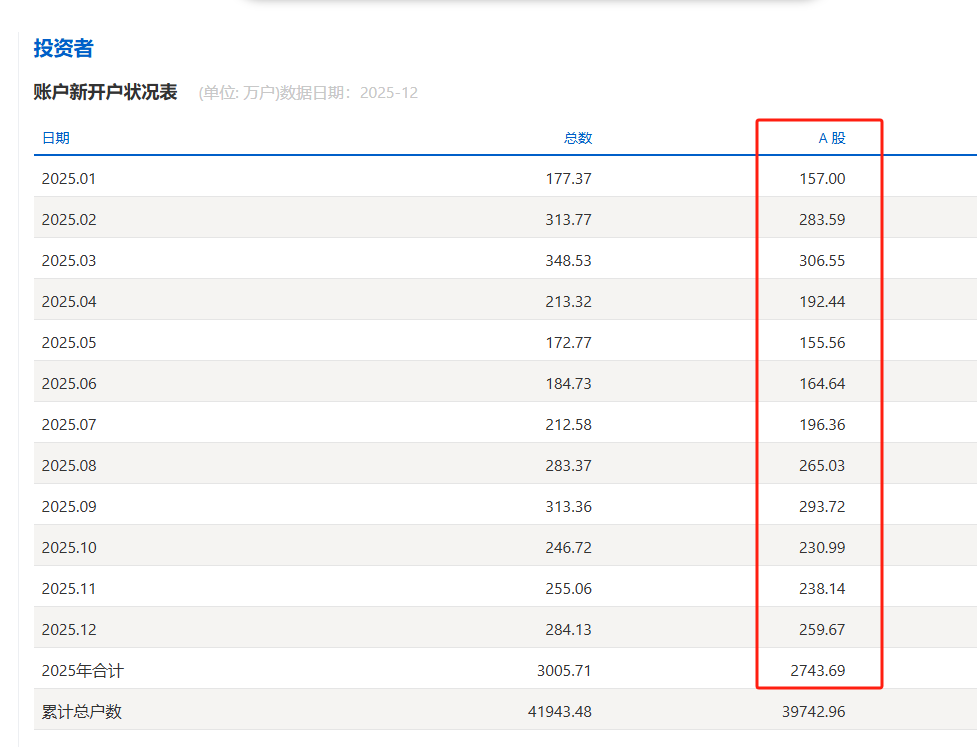
Core Insights - The A-share market has seen a significant increase in new account openings, with 27.44 million new accounts in 2025, representing a 9.75% growth compared to 24.99 million in 2024, indicating sustained high growth for two consecutive years since 2023 [2][3]. Group 1: New Account Openings - In 2025, the monthly new account openings peaked in December at 2.5967 million, a 30.54% increase year-on-year compared to December 2024 [3]. - The total number of new accounts opened in 2025 reached 27.4369 million, contributing to a cumulative total of 39.74296 million A-share accounts [4]. - The new account openings reflect the long-term investment value and vitality of the A-share market, with a notable presence of younger investors, particularly those under 35 years old [5]. Group 2: Market Outlook for 2026 - Analysts are optimistic about the A-share market in 2026, expecting a continuation of the positive trend due to improved corporate profit structures and potential valuation increases [2][7]. - The market is anticipated to experience a "slow bull" phase in 2026, supported by stable net asset returns for non-financial enterprises and limited valuation overextension [7]. - The influx of incremental capital from various sources, including insurance and high-net-worth individuals, is expected to further bolster the market [7][8].
A股重磅!2025年,新开户2744万!
券商中国· 2026-01-06 12:03
Core Viewpoint - The continuous growth in new A-share accounts in 2025 reflects the long-term investment value and vibrant activity of the A-share market, with a total of 27.44 million new accounts opened, representing a 9.75% increase from 2024 [1][4]. Group 1: New Account Growth - A-share new account openings have shown steady growth over the past two years, with 24.99 million new accounts in 2024, a 16.6% increase from 21.44 million in 2023, and further growth to 27.44 million in 2025 [2][4]. - Monthly data indicates that December 2025 saw a significant increase in new accounts, reaching 2.5967 million, a 30.54% year-on-year increase compared to December 2024 [2][6]. - In December 2025, institutional new accounts reached 11,100, marking a new high for the year, while individual investors opened 2.5856 million new accounts [2][5]. Group 2: Market Outlook for 2026 - Analysts are optimistic about the A-share market in 2026, expecting a continuation of the positive trend due to improved corporate profit structures and potential for valuation increases [1][7]. - The market is anticipated to experience a "slow bull" pattern in 2026, supported by a stable return on equity (ROE) for non-financial enterprises and limited valuation overextension [7]. - The influx of new capital from insurance and high-net-worth individuals is expected to further bolster market performance [7].