
慢牛长牛

Search documents
视频|杨德龙:2026年延续本轮慢牛长牛 春季攻势行情呼之欲出
Xin Lang Cai Jing· 2025-12-25 07:47
Group 1 - The core viewpoint of the article highlights that the public fund industry in China has reached nearly 36 trillion yuan, with active equity funds regaining prominence in the market [1][2] - The article discusses the countdown to the announcement of the "champion funds," indicating a competitive environment within the fund industry [1][2] - The MACD golden cross signal formation suggests positive momentum for certain stocks, indicating potential investment opportunities [1][2] Group 2 - The article emphasizes the significant growth in the public fund industry, reflecting a robust market environment [1][2] - Active equity funds are noted to have reclaimed their leading position, suggesting a shift in investor preferences towards actively managed strategies [1][2] - The mention of the "champion funds" indicates an upcoming recognition of top-performing funds, which may influence investor decisions [1][2]
杨德龙:本轮慢牛长牛有望提升居民财产性收入 从而带动消费增长
Xin Lang Cai Jing· 2025-12-15 05:15
Group 1: Economic Overview - The macroeconomic data for November shows a clear characteristic of "strong production, weak demand, rising prices, and improved structure" [1][5] - The industrial added value for large-scale enterprises increased by 4.8% year-on-year, with significant internal structural differentiation; equipment manufacturing and high-tech manufacturing grew by 7.7% and 8.4% respectively, leading the overall industrial growth by 2.9 and 3.6 percentage points [1][5] - The retail sales of consumer goods only increased by 1.3% year-on-year, marking a new low for the year, with online retail sales growing by 5.7% but unable to offset the weakness in offline sales [1][6] Group 2: Consumer Behavior and Investment - The weak consumption is attributed to declining expectations of household income and a rise in "precautionary" savings, with household deposits increasing by over 10 trillion yuan in the first eleven months [6] - There is a significant shift in household assets from savings to investments, with over 25 million new stock accounts opened this year and equity public funds surpassing 500 billion yuan in sales [6][7] - Fixed asset investment decreased by 2.6% year-on-year, but excluding real estate development, it showed a slight increase of 0.8% [6][7] Group 3: Foreign Trade and Price Trends - In November, the total import and export value increased by 4.1% year-on-year, with exports and imports growing by 5.7% and 1.7% respectively, and a historic trade surplus exceeding 1 trillion USD [7] - The Consumer Price Index (CPI) rose by 0.7% year-on-year, while the Producer Price Index (PPI) decreased by 2.2%, indicating a potential for PPI to turn positive by 2026 [7] - The monetary environment shows a widening gap between M1 and M2, with a notable shift of funds towards equity investments as the one-year fixed deposit rate falls below 1% [7] Group 4: Future Outlook - The policy direction for 2026 will focus on "three stabilizations and three expansions," aiming to stabilize employment, enterprises, and expectations while expanding domestic demand, high-end supply, and institutional openness [7] - The current market trend is expected to enhance household financial income, counteract real estate wealth depreciation, and provide financing support for technology innovation enterprises [8]
牛市还在吗,如何应对市场下跌?
雪球· 2025-11-21 13:01
Core Viewpoint - The article discusses the current phase of the A-share market, analyzing it through the lens of the classic bull market three-stage theory, and emphasizes the importance of balancing offensive and defensive strategies in investment as the market transitions from valuation recovery to performance-driven growth [4][6][25]. Group 1: Bull Market Phases - The bull market is divided into three stages: valuation recovery, performance-driven growth, and emotional-driven bubble [6][7]. - The first stage, characterized by policy shifts and risk appetite recovery, has been completed as of October 2024, with the market returning to historical valuation levels [7][9]. - The second stage, currently in progress, focuses on performance verification, with A-share companies' profits growing by 5.4% year-on-year in the first three quarters of 2025, and significant growth in sectors like TMT and manufacturing [9][10]. Group 2: Sector Performance - The TMT sector showed strong performance, with electronic profits up 45.3% year-on-year, and AI-related indices seeing profits increase by 83.3% [10]. - The midstream manufacturing sector also performed well, with profits in the power equipment and new energy sectors growing by 52.5% [10]. - The energy and materials sector benefited from policy changes, with industrial metals and precious metals seeing profit increases of 45.2% and 58.7%, respectively [10]. Group 3: Market Dynamics and Strategy - The current market dynamics suggest a need for a balanced strategy, moving from an aggressive "only attack" approach to a more defensive "balance attack and defense" strategy [18][25]. - A suggested allocation strategy includes maintaining a 50% equity position, diversifying across growth, stable, high-dividend, and cyclical sectors to mitigate risks [19][20]. - The article warns that if the market enters the third phase characterized by bubble-like valuations and extreme market sentiment, a shift to a defensive strategy will be necessary [22][23]. Group 4: Long-term Considerations - The article highlights the importance of sustainable performance growth, questioning whether the current high growth in tech stocks can be maintained amid macroeconomic challenges [13][14]. - It draws parallels with the U.S. market's slow bull experience, emphasizing the need for solid earnings support for a sustainable bull market [14]. - The article concludes that for the A-share market to transition into a long-term bull market, several factors, including macroeconomic stability and improved corporate governance, must be addressed [16][25].


A股失守3900点,牛市行情结束了吗?
Sou Hu Cai Jing· 2025-11-21 10:22
Market Overview - On November 21, the A-share market experienced a significant adjustment, with all three major indices opening lower and closing down. The Shanghai Composite Index fell 2.45% to 3834.89 points, while the ChiNext Index dropped over 4% [2][3] - More than 5000 stocks declined, with 107 stocks hitting the daily limit down, indicating a widespread sell-off in the market [3] Institutional Perspectives - Despite the market's downturn, institutional views suggest that the foundation of the current slow bull market remains intact, with potential for continued strength in A-share indices [2][9] - Yang Delong, Chief Economist at Qianhai Kaiyuan Fund, believes that the current market is a slow bull market that could lead to significant wealth growth for investors, with a possibility of a comprehensive bull market forming by 2026 [2][9] Global Market Context - The global stock markets are also under pressure, with major indices such as the Nikkei 225 and KOSPI experiencing declines of 2.40% and 3.79%, respectively. This global downturn is partly attributed to the cooling expectations for a Federal Reserve rate cut in December [5][6] - Concerns over high valuations in technology stocks have resurfaced, contributing to declines in global tech stocks, including Nvidia, which saw a drop despite reporting better-than-expected earnings [7][8] Future Market Outlook - Financial analysts maintain a positive outlook for the market in 2026, with expectations of continued inflows of micro-level capital and potential for exceeding profit expectations in companies [10][11] - The focus for future investments includes technology self-reliance, industrial base upgrades, and strategic resource security, as the market is expected to remain in a slow bull phase [10][11]

A股失守3900点,牛市行情结束了吗?
和讯· 2025-11-21 10:15
Market Overview - On November 21, the A-share market experienced a significant adjustment, with all three major indices opening lower and closing down. The Shanghai Composite Index fell 2.45% to 3834.89 points, while the ChiNext Index dropped over 4% [2][3] - A total of 5071 stocks declined, with 107 stocks hitting the daily limit down, contrasting sharply with only 33 stocks reaching the limit up [4] Sector Performance - According to the Wind China Industry Index, only the cultural media sector managed a slight increase of 0.1%, while all other sectors showed declines. The fine chemicals, basic metals, and forestry sectors had the largest drops [5] Global Market Context - The global stock markets also faced declines, with the Nikkei 225 index down 2.40%, the KOSPI index down 3.79%, and the Hang Seng Index down over 2% [8] - The pressure on global markets is attributed to the cooling expectations for a Federal Reserve rate cut in December, following mixed signals from the Fed's recent meeting minutes [9] Long-term Market Outlook - Despite the recent market volatility, analysts believe the foundation of the current slow bull market remains intact. They anticipate that the A-share index has the potential to continue strengthening [12] - The chief economist of Qianhai Kaiyuan Fund, Yang Delong, suggests that the market is likely to transition from a structural bull market to a comprehensive bull market by 2026, which could enhance consumer confidence and drive economic growth [12][13] Investment Strategies - Analysts recommend focusing on three investment themes for the future: technological self-reliance, upgrading industrial foundations, and securing strategic resources [13] - The Chen Guo team from Dongfang Caifu expresses optimism for the Chinese stock market in 2026, highlighting potential areas of outperformance, including corporate earnings and advancements in AI [14]

股市三点钟丨沪指收跌0.22%,两市合计成交额2.15万亿元
Bei Jing Shang Bao· 2025-10-28 07:53
Market Performance - A-shares opened lower but turned positive, with the Shanghai Composite Index reaching a high of 4010.73 points, breaking the 4000-point mark [1] - By the end of the trading day, the Shanghai Composite Index, Shenzhen Component Index, and ChiNext Index closed down by 0.22%, 0.44%, and 0.15% respectively, at 3988.22 points, 13430.1 points, and 3229.58 points [1] Sector Performance - Active sectors included shipbuilding, JD Finance, and synchronous reluctance motors, while precious metals, fourth-generation semiconductors, and combustible ice saw significant declines [1] Individual Stock Performance - Out of A-shares, 2366 stocks rose, with 71 hitting the daily limit up, while 2908 stocks fell, including 10 hitting the daily limit down [2] - The total trading volume reached 2.15 trillion yuan, with the Shanghai market accounting for 940.76 billion yuan and the Shenzhen market for 1.207 trillion yuan [2] Market Outlook - The chief economist of Qianhai Kaiyuan Fund, Yang Delong, stated that the 4000-point mark signifies the beginning of a new market cycle rather than its end [2] - The current market is still in the first half of a bull market, with expectations for the technology sector to continue its upward trend [2] - The ongoing bull market is anticipated to last for two to three more years, characterized as a "slow bull" market [2]
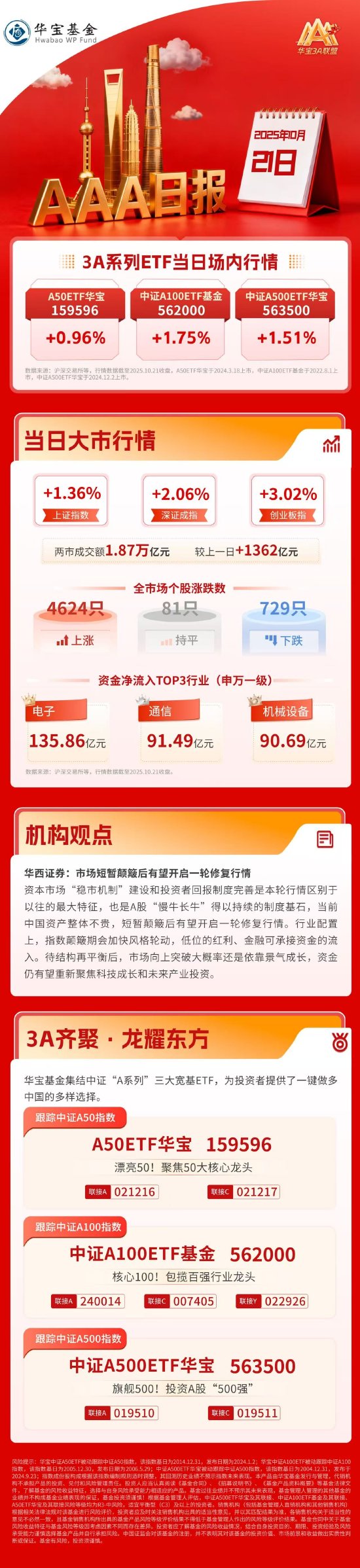
沪指重返3900点,CPO领衔科技股强势回归,新一轮行情开启? | 华宝3A日报(2025.10.21)
Xin Lang Ji Jin· 2025-10-21 09:31
Group 1 - The market is expected to enter a recovery phase after a brief fluctuation, supported by the construction of a "stability mechanism" in the capital market and improvements in investor return systems, which are seen as the foundation for a sustained "slow bull" market in A-shares [2] - The current valuation of Chinese assets is considered reasonable, and after a short-term dip, there is a high probability of market upward breakthroughs driven by growth in sectors with strong economic performance, particularly in technology and future industries [2] - The A-share market is experiencing a rotation in investment styles during this fluctuation period, with low-yield sectors like dividends and finance likely to attract capital inflows [2] Group 2 - The three major broad-based ETFs from Huabao Fund, tracking the CSI A50, A100, and A500 indices, provide diverse options for investors looking to invest in China [2] - The A50 ETF focuses on the top 50 core leading companies, while the A100 ETF encompasses the top 100 industry leaders, and the A500 ETF covers a broader range of 500 companies [2] - The trading data indicates a positive trend in the market, with significant increases in the indices, such as a 3.02% rise in the ChiNext Index and a total market turnover of 1.87 trillion yuan, up 136.2 billion yuan from the previous day [1][2]
存款都往股市挪,外资也加仓!融资2.3万亿,为啥有人说稳有人慌
Sou Hu Cai Jing· 2025-09-15 14:08
Core Viewpoint - The current market situation is characterized by a gradual upward trend, with significant capital inflow from both domestic and foreign investors, despite concerns over high margin financing levels [1][3][4]. Group 1: Market Trends - A-shares and Hong Kong stocks are steadily rising, with continuous inflow of external capital, indicating a positive market sentiment [3][4]. - The trend of household savings shifting to the stock market is beginning, as evidenced by the decline in deposit interest rates below 1% [4][5]. - The current margin financing balance has exceeded 2.3 trillion, but the ratio of margin financing to market capitalization is below 3%, significantly lower than the 4.2% peak seen ten years ago [4][5]. Group 2: Foreign Investment - Foreign capital has been consistently buying into Hong Kong stocks since last year, with over 100 billion USD flowing into A-shares in the first half of this year, and further acceleration expected [7]. - The global capital is undergoing a "rebalancing" from high-valued markets like the US to undervalued markets, positioning A-shares and Hong Kong stocks as attractive targets [7]. Group 3: Investment Strategies - The long-term upward trend in gold prices is expected to continue, with a recommendation to allocate around 20% of assets to gold for diversification [8]. - For stock selection, low-valuation, high-dividend stocks such as banks and utilities are recommended for conservative investors, while technology growth stocks should be evaluated based on their actual performance and competitive advantages [8][10].

杨德龙解读A股回调:是正常的技术性调整,提供了较好的上车机会
Sou Hu Cai Jing· 2025-09-04 10:18
Market Overview - The A-share market experienced a significant decline on September 4, with major indices dropping collectively. The Shanghai Composite Index fell by 1.25% to 3765.88 points, the Shenzhen Component Index dropped by 2.83% to 12118.7 points, and the ChiNext Index decreased by 4.25% to 2776.25 points. The STAR 50 Index saw a decline of over 6% [2]. Market Correction - The recent downturn is characterized as a normal short-term technical correction, with an expected decline of less than 10% and a brief duration. The primary reason for this correction is attributed to the rapid increase in the market, which rose over 700 points from 3200 to nearly 3900 points [4][5]. - The market's previous surge led to a significant accumulation of profit-taking positions, particularly in popular stocks, which contributed to the current sell-off [5][6]. Investor Sentiment - The market's rapid rise created an environment of heightened investor enthusiasm, leading to increased leverage and a record high margin balance of 2.3 trillion yuan. This situation also raised concerns about potential risks associated with such rapid gains [5][6]. - The current market sentiment reflects a collective expectation of a correction, resulting in panic selling across various indices [6]. Sector Analysis - The technology sector, particularly semiconductor and communication equipment stocks, is experiencing significant sell-offs due to previous speculative trading without solid earnings support. This has led to a sharp decline in stock prices as market sentiment shifts [8]. - Conversely, the photovoltaic sector is showing resilience, driven by expectations of "capacity reduction and anti-involution" policies aimed at addressing overcapacity issues and reducing competition within the industry [10]. Investment Strategy - Investors holding speculative stocks are advised to take profits during this correction and consider reallocating to more stable, undervalued blue-chip stocks. Those who are currently at a loss should remain patient and wait for the market to stabilize before making further adjustments [9]. - The photovoltaic sector's rebound is seen as a potential opportunity, although caution is advised as overall market adjustments could still impact this sector [10].

沪指3900点关前震荡,业内人士认为—— 本轮牛市处于中期阶段
Shen Zhen Shang Bao· 2025-08-27 05:55
Group 1 - The A-share market has shown a significant upward trend, with the Shanghai Composite Index reaching a 10-year high, indicating a potential breakthrough at the 3900-point mark this week [1] - The current bull market is characterized as a "slow bull" driven by policy support, technological innovation, and stable capital inflow, differing from previous bull markets in 2007 and 2015 [1] - The bull market is a result of a combination of policy, fundamentals, capital, and technical factors, emphasizing the long-term growth logic of industrial cycles such as AI, innovative pharmaceuticals, and new energy equipment [1] Group 2 - The current bull market is considered to be in its mid-stage, having started on September 24 of the previous year, and historical data suggests that A-share bull markets last at least 2 years [2] - As the economic fundamentals improve and corporate earnings gradually recover, the bull market is expected to transition into its second half [2] - Investors are advised to focus on undervalued stocks that have been stagnant for a long time and to avoid high-flying speculative stocks, as all sectors are likely to experience rotation in this bull market [2]