
房地产市场低迷

Search documents
二手房超过这个房龄的,真的不建议购买,内行人都会选择避开!
Sou Hu Cai Jing· 2025-09-30 13:04
Core Viewpoint - The second-hand housing market is experiencing a significant decline in both volume and price due to a sluggish real estate market, leading to an increase in listings across various cities in China [1][3]. Group 1: Market Trends - The surge in second-hand housing listings has resulted in a supply-demand imbalance, making it increasingly difficult to sell these properties [3]. - Major cities such as Beijing, Shenzhen, and Chongqing have seen listings exceed 100,000 to 200,000 units, indicating a substantial increase in market supply [1]. Group 2: Comparative Analysis - Despite the challenges in selling second-hand homes, they are still considered a better investment compared to new homes due to lower prices and established infrastructure [3][4]. - Many second-hand homes are now priced below new constructions, making them more attractive to buyers [3]. Group 3: Purchase Recommendations - It is advised to avoid purchasing second-hand homes that are over 20 years old due to various issues such as poor living conditions, inadequate property management, and difficulties in securing loans [4][6]. - Older properties often suffer from significant wear and tear, leading to a decline in living quality and potential safety hazards [6][8].

如果房地产“救不起来”,那么明年或将面临这4个“大麻烦”
Sou Hu Cai Jing· 2025-09-28 02:37
Core Viewpoint - The Chinese real estate market is experiencing a paradox where prices are declining significantly while government and financial institutions are continuously implementing measures to stimulate the market, yet these efforts have not yielded the expected results [1][3]. Group 1: Market Trends - The average decline in housing prices across the country has exceeded 30% [1]. - The government's measures include the removal of purchase restrictions in most areas and lowering mortgage rates and down payment ratios to historical lows [1]. - Despite these efforts, the anticipated recovery in the real estate market has not materialized [1]. Group 2: Challenges Ahead - Local governments are facing a significant drop in land transfer revenue, which fell to 2.85 trillion yuan in the first half of 2025, a year-on-year decrease of approximately 19.7% [5]. - Real estate companies are under pressure to sell off inventory, with a looming debt maturity peak of about 1.2 trillion yuan from late 2025 to 2026, raising concerns about potential bankruptcies [5][6]. - The non-performing loan rate for personal housing loans reached 0.7% in Q2 2025, an increase of 0.2 percentage points from the end of 2024 [6]. - The non-performing loan rate for real estate development loans was as high as 6.3% in the first half of 2025, up 1.5 percentage points from the beginning of the year [6]. Group 3: Price Adjustments and Market Dynamics - The long-term downward trend in housing prices is evident, with examples such as a property purchased for 4 million yuan in 2021 now valued at 2.56 million yuan [8]. - There is a trend of price declines in second and third-tier cities slowing down, while first-tier cities are beginning to experience similar declines [8]. - If the market does not stabilize, downward pressure on housing prices is expected to increase, aligning prices with local income levels and returning to their fundamental residential attributes [8].
高盛预言:2027年房价再跌10%?今明年买房,首付要打水漂了?
Sou Hu Cai Jing· 2025-09-26 05:32
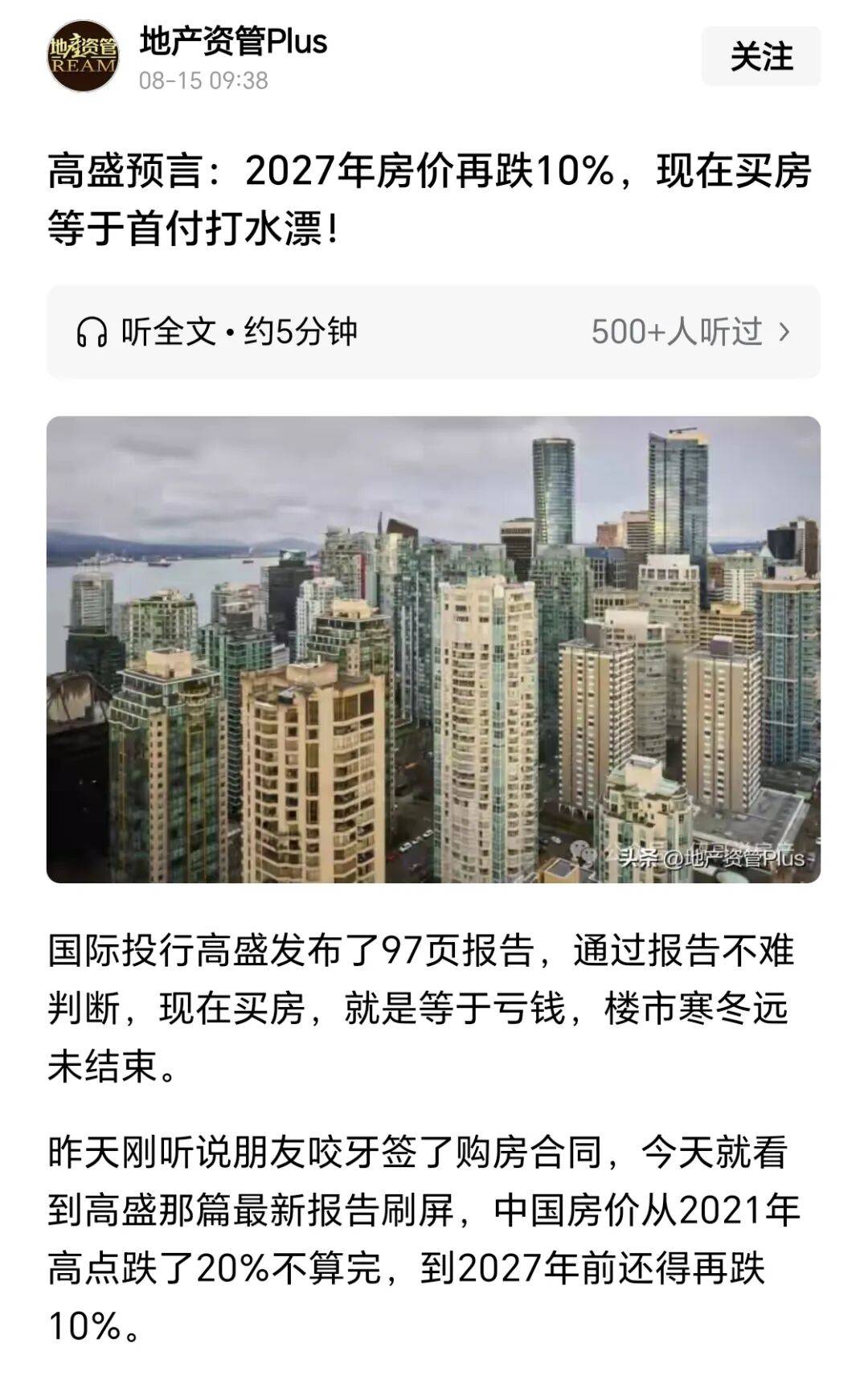
Core Insights - Goldman Sachs predicts that the current decline in China's real estate market, which began in 2021, has only completed 40% of its total expected drop, with an additional 60% decline anticipated before reaching the bottom by the end of 2027 [5][6][18] Market Analysis - The report evaluates the current state of the Chinese real estate market by comparing it to historical global real estate crashes, forecasting a potential further decline of 10% in property prices [6][9] - Since the peak in Q4 2021, Chinese property prices have already dropped by 20%, and the market is expected to follow a typical crash pattern, indicating a prolonged downturn [6][14] Supply and Demand Dynamics - The current oversupply in the housing market is significant, with a reported 750 million square meters of unsold residential properties, suggesting that it could take two to three years to digest the existing inventory [7][9] - The demographic shift indicates a decrease in the primary home-buying age group (25-39 years), with a projected reduction of 42 million individuals by 2027, leading to diminished demand [7][9] Financial Strain on Consumers - The household debt-to-GDP ratio has reached 63.5%, comparable to developed nations, with housing affordability becoming a critical issue, particularly in major cities like Beijing and Shanghai where the price-to-income ratio exceeds 12 times [7][9] Policy Response and Market Stability - Despite numerous government measures aimed at stabilizing the housing market, such as lowering down payment ratios and interest rates, the fundamental issues of population decline, high inventory, and elevated debt levels remain unresolved [9][11] - The government's approach has shifted from attempting to boost prices to merely preventing a rapid decline, indicating a more cautious stance in policy implementation [9][11] Regional Variations - Different cities are experiencing varying degrees of impact, with first-tier cities expected to stabilize by late 2025 after a cumulative drop of up to 20%, while second-tier cities may see declines of up to 25% [14][16] - In contrast, third and fourth-tier cities are facing severe challenges, with potential price drops of 40% or more, making recovery to 2021 peak prices unlikely [14][16] Future Outlook - The real estate sector is anticipated to see a more pronounced recovery by 2026, contingent upon successful debt restructuring and improved market confidence [6][9] - Investors are expected to reassess valuations post-debt resolution and inventory clearance, with a gradual normalization of credit conditions benefiting leading private developers [6][9]
2025收缩型城市分析——139个城市正 “悄悄收缩”
Sou Hu Cai Jing· 2025-09-14 03:13
Core Viewpoint - The phenomenon of "shrinking cities" in China has gained attention as urbanization enters a new phase, characterized by population decline and economic restructuring, necessitating targeted development strategies and policy recommendations for sustainable urban development [1][48]. Group 1: Definition and Identification of Shrinking Cities - Shrinking cities are defined as urban areas experiencing sustained population loss and structural economic crises, requiring a multi-dimensional understanding [3][6]. - Identification standards for shrinking cities include a continuous decline in urban population over three years, economic growth below the national average, and mismatched urban expansion and population growth [7][10]. Group 2: Characteristics and Distribution of Shrinking Cities - There are 139 identified shrinking cities in China, with significant concentrations in the Northeast, particularly in Heilongjiang, where 12 out of 13 cities are classified as shrinking [10][11]. - Shrinking cities exhibit a paradox of spatial expansion despite population decline, with 93.03% of these cities still expanding their built-up areas [35][36]. Group 3: Causes of Shrinking Cities - Macro factors contributing to shrinking cities include population aging, low birth rates, and regional development imbalances, leading to resource and talent concentration in coastal areas [17][19]. - Micro factors include population outflow, a decline in job opportunities, and a stagnant real estate market, exacerbating the shrinking phenomenon [27][29]. Group 4: Transformation Paths for Shrinking Cities - Strategies for transformation include "smart shrinkage," focusing on quality and efficiency rather than mere expansion, optimizing urban space, and developing new industries [38][39]. - Specific development paths for resource-dependent cities involve leveraging local resources for new industries, while cultural tourism and ecological cities are emerging as viable options for others [40][41]. Group 5: Policy Responses - National policies emphasize the need for "smart shrinkage" strategies, optimizing administrative divisions, and avoiding blind expansion to enhance urban quality and competitiveness [43][44]. - Future policy recommendations include establishing monitoring mechanisms for shrinking cities, implementing differentiated support policies, and promoting regional collaboration for resource sharing [46][47].

宝新置地(00299.HK)中期亏损约2.42亿港元
Ge Long Hui· 2025-08-29 10:51
Core Viewpoint - Baoxin Land (00299.HK) reported a significant decline in revenue due to the prolonged downturn in the Chinese real estate market, with a net loss recorded for the period [1] Financial Performance - The group's revenue for the six months ending June 30, 2025, was approximately HKD 57,377,000, representing a substantial decrease of about 87.4% compared to the same period last year [1] - The net loss for the current period was approximately HKD 241,770,000, a notable improvement from the net loss of approximately HKD 1,569,918,000 recorded in the same period last year [1]
宝新置地公布中期业绩 公司拥有人应占亏损约1.67亿港元 同比收窄86.22%
Zhi Tong Cai Jing· 2025-08-29 10:43
Core Viewpoint - Baoxin Land (00299) reported a significant decline in revenue and a narrowed loss for the first half of 2025, primarily due to the prolonged downturn in the Chinese real estate market [1] Financial Performance - Revenue for the period was HKD 57.377 million, representing a year-on-year decrease of 87.39% [1] - The loss attributable to shareholders was approximately HKD 166.7 million, which is a year-on-year reduction of 86.22% [1] - Loss per share was HKD 0.15328 [1] Reasons for Performance - The substantial decrease in revenue was mainly attributed to the long-term slump in the Chinese real estate market [1] - The net loss was significantly impacted by inventory write-downs, leading to a gross loss of approximately HKD 7.169 million, which is a decrease of about HKD 107.6 million compared to the same period last year [1] - The group also faced a fair value loss of approximately HKD 56.413 million on investment properties during the period [1] - Additionally, there was a recognized impairment loss of approximately HKD 65.392 million related to prepayments for a land redevelopment project [1]
中报点评|绿城中国:逆势扩张拿地,归母净利下降近九成
克而瑞地产研究· 2025-08-26 09:38
Core Viewpoint - The company has shown resilience in sales despite a challenging market, with a focus on inventory reduction and strategic land acquisition, while maintaining a stable financial position and financing channels [2][3][22]. Sales Performance - In the first half of 2025, the company achieved a contract sales amount of 122.2 billion, with a sales area of 5.35 million square meters, representing a year-on-year decrease of 3.4% and 9.5% respectively [2][4]. - The construction business recorded a sales amount of 41.9 billion, showing a year-on-year growth of 1.9%, contributing 34.3% to total sales [2][4]. - The sales target completion rate for self-invested projects reached 53.6%, indicating a strong cash flow with a collection rate of 96% [4][6]. Inventory Management - The company has made progress in inventory reduction, with 19 billion of inventory from 2021 and earlier being liquidated, resulting in a decrease in the proportion of completed unsold properties to 14.9% [6][8]. - The average liquidation rate for the first half of the year was 48%, with a target of 45% for the second half to meet the annual goal of 160 billion for self-invested projects [6][8]. Land Acquisition and Development - The company acquired 35 new land parcels with a total area of 3.55 million square meters, a year-on-year increase of 172%, with a new value of 90.7 billion [7][12]. - The land acquisition sales ratio increased to 0.67, indicating a significant increase in land acquisition efforts [7][10]. - The expected sales conversion rate for new projects in 2025 is 55%, which could contribute approximately 50 billion in sales [12][16]. Financial Performance - Total revenue for the first half of 2025 was 53.37 billion, a decrease of 23.3% year-on-year, with recognized revenue of 49.65 billion, down 22.1% [17][27]. - The comprehensive gross margin was 13.4%, a slight increase of 0.3 percentage points, while the net profit margin decreased by 2.5 percentage points to 2.3% [20][27]. - The company issued 7.711 billion in domestic bonds, with an average cost of 4%, and maintained a stable financial condition with a cash coverage ratio of 1.7 times for short-term debts [22][23].

全球多国严限外国人购房,这些国家却反向松绑
Di Yi Cai Jing· 2025-08-25 10:45
Core Insights - The implementation of new regulations in South Korea is expected to drastically reduce offshore property purchases by foreigners to nearly zero in the coming year [1] - A global trend is emerging where many countries are tightening restrictions on foreign buyers, with notable examples including Australia, Spain, and Japan [1][7] - Conversely, some countries like New Zealand and Saudi Arabia are considering easing restrictions to attract foreign investment [9] Summary by Category Regulatory Changes - South Korea's new policy requires foreign buyers to obtain local government approval and mandates actual residency for at least two years after purchase [1][8] - Australia has banned foreign investors from purchasing completed residential properties until March 2027 [1] - Spain proposed a 100% property tax on non-EU buyers who do not reside in the country, effective from 2025 [7] Market Trends - The global real estate market is experiencing a downturn, with the U.S. housing market index falling to 32, indicating low builder confidence [4] - In the UK, average house prices have dropped for three consecutive months, with London experiencing a 2.6% decline in August [4] - New Zealand's property prices have decreased for four months, with a 0.2% drop in July [6] Regional Insights - In South Korea, all regions except for Seoul and its surrounding areas are expected to see a decline in property prices by mid-2025 [5] - The U.S. and other major markets are facing a decline in transaction volumes, with ongoing housing supply shortages expected to drive cross-border capital investment [6] Foreign Buyer Dynamics - The new regulations in South Korea are aimed at curbing speculative buying by non-resident foreigners, which is expected to benefit local buyers [8] - In Japan, rising property prices have led to political discussions about restricting foreign purchases, with proposals for an "empty house tax" to deter speculative investments [8] Investment Opportunities - Despite tightening regulations, there is an increase in inquiries from international buyers, particularly from Asia, indicating potential demand for properties in South Korea [10] - Saudi Arabia's new policy will allow foreign buyers to purchase property in designated areas starting January 2026, with significant investment incentives [9]

【盈警】宝新置地(00299.HK)料中期净亏损收窄至不超2.45亿港元
Jin Rong Jie· 2025-08-22 01:40
Core Viewpoint - The company, Baoxin Land (00299.HK), is expected to report a net loss of no more than HKD 245 million for the six months ending June 30, 2025, compared to a net loss of approximately HKD 1.57 billion in the same period of 2024, primarily due to the prolonged downturn in the Chinese real estate market [1] Summary by Relevant Categories Financial Performance - The anticipated net loss for the upcoming period is significantly lower than the previous year's loss, indicating a potential improvement in financial performance despite ongoing challenges in the market [1] - The company recorded a net loss of about HKD 1.57 billion in 2024, highlighting the severity of the financial impact from the market conditions [1] Market Conditions - The expected net loss is attributed to the long-term slump in the Chinese real estate market, which has led to a substantial decline in revenue [1] - The decline in fair value of investment properties is also a contributing factor to the anticipated losses [1] Impairment Losses - The company is facing impairment losses related to prepayments for a land redevelopment project and other deposits, which further exacerbates the financial challenges [1]
宝新置地发盈警 预期中期取得净亏损同比收窄至不多于2.45亿港元
Zhi Tong Cai Jing· 2025-08-21 23:29
Group 1 - The company, Baoxin Land (00299), expects a net loss of no more than HKD 245 million for the six months ending June 30, 2025, compared to a net loss of approximately HKD 1.57 billion for the same period ending June 30, 2024 [1] - The anticipated net loss is primarily attributed to the prolonged downturn in the Chinese real estate market, resulting in a significant decline in revenue [1] - Additional factors contributing to the expected net loss include a decrease in the fair value of investment properties and impairment losses related to advance payments and deposits for a land redevelopment project during the period [1]