
房地产政策放松

Search documents
如何看待北京继续放松房地产政策︱重阳问答
重阳投资· 2025-12-26 07:32
Core Viewpoint - Beijing continues to relax real estate policies to stimulate demand and support genuine housing needs amid a weakening property market [2][3][4] Group 1: Policy Adjustments - The recent policy changes include lowering the social security contribution requirements for non-Beijing residents, allowing families with two or more children to purchase an additional property within the Fifth Ring Road, reducing the down payment ratio for second homes from 30% to 25%, and eliminating the distinction in commercial loan rates between first and second homes [2] - These adjustments aim to lower the barriers for homebuyers and reduce their costs, thereby supporting real housing demand [2] Group 2: Market Conditions - Nationally, the residential property market has shown signs of weakness, with a reported 8.8% year-on-year decline in the total area of residential transactions for the first eleven months of the year, and a nearly 20% drop in new home sales in November alone [3] - In Beijing, the listing prices for second-hand homes have decreased by over 10% year-on-year, indicating a continued trend of price adjustments to stimulate transactions [3] - Despite the overall decline, there is a stable transaction volume in first-tier cities like Beijing and Shanghai, with an increase in the proportion of low-priced properties sold, suggesting some persistent demand [3] Group 3: Future Expectations - The central government's focus on stabilizing the real estate market is evident, with expectations for further policy relaxations in cities like Shanghai [4] - The stability in new and second-hand home transactions is seen as crucial for meeting residents' housing needs and promoting high-quality development in the real estate sector [4] - If transaction volumes continue to decline, more aggressive measures to stabilize the market are anticipated [4]


地产链:扭转预期,需要踏出那一步
2025-11-24 01:46
Summary of Conference Call Records Industry Overview - The real estate market is currently experiencing a downturn, particularly in first-tier cities where second-hand housing prices have fallen more than the national average, negatively impacting market confidence [1][2][4] - Despite a stable overall performance in the first half of 2025, prices have accelerated downward since the third quarter, with a significant decline in sales and investment data in October [2][3] Key Points and Arguments Market Performance - In the first half of 2025, the real estate market was stable, with good sales of new and second-hand homes, but began to decline in the third quarter [3] - The average price drop in second-hand homes across 70 cities has raised concerns about market confidence [4] Policy Environment - Administrative easing policies have not fully reversed the market downturn; the main expectation is a reduction in mortgage rates [5] - The LPR (Loan Prime Rate) saw only a slight decrease in 2025, limiting banks' ability to lower rates further due to net interest margin pressures [5] - There are discussions about implementing fiscal subsidies to alleviate the burden of mortgage loans, which could cost between 50 to 60 billion yuan annually [6] Stock Market Outlook - There is a relatively optimistic outlook for the real estate stock market, as policy advancements could improve market liquidity and company performance [7] - Companies with low debt pressure, ample cash flow, and attractive valuations are recommended for investment, particularly in Hong Kong real estate and commercial properties [7] Company-Specific Insights: Beike (贝壳找房) - Beike's revenue is affected by the price decline in first-tier cities, but its brokerage business is expected to show resilience as market demand recovers [8] - The company anticipates a net profit increase from approximately 5 billion yuan in 2025 to 7 billion yuan in 2026, driven by improved efficiency, AI technology application, and profit release from home decoration and rental businesses [9][11] - Beike's current stock price has significant upside potential, estimated at 40%-50% based on its cash reserves and low P/E ratio [12] Additional Insights Related Sectors - The kitchen appliance and integrated stove sectors are closely tied to the real estate cycle and have faced valuation pressures due to market weakness [13][14] - The central air conditioning sector is also linked to real estate, with potential for valuation recovery if market expectations shift [15] - White and black goods sectors are less correlated with real estate cycles, relying more on their own industry dynamics [16] Building Materials Market - The building materials industry has seen fluctuations in volume and price since 2021, with signs of stabilization in certain segments like coatings [17][18] - Future demand in the building materials sector is expected to decline but at a slower rate, with potential price stabilization due to supply-side adjustments [19] - Investment opportunities are seen in the renovation of existing homes, particularly in coatings and board materials, with a projected 5% compound annual growth rate in renovation area from 2025 to 2026 [21] Risk Assessment - Risks related to accounts receivable and asset impairment from the real estate sector have been effectively controlled, although attention is needed for potential asset devaluation from unsold properties [20] Investment Recommendations - Focus on companies with strong market positions and potential for recovery, such as Beike, and sectors like coatings and engineering materials that are less affected by the real estate downturn [22][24]
——房地产行业周度观点更新:如何看待未来政策空间?-20251116
Changjiang Securities· 2025-11-16 13:45
Investment Rating - The investment rating for the real estate industry is "Positive" and is maintained [14] Core Insights - The necessity for further relaxation of industrial policies is gradually increasing based on high-quality development and macro-prudential management. Conventional measures such as loosening purchase restrictions, moderate interest rate cuts, and tax incentives still have room for implementation. The current mortgage rates remain relatively high, especially for provident fund loans, which have significant optimization potential. On an extraordinary level, deep discounts on mortgage rates are needed, as the current discount levels are still significantly different from those in 2008-2009. Given the constraints of bank interest margins, additional subsidies from fiscal or central bank structural tools may be required. Furthermore, there is potential for further efforts in areas such as storage or old renovation. Conventional relaxations can temporarily alleviate downward pressure, while extraordinary measures can partially resolve deep-seated industry contradictions. Low interest rates are a necessary condition for structural stabilization in the industry, with remaining issues being macroeconomic in nature [3][12]. Market Performance - This week, the Yangtze River Real Estate Index increased by 2.42%, with an excess return of 3.50% relative to the CSI 300, ranking relatively high at 10 out of 32. Year-to-date, the real estate index has risen by 14.86%, with an excess return of -2.75% relative to the CSI 300, ranking lower at 22 out of 32. The real estate sector performed relatively well this week, primarily driven by increases in development and property management sectors, while rental sectors showed mixed results [9][19]. Policy Updates - The People's Bank of China released the third quarter monetary policy execution report, indicating that the economy still faces numerous risks and challenges. It emphasized the need to consolidate the foundation for economic recovery. In the real estate sector, it mentioned support for stable and healthy development, gradually implementing re-loan policies for affordable housing, and optimizing mortgage supplementary loan management. As of the end of September, the balance of mortgage supplementary loans was approximately 1 trillion yuan. Additionally, Tianjin released new regulations for public rental housing management, aiming to enhance living quality and ensure fair use of public resources [10][22]. Sales Data - The year-on-year decline in new housing transaction area in 37 sample cities slightly narrowed. The four-week rolling year-on-year decline for new housing transaction area was -37.4%, a decrease of 2.5 percentage points from the previous week. For second-hand housing, the decline was -22.3%, an increase of 0.1 percentage points from the previous week. Year-to-date, the cumulative year-on-year decline for new housing in 37 cities was -11.9%, while for second-hand housing in 17 cities, it was +8.5% [11][23].
房企“银十”成绩单:48家企业销售额环比上涨
Di Yi Cai Jing· 2025-10-31 14:27
Core Insights - The total sales of the top 100 real estate companies in China for the first ten months of 2025 reached 289.67 billion yuan, representing a year-on-year decline of 16.3%, with the decline rate widening by 4.1 percentage points compared to the first nine months of the year [1] - The sales performance in October showed a slight month-on-month recovery, with a total sales amount of 253 billion yuan, reflecting a 0.1% increase from the previous month [6] Group 1: Sales Performance by Company Tier - The average sales for the top 10 real estate companies was 143.09 billion yuan, down 15.0% year-on-year [4] - The average sales for companies ranked 11 to 30 was 35.51 billion yuan, down 17.8% year-on-year [4] - The average sales for companies ranked 31 to 50 was 17.21 billion yuan, down 16.6% year-on-year [4] Group 2: Company Breakdown - There are 7 companies in the 100 billion yuan and above tier, with sales figures of 222.7 billion yuan, 201.1 billion yuan, 189.1 billion yuan, 169.6 billion yuan, 156.0 billion yuan, 114.6 billion yuan, and 106.5 billion yuan respectively [4] - The second tier (500-1000 billion yuan) has 7 companies, down 2 from the previous year, with sales figures of 92.6 billion yuan, 92.1 billion yuan, 86.3 billion yuan, 68.7 billion yuan, 62.1 billion yuan, 55.7 billion yuan, and 55.3 billion yuan respectively [4] - The third tier (300-500 billion yuan) has 6 companies, down 3 from the previous year, with sales figures of 43.8 billion yuan, 43.5 billion yuan, 41.5 billion yuan, 33.9 billion yuan, and 32.7 billion yuan respectively [4] Group 3: Market Trends - In October, first-tier cities recorded a total transaction volume of 1.68 million square meters, remaining flat month-on-month but down 41% year-on-year [6] - The total transaction volume in 26 second and third-tier cities was 7.91 million square meters, with a slight month-on-month increase of 1% but a year-on-year decline of 35% [6] - The city of Chengdu led in monthly transactions with 800,000 square meters, followed by Qingdao, Wuhan, and Xi'an [6] Group 4: Policy Implications - The recent "14th Five-Year Plan" emphasizes boosting consumption and may lead to the relaxation of housing purchase restrictions in major cities [7] - The industry anticipates that as year-end performance targets approach, supply in key cities may improve, providing some support to the market [7] - A more comprehensive approach from the central government is needed to stabilize the industry and break the negative cycle [7]




房地产及建材行业双周报(2025、09、12-2025、09、25):建材稳增长工作方案提出,行业供需矛盾有望进一步改善-20250926
Dongguan Securities· 2025-09-26 09:17
Investment Rating - The report maintains a "Neutral" rating for both the real estate and building materials sectors [2][4]. Core Insights - The real estate market is experiencing a decline, with new residential sales area down 4.7% and sales value down 7.3% year-on-year for the first eight months of 2025. The decline in sales has accelerated, indicating a weakening fundamental outlook [4][25]. - The building materials sector is expected to see improved supply-demand dynamics due to government policies aimed at stabilizing growth, including restrictions on new capacity for cement and flat glass [4][47]. Summary by Sections Real Estate Sector - The real estate sector has seen a significant drop in sales, with August figures showing a year-on-year decrease of 10.98% in sales area and 14.76% in sales value. Prices in first, second, and third-tier cities have also declined [4][25]. - Policy adjustments in Shanghai aim to stimulate the market by exempting certain homebuyers from property tax, indicating a trend towards loosening regulations [4][23]. - Recommended companies for investment include Poly Developments (600048), Binjiang Group (002244), and China Merchants Shekou (001979) due to their stable operations and focus on first and second-tier cities [4][25]. Building Materials Sector - The Ministry of Industry and Information Technology has issued a "Stabilization Growth Work Plan" for the building materials industry, prohibiting new capacity for cement and flat glass, which is expected to alleviate supply-demand conflicts [4][47]. - Cement demand is anticipated to recover due to urban renewal projects and infrastructure construction, with companies like Conch Cement (600585), Taipai Group (002233), and Huaxin Cement (600801) being highlighted for their investment potential [4][47]. - The glass industry is currently facing challenges, but opportunities may arise in the fiberglass sector due to growth in emerging fields such as wind power and electric vehicles, with China Jushi (600176) recommended for investment [4][49].
纸浆2025年09月第2周报-20250915
Yin He Qi Huo· 2025-09-15 03:14
1. Report Industry Investment Rating No information provided in the given content. 2. Core Viewpoints of the Report - The fundamental situation of pulp is weak. Although there are positive factors from the real - estate policy on pulp prices, the current pulp fundamentals remain pessimistic, which may prevent macro - drivers from effectively affecting pulp prices [3][4]. 3. Summary According to Related Catalogs 3.1 Spot Market Changes - The downstream paper industry's cost - reduction and efficiency - improvement efforts resist pulp price increases. The average market prices of imported hardwood pulp and natural pulp have declined, while the average market price of imported chemi - mechanical pulp remains stable [4]. - Real - estate policies have increased market expectations of policy relaxation, and the real - estate stock market is active. Since the domestic real - estate market has a leading relationship with pulp prices and real - estate sales area has been growing steadily for 7 months, this is a significant positive for SP single - side [4][5]. - In August, the import value of domestic pulp decreased for two consecutive months to $1.545 billion, and in July, the import value of US pulp increased to $378 million, with a combined (staggered - month) total of $1.923 billion, a year - on - year decrease of 18.5%, the lowest decline since February 2024. As of July, the total export value of paper products from Japan, South Korea, and Brazil decreased for three consecutive months, which is negative for SP single - side [18]. - Since September, the inventory of SHFE SP has decreased for six consecutive months, while the pulp inventory in Qingdao Port has increased for three consecutive months, and that in Changshu Port has decreased for two consecutive months. The total inventory has a year - on - year decrease of 0.2% but a marginal increase, which is negative for SP single - side [20]. - As of July, Canada's trade deficit increased marginally, which is slightly positive for SP single - side. As of August, the domestic total import and export volume increased year - on - year, but the growth rate narrowed for two consecutive months, which is slightly negative for SP single - side [29]. - The stock market indices such as the Small and Medium 100 Index, CSI 1000 Index, and Galaxy CSI Index have risen, and the ChinaBond New Composite Index has declined for two consecutive months, which is positive for SP single - side [34]. - As of August, the import of hardwood chips increased, while the import of hardwood pulp decreased. The import of softwood chips and softwood pulp decreased. The consumption of hardwood pulp and softwood pulp increased, with the consumption ratio showing a slight negative impact on the spread between hardwood and softwood pulp [43]. - As of July, the domestic paper - making industry's production of machine - made paper and paperboard decreased, and the overall production growth rate slowed down, which is significantly negative for SP single - side [49]. - As of July, the domestic paper - making industry's finished - product inventory increased marginally, which is positive for SP single - side, while the monthly average profit - loss difference decreased marginally, which is negative for SP single - side [56]. - The European softwood pulp inventory and consumption increased, and the inventory - to - sales ratio increased, which is negative for SP single - side. The domestic import of softwood chips and softwood pulp decreased, but the total long - fiber import increased marginally, which is significantly negative for SP single - side [61].
房地产开发2025W36:本周新房成交同比-11.2%,深圳跟进放松限购
GOLDEN SUN SECURITIES· 2025-09-07 14:13
Investment Rating - The report maintains an "Overweight" rating for the real estate industry [4][6]. Core Insights - Shenzhen has followed Beijing and Shanghai in relaxing purchase restrictions, with a more significant impact expected compared to the latter cities [11]. - The overall performance of the real estate sector has lagged behind the broader market, with the Shenwan Real Estate Index down 1.5% this week, ranking 24th among 31 sectors [12]. - New home sales in 30 cities totaled 1.488 million square meters this week, reflecting a 17.9% decrease month-on-month and an 11.2% decrease year-on-year [23]. - The report emphasizes the importance of policy-driven changes in the real estate market, suggesting that the current policy environment is more robust than in previous cycles [4]. Summary by Sections Real Estate Development - Shenzhen's new policy has narrowed the scope of purchase restrictions, with only specific areas remaining under strict limits [11]. - The report anticipates that the marginal effects of Shenzhen's new policy will be more pronounced than those in Beijing and Shanghai [11]. Market Review - The Shenwan Real Estate Index has decreased by 1.5%, underperforming the CSI 300 Index by 0.67 percentage points [12]. - A total of 49 stocks in the real estate sector increased in value this week, while 62 stocks declined [12]. New Home and Second-Hand Home Transactions - New home sales in first-tier cities increased by 4.4% month-on-month, while second-tier cities saw a 23.3% decrease [23]. - Second-hand home transactions in 14 sample cities totaled 1.719 million square meters, with a year-on-year increase of 13.0% [34]. Credit Bonds - Eight credit bonds were issued by real estate companies this week, totaling 8.69 billion yuan, with a net financing amount of -1.24 billion yuan [42]. - The majority of bonds issued were rated AAA, indicating a strong credit quality among issuers [42]. Investment Recommendations - The report suggests focusing on real estate stocks due to the expected policy-driven recovery and the early-cycle nature of the real estate market [4]. - Recommended companies include major players in both A-shares and H-shares, as well as local state-owned enterprises and property management firms [4].



政策“暖风”能否预热楼市“金九银十”?
3 6 Ke· 2025-09-05 02:36
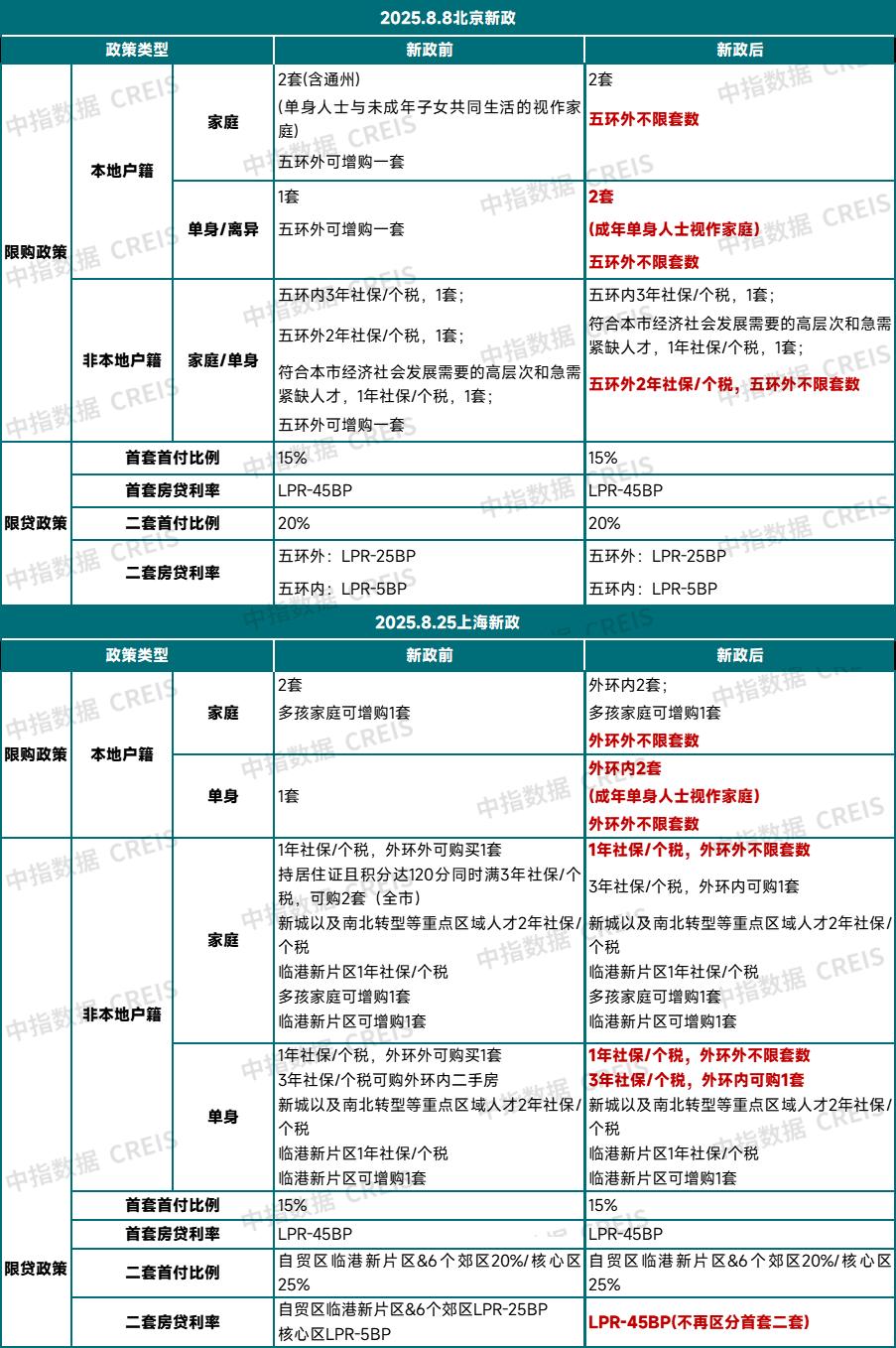
Core Viewpoint - The new housing policies in Beijing and Shanghai aim to stimulate domestic demand by relaxing purchase restrictions and optimizing loan policies, although the marginal effects may be limited due to the moderate nature of the policies and prior demand releases in 2024 [1][20]. Policy Changes - Beijing's new policy allows eligible families to purchase an unlimited number of homes outside the Fifth Ring Road, while previously they were limited to two [2]. - Shanghai's new policy similarly permits families to buy an unlimited number of homes outside the Outer Ring Road, with adjustments made to local residency requirements [2][18]. Market Response - Following the implementation of the new policies, Beijing saw a slight increase in both new and second-hand home transaction volumes, with new home daily average transactions rising by 9% compared to July [4][10]. - In Shanghai, new home transactions increased by 25% compared to July, indicating a more pronounced recovery in the new home market [11][15]. Transaction Trends - In the first eight months of 2025, Beijing's new residential sales area totaled 3.42 million square meters, a year-on-year decrease of 6.8%, while Shanghai's new residential sales area was 6.95 million square meters, a slight decline of 4% [10][18]. - The proportion of transactions occurring outside the Fifth Ring Road in Beijing and outside the Outer Ring Road in Shanghai has consistently exceeded 70%, highlighting these areas as key markets for new home sales [19]. Future Outlook - The policies are expected to enhance market activity in peripheral areas, with potential for increased demand from families looking to upgrade their housing [20]. - As the traditional peak sales season approaches, the synchronized rollout of supportive policies in both cities is anticipated to boost market confidence and gradually restore transaction volumes [1][20].
国泰海通:9月地产销售旺季开启 关注政策落地情况
智通财经网· 2025-09-04 08:01
Core Viewpoint - The report from Guotai Junan maintains an "overweight" rating for the real estate industry, anticipating an acceleration in sales and increased discounts from property companies as September marks a traditional marketing peak [1] Group 1: Sales Performance - In August 2025, the top 100 property companies reported a sales amount of 20,708.6 billion yuan, reflecting a year-on-year decline of 13.1%, with the decline rate widening by 0.5 percentage points compared to July 2025 [1] - The top 50 property companies achieved a sales amount of 17,984.8 billion yuan in August 2025, down 12.3% year-on-year, with the decline rate narrowing by 0.03 percentage points from July 2025 [2] - Approximately 30% of the top 100 property companies experienced positive year-on-year sales growth in August 2025, with the highest growth rate recorded by Bangtai Group at 215.5% [3] Group 2: Sales Thresholds - The sales threshold for the top 1-10 property companies decreased by 4.3% year-on-year, from 58.6 billion yuan to 56.1 billion yuan, indicating the smallest decline among the groups [2] - The sales threshold for the top 51-100 property companies saw the largest decline, dropping by 23.9% from 4.6 billion yuan to 3.5 billion yuan [2] Group 3: Market Dynamics - The report highlights that core first-tier cities like Beijing and Shanghai have introduced favorable policies such as relaxing purchase restrictions, with Shenzhen expected to follow suit [1] - The real estate industry is entering a low season, and the report suggests monitoring the impact of potential interest rate cuts overseas and the easing of domestic monetary policy [1]

中指研究院:8月一线城市新建住宅价格同比上涨6.88%
Zheng Quan Shi Bao Wang· 2025-09-01 04:20
Group 1 - In August, the average price of new residential properties in first-tier cities increased by 6.88% year-on-year, with a month-on-month increase of 0.48% [1] - The average price of new residential properties in second-tier cities rose by 1.64% year-on-year, while third and fourth-tier cities experienced a year-on-year decline of 1.06% [1] - The average price of second-hand residential properties in first-tier cities decreased by 4.17% year-on-year, with a month-on-month decline of 0.55% [1] Group 2 - Recent policy adjustments in major cities like Beijing and Shanghai have relaxed purchase restrictions, allowing eligible buyers to purchase multiple properties outside the city center [2] - The central government has reiterated its goal of stabilizing the real estate market, which is expected to boost market confidence and lead to a series of supportive policies in September [2] - The traditional peak sales season in September and October is anticipated to increase market activity, with developers expected to accelerate the launch of new projects in core cities [2]