房地产行业调整

Search documents
2025年房地产行业十大关键词
Zhong Guo Jing Ji Wang· 2025-12-24 07:48
Core Insights - The Chinese real estate industry in 2025 is undergoing deep adjustments, shifting from "scale-oriented" to "quality-focused" development, influenced by policies, market dynamics, technology, and finance [2] Group 1: Quality Housing - The concept of "good housing" has been emphasized in the 15th Five-Year Plan, aiming to enhance housing quality and safety, reflecting the upgraded living demands of the populace [4] - Over 15 provinces have included "good housing" initiatives in their government work reports, marking a transition from mere housing availability to quality living standards [4] Group 2: Stabilizing the Real Estate Market - The government aims to stabilize the real estate market, recognizing it as a crucial economic indicator and a significant asset for citizens [6] - In November, the average price of new residential properties in 100 cities was 17,036 yuan per square meter, showing a month-on-month increase of 0.37% and a year-on-year increase of 2.68% [6] Group 3: Revitalizing Existing Stock - The focus on "revitalizing existing stock" is central to supply-side structural reforms, aiming to optimize resources and activate the market [9] - Policies are in place to empower local governments with greater autonomy in managing idle land and commercial properties, facilitating the use of special bonds for land acquisition [9] Group 4: Policy Benefits - A systematic support framework for real estate has been established, addressing demand, supply, and security [13] - Significant policy changes include the relaxation of purchase restrictions in major cities and a reduction in credit costs, with mortgage rates dropping below 3% [13] Group 5: Urban Renewal - Urban renewal has entered a phase of normalization, with a focus on improving living conditions and preserving cultural heritage [17] - The government has outlined practical measures to address urgent community issues, including the renovation of old neighborhoods and enhancing urban infrastructure [17] Group 6: Debt Restructuring - Major real estate companies are progressing towards substantial debt reduction, with notable firms like Sunac China and Country Garden completing significant debt restructuring [21] - The overall sales of the top 100 real estate companies have decreased by 13.3% year-on-year, indicating ongoing financial pressures [21] Group 7: Ensuring Delivery of Properties - The "ensure delivery" initiative has shifted from emergency measures to a long-term strategy, focusing on safeguarding buyers' rights and promoting market stability [23] - A "white list" financing system has been implemented to isolate project risks from corporate debt risks, supporting project continuity [23] Group 8: Cancellation of Shared Area Trials - Trials for canceling shared area calculations have been implemented in several cities, shifting pricing from gross to net area, which has positively impacted buyer sentiment [26] - The focus is on transparency and sales regulation rather than eliminating shared areas for free, promoting quality competition among developers [26] Group 9: Dual Rental and Purchase System - The "dual rental and purchase" system is evolving, providing a tiered housing solution that aligns with population mobility and lifecycle patterns [29] - By the end of October, significant progress has been made in the construction of affordable rental housing, with a 30% year-on-year increase in supply [29] Group 10: Accelerating Green Transition - The real estate sector is expected to undergo systematic changes to achieve green and low-carbon transformation, contributing to national carbon reduction goals [32] - Key actions include promoting green construction practices and integrating clean energy solutions into building projects [32]

苦候21个月 中原建业复牌首日涨超60%
Xin Lang Cai Jing· 2025-12-22 18:17
Core Viewpoint - The resumption of trading for Zhongyuan Jianye marks a significant turning point after nearly 21 months of suspension, lifting the shadow of delisting and reopening opportunities for capital operations [2][6][7]. Group 1: Trading Resumption - Zhongyuan Jianye's stock price had been stagnant at 0.11 HKD for almost 21 months before resuming trading, with a trading volume of 323 million shares and a turnover of 51.37 million HKD on the first day [2][4]. - The stock opened at 0.179 HKD, peaked at 0.18 HKD (a 63.64% increase), and closed at 0.163 HKD, reflecting a 48.18% rise on the first trading day [2][4]. - The resumption signifies not just a restart of trading but also a potential for future equity financing and mergers and acquisitions [2][7]. Group 2: Loan Controversy - The suspension was triggered by the company's inability to provide sufficient documentation for a 750 million HKD loan, which led to the failure of the 2023 annual report audit [4][6]. - The loan was issued in ten separate transactions to various real estate developers, with interest rates ranging from 10% to 14% [4]. - The company has since recovered the principal amount of the loan, with only approximately 53 million HKD in interest still being pursued [6]. Group 3: Market Challenges - Despite the resumption, Zhongyuan Jianye faces significant challenges, including a decline in revenue and net profit, with a reported revenue of 140 million HKD (down 4.5%) and a net profit of 37 million HKD (down 23.4%) for the first half of 2025 [10][11]. - The company manages 246 projects with a total construction area of approximately 29.2 million square meters, indicating a contraction in project management compared to earlier periods [10]. - The competitive landscape for construction services is intensifying, with state-owned enterprises and quality private firms entering the market, putting pressure on Zhongyuan Jianye's performance [10][11]. Group 4: Future Outlook - The company must focus on improving its declining performance and regaining investor confidence through transparent and sustainable results [8][11]. - There is a need to clarify the financial and operational boundaries between Zhongyuan Jianye and its parent company, Jianye Real Estate, to demonstrate independence and risk resilience [11]. - The path to recovery is expected to be challenging, requiring careful and solid steps moving forward [3][11].
十大首席看2026中国经济
Xin Lang Cai Jing· 2025-12-22 03:08
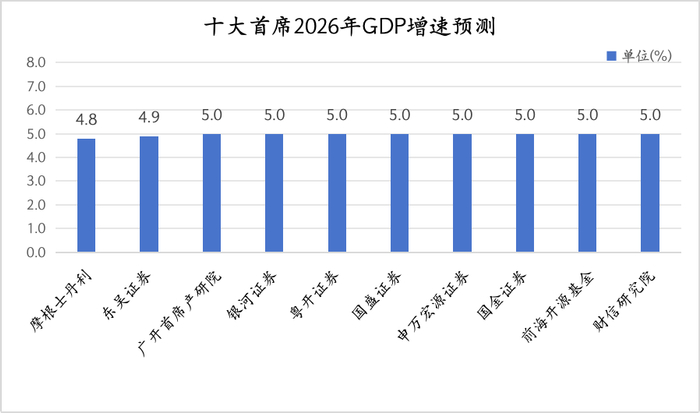
Economic Growth Outlook - In 2025, China's GDP is projected to grow by 5.2% year-on-year, laying a solid foundation for achieving the annual growth target of around 5% [1] - Economists predict that in 2026, China's GDP growth will continue to recover, with an expected growth rate of approximately 5.0% [2][4] Key Economic Drivers - The main drivers for economic growth in 2026 include stable export growth and a rebound in investment, particularly in infrastructure, supported by government policies [4][5] - The real estate market is expected to continue its bottoming process, with overall market risks considered manageable [4][8] Export and Trade Dynamics - Despite challenges from US-China trade tensions, China's exports are anticipated to maintain resilience, supported by new demands from emerging markets and global investments in AI [7] - Economists express cautious optimism regarding export stability, influenced by the global economic environment and potential easing of trade conflicts [7][6] Real Estate Market Trends - The real estate sector is projected to remain in a deep adjustment phase, with investment in real estate expected to decline by 15.9% year-on-year in 2025 [8] - Economists believe that while the real estate market will continue to face downward pressure, the rate of decline may gradually narrow due to previous policy measures [9][8] Price Level Expectations - Consumer Price Index (CPI) is expected to rise by 0.5% year-on-year in 2026, while Producer Price Index (PPI) is projected to decline by 0.9% [10] - The overall price levels are anticipated to remain low, with potential for gradual recovery influenced by supply and demand dynamics [12][10] Fiscal and Monetary Policy - The fiscal deficit rate for 2026 is expected to remain at 4%, consistent with 2025, with slight increases in special bonds and local government debt [14] - Economists forecast 1-2 interest rate cuts in 2026, with a reduction of 0.1-0.2 percentage points, and a potential decrease in the reserve requirement ratio [14][15] Policy Focus Areas - The policy focus for 2026 will include expanding domestic demand, strengthening industries, and promoting consumption through various subsidies and support measures [16] - Key areas of investment will include infrastructure, technology advancement, and stabilizing the real estate market through targeted policies [16][5]
——2025年1-11月统计局房地产数据点评:基本面延续弱势表现,政策阈值逐步临近
Changjiang Securities· 2025-12-16 23:30
Investment Rating - The report maintains a "Positive" investment rating for the real estate industry [9] Core Insights - The real estate industry continues to show weak fundamentals, with significant year-on-year declines in sales and construction activities. The central economic work conference emphasizes "controlling increments, reducing inventory, and optimizing supply," indicating that policy thresholds are approaching, which may open up policy windows for intervention [2][12] - In November 2025, the sales volume and area of commercial housing decreased by 25.1% and 17.3% year-on-year, respectively, reflecting ongoing pressure from high bases and declining market sentiment. The report anticipates that December will also face significant year-on-year pressure [12][12] - The report highlights the importance of focusing on quality real estate companies with low inventory, strong regional presence, and product strength, as well as stable cash flow from leading brokerage firms, commercial real estate, and state-owned property management companies [2][12] Summary by Sections Sales Performance - In the first eleven months of 2025, the national commercial housing sales amount and area decreased by 11.1% and 7.8% year-on-year, respectively. November saw a more pronounced decline, with sales amount and area down by 25.1% and 17.3% [12][12] - The average sales price of new homes in November was 9,097 yuan per square meter, down 9.5% year-on-year, while the average price of residential properties fell by 11.1% [12][12] Construction Activity - New construction area in the first eleven months of 2025 decreased by 20.5% year-on-year, with November's decline at 27.6%. The report suggests that the construction sector may have entered an oversold state [12][12] - The completed construction area also saw a decline of 18.0% year-on-year, with November's figure down 25.5% [12][12] Investment Trends - The total funds available to real estate companies decreased by 11.9% year-on-year, with November seeing a sharp decline of 32.5%. This includes a 10.4% drop in domestic loans and a 30.7% decrease in self-raised funds [12][12] - Real estate development investment completed in the first eleven months of 2025 fell by 15.9% year-on-year, with November's investment down 30.3% [12][12] Market Outlook - The report forecasts that the real estate industry will remain in an adjustment phase throughout 2025, with an expected annual sales decline of around 10% and construction activity down by approximately 20% [12][12]
万科年末低调买地,新任董事长黄力平现身股东会表态“继续支持”
Xin Lang Cai Jing· 2025-11-25 12:21
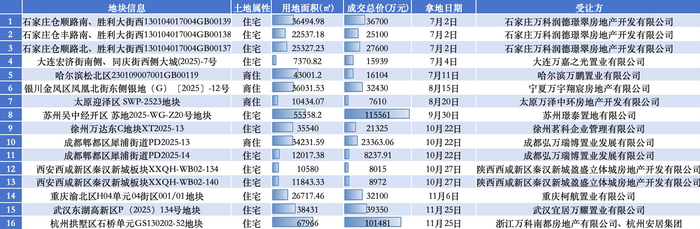
Core Viewpoint - Vanke is accelerating its land acquisition activities as the year-end approaches, with significant investments in key cities like Hangzhou and Wuhan, totaling over 1.4 billion yuan in a single day, signaling a proactive strategy in a challenging market environment [1][2]. Group 1: Land Acquisition - On November 25, Vanke, in partnership with Hangzhou Anju Group, acquired a residential land parcel in Hangzhou for a base price of 1.015 billion yuan, marking it as the first public transport-oriented residential project in the city [1]. - The same day, Vanke and Hubei Ketiou successfully acquired a residential land parcel in Wuhan for 393.5 million yuan, following a previous acquisition in June [1]. - Since July 2025, Vanke has acquired 16 land parcels across 12 major cities, with a total investment of approximately 5.199 billion yuan [1]. Group 2: Financial Performance - For the first nine months of 2025, Vanke reported a revenue of 161.39 billion yuan, with a net loss attributable to shareholders of 28.02 billion yuan [4]. - The pre-tax gross margin for the real estate development business was 7.8%, while the post-tax gross margin dropped to 2.0% [4]. - The losses were attributed to a decline in the scale of business settlements, low gross margins, and provisions for inventory depreciation [4]. Group 3: Debt and Financial Strategy - Vanke's total domestic debt amounts to 21.798 billion yuan, with a peak repayment of 5.871 billion yuan due in December 2025 [5]. - As of September 2025, Vanke held cash reserves of 65.68 billion yuan against total interest-bearing liabilities of 362.93 billion yuan, resulting in a debt-to-asset ratio of 73.5% [5]. - The company has sold all its shares in Beike, marking the end of a six-year partnership, and is actively working on asset disposals to improve cash flow [5][7].

北京起始价超84亿元挂牌一综合用地;大悦城地产私有化计划获通过 | 房产早参
Mei Ri Jing Ji Xin Wen· 2025-11-18 23:18
Group 1: Real Estate Developments - Beijing Haidian District has officially listed a comprehensive land parcel with a starting price of 8.422 billion yuan, covering an area of 77,100 square meters and a planned construction area of approximately 225,400 square meters, indicating the scarcity of land resources in the area and the market's recognition of the value of the technology innovation core zone [1] - The privatization plan of Joy City Property has been approved, with the company's listing status on the Hong Kong Stock Exchange expected to be revoked on November 27, following the approval of shareholders at a court meeting, reflecting a strategic choice for resource allocation and focus during the industry's adjustment period [4] Group 2: Corporate Transactions - Zhuhai Jinwan Group plans to sell 100% equity of Gree Real Estate for 5.518 billion yuan to Zhuhai Toujie Holdings, marking a strategic shift towards focusing on the duty-free business and consumer sector, indicating a transition from real estate to duty-free consumption trends [2] - Kington Service is facing a mandatory cash offer for all its shares at a revised price of 8.69 HKD per share, with potential privatization reflecting the deep adjustments within China's property management industry, aiming for a restructuring post-privatization [3] Group 3: Leadership Changes - China Nanshan Development Group has elected Jiang Tiefeng as the new chairman, succeeding Wang Xiufeng, with the change being a normal personnel adjustment that is not expected to negatively impact the company's operations or debt repayment capabilities, indicating a new phase of collaboration within the招商系 enterprises [5]

国联民生证券:三季度房企业绩表现分化 关注核心城市核心地区持续拿地的头部房企
智通财经网· 2025-11-13 03:35
Core Viewpoint - The real estate industry is still in an adjustment period, with performance among companies continuing to diverge. Some companies may see a turning point in gross margins as quality projects are recognized. Sales may face pressure in Q4 due to high base effects from policy stimuli, but core city land sales are expected to provide some support [1] Financial Performance - In the first three quarters of 2025, 23 sample real estate companies reported a 12.5% year-on-year decline in operating revenue, a narrowing decline compared to the full year of 2024. Net profit attributable to shareholders fell by 161.6%, with companies like Binjiang Group and Urban Construction Development achieving positive growth, while Zhonghua Enterprise turned a profit. The overall gross margin was 13.0%, down 0.3 percentage points from 2024, while state-owned enterprises saw a recovery in gross margins. The overall selling and administrative expense ratio was 5.5%, down 0.1 percentage points from 2024. Total contract liabilities amounted to 1.2069 trillion yuan, a year-on-year decrease of 28.7%, with the coverage ratio of contract liabilities to operating revenue dropping to 1.4 times. Total assets decreased to 7.4 trillion yuan, down 10.5% year-on-year, and the asset-liability ratio rose to 77.0%, up 0.7 percentage points, indicating continued balance sheet contraction and accelerated industry divergence [1] Sales Performance - In the first three quarters of 2025, the cumulative sales amount of commercial housing nationwide decreased by 7.9% year-on-year, while the cumulative sales area fell by 5.5%, with a smaller decline compared to the full year of 2024. The top 100 real estate companies reported a cumulative sales amount of 2.4948 trillion yuan, down 12.8% year-on-year. Among the top 10 companies, sales amounted to 1.2102 trillion yuan, a decline of 11.7%, although companies like Jianfa Real Estate, China Jinmao, and Yuexiu Property achieved growth of 12.1%, 27.3%, and 2.0% respectively. In terms of land transactions, the cumulative transaction area of residential land in 300 cities was 29.766 million square meters, down 7.6% year-on-year, while the cumulative transaction amount was 1.3304 trillion yuan, up 11.9%. Leading state-owned enterprises and improvement-oriented companies showed stable land acquisition performance, with companies like China Overseas Property, Greentown China, and Poly Development actively acquiring quality land in core cities [2] Financing Environment - The bond issuance scale for real estate companies rebounded in 2025, indicating a gradual recovery in market confidence. In the first three quarters of 2025, the total bond issuance by real estate companies increased by 3.9% year-on-year, with the average issuance interest rate declining from 5.5% in 2021 to 2.8% in the first half of 2025, further dropping to 2.5% in July and August, before slightly rising to 2.7% in September. As of the end of September 2025, the bond balance for real estate companies was 2.1409 trillion yuan, with 70.4% being credit bonds. The bond maturity balance for Q4 2025 is 143 billion yuan, while the maturity scale for 2026 reaches 664.1 billion yuan, indicating significant repayment pressure. Companies like Shimao Group, China Resources Land, and Poly Development have the largest bond balances, reflecting ongoing liquidity divergence in the industry [3]

房地产行业专题研究:景气低位分化加速,优质房企毛利率率先回升
Guolian Minsheng Securities· 2025-11-12 11:17
Investment Rating - The report maintains an investment rating of "Outperform the Market" for the real estate industry [7] Core Insights - The real estate industry is experiencing a low-level adjustment with accelerated differentiation among companies, where the overall revenue of sample companies decreased by 12.5% year-on-year, and net profit attributable to shareholders dropped by 161.6% [4][8] - The sales decline is narrowing, with top companies like Jianfa Real Estate, China Jinmao, and Yuexiu Property achieving growth against the trend [4][9] - The land market is showing a trend of quality improvement and reduced volume, with core city premium land transactions supporting a year-on-year increase in transaction value [4][9] Summary by Sections 1. Financial Performance: Weakness Continues, Differentiation Among Companies - In the first three quarters of 2025, the overall revenue of 23 sample companies decreased by 12.5% year-on-year, with state-owned enterprises showing a growth of 6.1% while private and mixed-ownership companies faced declines of 17.1% and 27.8% respectively [16] - The net profit attributable to shareholders for these companies fell by 161.6%, with state-owned enterprises experiencing a decline of 1595.6% [16][22] - The overall gross margin for the sample companies was 13.0%, a decrease of 0.3 percentage points compared to the full year of 2024, while state-owned enterprises saw a recovery in gross margin [22][40] 2. Operational Performance: Sales Under Pressure, Land Market Quality Improvement - In the first three quarters of 2025, the cumulative sales amount of commercial housing nationwide decreased by 7.9% year-on-year, with a decline in sales area of 5.5% [9][43] - The top 100 real estate companies reported a cumulative sales amount of 24,948 billion, down 12.8% year-on-year, with the top 10 companies showing a decline of 11.7% [49][52] - The land market is characterized by a reduction in supply and an increase in transaction value, with the cumulative transaction amount reaching 13,304 billion, up 11.9% year-on-year [54][57] 3. Financing Environment: Marginal Improvement, State-Owned Enterprises at an Advantage - The bond issuance scale for real estate companies has stopped declining, with a year-on-year increase of 3.9% in the first three quarters of 2025 [10] - The average bond issuance interest rate has decreased from 5.5% in 2021 to 2.8% in the first half of 2025, indicating a recovery in market confidence [10][57] - The liquidity pressure remains, with significant differences in the financial health of various companies [10][57] 4. Investment Recommendations: Focus on Leading Companies in Core Areas - The report recommends focusing on leading companies that continue to acquire land in core areas of first-tier and strong second-tier cities, such as Greentown China, Jianfa International Group, and China Overseas Development [11][57] - Attention should also be given to companies with potential turnaround opportunities and those with core competitive advantages in the real estate intermediary sector [11]




福州发布新政严管商品房销售和房企信用;今年全国首个单日销售额破百亿元楼盘诞生|房产早参
Mei Ri Jing Ji Xin Wen· 2025-11-09 21:59
Group 1: Fuzhou Real Estate Regulations - Fuzhou has implemented new regulations to strengthen the management of commodity housing sales and the credit evaluation of real estate companies [1] - Real estate companies must create and publicly disclose a pre-sale plan that includes eight key components before applying for pre-sale permits [1] - The new credit evaluation system mandates that companies in five districts undergo credit scoring every two years, directly linking results to pre-sale and fund supervision [1] Group 2: Record Sales in Guangzhou - Poly Developments' project, Guangzhou Poly·Yuexi Bay, achieved a remarkable sales record with a single-day transaction amount of 10.6 billion yuan, selling 236 units [2] - The project set a new sales record for Guangzhou, with an average transaction price of 170,000 yuan per square meter and a peak price exceeding 300,000 yuan per square meter [2] - The success of this project is attributed to a combination of scarce resources, product innovation, and brand premium, providing confidence to the market during a period of adjustment [2] Group 3: Shimao Construction Lawsuit - Shimao Construction announced a new lawsuit involving a claim amounting to 11.291 billion yuan, with the plaintiff being China CITIC Financial Asset Management [3] - The lawsuit is based on a contract dispute, with the first-instance court accepting the case on September 30 [3] - The company needs to accelerate asset disposal while maintaining close communication with creditors to explore diverse debt resolution paths [3] Group 4: China Merchants Shekou Loan Guarantee - China Merchants Shekou announced it will provide a guarantee for an 800 million yuan fixed asset loan requested by Hangzhou Ruisheng [4] - The loan has a term of 15 years, and the guarantee period will last for three years after the debt is fulfilled [4] - This move is seen as a strategic bet on the prospects of Hangzhou's digital economy and a key step in the company's transformation into an "industrial operator" [4] Group 5: Financial Street Holdings Bond Project - Financial Street Holdings' private placement bond project of 5.17 billion yuan has been accepted for review [5] - The bond issuance aims to consolidate market position and optimize financial structure during the industry adjustment period [5] - With an AAA credit rating and a state-owned enterprise background, the company is expected to secure low-cost financing to support future development [5]
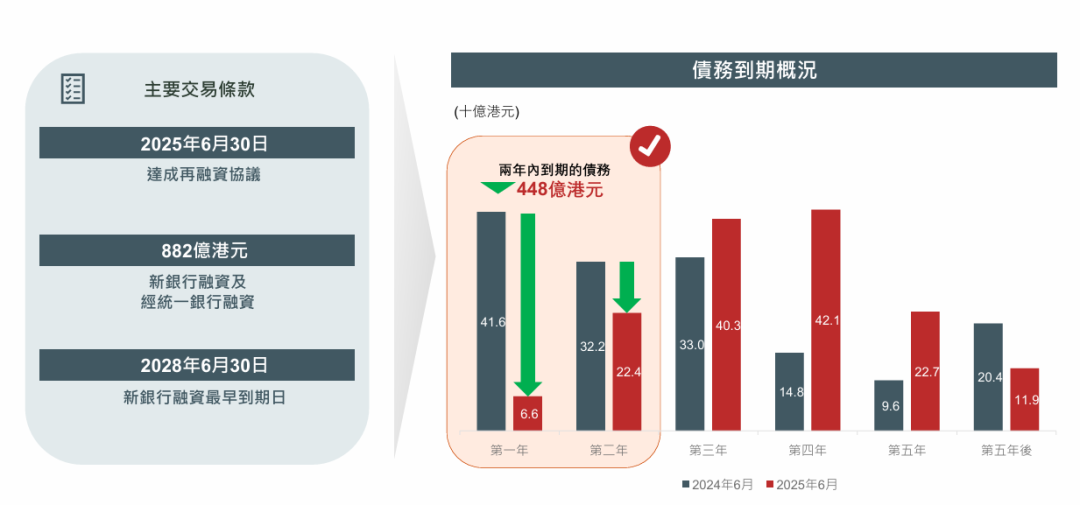
主动上调业绩目标,全力减债回笼现金,新世界发展以韧性求高质量发展
Hua Xia Shi Bao· 2025-11-04 06:44
Core Viewpoint - The real estate industry is undergoing a prolonged adjustment phase, entering a "bottoming" stage, with tightening external financing conditions and accelerated deleveraging processes posing significant challenges [1] Group 1: Company Performance - New World Development (0017.HK) reported strong performance in both Hong Kong and mainland markets, with a 12% year-on-year increase in foot traffic at K11 MUSEA during the National Day holiday, setting a record since its opening [1] - The company achieved a revenue of HKD 27.68 billion and a core operating profit of HKD 6.01 billion for the fiscal year 2025, demonstrating resilience amid market fluctuations [2] - New World has raised its sales target for fiscal year 2026 to HKD 27 billion, reflecting a proactive approach to market conditions and a commitment to high-quality development [2][3] Group 2: Sales and Market Dynamics - The company successfully completed its sales target of HKD 26 billion for fiscal year 2025, with contract sales contributions of HKD 11 billion from Hong Kong and RMB 14 billion from mainland China [3] - In the mainland market, projects like "Guangyue Guandi" achieved sales of RMB 2 billion upon opening, indicating strong market demand [4] - The "PAVILIA COLLECTION" series in Hong Kong has outperformed the market, with significant sales figures reported for various projects [3][4] Group 3: Investment Properties - New World Development's investment properties generated stable income, with total investment property revenue of HKD 5.055 billion, supported by high occupancy rates at K11 MUSEA and office buildings [6][7] - The company is expanding its investment property portfolio, with new projects like the second K11 commercial complex in Guangzhou expected to contribute to future revenue [7][8] Group 4: Debt Management and Financial Health - New World is actively implementing a "seven-pronged debt reduction plan," significantly reducing its short-term debt from HKD 73.8 billion to HKD 29 billion over two years [9][11] - The company secured a commitment for a loan of up to HKD 5.9 billion from Deutsche Bank, enhancing its financial flexibility [2][11] - Average financing costs have decreased to 4.8%, resulting in a reduction of total financing costs from HKD 8.7 billion to HKD 7.4 billion [11]