房票制度

Search documents
一次人生跨越的体会
集思录· 2025-08-03 14:26
Core Viewpoint - The article reflects on the author's personal experience with a property demolition and the subsequent financial gains, highlighting the impact of local government policies on real estate and personal investment strategies [1][3]. Group 1: Property Demolition Experience - The demolition process took two years, with the author receiving a total compensation of 2.88 million yuan, which was primarily in cash [1]. - The author worked in a local state-owned enterprise and did not face significant challenges during the demolition process, indicating strong governmental influence in expediting the compensation [2]. - The property was a self-built house from the 1970s, located in a central area, which contributed to its value during the demolition [1]. Group 2: Financial Gains and Investment Strategy - The author started with 3 million yuan in the stock market and, after receiving the demolition compensation, had a total of 5.8 million yuan, which later grew to over 14 million yuan within two years [3]. - The timing of the demolition was fortunate, as it occurred before a significant downturn in the real estate market, allowing the author to capitalize on the last high point of property values [3][4]. - The author chose not to invest in real estate immediately after receiving the compensation, respecting the wife's preference and considering the overall market conditions [4]. Group 3: Economic and Market Insights - The article discusses the negative consequences of local government policies, particularly the reliance on state-owned enterprises to support the real estate market, which has led to financial strain on local governments [4]. - The author notes that the compensation process was complicated by the local government's financial issues, leading to delays in receiving the promised funds [4]. - The overall investment strategy has been influenced by a combination of market understanding and personal circumstances, with the author acknowledging the role of luck in their financial success [4][5].


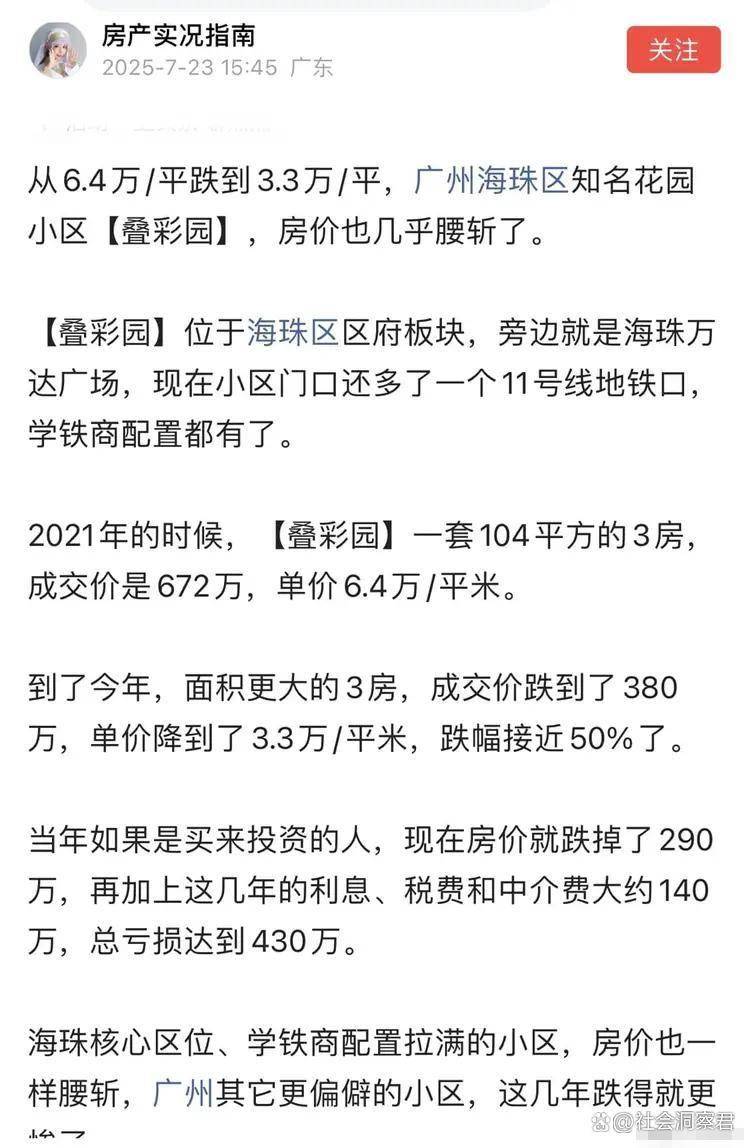
跌惨了!从6.4万跌到3.3万,广州一知名小区房价腰斩,缩水近50%
Sou Hu Cai Jing· 2025-07-26 04:21
Core Viewpoint - The housing prices in Guangzhou, particularly in the well-known residential area "Diecai Garden," have significantly declined, with prices dropping from 64,000 yuan per square meter to 33,000 yuan per square meter, indicating a nearly 50% decrease [1][2][4]. Group 1: Price Decline Details - In 2021, a 104 square meter three-bedroom unit in Diecai Garden sold for 6.72 million yuan, equating to 64,080 yuan per square meter. By 2025, a larger unit of similar type sold for 3.8 million yuan, or 33,875 yuan per square meter, reflecting a depreciation of over 47% [2][4]. - The total loss for investors who purchased at the peak price, considering interest, taxes, and fees, could reach approximately 4.3 million yuan [2][5]. Group 2: Market Analysis - Analysts suggest that the overall housing market in Guangzhou still has considerable downward potential due to the current supply and demand dynamics, with predictions of continued price declines over the next five years [5]. - Recent data indicates that in June, Guangzhou's new home prices fell by 0.5%, while second-hand home prices decreased by 0.7%, marking it as the city with the largest decline among first-tier cities [18]. Group 3: Buyer Behavior and Trends - The current market shows a shift in buyer preferences, with more buyers focusing on affordable housing options. In the first half of 2025, over half of the new homes sold were priced below 3 million yuan, a record high in four years [25][23]. - Popular districts for home purchases include Panyu, Baiyun, and Huangpu, with significant transactions occurring in areas like Xintang Town [23][24]. Group 4: Policy and Market Stimulus - The issuance of a 1 billion yuan housing voucher in Tianhe District is seen as a key initiative to stimulate the real estate market, reflecting a broader strategy to enhance resource allocation and market activity [27][28]. - The housing voucher system is becoming a vital tool in revitalizing the Guangzhou real estate market, with increased buyer confidence observed [28].
昆明楼市多重利好相继落地,义承丹霞翠屿劲销单价保持在2万+以上
Sou Hu Cai Jing· 2025-05-13 10:58
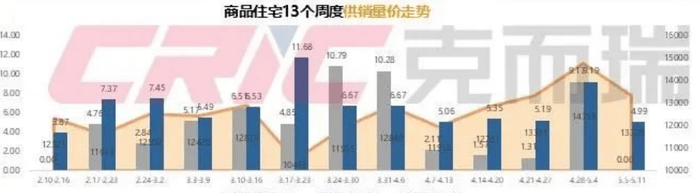
Market Overview - In the week of May 5-11, 2025, the Kunming real estate market experienced a decline in both transaction volume and prices due to high base effects from the previous week, with residential sales dropping to 49,900 square meters, a 46% decrease week-on-week, and an average price of approximately 13,325 yuan per square meter, down 10% [1][3] Key Products - The main sales drivers included "four generations of housing," "zero public area," and "negative public area" products, with the top-selling project being Yicheng Danxia Cuiyu, achieving sales of 125 million yuan with 39 units sold at an average price of about 20,789 yuan per square meter [3] - Vanke's Guiyu Dongfang, another notable project, recorded sales of 66 million yuan with 38 units sold at an average price of approximately 14,845 yuan per square meter [5] Land Supply and Transactions - The Kunming main city has seen a two-week supply halt, with only one commercial land plot sold at a base price, located in the Ciba area, covering approximately 33.62 acres, sold for 70.9382 million yuan, resulting in a floor price of about 2,110 yuan per square meter [5][7] Policy Changes - The housing ticket system has officially been implemented, allowing holders to purchase new commodity housing from a unified source pool without regional restrictions, effective from June 8 [10] - The public housing rental policy has been revised to eliminate local work duration requirements for applicants, expanding eligibility criteria and increasing rental subsidies significantly [11][12]
南京全面退出限售背后:新房价格连涨3月领跑全国
Bei Ke Cai Jing· 2025-03-31 14:14
相比于去年四季度宽松重磅政策的密集出台,今年房地产市场似乎安静了许多。不过,南京的一套"组 合拳"引发了市场关注,让平静的水面激起层层涟漪。 南京市房协副会长兼秘书长张辉在接受新京报贝壳财经记者采访时表示,南京取消限售的利好主要体现 在两个方面,一是有利于一部分购房人加速以旧换新,有利于新房的成交;二是对于有购置新房的人群 来说,此前由于限售存在一些顾虑,而限售取消则打消了这部分的顾虑。 随着市场的变化,各地限购、限售政策陆续退出。2024年底,南京的限售政策有所松动:买房人购买新 建商品房后,名下处于限售期的二手房可上市交易;二孩及多孩家庭且有未成年子女的,名下处于限售 期的二手房也可上市交易。 直至今日,南京全面取消限售,全市范围内商品住房在取得不动产权登记证书后即可上市交易,有效满 足居民各类住房置换需求。 上海易居房地产研究院副院长严跃进分析称,从房屋交易的流动性角度来看,过去限售政策的出台,主 要是从限制房屋交易短线操作的角度出发,旨在防范各类投资投机需求和快进快出的炒作现象,本质是 限制了流动性;当前取消限售政策,吻合了房地产市场供求关系的新变化,体现了精准施策、响应群众 呼声的导向。取消限售政策 ...
四大一线城市已开始探索房票制度,将给房地产市场带来哪些影响?
Sou Hu Cai Jing· 2025-03-31 00:47
Core Viewpoint - The introduction of the housing voucher system in China's four major first-tier cities is a significant change in the real estate market, aimed at stimulating demand and addressing inventory issues. Group 1: Background and Implementation - The housing voucher system is not new; it was previously attempted in some cities in 2005 and gained traction during the 2015 urban renewal wave, but faded after 2018. Recent pressures from urban village renovations and inventory reduction have revived interest in this system [3][5]. - Guangzhou was the first to implement a housing voucher policy in early 2024, followed by Shanghai's Jinshan and Qingpu districts, and Beijing's Tongzhou district. Shenzhen also announced plans to establish a housing voucher system by March 2025 [3][5]. Group 2: Impacts on the Real Estate Market - The housing voucher provides greater housing choices for displaced residents, potentially increasing their purchasing power and stimulating demand for new homes, thereby enhancing market activity [5][7]. - The system is expected to facilitate the reduction of real estate inventory by directing compensation funds into the housing market, alleviating excess supply issues [5][7]. - It can optimize resource allocation by ensuring that housing demand is met locally, reducing vacancy rates caused by population outflow, and accelerating urban renewal processes [5][7]. Group 3: Opportunities and Challenges for Real Estate Companies - Real estate companies may benefit from new sales channels and customer resources through the housing voucher system, which can help in inventory clearance and financial pressure relief [7]. - However, companies must adapt to the changes brought by the housing voucher system, including adjusting marketing strategies and product offerings to meet the diverse needs of displaced residents [7]. Group 4: Future Prospects and Recommendations - The housing voucher system is anticipated to be more widely adopted across the country, playing a crucial role in promoting stable and healthy development in the real estate market and facilitating urban renewal [10]. - Local governments should tailor the housing voucher policies to fit their specific circumstances, potentially expanding the usage scope of vouchers to enhance flexibility and attractiveness [10]. - Public participation in the implementation process is encouraged to gather feedback and improve the system, which may increase public acceptance and support [10].

深圳的房票姗姗来迟,谁是受益者?
吴晓波频道· 2025-03-28 17:03
Core Viewpoint - The introduction of the housing ticket system in Shenzhen represents a shift in urban renewal strategies, aiming to stabilize the real estate market and address the challenges of urban redevelopment and housing demand [3][6][19] Group 1: Housing Ticket System Overview - The housing ticket system is a compensation method for demolition, allowing displaced residents to purchase homes using tickets instead of receiving direct cash or housing [3][4] - This system has been adopted in over 60 cities across China, initially starting in second and third-tier cities before reaching first-tier cities like Shenzhen [6][3] - The housing ticket serves to convert demolition costs into future land income while generating housing demand [11][19] Group 2: Implementation in Shenzhen - Shenzhen's housing ticket system is designed to address the challenges of large-scale urban renewal, particularly in areas with high housing prices and significant demolition needs [6][17] - The system aims to prevent capital outflow by ensuring that compensation funds are reinvested in the local real estate market, thereby stabilizing property prices [6][19] - The implementation of the housing ticket system is seen as a crucial tool for urban renewal, with its effectiveness dependent on the pace and scale of urban redevelopment efforts [7][18] Group 3: Benefits and Challenges - The housing ticket system benefits all parties involved: it protects the rights of displaced residents, helps absorb excess housing inventory, and enhances the efficiency of urban renewal [4][19] - However, challenges remain, including the lack of standardized valuation for housing tickets and unclear legal status, which could lead to disputes [10][11] - The system's limitations include restrictions on purchasing only new homes in designated areas, which may pressure buyers to make hasty decisions [19] Group 4: Future Outlook - Experts suggest that the housing ticket system could stimulate the real estate market, particularly in Shenzhen, where recent sales have surged significantly [17][19] - There is a call for further relaxation of purchase restrictions in first-tier cities to enhance market dynamics and support new residents [13][19] - The future success of the housing ticket system will depend on the development of complementary policies that integrate monetary compensation with the housing ticket approach [19]