投资组合再平衡

Search documents
一年中最动荡月份来了!美股今年能否打破魔咒
Di Yi Cai Jing· 2025-09-01 23:49
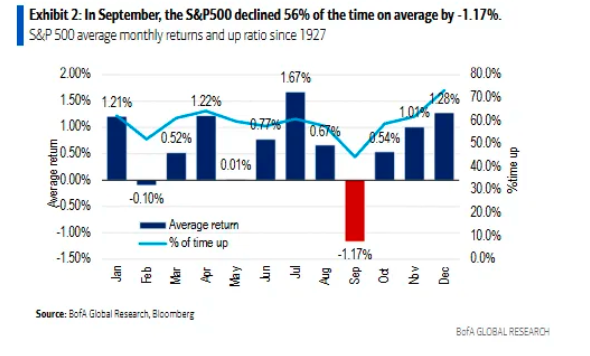
Core Viewpoint - September historically shows a decline in the S&P 500 index, averaging nearly 2% over the past decade, with current uncertainties such as potential Fed rate cuts and political pressures adding to market volatility [1][3]. Market Performance - September is noted as the most volatile month for U.S. markets, with a 56% probability of decline in the S&P 500 index since 1927, averaging a drop of 1.17%. In the last decade, the average decline has worsened to 1.93% [3]. - In the first year of a presidential term, the S&P 500 index has a 58% chance of declining in September, with an average drop of 1.62% [3]. Valuation and Investment Trends - The forward P/E ratio of the S&P 500 index has reached 22 times, nearing levels seen at the end of the internet bubble, raising concerns about potential sell-off pressures during portfolio rebalancing at the end of September [4]. - Recent market shifts show cyclical sectors and small-cap stocks leading gains, while large tech stocks lagged behind. Non-essential consumer goods ETFs rose by 4.3%, financial sector ETFs by 2.6%, and the Russell 2000 small-cap index increased by 7.3% [4]. Economic Indicators - Recent U.S. economic data presents a mixed picture, with significant drops in non-farm payrolls from May to July, while retail sales and major retailers' earnings indicate strong consumer spending [4]. - The upcoming non-farm payroll report is expected to show an increase of 75,000 jobs, with the unemployment rate potentially rising to 4.3% [7]. Federal Reserve Outlook - The Fed is anticipated to consider rate cuts due to recent employment data, with Chairman Powell indicating a shift in stance towards a more accommodative policy [7][9]. - Market expectations for rate cuts have fluctuated, with the probability of more than two cuts this year dropping from over 50% to below 30% [9]. Political Pressures - Concerns arise regarding the Fed's independence amid political pressures from the Trump administration, particularly regarding the potential influence over the Fed's board composition [9].

关税风暴后股市反弹 日本养老金巨头GPIF单季大赚680亿美元
Zhi Tong Cai Jing· 2025-08-01 09:02
Group 1 - The core viewpoint of the article highlights the significant recovery of the GPIF, Japan's largest pension fund, which reported a substantial investment gain of 10.2 trillion yen (approximately 678 million USD) in the quarter ending June, following a rebound in global and Japanese stock markets after a sell-off triggered by U.S. tariffs [1] - GPIF's total assets increased to 260.02 trillion yen, with a return rate of 4.09%, compared to 8.97 trillion yen in the same period last year [1] - The investment return rates for different asset classes included a 7.5% return on domestic stocks, a slight decline of 0.2% in bond investments, a 7.4% return on overseas stocks, and a 1.6% yield on foreign bonds [1] Group 2 - GPIF's investment strategy involves an average allocation of funds across four major asset classes: domestic Japanese stocks, domestic bonds, foreign stocks, and foreign bonds, with each asset class targeted at 25% of the total portfolio [2] - The fund's president, Kazuto Uchida, expressed confidence in the fund's ability to navigate recent market volatility and indicated that the newly established U.S.-Japan trade agreement is expected to positively impact the stock market [1] - To address current market fluctuations, GPIF plans to enhance its investment portfolio rebalancing through futures instruments and is conducting in-depth research on the correlations between different asset classes [1]
外资机构年中展望:中国经济增长韧性足 科技与高股息公司成投资焦点
Zheng Quan Ri Bao· 2025-07-09 16:20
Group 1: Economic Outlook - The resilience of the Chinese economy is highlighted as a key theme, with foreign institutions like Barclays and Goldman Sachs noting that consumption and export performance continue to exceed expectations, driven by policy stimulus effects [1][2] - Goldman Sachs projects China's GDP growth rate for the first half of the year to reach 5.2%, indicating potential for further upward movement [2] - Barclays attributes the strong performance in consumption to the upgraded "trade-in" subsidy policy, which has significantly boosted sales in categories such as home appliances and furniture [2] Group 2: Export and Consumption Trends - Exports have shown strong performance, with many Chinese exporters shifting focus to markets outside the U.S., particularly in Europe and ASEAN countries, which is a key structural factor supporting export resilience [2] - The government is expected to intensify efforts to promote consumption, potentially expanding the coverage of the trade-in policy and extending subsidies to more service sectors [2] Group 3: Technology Sector Potential - The global market environment is seen as providing opportunities for investors to diversify their portfolios, with Chinese stocks emerging as a significant choice [3] - UBS forecasts a 6% year-on-year growth in earnings per share for the constituents of the CSI 300 index in 2025, indicating positive earnings momentum [3] - Foreign institutions view China's technological innovation as a strong attraction for assets, with Fidelity noting that breakthroughs in AI could support the stock market and enhance overall emerging market performance [3] Group 4: Structural Changes in A-Share Valuation - Multiple factors are expected to drive a structural revaluation of A-shares, including further macro policy easing, sustained inflows of medium to long-term capital, and comprehensive structural reforms [4] - These factors are anticipated to enhance the attractiveness of investing in China and reduce the valuation discount of A-shares [4] Group 5: High Dividend Companies - High dividend companies are gaining attention from foreign institutions, with Goldman Sachs indicating that companies prioritizing shareholder returns are favored by investors [5] - Goldman Sachs projects that total cash returns to shareholders from Chinese listed companies will reach 3 trillion yuan and 600 billion yuan in dividends and buybacks, respectively, in 2025, representing year-on-year growth of 10% and 35% [5] - Quality companies characterized by high return on equity, low leverage, and stable earnings are seen as more resilient during market volatility [5]


Cannae(CNNE) - 2025 Q1 - Earnings Call Transcript
2025-05-12 22:00
Financial Data and Key Metrics Changes - Cannae's total operating revenue for Q1 2025 was $103 million, a 7% decrease from the prior year due to lower restaurant revenue [23] - The company reported net recognized gains of $7 million in Q1 2025, compared to $5 million in the prior year [27] - Cannae's equity in earnings and losses of unconsolidated affiliates posted a $2 million net loss in Q1 2025, compared to an $18 million gain in the prior year [28] Business Line Data and Key Metrics Changes - CNB reported revenue of $580 million, representing 3.6% constant currency organic growth compared to the prior year's first quarter [13] - Alight reported total revenue from continuing operations of $548 million for Q1 2025, a 2% decrease from the prior year [14] - Adjusted EBITDA for Alight was $118 million, a $2 million increase compared to the prior year [14] Market Data and Key Metrics Changes - Cannae's largest public investment, Dun and Bradstreet, is being acquired for $4.1 billion, from which Cannae will receive $632 million upon closing [7][9] - The company expects to utilize approximately $730 million from public portfolio sales for shareholder returns and debt repayment [10] Company Strategy and Development Direction - Cannae is focused on rebalancing its portfolio away from public investments and investing in companies with positive cash flows [7] - The company aims to return capital to shareholders and improve operational performance of its portfolio companies [7] - Cannae announced an agreement to acquire an additional 30% stake in JANNA Partners for $67.5 million, enhancing its ability to allocate capital towards proprietary acquisitions [10][11] Management's Comments on Operating Environment and Future Outlook - Management expressed optimism about the strategic relationship with JANNA Partners and the potential for future investments [32] - The company believes there remains significant embedded value in its portfolio and upside in stock price as it executes its strategic plan [50] Other Important Information - Cannae appointed Bill Royan and Woody Tyler to its board, both bringing strong investment management experience [12] - The company is undergoing significant changes in its Restaurant Group, including management restructuring and cost-cutting measures [26] Q&A Session Summary Question: Can you discuss the revenue and earnings profile of JANNA Partners? - Management indicated that JANNA has significantly higher assets under management than initially invested, exceeding $2 billion, and is performing well financially [31][32] Question: Are there plans to increase ownership in JANNA Partners? - Currently, there are no plans to increase ownership percentage as the existing structure is deemed effective [35] Question: Can you elaborate on the Vitality Stadium acquisition? - Management believes the redevelopment of the stadium is financially attractive, projecting mid-teens returns on the investment [42][43] Question: How does Cannae plan to deploy incremental capital for M&A? - In the short term, the focus will be on returning capital to shareholders, but the company remains open to opportunistic investments that can deliver attractive returns [46][47]

美股常见投资陷阱:4个对策,避免踩坑
Sou Hu Cai Jing· 2025-04-29 15:14
Group 1: Core Investment Principles - Accumulating long-term wealth requires not only earning income but also making wise financial decisions to ensure asset appreciation [1] - Understanding risk tolerance is crucial for selecting appropriate investment strategies, with categories including aggressive, conservative, and balanced investors [3][5] - A well-structured investment portfolio typically includes stocks, bonds, real estate, and alternative investments to mitigate risks [5] Group 2: Investment Strategies - Passive investment involves tracking market performance through index funds or ETFs, focusing on long-term growth with lower costs [5][6] - Active investment requires frequent trading to outperform the market, often involving higher fees and more intensive research [5][6] - Many investors adopt a mixed strategy, combining passive and active investments to achieve stable long-term returns while enhancing growth potential [5] Group 3: Long-term Investment Tools - Growth stocks, dividend stocks, blue-chip stocks, government bonds, corporate bonds, and real estate are essential tools for wealth accumulation [6] - A balanced allocation among stocks, bonds, and real estate can help achieve steady growth and risk diversification [6] Group 4: Market Volatility Management - Regular investment of fixed amounts, regardless of market conditions, can reduce the impact of market fluctuations [8] - Periodic rebalancing of the investment portfolio is necessary to maintain target asset allocation [8] Group 5: Common Investment Traps - Emotional investing, such as panic selling during downturns or chasing trends during market upswings, can lead to poor long-term returns [9][10] - Insufficient diversification increases portfolio risk, making it vulnerable to market downturns [11][12] - Ignoring fees and tax implications can erode investment returns over time [13][14] - Attempting to time the market often results in missed opportunities and increased risk [15][16] Group 6: Maintaining Long-term Success - A disciplined approach, patience, and a clear strategy are essential for successful long-term investing [18] - Avoiding common mistakes and adhering to a systematic investment method can enhance returns and reduce risks [18]