
时间管理

Search documents
一个人变富的开始:少相信人,多相信书
洞见· 2025-09-15 12:38
Core Viewpoint - The article emphasizes the importance of relying on books and knowledge rather than on others' advice for wealth accumulation, suggesting that reading is a more reliable path to financial success [4][6][37]. Group 1: The Dangers of Blind Trust - Many individuals fall into financial traps by trusting friends or acquaintances' investment advice, leading to significant losses [5][10]. - A case study of an individual named "Old Zhang" illustrates the risks of leveraging personal assets based on unreliable recommendations, resulting in substantial debt after a market crash [12][14]. Group 2: The Value of Reading - Research indicates that 88% of billionaires read at least 30 minutes daily, highlighting reading as a key habit for success [16]. - Notable investors like Warren Buffett attribute their success to extensive reading, which broadens their knowledge and enhances decision-making capabilities [17][19]. Group 3: Recommended Reading for Wealth Building - The article suggests various books that can enhance time management and cognitive skills, such as "The 7 Habits of Highly Effective People" and "The Pomodoro Technique Illustrated" [23][26]. - It also recommends books focused on cognitive awakening and financial literacy, including "The Essence of Poverty" and "Rich Dad Poor Dad," which provide insights into wealth-building mindsets [30][32].


人民日报推荐:从摆烂到无痛自律的8张清单
洞见· 2025-08-30 12:34
Core Viewpoint - The article emphasizes the importance of self-management in various aspects of life, including time, space, emotions, goals, image, health, energy, and mindset, to achieve personal growth and success [4][102]. Time Management - Effective time management is crucial for gaining control over work and life, as highlighted by Peter Drucker [9]. - Bill Gates organizes his schedule in 5-minute increments, maximizing productivity [12][13]. - Five tips for time management include: 1. Allocate fixed times for specific tasks and reserve 20% of time for unforeseen events [15]. 2. Use the "Four Quadrants" method to prioritize tasks [15]. 3. Segment daily time for single tasks [16]. 4. Set clear deadlines for tasks [17]. 5. Overcome procrastination by starting tasks for just 5 minutes [18]. Space Management - A clean and organized environment can lead to improved mental clarity and productivity [24]. - Five tips for space management include: 1. Categorize and declutter items, keeping only what is necessary [27]. 2. Use labels and storage boxes for easy access [28]. 3. Establish a daily cleaning habit [29]. 4. Maintain a minimalist decor to avoid distractions [30]. 5. Cultivate a tidy lifestyle attitude [31]. Emotion Management - Albert Ellis's ABC model illustrates how perceptions influence emotional responses [34]. - Managing emotions is essential to avoid negative cycles of behavior [36]. - Five strategies for emotion management include: 1. Temporarily remove oneself from negative situations [39]. 2. Distract oneself with enjoyable activities [39]. 3. Engage in physical exercise to alter mood [39]. 4. Keep a journal for self-reflection [39]. 5. Analyze and review emotional triggers for better control [39]. Goal Management - A Harvard study found that only 3% of individuals with clear long-term goals achieved significant success [42][44]. - Five methods for effective goal management include: 1. Set measurable and quantifiable goals [47]. 2. Ensure goals are realistic and actionable [48]. 3. Transform goals into actionable steps [49]. 4. Focus on one goal at a time [50]. 5. Enhance goal execution by minimizing distractions [51]. Image Management - Personal image significantly impacts opportunities and perceptions [56]. - Five tips for image management include: 1. Identify a personal style that suits oneself [59]. 2. Limit clothing colors to avoid overwhelming visuals [60]. 3. Regularly maintain hair and grooming [61]. 4. Apply light makeup or grooming before going out [62]. 5. Invest in quality clothing for better appearance [63]. Health Management - Common health issues among adults include poor diet, lack of exercise, and irregular sleep patterns [65]. - Five health management tips include: 1. Maintain regular meal times and avoid junk food [74]. 2. Exercise for at least 30 minutes daily [75]. 3. Aim for 8 hours of sleep and limit screen time before bed [76]. 4. Develop a habit of waking up early for better productivity [77]. 5. Schedule regular health check-ups [78]. Energy Management - Focusing on one task at a time enhances efficiency [81]. - Five energy management tips include: 1. Build physical stamina to support energy levels [83]. 2. Complete one task before moving to the next [84]. 3. Reduce time spent on socializing and entertainment [85]. 4. Apply the 80/20 rule to prioritize important tasks [86]. 5. Combat procrastination by starting tasks immediately [87]. Mindset Management - A positive mindset is crucial for personal and professional success [89]. - Five strategies for mindset management include: 1. Shift perspectives to find positive solutions [98]. 2. Practice self-care and attend to personal needs [99]. 3. Foster a healthy lifestyle for emotional stability [100]. 4. Build a supportive network for sharing challenges [101]. 5. Engage in mindfulness practices to enhance focus and emotional control [101].

开学倒计时,“电子依赖”如何破解?
Xin Hua She· 2025-08-23 11:18
Group 1 - The article discusses the increased reliance of children on electronic devices during the summer, leading to potential addiction to gaming and excessive screen time as the new school year approaches [1] - Parents are advised to collaboratively set reasonable daily limits for mobile phone usage, such as not exceeding 2 hours per day, ensuring that academic tasks and physical activities are completed first [3] - It is recommended that children place their phones in another room or have parents hold them for one hour before bedtime to promote relaxation and better sleep [4] Group 2 - Parents should establish clear rules regarding phone usage in specific situations, such as during meals, study time, and family interactions, and explain the reasons for these restrictions [6] - Instead of constant supervision, parents are encouraged to teach children self-management skills by creating a "mobile usage plan" to track their daily screen time and activities [7] - Providing attractive alternative activities is essential to prevent resistance to losing access to phones, such as engaging in offline activities like puzzles, board games, or outdoor sports, and encouraging interests in arts or reading [9][10]

如何从普通生活中获得更深层次的满足感?
3 6 Ke· 2025-08-22 07:13
Core Insights - The article discusses techniques to slow down the perception of time and enhance the experience of daily life, emphasizing the importance of being present and mindful in everyday activities [3][10]. Group 1: Techniques to Enhance Life Experience - The first technique involves savoring small moments of happiness in daily life, encouraging individuals to consciously notice details in familiar experiences to derive joy from them [5][6]. - The second technique suggests introducing novelty into routines to break the monotony, which can enhance memory and attention, making experiences feel more unique and fulfilling [6][7]. - The third technique focuses on reducing the pressure to constantly engage with content and social media, allowing individuals to feel more relaxed and perceive they have more time [8][9].

ChatGPT治好了我的拖延症:如何用AI管理时间
Hu Xiu· 2025-08-20 05:53
Group 1 - The article discusses the challenges faced by freelancers in managing their time and tasks effectively, highlighting that freedom can sometimes feel like a curse due to lack of structure and accountability [9][12][51] - It emphasizes that traditional time management methods may not be suitable for freelancers, who often struggle with distractions and maintaining focus [11][12][30] - The author proposes a new approach to task management that focuses on clarity of goals, task breakdown, and prioritization to enhance productivity [15][16][27] Group 2 - The article introduces the use of AI as a tool for task management, suggesting that AI can help streamline the process by understanding the user's management logic [34][35] - It highlights the importance of entering a flow state for productivity and presents a method called "random prompt sound focus method" to maintain concentration [41][44][50] - The author concludes that with the right tools and methods, freelancers can transform their experience of freedom from a curse to a blessing, allowing them to work at their own pace and create value [54][55]
X @杀破狼 WolfyXBT
杀破狼 WolfyXBT· 2025-08-16 10:01
Health & Lifestyle Management - Masturbation is presented as the most cost-effective method for satisfying sexual desire, considering time, mental energy, and financial resources [1] - The report suggests mastering masturbation techniques to achieve pleasure comparable to sexual intercourse [1] - Masturbation is framed as an important lesson in personal time management [2]
练就一身赚钱本事的10大习惯!建议收藏!
天天基金网· 2025-07-12 03:05
Core Insights - The article emphasizes the importance of consistent small habits in building wealth over time, rather than seeking instant riches [10][11] Group 1: Practical Skills and Actions - Focus on learning practical skills related to financial goals daily, such as online courses or industry articles [1] - Take immediate action on money-making ideas with minimal cost instead of waiting for perfect conditions [2] - Record daily income and expenses to understand cash flow, which is essential for financial management [3] Group 2: Networking and Goal Setting - Actively engage with individuals in the target field, including peers and potential clients, to uncover opportunities [4] - Break down large financial goals into smaller, measurable targets to make them less daunting and easier to achieve [5] Group 3: Review and Health - Conduct weekly reviews to assess earnings, effective actions, and necessary adjustments for the following week [7] - Maintain basic health habits, such as adequate sleep and hydration, to ensure high energy levels for work and learning [8]

每天忙得要死,我是怎么坚持学习的?
3 6 Ke· 2025-07-05 00:02
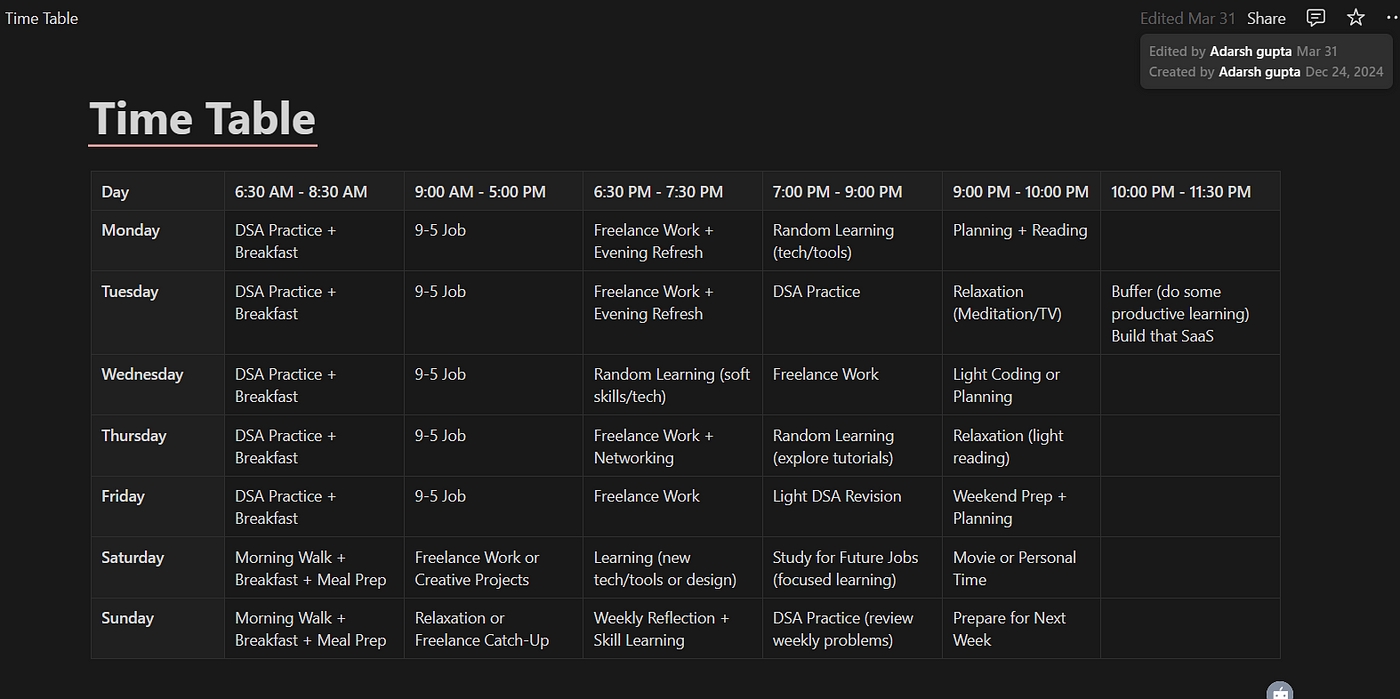
Core Insights - The article emphasizes the importance of continuous learning and time management, especially in a volatile job market where job security is not guaranteed [1][7] - It presents a practical time management strategy that includes creating a structured schedule and eliminating unnecessary tasks to carve out time for personal development [2][5] Time Management Strategy - The individual maintains a busy schedule that includes a full-time job, freelance work, and personal projects, highlighting the need for a sustainable approach to manage multiple responsibilities [2][3] - A detailed weekly schedule is provided, showcasing time allocated for various activities such as DSA practice, freelance work, and relaxation, indicating a balanced approach to productivity [3][4] Key Principles - The article stresses that having a time table is not about strict adherence but serves as a guide to keep one accountable and focused on goals [4][6] - It argues that many people fail to utilize their time effectively, often making excuses instead of taking action, and emphasizes the need to prioritize and eliminate time-wasting activities [5][6] Adaptability - The author acknowledges that while the methods may vary with life circumstances, the core principle of finding one's rhythm and taking control of time remains constant [7] - The focus is on creating a personalized schedule that fosters growth rather than merely replicating someone else's plan [7]
2025下半年,0成本改命的50种方式
洞见· 2025-07-04 11:50
Core Viewpoint - The article emphasizes the importance of making significant changes in life as the second half of the year approaches, encouraging individuals to take actionable steps to improve their circumstances and mindset [11][65]. Time Management - Time is a crucial resource, and wasting it equates to self-sabotage. Individuals should utilize every moment effectively to avoid a stagnant life [14][15]. - Setting clear goals and consistently working towards them can yield significant results by the end of the year [18]. Changing Environment - The environment significantly influences personal development. A disorganized living space can lead to a chaotic life, while a positive environment fosters growth [24][26]. - Making small adjustments to one's surroundings can enhance energy levels and overall well-being [29][30]. Image Management - Personal appearance serves as a representation of one's lifestyle and status. A well-maintained image can create a positive impression and open doors for opportunities [34][36]. - As the new time period begins, individuals should focus on improving their outward appearance to reflect their inner capabilities [38]. Social Circle Optimization - The article critiques the notion of amassing a large network, suggesting that quality over quantity in relationships is more beneficial. Superficial connections can drain energy without providing real value [43][45]. - It encourages individuals to prioritize meaningful relationships and let go of those that do not contribute positively to their lives [50]. Cognitive Upgrade - Continuous self-improvement and skill enhancement are essential in navigating challenges and career transitions. Individuals must elevate their self-awareness to thrive in a rapidly changing environment [55][57]. - The article advocates for prioritizing cognitive development to better understand and respond to the complexities of modern life [60].

时间管理的陷阱
Hu Xiu· 2025-07-01 12:42
Core Viewpoint - The article discusses the paradox of time management, highlighting how tools designed to enhance productivity can lead to anxiety and a loss of focus on long-term goals [9][18]. Group 1: The Evolution of Time Management - Time management has become a modern obsession, with various tools and methodologies emerging to help individuals maximize efficiency and productivity [2][3]. - Initially, the purpose of time management was to complete tasks efficiently and visualize time usage, but it has evolved into a performance-driven activity [2][4]. Group 2: The Negative Impact of Time Management Tools - Many individuals have turned time management into a performative act, where the use of tools becomes a way to showcase self-discipline rather than genuinely enhance productivity [4][5]. - The complexity and time-consuming nature of these tools can lead to individuals becoming slaves to the tools themselves, rather than using them to facilitate their work [5][6]. Group 3: Psychological Effects of Time Management - The pressure to maximize every minute can create anxiety and feelings of inadequacy when individuals fail to meet unrealistic efficiency standards [7][8]. - The internalized moral pressure associated with being "efficient" can lead to guilt over taking breaks or engaging in leisure activities, resulting in burnout [8][9]. Group 4: The Paradox of Productivity - As individuals become more engrossed in managing their time, they may find themselves with less actual time to engage in meaningful work, leading to a cycle of endless tasks without real progress [12][13]. - The focus on completing small tasks can distract from larger, more significant goals, resulting in a superficial sense of achievement [10][11]. Group 5: Redefining Time Management - Effective time management should focus on aligning daily activities with long-term goals rather than merely completing tasks [18][21]. - Allowing time for unstructured activities can foster creativity and innovation, which are often stifled by rigid time management practices [24][25].