机器人产业化

Search documents
机器人年前催化事件不断,产业化前夜谁受益?| 0122
Hu Xiu· 2026-01-22 15:05
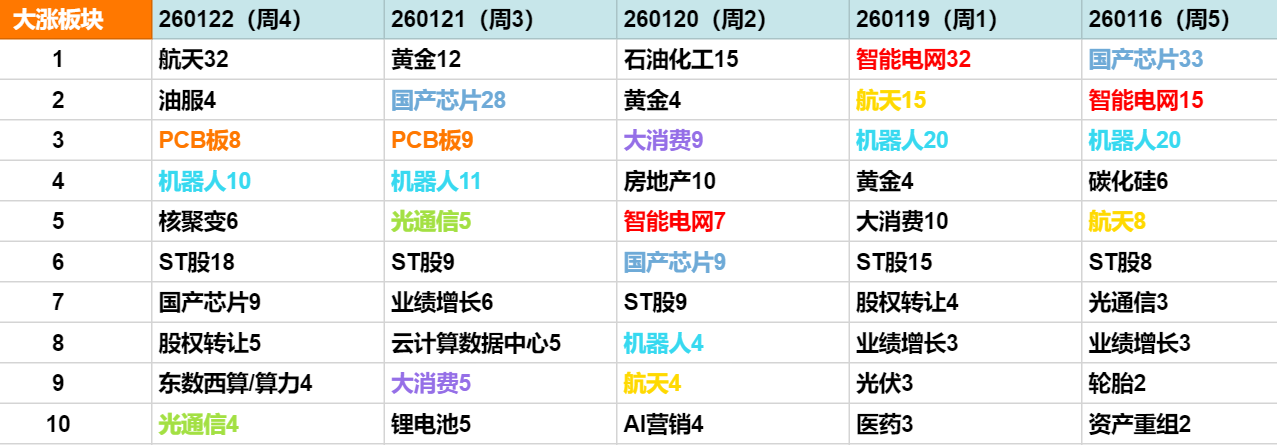
Market Analysis - On January 22, the market saw a rebound in the afternoon, with all three major indices turning positive, particularly a strong performance from the ChiNext Index. The total trading volume in the Shanghai and Shenzhen markets reached 2.69 trillion yuan, an increase of 91 billion yuan compared to the previous trading day. The Shanghai Composite Index rose by 0.14%, the Shenzhen Component Index increased by 0.5%, and the ChiNext Index gained 1.01% [1]. Investment Opportunities in Robotics - The humanoid robotics sector is experiencing significant developments, transitioning from "technology validation" to "mass production." Notable events include the successful rehearsal of the 2026 Spring Festival Gala, which integrates technology and art, showcasing advancements in robotics [8]. - At CES 2026, several companies presented advancements in humanoid robotics, including LG's CLOiD for home assistance and Boston Dynamics' new Atlas robot, which features 56 degrees of freedom and can autonomously change batteries [8]. - Tesla is set to launch its Gen 3 production machine in Q1 2026, marking a pivotal moment in global production processes [9]. Company Transformations - Fulei New Materials is transitioning from a traditional functional materials manufacturer to a technology company capable of supplying advanced robotic sensing components. The company aims to optimize its traditional business while focusing on the growth potential of "electronic skin" technology in high-end applications [11]. - The company reported a strong rebound in revenue and profit in Q3 2025, driven by an increase in operating income and gross profit [12]. Semiconductor Industry Developments - Jinhua New Materials is focusing on the semiconductor sector, developing electronic-grade hydroxylamine aqueous solution for chip cleaning, a critical chemical for chip yield. The company is in the pilot testing phase and aims to establish a production capacity of 500 tons per year [15][16]. - The company has successfully delivered electronic-grade hydroxylamine to several chip manufacturers, with expectations for significant revenue growth in 2026 as production capacity expands [17]. Chemical Industry Insights - The chemical sector is shifting from traditional cyclical investments to a focus on structural opportunities and long-term value. The basic chemical industry in China is undergoing a transformation towards high-quality development, with expectations for improved supply-demand dynamics in 2025 [18]. - Hubei Xingfa Chemical Group is transitioning from a resource-based company to a technology-driven green chemical new materials enterprise, leveraging its upstream phosphate resources for competitive advantage [22][23]. Phosphorus Chemical Market - The domestic phosphorus production capacity has seen fluctuations, with a decrease from 1.9 million tons in 2013 to 1.41 million tons in 2020, followed by a slight recovery. The supply of phosphorus is expected to remain constrained due to carbon neutrality policies [19]. - Xingfa Group is positioned as a leading player in the fine phosphorus chemical industry, with a complete "mining-phosphorus-chemical" integration strategy, enhancing its resilience against market fluctuations [24].


机器人行业点评报告:机器人密集资本化,产业化有望迎来加速
Shenwan Hongyuan Securities· 2026-01-20 13:45
Investment Rating - The report rates the robotics industry as "Overweight," indicating a positive outlook for the sector compared to the overall market performance [2][8]. Core Insights - The robotics industry is currently experiencing a phase of intensive capitalization, with leading companies preparing for IPOs and existing firms leveraging differentiated capital platforms for expansion. This trend is driven by the industry's transition from zero to one, requiring significant capital for operations, and the favorable regulatory environment creating an optimal window for capitalization over the next 1 to 2 years [2]. - The commercialization of robotics is accelerating, with increased capital expenditure expected to catalyze the development of funding, R&D, industrialization, and application scenarios. The report outlines three stages of commercialization: industrial use, commercial use, and ultimately household use [2]. - Key segments benefiting from the 2026 industrialization of robotics include: 1. The robotics body segment, where leading companies are expected to catalyze market growth through IPOs [2]. 2. The robotics components and modules segment, supported by manufacturing companies in regions like the Yangtze River Delta and Pearl River Delta [2]. 3. The soft technology segment, which may see mergers and acquisitions involving quality startups and unicorns [2]. 4. The application segment, where companies with strong customer loyalty and viable scenarios are likely to launch successful products in collaboration with established robotics firms [2]. Summary by Sections - **Capitalization Phase**: The robotics industry is in a critical phase of capitalization, with numerous companies preparing for public offerings and leveraging existing platforms for growth [2]. - **Commercialization Stages**: The report identifies three stages of robotics commercialization, emphasizing the need for capital and policy support to transition from industrial to household applications [2]. - **Beneficial Segments**: The report highlights four key segments poised for growth, including robotics body, components, soft technology, and applications, each with unique investment opportunities [2]. - **Investment Opportunities**: Recommended stocks include leading companies such as Hengli Hydraulic, Zhejiang Rongtai, and others, indicating a focus on both core and domestic chains within the robotics sector [2].


【大涨解读】机器人有望再登春晚,行业产业化今年全面提速,迎来0-1关键节点
Xuan Gu Bao· 2026-01-19 14:30
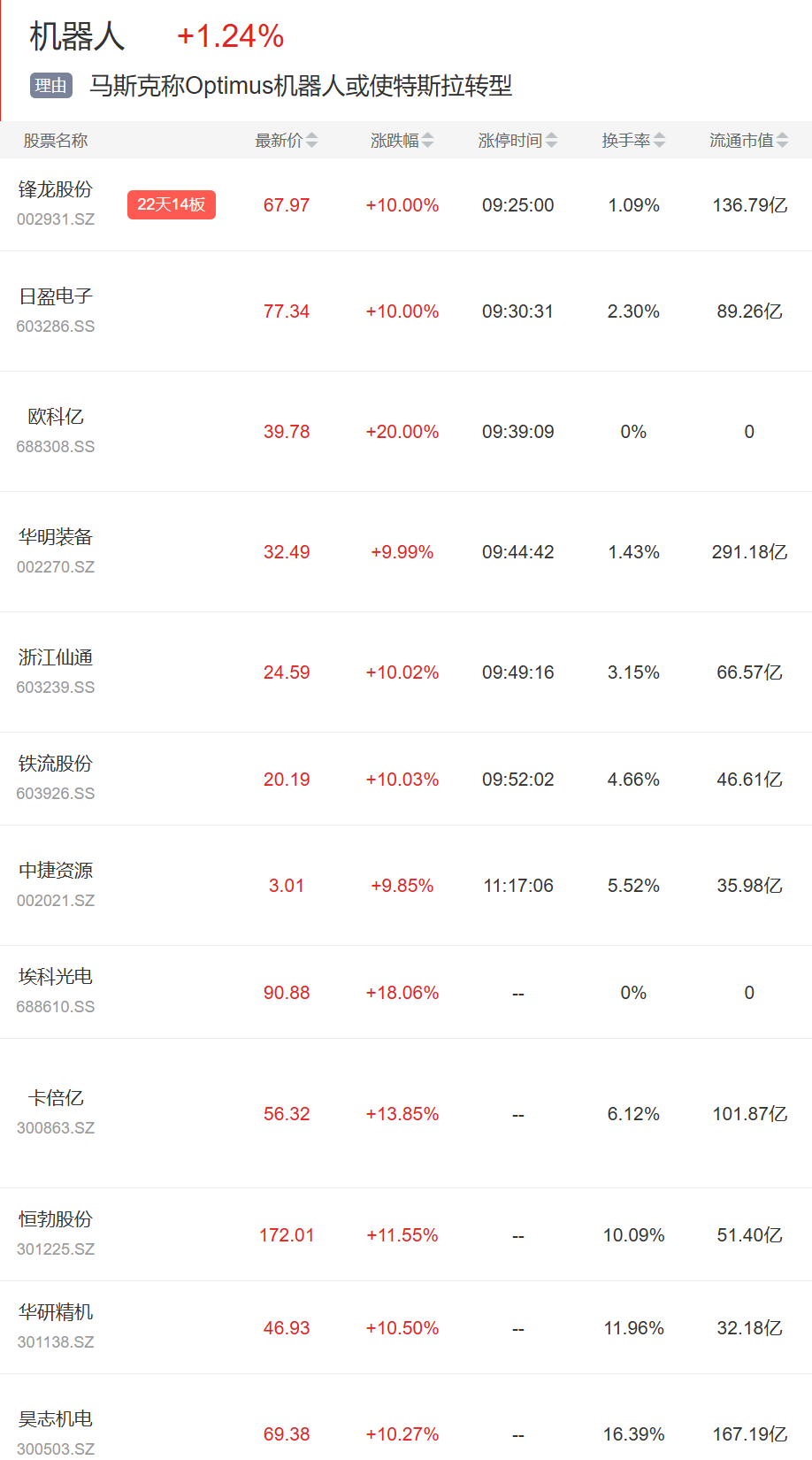
Market Overview - The robotics sector experienced a significant surge today, with stocks such as Fenglong Co., Ltd. achieving a 14-day consecutive rise, and companies like Riying Electronics, Oke Yi, and Tieliu Co. reaching their daily price limits [1]. Stock Performance - Fenglong Co., Ltd. (002931.SZ) reached a price of 67.97, increasing by 10.00% with a market cap of 13.679 billion [2] - Riying Electronics (603286.SS) also saw a 10.00% increase, reaching 77.34 with a market cap of 8.926 billion [2] - Oke Yi (688308.SS) surged by 20.00% to 39.78, with no available market cap data [2] - Other notable performers include Banming Equipment (002270.SZ) at 32.49 (+9.99%), and Tieliu Co. (603926.SS) at 20.19 (+10.03%) [2] Industry Events - The 2026 Spring Festival Gala will feature robots again, enhancing industry visibility, as previous appearances by companies like Yushu Technology have shown [4] - OpenAI is reportedly seeking domestic hardware suppliers in the U.S. for core components of robots, indicating ambitions for large-scale production [4] - Qianxun Intelligent has open-sourced its VLA foundational model Spiritv1.5, achieving over 50% success in RoboChallenge evaluations, which supports technological iteration in the industry [4] Institutional Insights - Tesla's mass production is expected to initiate a cycle of growth in the supply chain, with domestic manufacturers poised to increase output from thousands to tens of thousands of units by mid-2026 [5] - The hardware supply chain for Tesla is consolidating, with domestic firms showing advantages in supply chain integration, cost control, and rapid product iteration [5] - The industry is accelerating towards mass production, with Chinese robotics companies showcasing integrated engineering capabilities at CES 2026 [5] - China holds significant advantages in supply chain completion, large-scale manufacturing, and cost reduction, with leading firms establishing production bases in Thailand to support Tesla's 2026 production plans [5]




机器人行业开启产业化加速期
Zheng Quan Ri Bao· 2026-01-16 12:37
Core Insights - The Chinese robotics industry is experiencing a rapid acceleration in commercialization, driven by favorable policies, orders, and exports [1] Market Orders and Export Data - Multiple listed companies have reported significant business developments, indicating heightened industry activity. For instance, Lens Technology announced a 10,000-unit order for quadruped robotic dogs from Yujian Technology, along with a partnership for automation solutions [2] - Dou Shen Education reported that its first batch of companion robots sold out, with further sales plans in preparation [2] - Jian Ke Intelligent Equipment revealed its focus on intelligent CNC rebar processing robots, providing comprehensive solutions and expanding its market presence to over 100 countries [2] - According to customs data, high-tech product exports are projected to grow by 13.2% by 2025, with industrial robot exports increasing by 48.7%, marking China as a net exporter of industrial robots [2] Policy Support - The Ministry of Civil Affairs has outlined measures to promote the elderly care economy, emphasizing the development of key areas such as elderly care robots, with a focus on collaborative technology development and product application [2] Industry Development Outlook - The dual drivers of policy and market demand are accelerating technological innovation and domestic breakthroughs in core components, such as harmonic reducers and force control sensors, which are now entering international supply chains [4] - The 2026 International Consumer Electronics Show showcased advancements from NVIDIA, which introduced new models and frameworks to enhance robotic training and evaluation [4] - A report from Haitong Securities indicates that leading domestic and international companies are poised to achieve breakthroughs in core areas of robotics, potentially leading to a new phase of commercialization [4] Growth Potential - The Shenzhen Zhongshang Research Institute predicts that the humanoid robot market in China will reach 2.398 billion yuan by 2025 and could grow to 25.404 billion yuan by 2030 [5] - The long-term growth of the robotics industry is deemed certain, driven by structural demand expansion, supply-side efficiency improvements, and the impact of aging populations and service upgrades [5] - However, there are areas within the industry that require ongoing refinement, such as the performance of precision sensors and safety in human-robot interaction [5]
中国机器人行业年度融资回顾
机器人圈· 2026-01-06 12:06
Core Insights - The Chinese robotics industry in 2025 is characterized by a dramatic interplay of capital, technology, and application scenarios, described as a "song of ice and fire" [2] - The industry has seen unprecedented growth in financing, with approximately 610 financing events and a total amount nearing 50 billion RMB, representing over a 150% increase compared to the previous year [5][9] - A shift in investment logic is evident, moving from a focus on flashy technological demonstrations to a critical evaluation of scalable production capabilities and real-world commercial applications [10][11] Financing Scale and Structure - The financing scale in 2025 has reached a historic high, with total financing exceeding 50 billion RMB, marking a 2.5 times increase from the previous year [5] - There is a significant "head concentration" effect, with 9 companies completing 13 financing rounds of over 100 million USD, indicating that "billion-level" financing has become the new norm for leading players [5][9] - The capital structure has evolved into a diversified ecosystem, with financial VCs, industrial capital, and state-owned capital forming a "tripod" [6][8] Investment Logic Evolution - The focus of investors has shifted from prototype demonstrations to the ability to scale production, with metrics such as production line progress and order stability becoming critical [10][11] - Companies that can disclose specific order data and delivery milestones are more attractive in the financing market, as seen with firms like UBTECH and Zhiyuan Robotics [11] Application Scenario Differentiation - The application scenarios for robotics are increasingly stratified, moving away from the ambition of creating a general AI to focusing on practical economic value [14][15] - A "value pyramid" is forming, with high-end manufacturing at the top, standardized process scenarios in the middle, and specialized tasks at the base [14][15][16] Challenges and Market Dynamics - The robotics industry faces significant challenges, including technological bottlenecks in hardware and software, as well as economic viability issues related to manufacturing costs [19][20] - The current high valuations in the market are under scrutiny, with debates on whether they reflect genuine future potential or are speculative bubbles [21][22] Future Trends and Competitive Landscape - 2026 is anticipated to be a pivotal year for mass production in the robotics sector, with key performance indicators such as delivery rates and customer retention becoming crucial [23][24] - The competitive landscape is expected to evolve from product-centric competition to a more integrated ecosystem approach, with major tech companies like Tencent and JD.com establishing platforms to enhance their competitive edge [25][26]

新能源车ETF(159806)涨超2%,行业竞争格局与政策红利受关注
Mei Ri Jing Ji Xin Wen· 2026-01-05 07:08
Group 1 - The automotive industry is at a critical stage of transitioning from old to new logic, with the end of the electric vehicle (EV) bonus and the smart technology still in its early stages [1] - By 2025, the penetration rate of new energy vehicles is expected to reach 55.4%, with L3-level autonomous driving (urban NOA) penetration increasing to 20% and L2+ (highway NOA) penetration reaching 34% [1] - The policy of replacing old vehicles with new ones is expected to boost passenger car sales by 3.8% year-on-year to 23.62 million units, with the market share of domestic brands projected to rise to 67% [1] Group 2 - In the heavy truck sector, driven by replacement demand, wholesale sales are expected to grow by 16.9% year-on-year by 2025, with the penetration rate of electric heavy trucks rapidly increasing to 26.9% [1] - The bus industry is anticipated to see domestic sales grow by 15% and exports increase by 20% due to a resonance of domestic and international demand [1] - The current industry landscape features three main lines: optimization at the end of the electrification phase, cultivation of the supply chain on the brink of smart technology breakthroughs, and early-stage layout of the robotics industry [1] Group 3 - The New Energy Vehicle ETF (159806) tracks the CS New Energy Vehicle Index (399976), which selects listed companies involved in the upstream materials, midstream components, and downstream vehicle manufacturing of the new energy vehicle industry chain [2] - The index effectively reflects the overall performance of listed companies in the new energy vehicle sector by focusing on core enterprises, combining growth potential with industry representation [2]
弘毅远方基金王哲宇:内外利好催化,机器人板块或将进入高胜率阶段
Xin Hua Cai Jing· 2025-12-30 10:00
Core Viewpoint - The robotics sector is experiencing a strong performance, driven by the acceleration from technology research to commercial validation, with significant contributions from domestic manufacturers and positive developments in Tesla's supply chain [1][2]. Group 1: Market Performance - The CSI Robotics Index rose by 3.31% on December 30, with several stocks, including Boke Co., Ltd., Weichuang Electric, and New Times, hitting the daily limit [1]. - The current trading volume of the robotics sector is at a historical low, indicating potential for future upward movement [2]. Group 2: Industry Trends - Domestic advancements include the listing guidance of Hangzhou Yundongchu Technology Co., Ltd., which is expected to lead to more companies in the robotics supply chain entering the capital market next year, potentially boosting capital expenditures across the industry [1]. - Tesla's Optimus production plan is becoming clearer, with positive feedback from the supply chain and expectations that key component work will be completed by early next year, surpassing previous market expectations for production timing and scale [1]. Group 3: Investment Strategy - The year 2026 is anticipated to be a pivotal year for the global humanoid robotics supply chain, shifting the pricing logic towards actual performance verification [2]. - Despite potential short-term volatility in leading stocks, the long-term investment value remains significant, suggesting a high probability investment phase; investors are advised to adopt a strategy of buying on dips and holding long-term [2].
富维股份:公司与月泉仿生合作的项目是机器人场景化应用的项目
Zheng Quan Ri Bao Wang· 2025-12-22 12:12
Core Viewpoint - The collaboration between Fuwei Co., Ltd. and Yuequan Bionic focuses on the application of robotics in automotive parts manufacturing, aiming to accelerate the industrialization of robotics through a dedicated laboratory [1] Group 1: Company Initiatives - Fuwei Co., Ltd. has established the "Fuwei-Yuequan Robot Application Laboratory" to create a simulation environment that replicates actual production needs in a 1:1 scale [1] - The laboratory will facilitate data collection and model training for the W-Bot wheeled humanoid robot, enhancing its application in the automotive parts sector [1] Group 2: Industry Impact - The project aims to promote the practical implementation of humanoid robots in the automotive components manufacturing industry, thereby accelerating the overall robotics industry development [1]

精工科技:第二代单关节外骨骼机器人已具备量产能力
Ge Long Hui· 2025-12-12 07:05
Group 1 - The core point of the article is that Jinggong Technology (002006.SZ) has announced the mass production capability of its second-generation single-joint exoskeleton robot [1] - The company's wholly-owned subsidiary, Zhejiang Xianli Intelligent Technology Co., Ltd., is responsible for the operation of the exoskeleton robot business and is currently engaged in industrialization and business model planning [1]

前特斯拉高管掌舵,人形机器人公司矩阵超智获上市公司联合投资,132天造出对标Figure 02的人形机器人
机器人圈· 2025-12-04 09:15
Core Viewpoint - Matrix Superintelligence is rapidly emerging as a key player in the humanoid robot sector, driven by its strong founding team and strategic partnerships, aiming for scalable commercialization of its technology [1][5]. Group 1: Company Overview - Matrix Superintelligence, established in April 2024, has recently completed a strategic financing round, increasing its registered capital to approximately 24.31 million yuan [1]. - The company is led by Zhang Haixing, former head of Tesla's China design center, who has extensive experience in consumer electronics and smart hardware [1]. - The core team consists of members from top tech companies like Tesla, NVIDIA, Huawei, and OpenAI, creating a robust technological barrier [2]. Group 2: Product Development - The company developed its full-size humanoid robot prototype, MATRIX-1, in just 132 days, set to be launched online in December 2024 [2]. - MATRIX-1 stands 1.8 meters tall, weighs about 65 kg, has 77 degrees of freedom, can walk at a speed of 8 km/h, and has a maximum arm load of 35 kg with a battery life of approximately 5 hours [2]. - The robot features advanced capabilities, including a self-developed "robot brain" system, dynamic motion control technology, and a fully autonomous technology loop [4]. Group 3: Market Validation and Partnerships - MATRIX-1 has already received nearly 1,000 pre-orders from various sectors, including AI companies, research institutions, and manufacturing scene integrators [5]. - The investments from Kabeyi and Hongrun Construction are not merely financial but are based on clear industrial collaboration logic, providing essential support for Matrix Superintelligence's growth [5]. - Kabeyi, a leading supplier in automotive cables, and Hongrun Construction, a prominent infrastructure company, are both contributing to the supply chain and application scenarios for the humanoid robot [6]. Group 4: Business Model and Future Outlook - Matrix Superintelligence's business model focuses on providing a comprehensive solution of "platform + service + ecosystem" rather than just selling robots [6]. - The company aims to integrate deeply into the industrial ecosystem, enhancing its resilience and depth in the market [6]. - Zhang Haixing emphasizes the goal of creating reliable robots that can "support a family," focusing on engineering and scalability rather than just aesthetics [6].