法治经济

Search documents
奋进的法治中国|民营经济促进法为民企吃上定心丸
Yang Shi Wang· 2025-11-12 23:35
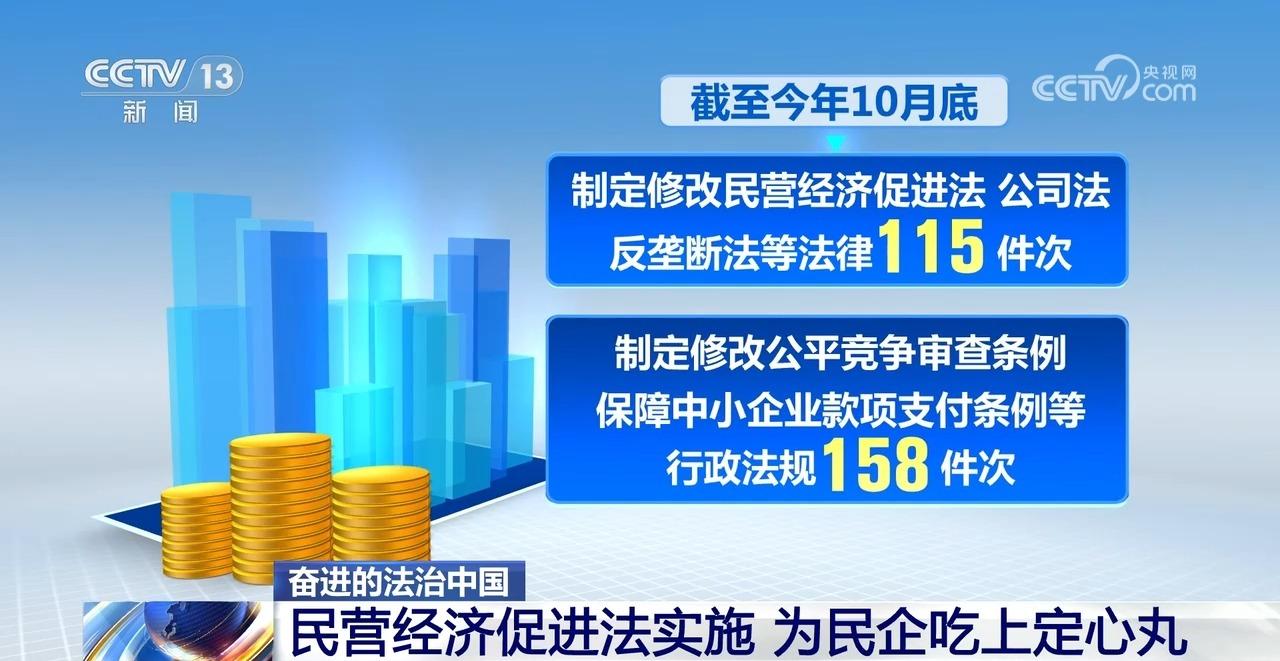
Core Viewpoint - The construction of a rule of law-based business environment is crucial for attracting talent and capital, which is beneficial for development. Recent legal reforms have provided reassurance to private entrepreneurs [1][3]. Group 1: Legal Reforms - Over the past five years, China has made significant progress in establishing a rule of law-based business environment through scientific, democratic, and lawful legislation, with 115 laws related to private economy, company law, and anti-monopoly law being enacted or amended [3]. - Additionally, 158 administrative regulations, including those on fair competition review and payment guarantees for small and medium enterprises, have been established or amended [3]. - A comprehensive review of over 600 existing administrative regulations has been conducted to eliminate unequal policies and laws affecting enterprises, supporting the creation of a unified market and promoting high-quality development [3]. Group 2: Government Services - The previous challenges of bureaucratic inefficiency have been addressed, with new experiences such as "one-stop service" and "data-driven processes" becoming part of daily operations [5]. Group 3: Market Environment - The combination of an effective market and proactive government has led to the establishment of a legal economy and credit economy, resulting in a continuously optimized business environment. China is now recognized as one of the countries with the fastest and most significant improvements in the business environment among major global economies [7].

人民日报:有效畅通“大循环”,建设统一大市场
Ren Min Ri Bao· 2025-08-31 23:54
Group 1 - The core viewpoint emphasizes the importance of a unified national market for China's development, highlighting that a large, efficient, and open market is crucial for gaining a competitive edge in the global landscape [1][2][3] - The construction of a unified national market is seen as essential for promoting high-quality development and optimizing market competition [1][2] - The concept of "Five Unifications and One Openness" is introduced as a guiding principle for local governments to break down barriers and enhance economic circulation [1][2][3] Group 2 - The article discusses the need for a holistic approach in governance, urging leaders to focus on national interests rather than local benefits, which aligns with the goal of building a unified market [2][3] - It highlights the necessity of breaking local protectionism and market segmentation to facilitate smooth economic circulation [2][3] - The importance of fostering a collaborative mindset among regions to enhance overall market strength is emphasized, suggesting that cooperation leads to mutual benefits [7][8] Group 3 - The article stresses that a high degree of legal governance is vital for a unified market, with clear market rules leading to stable expectations for business entities [4][5] - It outlines the government's role in creating a fair competitive environment through regulatory measures and legal frameworks [6][5] - The need for a balanced approach where government intervention supports rather than stifles market dynamics is highlighted [6][5] Group 4 - The article provides examples of successful cross-regional collaborations, such as the establishment of a cross-province air freight station and water rights trading, demonstrating the benefits of a unified market [7][9] - It mentions the growth of collaborative innovation indices in regions like the Yangtze River Delta, indicating the positive impact of unified market initiatives on economic performance [9] - The article concludes that a unified national market will enhance China's attractiveness as a destination for foreign investment, with a notable increase in new foreign enterprises established [9][10]
封丽霞:社会主义市场经济本质上是法治经济
Jing Ji Ri Bao· 2025-08-13 00:20
Core Viewpoint - The development of a socialist market economy is a significant creation of the Party, emphasizing the intrinsic relationship between socialist market economy and the rule of law, which is essential for constructing a high-level socialist market economy system [1][2]. Group 1: The Role of Law in Socialist Market Economy - The rule of law is an inherent requirement of the socialist market economy, ensuring that market mechanisms effectively allocate resources while maintaining government roles [2][3]. - A comprehensive legal system is necessary to confirm subject qualifications, regulate market behavior, and maintain market order, fostering a fair competitive environment [2][3]. - The legal framework must ensure that price signals accurately reflect supply and demand, guiding resources to the most efficient sectors [2][3]. Group 2: Government's Role and Legal Framework - The government must manage areas that the market cannot effectively handle, with the rule of law clarifying the boundaries between government and market functions [3]. - The legal system, centered around the Constitution, provides institutional guarantees for the socialist market economy, ensuring that reforms and legal frameworks advance simultaneously [3][4]. Group 3: Functions and Effects of Law on Economic Development - Law plays a crucial role in confirming and protecting property rights, which are foundational to the socialist market economy [4][5]. - A well-defined legal system helps regulate market order, addressing issues like unfair competition and consumer rights protection [4][5]. - Legal clarity reduces transaction costs and enhances resource allocation efficiency by establishing transparent rules for business operations [5][6]. Group 4: Promoting Reform and Development through Law - Emphasizing equal legal protection for all types of economic entities is vital for a balanced socialist market economy [6][7]. - The construction of a unified national market is essential, requiring legal frameworks to ensure compliance and standardization across various sectors [7][8]. - A fair law enforcement and judicial system is necessary to maintain market order and resolve disputes effectively [8][9]. Group 5: Building a Law-abiding and Trustworthy Society - Promoting a law-abiding society is crucial for enhancing market efficiency and fostering a collaborative environment among various stakeholders [8][9]. - Strengthening legal awareness and contract spirit across society can lower transaction costs and enhance market safety, allowing businesses to focus on innovation [8][9].
社会主义市场经济本质上是法治经济
Jing Ji Ri Bao· 2025-08-12 22:44
Group 1 - The core viewpoint emphasizes the intrinsic relationship between socialist market economy and the rule of law, highlighting that a high-level socialist market economy system is essential for national governance [1][2][3] - The rule of law is an inherent requirement of the socialist market economy, ensuring that market mechanisms effectively allocate resources while maintaining government roles within a legal framework [2][3] - The government's role is to manage areas that the market cannot effectively handle, ensuring that administrative functions are performed within legal boundaries to avoid unreasonable interventions [3][4] Group 2 - The rule of law promotes the development of the socialist market economy by confirming and protecting property rights, which are fundamental to the economic system [4][5] - Establishing a clear and transparent legal framework reduces transaction costs and enhances market efficiency by defining the rights and obligations of market participants [5][6] - The construction of a unified national market is crucial for a high-level socialist market economy, requiring legal frameworks to ensure fair competition and effective governance [6][7] Group 3 - A fair law enforcement and judicial system is essential for maintaining market order and resolving disputes, ensuring justice and efficiency in economic activities [8] - Creating a law-abiding and trustworthy social environment is vital for enhancing market efficiency and encouraging innovation, shifting focus from price competition to value competition [8][9]
让地方立法成为发展“推进器”(人民时评)
Ren Min Ri Bao· 2025-07-14 22:03
Group 1 - The core idea of the news is the establishment of the Hangzhou West Science and Technology Innovation Corridor, which aims to enhance innovation and economic development through local legislation that breaks down administrative barriers and promotes a supportive legal environment for technological advancement [1][2]. - The Hangzhou West Science and Technology Innovation Corridor spans 39 kilometers and covers over 400 square kilometers, having birthed more than 140,000 enterprises, indicating significant economic activity and innovation potential in the region [1]. - The introduction of the "Hangzhou West Science and Technology Innovation Corridor Regulations" serves as both a "guarantee law" for development and a "promotion law" for innovation, highlighting the importance of good laws as a prerequisite for effective governance and high-quality development [1][2]. Group 2 - The article emphasizes the role of local legislation in enhancing governance capabilities and ensuring that economic activities operate within a stable and predictable legal framework, which is crucial for fostering innovation and business confidence [2][3]. - Local legislative efforts have expanded significantly since the 2015 amendment to the Legislation Law, increasing the number of local legislative bodies and enabling tailored legal frameworks that address specific regional needs and challenges [2]. - Examples of successful local legislation include the "Changzhou New Energy Industry Promotion Regulations," which provide legal support for the development of the new energy sector, signaling a long-term commitment to sustainable growth [2][3].
良法善治促民企拔节生长
Jing Ji Ri Bao· 2025-05-14 22:06
Group 1 - The core viewpoint of the news is the enactment of the "Private Economy Promotion Law" in China, which aims to support and regulate the development of the private economy, emphasizing the importance of the rule of law in a socialist market economy [1][2] - The law consists of 9 chapters and 78 articles, outlining specific regulations on fair competition, investment promotion, technological innovation, and protection of rights, which are essential for the healthy development of the private economy [1][2] - The private economy has significantly contributed to China's economic landscape, accounting for over 50% of tax revenue, over 60% of GDP, and over 70% of technological innovations, as well as 90% of urban job creation and enterprise numbers [1][2] Group 2 - The establishment of the "Private Economy Promotion Law" is a key initiative from the 20th Central Committee's third plenary session, aimed at solidifying reform achievements and enhancing development confidence amidst external challenges like unilateralism and trade protectionism [2][3] - The law promotes a unified market access negative list system and supports private economic organizations in obtaining direct financing through stock and bond issuance, which will improve the business environment for private enterprises [3] - Measures such as establishing a credit repair system and prohibiting illegal administrative or criminal interference in economic disputes are included to ensure fair market competition and foster the growth of private economic entities [3]
计划经济不等于最有计划,市场经济也不等于最无计划
Sou Hu Cai Jing· 2025-03-25 13:01
Group 1 - The core viewpoint is that the terms "planned economy" and "market economy" are often misunderstood, with the former not equating to a well-planned economy and the latter not equating to a lack of planning [3][4] - Planned economy is characterized by command and authority, where a few individuals dictate plans for the many, leading to potential inefficiencies and uncertainties [4][6] - Market economy relies on a dynamic pricing system where market participants and consumers make decisions, reducing the power of bureaucratic elites [9][11] Group 2 - Planned economy is described as a system governed by administrative commands and centralized authority, which can lead to significant failures if lower levels do not comply or have too much autonomy [6][7] - Market economy is defined as a system where resources are allocated based on market dynamics rather than administrative intervention, emphasizing the importance of legal frameworks that bind both elites and market participants [9][11] - The distinction between planned and market economies is framed as a difference between rule by people (human governance) and rule by law (legal governance) [11]