
海洋可持续发展

Search documents
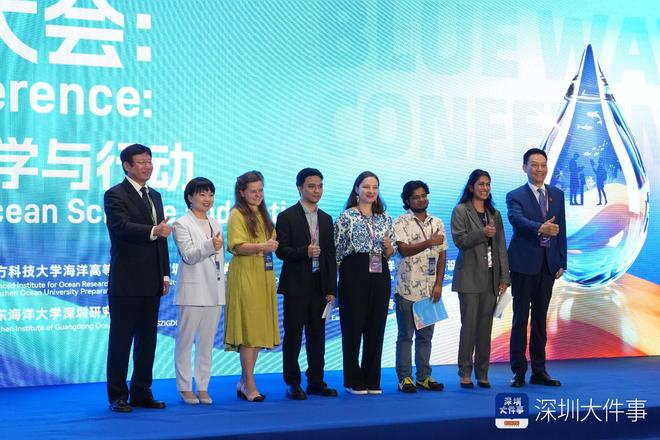
蓝色浪潮大会启幕,聚焦青年引领海洋科技创新与可持续发展
Nan Fang Du Shi Bao· 2025-10-30 09:33
Core Points - The first "Blue Wave Conference" was launched in Shenzhen as part of the 2025 China Marine Economy Expo, gathering over a hundred young scientists and entrepreneurs from around the world to discuss marine science innovation and sustainable blue economy development [1][3]. Group 1: Conference Overview - The conference is co-hosted by several organizations, including the China Ocean Mineral Resources Research and Development Association and Southern University of Science and Technology, aiming to empower youth in marine science and action [3]. - The event aligns with the United Nations' "Decade of Ocean Science for Sustainable Development" initiative, focusing on creating a "science-policy-action" loop through various formats such as workshops and creative presentations [3][4]. Group 2: Key Messages from Leaders - Zhang Zanhai, the initiator of the conference, emphasized the importance of youth as a driving force in marine science innovation and called for collective action among young talents [3]. - Lin Jian, the president of the Southern University of Science and Technology's Marine Research Institute, highlighted the need for global youth collaboration to tackle marine challenges and mentioned the establishment of new marine landmarks in Shenzhen [4]. Group 3: Initiatives and Collaborations - The conference officially launched the "2025 Blue Wave Shenzhen Initiative," outlining ten action directions to facilitate youth participation in marine affairs, including the establishment of a global marine youth partnership network [7]. - Strategic cooperation agreements were signed between Southern University of Science and Technology and the China Merchants Heavy Industry Marine Equipment Research Institute, as well as a letter of intent with PEMSEA [8]. Group 4: Engagement Activities - The conference featured various activities aimed at showcasing youth contributions to marine practices, including a "Marine Decade Youth Action Flash" and a "Marine Protection Youth Project Roadshow" [8]. - Innovative formats such as "word clouds" were used to gather global youth visions for the future of the ocean, promoting diverse ideas and collaboration [8].

中银金融、国家电投等新设海洋可持续发展基金
Zheng Quan Shi Bao Wang· 2025-10-30 00:56
Core Viewpoint - The establishment of the Ocean Sustainable Development (Qingdao) Equity Investment Fund Partnership (Limited Partnership) with a capital contribution of 2 billion yuan indicates a growing interest in sustainable investment opportunities in China [1] Group 1: Fund Details - The newly formed fund has a capital contribution of 2 billion yuan [1] - The fund's business scope includes private equity investment, investment management, and asset management activities [1] Group 2: Investors - The fund is co-funded by Bank of China Financial Asset Investment Co., Ltd. and the State Power Investment Corporation's Guodian Investment Sanxin Phase II Industrial Equity Investment Fund (Tianjin) Partnership (Limited Partnership) [1]

【新华社】第十届中斯气候变化与海洋可持续发展联合研讨会在科伦坡举行
Xin Hua She· 2025-10-25 13:01
Core Points - The 10th China-Sri Lanka Joint Seminar on Climate Change and Marine Sustainable Development was held in Colombo, Sri Lanka, with over 200 experts from multiple countries discussing climate change, marine ecological protection, and sustainable development [1][2] - The seminar focused on the impact of climate change on the Indian Ocean marine system, ecological environment monitoring, coastal disaster prevention, water resource management, and the implementation of sustainable development goals [1] - More than 40 reports were presented, covering topics such as "Climate Change and Ecological Response in the Indian Ocean" and "Innovations in Water Treatment and Reuse" [1] - The seminar also reviewed the 10-year development of the China-Sri Lanka Joint Science and Education Center, highlighting successful collaborations in marine observation, disaster warning, clean drinking water, and talent training since its establishment in 2015 [1] Industry Insights - The cooperation in technology and marine fields is a significant component of the friendly relations between China and Sri Lanka, with a commitment to enhance collaboration for mutual benefits [2] - An "Indian Ocean Climate Change and Ecological Response Action Initiative" was jointly released by scientists from Sri Lanka, Australia, Maldives, Pakistan, and China during the seminar [2] - The seminar was organized by the China-Sri Lanka Joint Science and Education Center, with support from various institutions including the South China Sea Institute of Oceanology and the Institute of Ecology and Environment Research of the Chinese Academy of Sciences [2]
坚持系统观念 提升治理效能 立体开展海洋生态环境治理(专题深思)
Ren Min Ri Bao· 2025-10-08 23:21
Core Viewpoint - The emphasis on marine ecological civilization construction and the importance of protecting marine biodiversity and preventing marine pollution is highlighted as essential for sustainable development and ecological security [1][2]. Group 1: Strategic Goals - The complexity of marine ecological environment governance necessitates a comprehensive approach that balances ecological, economic, and social benefits [2]. - The strategy should prioritize ecological protection while promoting high-quality marine economic development, ensuring that short-term gains do not compromise long-term sustainability [2][3]. Group 2: Governance Chain - A shift from fragmented governance to a comprehensive approach that includes source control, process management, and end-point treatment is essential for effective marine ecological governance [3]. - Emphasis on controlling land-based pollution sources and implementing ecological restoration post-pollution management is crucial for maintaining marine ecosystem health [3]. Group 3: Resource Integration - Establishing cross-regional and cross-departmental cooperation mechanisms is necessary to enhance the effectiveness of marine ecological governance [4]. - A unified strategy and policy framework should be developed to break down barriers between departments and clarify responsibilities, promoting proactive collaboration [4]. Group 4: Governance Methods - A multi-faceted approach utilizing legal, market, and technological tools is vital for effective marine ecological governance [5]. - The implementation of strict legal frameworks and economic incentives, alongside the integration of advanced technologies, will enhance the efficiency and effectiveness of governance efforts [5].
海洋经济的“深蓝突围”
Qi Lu Wan Bao· 2025-09-25 23:20
Core Insights - Qingdao aims for a marine GDP of 551.32 billion yuan in 2024, contributing 5.2% to the national and 30.6% to the provincial marine GDP, and accounting for 33% of the city's total GDP [1] - The city is focusing on technological innovation to drive its marine economy, targeting a growth rate of approximately 6.5% for marine GDP this year [2] - Qingdao is developing a modern marine industry system with a focus on high-end, intelligent, green, and clustered development [3] Marine Economy Development - The marine economy's contribution rate reached 45.9%, boosting the city's economic growth by 2.1 percentage points [1] - The marine primary, secondary, and tertiary industries contributed 2.9%, 43.5%, and 53.6% respectively to the marine GDP [1] - Qingdao has developed 34 marine AI models to enhance marine productivity and innovation [3] Technological Innovations - A groundbreaking wave energy conversion device developed by Tsinghua University won a special award at the Geneva International Invention Exhibition, addressing cost and reliability issues in wave energy generation [2] - The first cylindrical floating production storage and offloading unit in Asia, "Hurricane No. 1," was completed in Qingdao, capable of operating at sea for 15 years [2] - The city is also advancing in marine pharmaceuticals, with significant production of seaweed-based medical products and the development of marine drugs entering clinical trials [5] International Collaboration - Qingdao has established the "Marine Decade" International Cooperation Center, integrating into the UN's global initiatives for sustainable marine development [7] - The city hosted the first United Nations Marine Cities Conference, facilitating international dialogue on marine governance and technology [8] - Qingdao is actively participating in global marine governance, contributing to international frameworks and initiatives [8] Environmental Sustainability - The city is committed to marine ecological protection, launching initiatives to restore marine ecosystems and promote sustainable management [9][10] - Qingdao's ecological restoration efforts have been recognized nationally, enhancing both environmental quality and economic value [10] - Digital initiatives, such as virtual activities promoting marine conservation, are being implemented to raise awareness and engage the public [10]
锚定“人海和谐”建设海洋生态
Jing Ji Ri Bao· 2025-09-17 22:07
Core Viewpoint - The Guangdong-Hong Kong-Macao Greater Bay Area has made significant progress in marine ecological construction, serving as a model for sustainable development and harmonious coexistence between humans and nature [1][2]. Group 1: Marine Ecological Status - The overall marine ecological condition in the Greater Bay Area is stable and improving, with coral reefs and mangrove ecosystems primarily rated as good [1]. - The Zhuhai area has restored 3.9 kilometers of damaged coastline, re-greened 5 hectares of slopes, and 24 hectares of bare land, increasing forest coverage to 64% [1]. - The population of the Chinese white dolphin in the Pearl River Estuary has remained stable at approximately 2,600 individuals from 2017 to 2021, indicating effective protection of rare species [1]. Group 2: Challenges and Strategies - The Greater Bay Area faces challenges such as inadequate collaborative governance mechanisms, conflicts between development and protection, and insufficient technological support for governance [2]. - A multi-governance approach is necessary to establish a collaborative governance mechanism for marine ecology, integrating land and sea management and promoting regional cooperation [3]. Group 3: Development and Protection Balance - Emphasizing the dual focus on development and protection, the area aims to create a green and low-carbon development model for marine ecology [3]. - Strict limitations on development activities in ecologically fragile areas and the implementation of pollution control measures are essential for sustainable marine resource management [3]. Group 4: Technological Innovation - The "Technology-Driven Ocean" strategy aims to leverage technology for marine ecological protection, utilizing observation, simulation, and prediction to monitor environmental changes [4]. - Advanced technologies such as AI, drones, and satellites will be employed to dynamically monitor the status of marine rare species and ecosystems, supporting the construction of a "smart ocean" in the Greater Bay Area [4].
香港特区政府欢迎世贸组织《渔业补贴协定》正式生效
Zhong Guo Xin Wen Wang· 2025-09-16 07:37
Core Points - The Hong Kong SAR government welcomes the official implementation of the WTO's Fisheries Subsidies Agreement, which took effect on September 15, 2023 [1] - The agreement marks a significant step towards sustainable ocean development and highlights the WTO's role in addressing global issues [1] - The agreement regulates fisheries subsidies among WTO members, promoting sustainable fishing practices and reducing harm to marine and global fish resources [1] - The implementation of the agreement is expected to benefit trade, development, and the environment [1] Summary by Sections - **Agreement Details** - The Fisheries Subsidies Agreement was adopted at the WTO's 12th Ministerial Conference in June 2022 and opened for member accession thereafter [1] - China approved the agreement on June 27, 2023, becoming one of the early major members to complete the ratification process [1] - **Regulatory Aspects** - The agreement requires the elimination of subsidies for illegal, unreported, and unregulated fishing, as well as for overfished species and unregulated high seas fishing [1] - It incorporates elements of fisheries management such as enforcement, resource sustainability assessment, policy transparency, and international cooperation [1] - **Local Implementation** - Following the acceptance of the agreement in August 2023, the Hong Kong SAR government's Agriculture, Fisheries and Conservation Department has made appropriate adjustments to relevant fisheries subsidy and support program guidelines [2]
中国-非洲国家海洋治理培训班在杭州开班
Zhong Guo Zi Ran Zi Yuan Bao· 2025-08-01 02:59
Group 1 - The training program "China-Africa National Ocean Governance Training Course" commenced in Hangzhou, focusing on cooperation between China and five African countries: Nigeria, Liberia, Mauritius, Gambia, and Egypt [1] - The director of the Second Institute of Oceanography emphasized the importance of collaboration with African nations, highlighting ongoing partnerships in marine scientific research, spatial planning, and capacity building through platforms like the China-Africa Marine Science and Blue Economy Cooperation Center [1] - Representatives from Gambia and Egypt expressed their anticipation for the training, which covers both professional courses and practical fieldwork, aiming to learn from China's successful experiences in marine technology and ecological governance [1] Group 2 - The training lasts for seven days, featuring experts from various Chinese institutions who will conduct face-to-face lectures on topics such as "China's National Conditions and Marine Policies," "Distribution and Ecological Risks of Marine Microplastics," and "Marine Ecological Restoration and Governance" [2] - The program includes a field trip to Zhoushan to visit the "Daiyang" research vessel and Zhejiang Ocean University, allowing participants to experience practical applications of marine technology, ecological governance, and low-carbon technologies [2]
文旅互动 擘画互利共赢新画卷
Ren Min Ri Bao· 2025-07-26 21:36
Core Viewpoint - The "World Mayors Dialogue in Qingdao 2025" has initiated a month of international city exchanges, focusing on enhancing marine tourism, revitalizing historical districts, and promoting international tourism for cultural exchange [1] Group 1: Marine Economy - Qingdao Port achieved a cargo throughput of 710 million tons in 2024, ranking fourth globally, with a 30% increase in cargo turnover efficiency due to automation technology [2] - Clean energy applications such as wind, solar, and hydrogen are widely utilized at Qingdao Port, showcasing significant achievements in sustainable development [2] - The marine economy in Qingdao is rapidly developing, with suggestions for collaboration between New Zealand's Otago University and China Ocean University to promote research and tourism development [2][3] Group 2: Urban Governance - Qingdao's historical district has preserved over 1,800 historical buildings, attracting nearly 90 million visitors last year, showcasing a blend of old and new through innovative urban development [4] - The integration of technology in urban governance is highlighted, with cities sharing their smart city initiatives to enhance international tourist experiences [5][6] Group 3: Cultural Exchange - Qingdao has established friendly city relationships with 95 cities across 54 countries, enhancing global cultural exchanges and cooperation [7] - Events like the International Beer Festival serve as cultural exchange platforms, with cities like Daegu in South Korea expressing interest in deepening friendly ties through shared cultural symbols [7] - Lagos, Nigeria, is ready to collaborate on green economy initiatives, sustainable tourism, and digitalization, emphasizing the importance of global dialogue and cooperation [8]
中欧蓝色伙伴关系助力全球海洋治理
Ren Min Ri Bao· 2025-07-22 21:50
Core Points - The third United Nations Ocean Conference in Nice, France highlighted the vitality of the China-Europe blue partnership in multilateral cooperation on marine protection, port decarbonization, and digital ocean construction [1] - China and the EU have established a blue partnership to enhance marine governance, sustainable fisheries, and marine economic prosperity, marking the EU's first such partnership with a non-EU country [2] - The collaboration between China and France in marine monitoring has been exemplified by the successful launch of the China-France ocean satellite, which has extended its service period and continues to contribute valuable data for global marine observation [3] Group 1: Marine Environmental Protection Cooperation - The international cooperation platform initiated by the French National Center for Space Studies aims to connect space observation data with marine actions, promoting scientifically-based marine protection and management [2] - The signing of the fourth cooperation memorandum between China's National Marine Environmental Forecasting Center and France's Mercator Ocean International exemplifies 12 years of fruitful collaboration in marine disaster warning and global ocean forecasting technology [3][4] Group 2: Marine Economic Development - China and the EU's trade relationship is robust, with imports and exports reaching 2.82 trillion yuan in the first half of the year, emphasizing the importance of green and low-carbon initiatives in their "blue economy" cooperation [5] - The "Sea Kite" propulsion system developed by the French company "Beyond the Ocean" aims to reduce fuel consumption and carbon emissions, showcasing innovation in the shipping industry [5] - The Piraeus Port in Greece has become a significant node for China-Europe maritime connectivity, enhancing regional logistics efficiency and promoting a green and intelligent transformation of Southern European ports [5][6] Group 3: Sustainable Marine Development - The signing of three cooperation memorandums between Xiamen City in China and Biarritz City in France focuses on establishing mechanisms for blue industry investment and collaboration in sustainable marine sectors [8] - Both China and the EU are committed to multilateralism and actively participate in the formulation of international marine governance rules, addressing challenges such as pollution and sustainable fisheries [9]