消费平替

Search documents
618存量之战:电商平台重新定义“增长”
2 1 Shi Ji Jing Ji Bao Dao· 2025-06-18 05:30
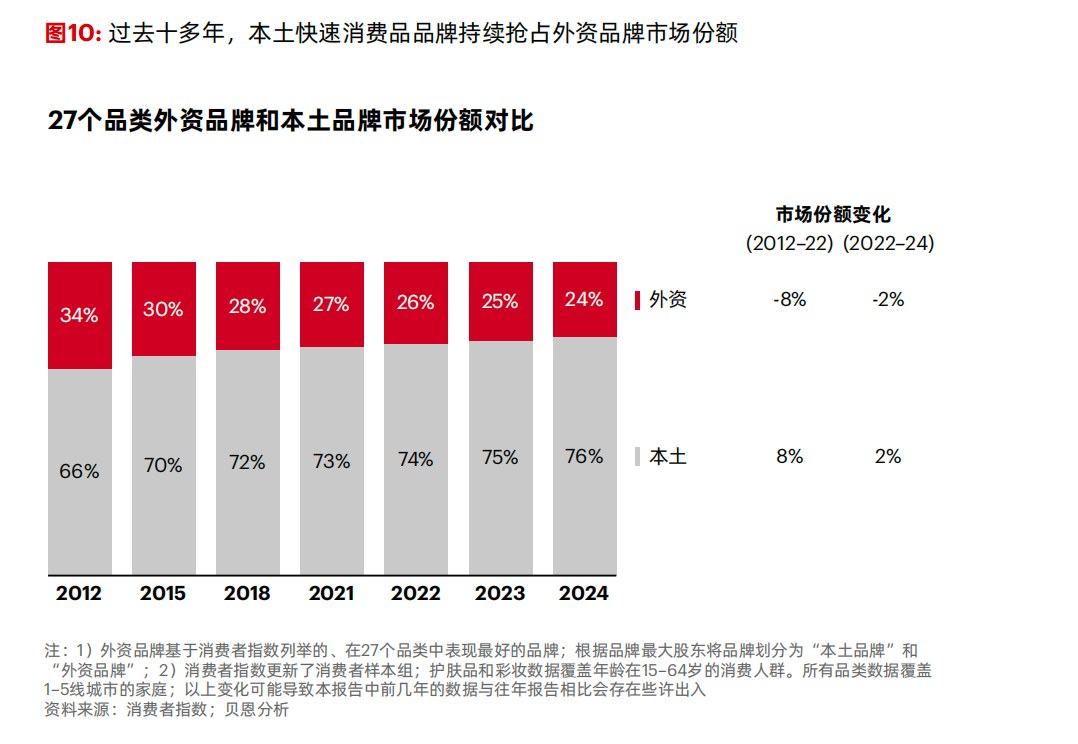
Core Insights - The traditional promotional model of "618" is evolving as consumers become more discerning about their purchases, focusing on the reasons behind their buying decisions rather than just discounts [2][9] Group 1: Changes in Consumer Behavior - Consumers are increasingly prioritizing high cost-performance products, leading to a normalization of value-driven offerings across both online and offline platforms [3][4] - The impact of promotions on consumer behavior is diminishing, with consumers becoming more aware of their needs and less influenced by single promotional events [4] - The market share of domestic brands in the fast-moving consumer goods (FMCG) sector has risen from 66% in 2012 to an expected 76% by 2024, indicating a shift towards local brands that better understand consumer preferences [4] Group 2: E-commerce Platform Strategies - E-commerce platforms are moving away from complex discount structures to simpler pricing strategies, which reduces decision-making costs for consumers and enhances shopping experiences [3] - Platforms like Taobao, JD, Douyin, and Kuaishou are focusing on emotional engagement and user understanding to drive sustainable growth, rather than relying solely on price competition [3][6] - Instant retail is reshaping the purchasing and fulfillment process, with significant growth in categories like alcohol and baby formula during the "618" period, highlighting the demand for quick delivery services [6] Group 3: Emotional Economy and New Trends - The emotional economy is becoming a key driver of consumer behavior, with platforms leveraging content and emotional resonance to stimulate "self-rewarding" consumption [7][8] - The integration of content marketing with e-commerce is evident, as seen in initiatives like the "Red Cat Plan" by Taobao and Xiaohongshu, targeting specific consumer segments [7] - The rise of niche markets, such as the toy and collectible sector, has led to explosive sales growth, with many merchants achieving significant sales milestones during the "618" event [8]



2025年一季度快消品市场同比增长2.7% “平替”需求不减
Zhong Guo Jing Ying Bao· 2025-06-15 04:43
Core Insights - The report indicates that the overall sales of China's fast-moving consumer goods (FMCG) market grew by 2.7% year-on-year in Q1 2025, showing an improvement from the 0.8% growth in 2024 [1] - The growth in Q1 2025 was significantly driven by consumer spending during the Spring Festival, with various categories performing well [1][2] - The trend of consumers opting for cost-effective products continues, with a notable shift towards affordable channels and products with better price-performance ratios [1][4] Sales Performance - In Q1 2025, the sales growth rates for different FMCG categories were as follows: household care increased by 6.1%, personal care by 4.0%, packaged food by 3.2%, and beverages only by 0.5% [1][2] - The overall volume of FMCG sales increased by 5.3% in Q1 2025, while the average selling price decreased by 2.5%, indicating a shift towards higher volume sales at lower prices [3][4] Channel Dynamics - Offline retail channels, particularly self-operated platforms of retailers like Sam's Club and Hema, showed significant growth, with Sam's Club growing by 63% in Q1 2025 [2] - Online channels also saw growth, with Douyin capturing 23% of e-commerce sales, and Pinduoduo experiencing an 11% increase in Q1 2025 [2][3] Consumer Behavior - Consumers are increasingly prioritizing value for money, leading to a decline in average selling prices while still driving volume growth [4][5] - The trend of "consumption substitution" is evident, with private labels and store brands gaining market share in categories like facial tissues and personal care [4][5] Innovation and Premiumization - Certain categories, such as juice and instant coffee, are experiencing growth due to innovative products that offer health benefits or unique flavors, allowing brands to command a premium [5] - Brands that can demonstrate unique value and quality are more likely to succeed in the current market environment, as consumers are willing to pay more for products that meet their health and quality expectations [5]
2024年三四线城市消费增速超过一二线城市 贝恩:2025年“消费平替”趋势延续
Mei Ri Jing Ji Xin Wen· 2025-06-12 13:56
Core Insights - The report indicates a slowdown in the overall sales growth of China's fast-moving consumer goods (FMCG) market, with a projected growth of only 0.8% in 2024, driven by a 4.4% increase in volume but a 3.4% decrease in average prices [1][12] - The trend of "consumption alternatives" is prominent, with significant price reductions observed, particularly in 2024, marking the largest decline in average prices over the past four years [1][12] - The consumption growth rate in third- and fourth-tier cities is outpacing that of first- and second-tier cities, indicating a shift in market dynamics [1] Market Performance - In 2024, the community group buying platform experienced a 17.0% decline in sales, reflecting increased competition from discount stores and other emerging business models [2][6][7] - The overall market share of e-commerce and offline channels remained stable, but internal dynamics shifted, with grocery stores and supermarkets performing better than the market average, particularly in lower-tier cities [3][4] - Warehouse membership stores showed resilience with a growth rate in average purchase frequency of 1.6%, despite a 6.5% drop in average transaction value [4] Brand Dynamics - The competition among brands remains intense, with over half of the tracked categories seeing the top five brands lose market share [8] - Local brands have significantly increased their market share, reaching 76% by 2024, as they continue to outperform foreign brands [8] Consumer Behavior - The primary factor influencing household spending is product selection, with consumers increasingly seeking economical alternatives across various categories [12] - High-end products in categories like juice and coffee have seen growth due to innovation and rising consumer demand for quality [12][13] - Promotional activities have less impact on consumer purchasing behavior, as consumers are now more discerning and focused on value for money [13]

贝恩:2025年“消费平替”趋势延续
Guo Ji Jin Rong Bao· 2025-06-12 13:00
Core Insights - The report by Bain & Company and Worldpanel indicates a slowdown in the overall sales growth of China's fast-moving consumer goods (FMCG) market due to the ongoing "consumption substitution" trend [1] - In 2024, the FMCG market is projected to achieve a modest sales growth of 0.8%, with a volume increase of 4.4% but an average price decline of 3.4% [1] - The first quarter of 2025 shows a year-on-year sales growth of 2.7%, driven by improvements in macroeconomic indicators and strong consumption during the Spring Festival [1] Market Trends - The FMCG market in China is experiencing a significant "consumption substitution" trend, with the average price decline being the largest in the past four years [1] - Consumption growth in third- and fourth-tier cities is outpacing that of first- and second-tier cities, indicating a shift in consumer spending patterns [1] - The largest factor affecting household spending is product choice, with consumers actively seeking more affordable alternatives across categories such as packaged food, beverages, household care, and personal care [1] Strategic Considerations - Brands face strategic decisions regarding whether to focus on the high-end market, compete in the mass market, or adopt a dual approach [2] - The high-end market is experiencing a decline compared to the overall market, presenting challenges for brands [2]
《2025年中国购物者报告,系列一》:2025年“消费平替”趋势延续,中国快消品市场全力以赴促增长
凯度消费者指数· 2025-06-12 05:18
Core Insights - The report highlights a slowdown in the growth of China's fast-moving consumer goods (FMCG) market, primarily influenced by the "consumption substitution" trend, with overall sales growth at 0.8% in 2024, driven by a 4.4% increase in volume but a 3.4% decrease in average prices [2][3][4] Market Performance - In 2024, the FMCG market saw a quarterly sales performance of 1.5% and 1.8% growth in Q1 and Q2, respectively, followed by a decline of 0.6% in Q3 and a slight rebound of 0.4% in Q4 [2] - The first quarter of 2025 continued this trend with a 2.7% year-on-year sales growth, supported by improved macroeconomic indicators and strong consumption during the Spring Festival [2] Category Insights - Household care led the market with a 2.4% sales growth in 2024, followed by packaged food and beverages with 2.0% and 1.5% growth, respectively [4] - Personal care categories experienced a decline of 2.3%, impacted by competition from the medical beauty industry and a decrease in birth rates affecting diaper sales [7] - In Q1 2025, household care, personal care, and packaged food categories all saw sales growth, with household care achieving the highest growth at 6.1% [7] Channel Dynamics - The e-commerce and offline channels maintained stable overall shares in 2024, with grocery stores and supermarkets outperforming the market, particularly in lower-tier cities [8] - E-commerce platforms like Douyin showed rapid growth, while other platforms experienced stagnation, indicating a polarization in the market [8][9] Competitive Landscape - Over half of the categories saw the top five brands losing market share, with emerging brands gaining traction by emphasizing health attributes and continuous innovation [9] - Local brands captured 76% of the market share by 2024, indicating a strong performance against foreign brands [10] Consumer Behavior - The primary factor influencing household spending was product choice, with consumers increasingly seeking economical alternatives, reinforcing the "consumption substitution" trend [13] - High-end products in categories like juice and coffee saw growth due to consumer demand for quality, while other high-end categories faced declines due to the rise of private labels [14] Strategic Recommendations - Brands must navigate the pricing challenges in the FMCG market, deciding whether to focus on high-end or mass-market strategies, or adopt a dual approach [14] - Understanding consumer value needs is crucial for brands to effectively position themselves in the market [14]