红利投资策略

Search documents
今年A股最强的红利,已涨幅超20%——兼论当下的红利投资策略
Sou Hu Cai Jing· 2025-12-29 03:28
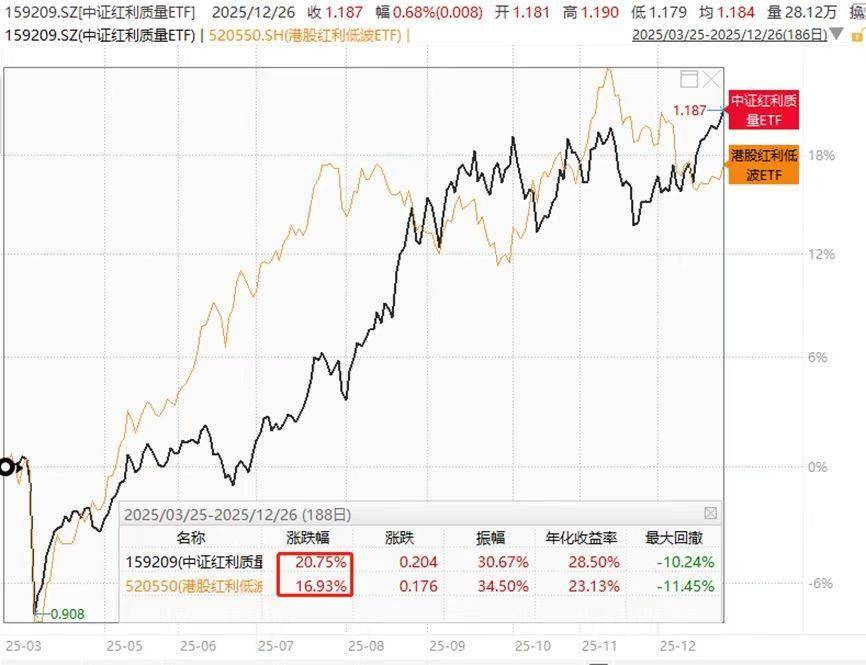
Group 1 - The core viewpoint is that dividend assets are gaining attention in the current market due to their certainty of returns and defensive characteristics, especially in a rising valuation environment and declining risk-free interest rates [1] - The market shows structural characteristics where some blue-chip stocks have limited price increases but offer attractive dividend yields of 3%-4% combined with annual growth expectations of 5%-10% [1] - Traditional dividend ETFs have seen their dividend yields exceed 5% again, significantly higher than the domestic ten-year government bond yield of less than 2% [1] Group 2 - Among various dividend strategies, the CSI Dividend ETF (515080.SH) is a classic high-dividend representative focusing on energy and finance, currently offering a dividend yield over 5% and demonstrating strong defensive characteristics in bear markets [2] - The CSI Dividend Quality ETF (159209.SZ) emphasizes "growth" and "profit quality," focusing on consumer and pharmaceutical sectors, with its total return index rising over 20% this year, led by Kweichow Moutai as its largest weighted stock [2] - The Hong Kong Dividend Low Volatility ETF (520550.SH) focuses on "high dividends" and "stability," with its total return index increasing over 28% this year, making it an ideal defensive choice during market fluctuations [3] Group 3 - For conservative investors, a combination of "A-share Dividend Quality (growth offensive) + Hong Kong Dividend Low Volatility (high-yield defensive)" is recommended, achieving dual diversification across markets and strategy factors [5] - Both products are characterized by low fees and monthly dividends, making them suitable for long-term holding to smooth out volatility and secure predictable returns [5]

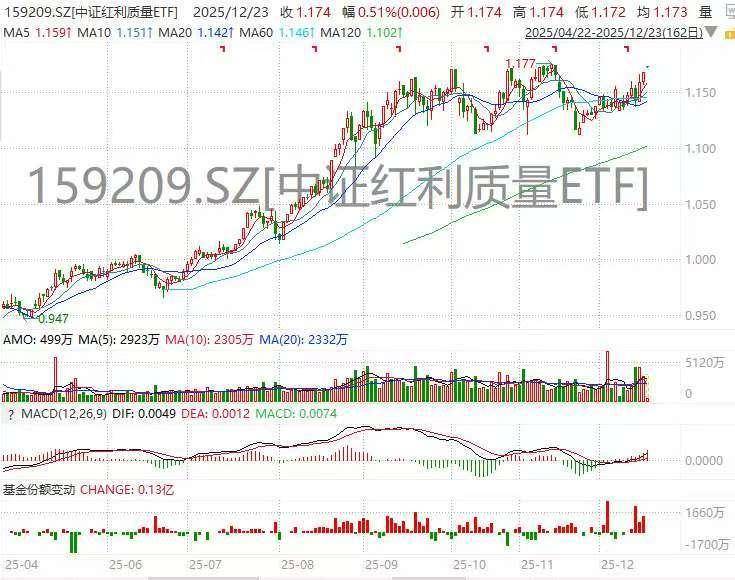
中证红利质量ETF(159209)强势五连涨冲击历史新高!资金连续6日汹涌增持!
Sou Hu Cai Jing· 2025-12-23 02:09
Group 1 - The core viewpoint of the articles highlights the strong performance of high-quality dividend assets, particularly the 中证红利质量ETF, which has seen a continuous inflow of funds and a notable increase in value [1][3] - As of December 22, the 中证红利质量ETF has experienced a net inflow of approximately 67 million over six consecutive days, with a total net inflow exceeding 230 million since the beginning of the year [1][3] - The current market trend indicates a shift in dividend investment strategies from traditional high dividend yield to a dual standard of high dividend yield combined with high profitability quality, which helps avoid potential pitfalls associated with traditional high dividend strategies [3] Group 2 - The strategy of selecting companies that can sustain dividends while also demonstrating high return on equity (ROE) and stable growth potential is gaining traction, providing both defensive and growth opportunities [3] - This upgraded strategy is becoming a key tool for medium to long-term investment in a low-interest-rate environment, as it balances defensive characteristics with growth potential in sectors like consumer goods and pharmaceuticals [3] - The continuous net inflow of funds into the 中证红利质量ETF reflects the increasing interest in this dual-focused investment approach, which serves as a stabilizing force in uncertain market conditions [3]
年末密集加仓!中证红利质量ETF(159209)获连续第4日净流入,累计超3000万
Sou Hu Cai Jing· 2025-12-18 06:38
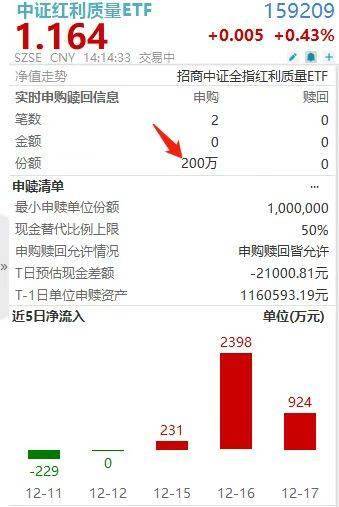
Core Viewpoint - The dividend sector is experiencing renewed strength, with the CSI Dividend Quality ETF (159209) showing a 0.43% increase and attracting over 30 million in net inflows over four consecutive days, indicating strong investor interest in dividend assets during a period of market uncertainty [1][4]. Group 1: Market Performance - As of December 18, the CSI Dividend Quality ETF has gained 0.43%, reflecting ongoing investor enthusiasm [1]. - The fund has seen a cumulative net inflow exceeding 30 million over the past four days, highlighting its popularity among investors [1][5]. Group 2: Investment Strategy Evolution - The current demand for the CSI Dividend Quality ETF is not solely based on traditional defensive needs but represents a significant evolution in dividend investment strategies, shifting from a focus on high dividend yields to a dual standard of high dividend yield and high profitability quality [3]. - Traditional high dividend strategies often involve companies in mature industries with high yields that may sacrifice future growth, leading to potential "value traps" [3]. - The dividend quality strategy emphasizes companies with sustainable dividend capabilities, incorporating quality factors such as return on equity (ROE), stable earnings growth, and sound financial health, aiming to identify firms that can not only pay dividends but also grow and increase them [3]. Group 3: Current Market Context - In a low-risk-free interest rate environment, the upgraded strategy that balances dividends and growth is becoming an essential tool for institutions and savvy investors for medium to long-term positioning and asset optimization [4]. - The continuous net inflows into the CSI Dividend Quality ETF serve as a clear indication of this trend [5].
登记就在今日!港股红利低波ETF、中证红利质量ETF本月同步收益分配
Sou Hu Cai Jing· 2025-12-12 02:03
Core Viewpoint - Two ETFs under China Merchants Fund have announced dividend distributions this month, highlighting the ongoing development of dividend investment strategies in the market [1]. Group 1: Dividend Distribution Details - The CSI Dividend Quality ETF (159209) will distribute a dividend of 0.003 yuan per share, marking its sixth distribution this year [1]. - The Hong Kong Dividend Low Volatility ETF (520550) will distribute a dividend of 0.004 yuan per share, representing its eighth distribution this year [1]. Group 2: Investment Strategies - The Hong Kong Dividend Low Volatility ETF (520550) follows a "high dividend + low volatility" dual-factor selection logic, focusing on sectors with defensive attributes such as finance and public utilities, with a current dividend yield exceeding 6% [2]. - The CSI Dividend Quality ETF (159209) employs a "high dividend + high profitability quality" stock selection strategy, focusing on high-quality companies in consumer and pharmaceutical sectors, achieving a balance between defensive characteristics and growth potential with a historical dividend yield of 3%-5% [3]. - Investors can choose between the two ETFs based on their risk preferences: conservative investors may prefer the Hong Kong Dividend Low Volatility ETF, while aggressive investors seeking growth may focus on the CSI Dividend Quality ETF [3].
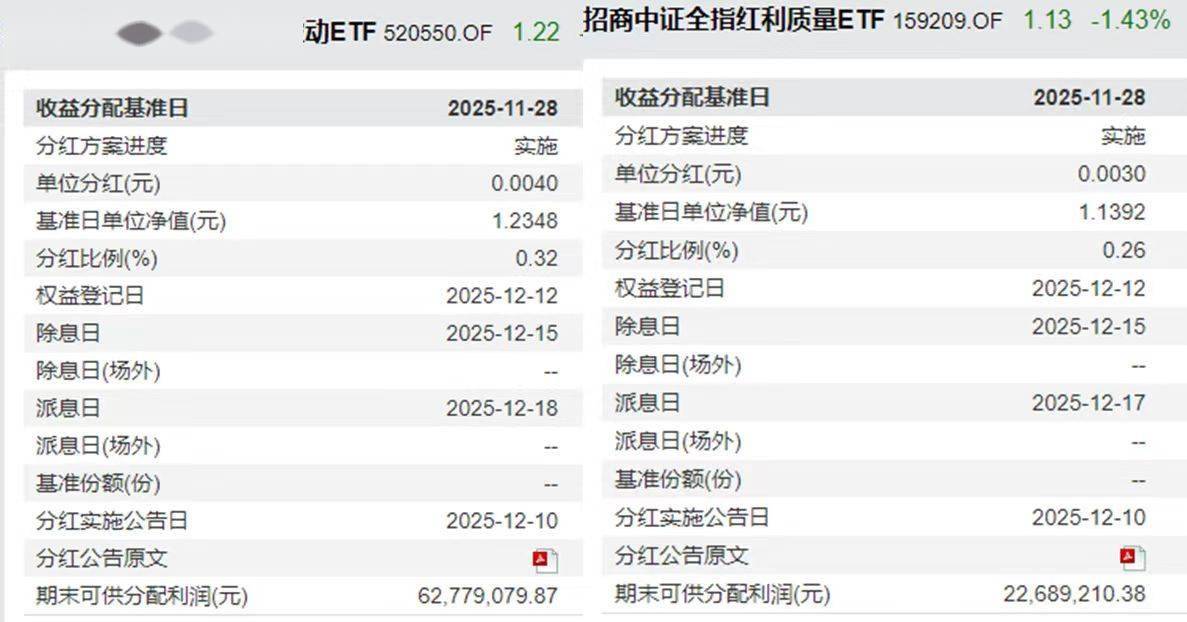
“双十二”!“双红利ETF”同步分红登记!港股红利低波ETF(520550)、中证红利质量ETF(159209)本月分红开启
Sou Hu Cai Jing· 2025-12-10 02:09
Core Viewpoint - Two ETFs under China Merchants Fund announced dividends this month, highlighting the growth of dividend investment strategies in the market [1] Group 1: Dividend Announcements - The CSI Dividend Quality ETF (159209) will distribute a dividend of 0.003 yuan per share, with a dividend ratio of 0.3%, marking its sixth dividend distribution this year [1] - The Hong Kong Dividend Low Volatility ETF (520550) will distribute a dividend of 0.004 yuan per share, also with a dividend ratio of 0.3%, representing its eighth dividend distribution this year [1] Group 2: Investment Strategies - Deep Value Strategy: Represented by the Hong Kong Dividend Low Volatility ETF (520550), which tracks the Hang Seng High Dividend Low Volatility Index, focusing on sectors like finance and utilities with defensive attributes. The current dividend yield exceeds 6%, supported by valuation advantages in the Hong Kong market and state-owned enterprise dividend policies [1] - Value Growth Strategy: Centered on the CSI Dividend Quality ETF (159209), which emphasizes a "high dividend + high profitability quality" stock selection strategy, focusing on high-quality companies in consumer and pharmaceutical sectors. Historical performance shows this index has outperformed mainstream broad-based indices while maintaining a dividend yield of 3%-5% and achieving a balance between defensiveness and growth potential [2] - Investors can choose based on risk preferences: conservative investors may prefer the Hong Kong Dividend Low Volatility ETF, while aggressive investors may focus on the CSI Dividend Quality ETF. A "barbell strategy" is suggested for dynamic adjustment of the allocation between the two products, with regular rebalancing to optimize overall portfolio performance [2]
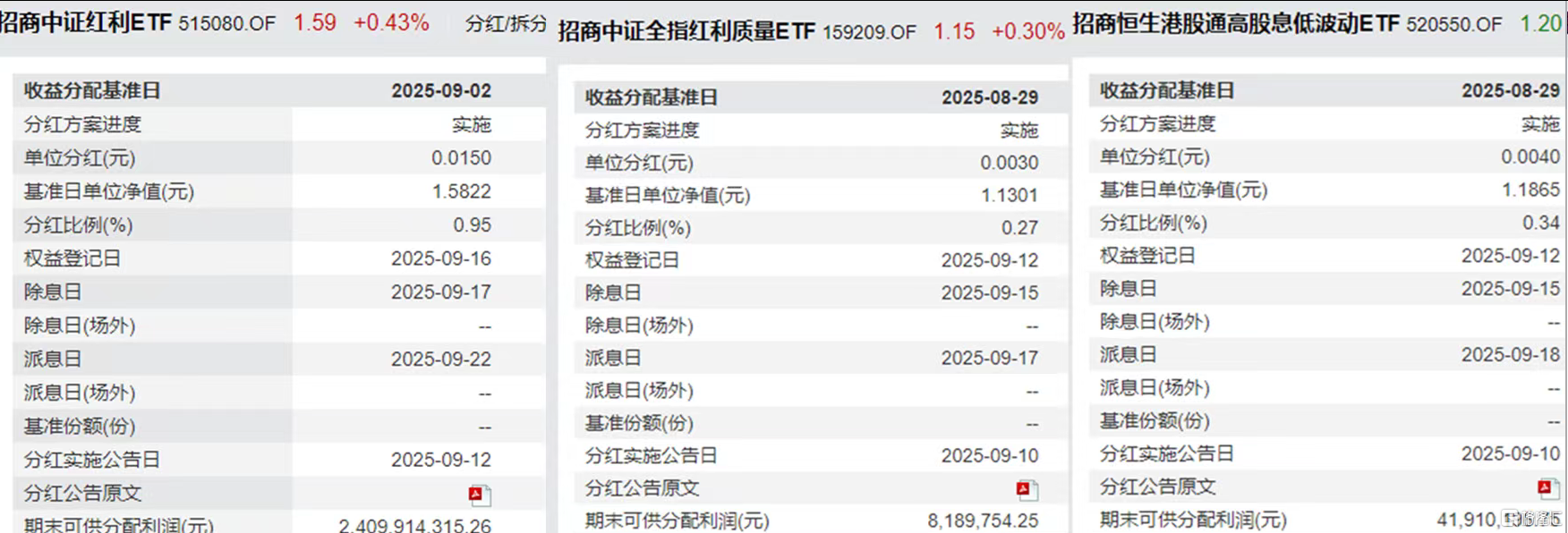
三弹齐发!中证红利ETF(515080)、中证红利质量ETF(159209)及港股红利低波ETF(520550)同步实施分红
Ge Long Hui· 2025-09-12 12:14
Core Viewpoint - The recent announcement by China Merchants Fund regarding the simultaneous dividend distribution of three dividend ETF products highlights the ongoing value of dividend investment strategies in the current market environment [1][3]. Group 1: Dividend Distribution Details - China Merchants Fund announced that three of its dividend ETF products will initiate dividend distribution, including the China Merchants CSI Dividend ETF (515080), which will distribute 0.15 yuan for every 10 shares [1]. - The CSI Dividend Quality ETF (159209) and the Hong Kong Dividend Low Volatility ETF (520550) will distribute 0.3 yuan each, marking their third and fifth distributions respectively [1]. - The record date for the dividends is set around mid-September 2025, with the ex-dividend date on September 17, 2025, and the payment date on September 22, 2025 [2]. Group 2: Market Analysis and Implications - Market analysis indicates that in the current hot market environment, dividend strategies continue to hold allocation value due to their stable performance and cash flow benefits [3]. - The simultaneous dividend distribution not only provides tangible returns to investors but also reflects the company's commitment to promoting long-term and value investment principles through product innovation [3]. - With the opening of subscription and redemption for the Hong Kong Dividend Low Volatility linked fund, investors can more flexibly allocate dividend assets and seize investment opportunities in high dividend strategies [3].
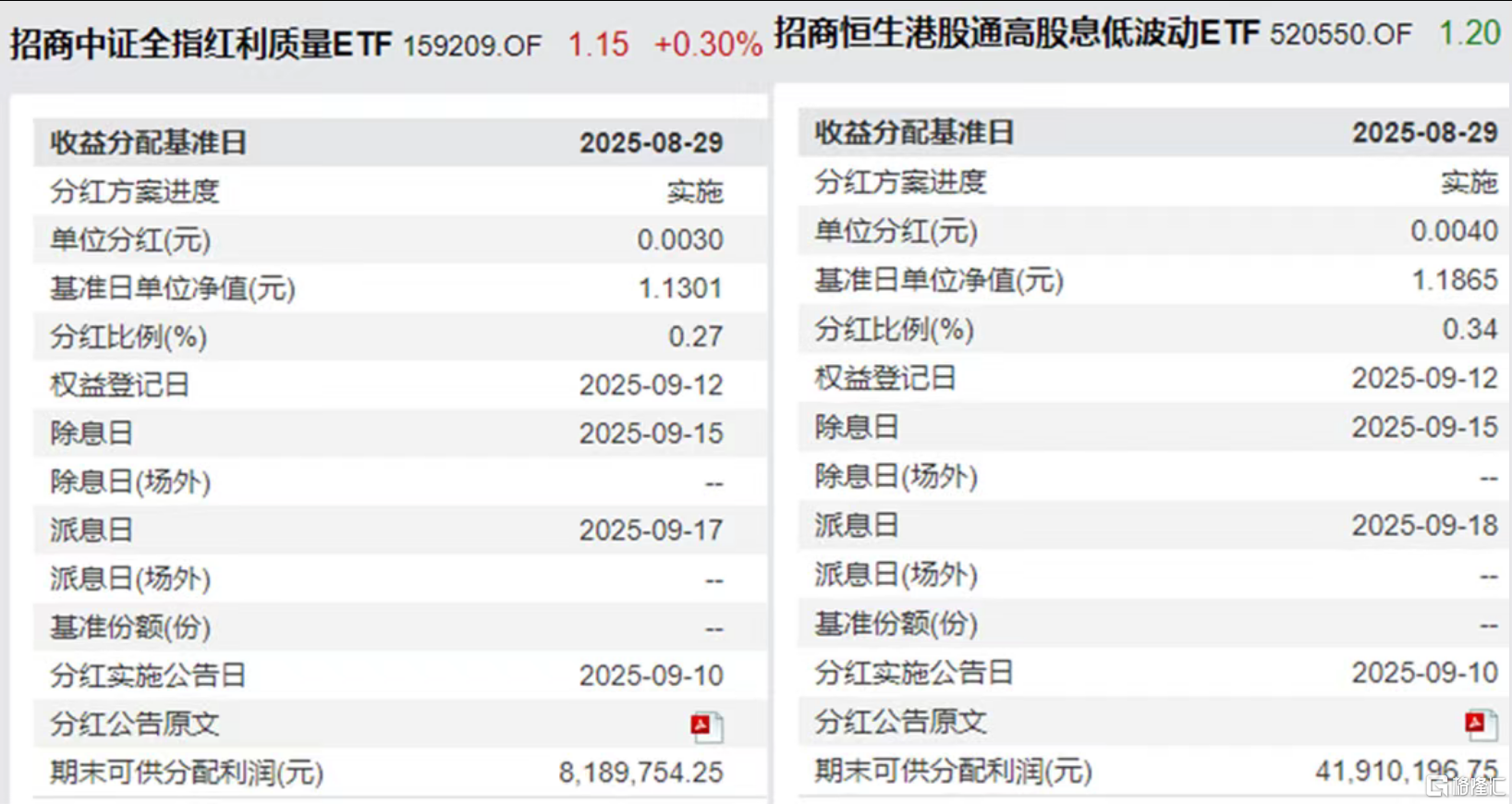
今日分红登记!月月评估分红的中证红利质量ETF(159209)、港股红利低波ETF(520550)同步分红进行时
Ge Long Hui· 2025-09-12 11:06
Core Insights - The article discusses the dividend distribution plan for a fund, highlighting key dates and financial metrics related to the distribution [1] - It emphasizes the current market context for dividend investment strategies, particularly the performance of two types of ETFs [2] Group 1: Dividend Distribution Details - The dividend distribution benchmark date is set for August 29, 2025, with a unit dividend of 0.0030 yuan [1] - The benchmark unit net value is 1.1301 yuan, resulting in a dividend ratio of 0.27% [1] - Key dates include the rights registration date on September 12, 2025, the ex-dividend date on September 15, 2025, and the payment date on September 17, 2025 [1] Group 2: Market Analysis and Investment Strategies - The article highlights the "value growth" strategy of the CSI Dividend Quality ETF, focusing on high dividend yields and high profitability quality, particularly in consumer and pharmaceutical sectors [2] - Historical data indicates that this index has outperformed mainstream broad-based indices, offering a dividend yield of 3%-5% alongside stable ROE performance, providing both defensive and growth potential [2] - The "deep value" strategy represented by the Hong Kong Dividend Low Volatility ETF tracks the Hang Seng High Dividend Low Volatility Index, emphasizing high dividend yields and low volatility, with a current yield exceeding 6% [2] - The article suggests a dynamic balance in dividend opportunities, recommending aggressive investors consider the CSI Dividend Quality ETF, while conservative investors focus on the Hong Kong Dividend Low Volatility ETF [2]
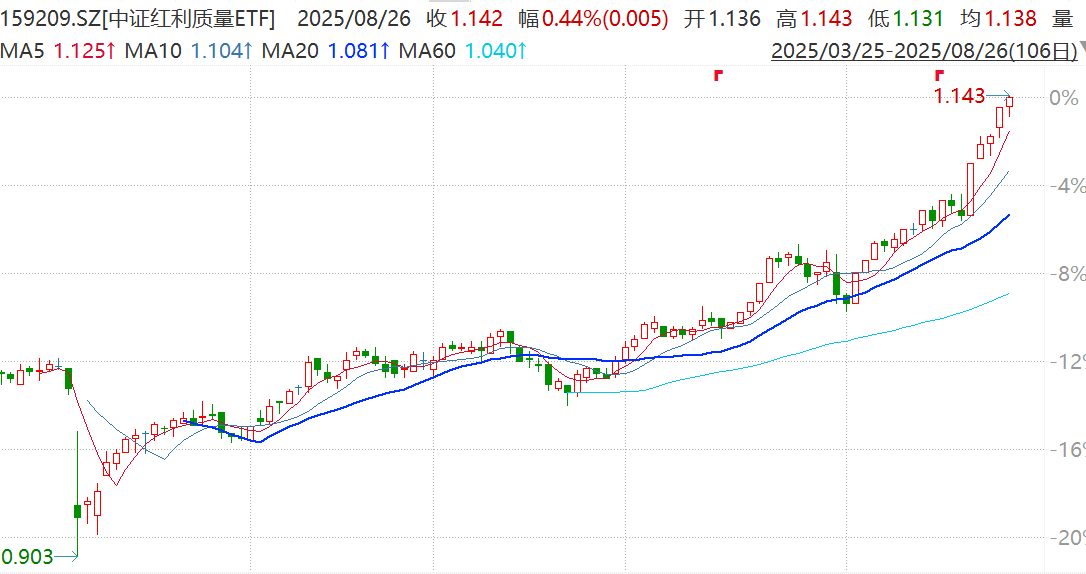
聚焦高质量、低拥挤赛道,“红利+质量”策略有效性凸显
Sou Hu Cai Jing· 2025-08-26 02:19
Core Viewpoint - The new "National Nine Articles" policy emphasizes the importance of dividends for listed companies, leading to a transformation in the evaluation system of corporate profitability, where dividend capability becomes a key indicator of corporate governance and profitability [2] Group 1: Dividend Investment Strategy - The dividend investment strategy is gaining recognition among investors as an important path for long-term and value investing, with high dividend assets becoming a new consensus in the market [2] - From a medium to long-term perspective, dividend assets still represent a high cost-performance ratio in the current market [2] - Traditional dividend sectors such as banking, coal, and electricity are experiencing trading congestion due to significant prior gains and limited growth expectations, making stock prices more sensitive to marginal changes [2] Group 2: Quality Factor and Index Performance - The "dividend + quality" strategy focuses on high-quality, low-congestion sectors, with the effectiveness of quality factors becoming more pronounced as market risk appetite gradually recovers [2] - The CSI Dividend Quality Index shows a more balanced allocation, with a single industry weight cap of 20%, and the top three industries being food and beverage, non-ferrous metals, and automobiles, contrasting with traditional dividend indices where banking stocks exceed 50% weight [2][4] - The CSI Dividend Quality Index has demonstrated superior profitability quality, with an average ROE of 4.13% at the end of Q1, significantly higher than the CSI Dividend Index (2.36%) and the low-volatility dividend index (2.40%) [5] Group 3: Performance Comparison - Despite the significant contribution of the banking sector to traditional dividend indices, the CSI Dividend Quality Index has outperformed major broad-based dividend indices even without banking stocks, showcasing stronger aggressiveness [5] - Over a longer period, the CSI Dividend Quality Index has significantly outperformed both the CSI Dividend Index and the low-volatility dividend index, validating the effectiveness of the quality factor [5] - Year-to-date performance shows the CSI Dividend Quality Index at 4.68%, the CSI Dividend Index at 8.50%, and the low-volatility dividend index at 16.75% [6]
跟踪指数年内涨超20%,港股通央企红利ETF天弘(159281)即将结募,机构:港股红利资产股息溢价长期更高
2 1 Shi Ji Jing Ji Bao Dao· 2025-08-14 02:47
Core Viewpoint - The Hong Kong stock market is experiencing active performance in dividend-related concepts, with the Hong Kong Stock Connect Central Enterprise Dividend Index showing a year-to-date increase of 20.17% as of August 13 [1][2]. Group 1: Index and ETF Performance - The Hong Kong Stock Connect Central Enterprise Dividend Index (931233) has risen by 0.66% as of the latest report, with significant contributors including New China Life Insurance and China Overseas Grand Oceans Group [1]. - The Hong Kong Stock Connect Central Enterprise Dividend ETF Tianhong (159281) is currently being issued, with a management fee of 0.5% and a custody fee of 0.1% [1][2]. Group 2: Investment Value of the Index - The index reflects stable dividend levels and high dividend yields from centrally controlled enterprises, making it a favorable investment option within the Hong Kong Stock Connect framework [2]. - The investment value of the index is supported by four main factors: 1. High dividend assets are more attractive in a weak recovery market due to stable cash flows [2]. 2. Central enterprises are increasingly focusing on market performance and dividend expectations as part of their value management [2]. 3. The Hong Kong market has a higher emphasis on dividends compared to the A-share market, with significant differences in dividend ratios and yields [3]. 4. The long-term effectiveness of dividend investment strategies in the Chinese market is supported by historical data showing a 10% annualized return over the past decade [3]. Group 3: Market Comparisons - The Hang Seng Index's dividend yield is currently higher than that of the Shanghai Composite Index, with the Hang Seng High Dividend Yield Index at 6% compared to the 4.6% of the A-share market [3]. - The long-term dividend yield premium of Hong Kong dividend assets over long-term government bonds has remained positive since 2019, indicating a stronger performance compared to A-shares [3].

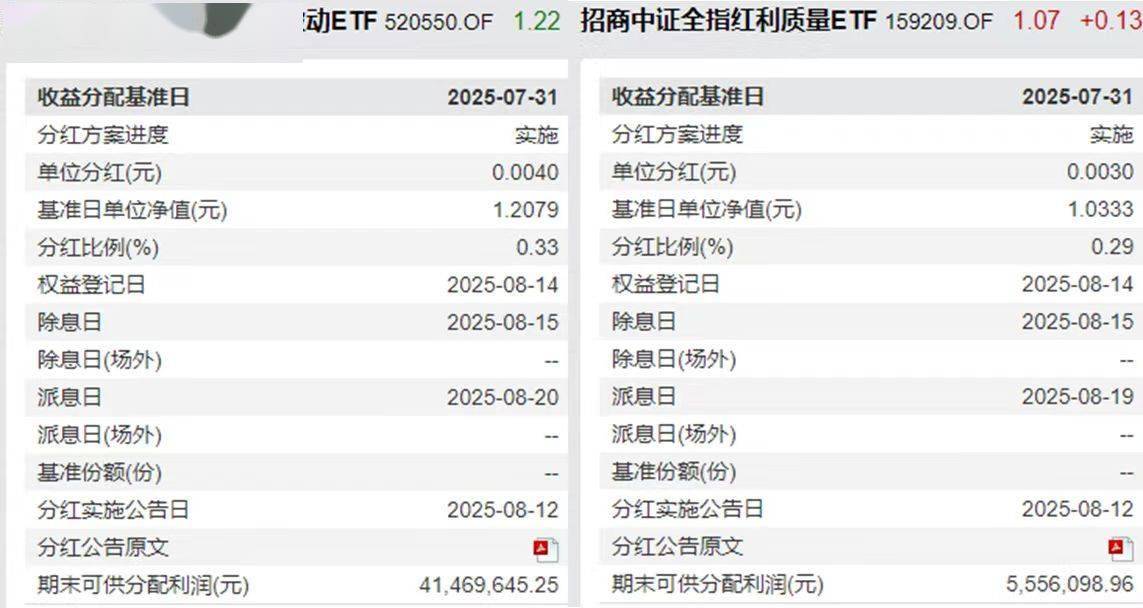
双红利ETF齐分红 港股红利低波ETF(520550)、中证红利质量ETF(159209)明日权益登记!
Sou Hu Cai Jing· 2025-08-13 03:02
Core Viewpoint - Two unique dividend ETF products from China Merchants Fund have simultaneously initiated dividend distributions, reflecting the ongoing trend of dividend investment strategies in the market [1] Group 1: Dividend Distribution Details - The CSI Dividend Quality ETF (159209) has announced its second dividend distribution of the year, with a cash dividend of 0.003 yuan per share, representing a distribution ratio of 0.3% [1] - The Hong Kong Dividend Low Volatility ETF (520550) is implementing its fourth dividend distribution of the year, with a cash dividend of 0.004 yuan per share, representing a distribution ratio of 0.33% [1] - Both products have set the record date for dividend distribution on August 14 [1] Group 2: Investment Strategies and Market Analysis - The Hong Kong Dividend Low Volatility ETF tracks the Hang Seng Hong Kong Stock Connect High Dividend Low Volatility Index, utilizing a "high dividend + low volatility" dual-factor screening mechanism, focusing on defensive sectors such as finance and public utilities [1] - The current dividend yield of this index exceeds 5%, supported by the undervaluation of Hong Kong stocks and state-owned enterprise dividend policies, showcasing strong anti-volatility characteristics [1] - The CSI Dividend Quality ETF employs a "high dividend + high profitability quality" strategy, focusing on high-quality fundamentals in sectors like consumer goods and pharmaceuticals [1] - Historical data indicates that this index has outperformed mainstream broad-based indices in terms of long-term returns, with a dividend yield of 3%-5% combined with stable ROE performance, offering both defensive attributes and growth potential [1]