组织能力

Search documents
钱江摩托(000913):系列点评六:2025Q2业绩符合预期,中大排销量稳健
Minsheng Securities· 2025-08-31 05:52
Investment Rating - The report maintains a "Recommended" rating for the company [6]. Core Views - The company's performance in Q2 2025 met expectations, with motorcycle sales showing resilience despite a decline in overall revenue [2][3]. - The company's product definition capabilities have significantly improved, leading to successful launches of high-end motorcycle models [3]. - The internationalization strategy is a key focus, with a notable increase in exports of mid-to-large displacement motorcycles [3]. Summary by Sections Financial Performance - In H1 2025, the company reported revenue of 3.07 billion yuan, a year-on-year decrease of 5.7%, and a net profit attributable to shareholders of 270 million yuan, down 22.9% year-on-year [1]. - Q2 2025 revenue was 1.74 billion yuan, a year-on-year decline of 9.2% but a quarter-on-quarter increase of 30.3%. The net profit for Q2 was 180 million yuan, down 12.8% year-on-year but up 110.6% quarter-on-quarter [1][2]. Motorcycle Business - The motorcycle segment saw a total sales volume of 106,000 units in Q2 2025, a decrease of 17.2% year-on-year but an increase of 9.6% quarter-on-quarter [2]. - The company has optimized its cost structure, leading to improved profit margins despite lower sales volumes [2]. Product Development - The company has enhanced its product definition capabilities, launching several high-end models that have received positive market reception [3]. - The company is expanding its all-terrain vehicle (ATV) product line, with multiple models in production and development [4]. Future Outlook - Revenue projections for 2025-2027 are estimated at 6.68 billion, 7.98 billion, and 9.47 billion yuan, respectively, with net profits expected to be 640 million, 760 million, and 890 million yuan [5]. - The report anticipates continued growth driven by the motorcycle business and improved product offerings [4].

李想感谢掏了近 40 万真金白银投票的 i8 车主,称一定要持续服务好“最可爱的理想用户”
Xin Lang Cai Jing· 2025-08-13 14:07
Core Viewpoint - The company aims to deliver over 8,000 units of the Li Auto i8 in September, with a challenge to reach 10,000 units, indicating strong market confidence in the product's appeal and performance [2][5]. Group 1: Product Recognition and Market Feedback - The current order volume for the Li Auto i8 reflects user recognition of its product definition, combining the versatility of an SUV, the handling of a luxury sedan, and the comfort of an MPV, emphasizing that market feedback is the ultimate test of a product's value [3][5]. - The unique design of the i8 has been a significant factor in attracting users, with positive reception expected to grow as more vehicles are seen on the road, reinforcing the idea that the design becomes more appealing over time [3][5]. Group 2: Organizational Capability and Adaptability - The transition from three configurations to a single configuration demonstrates the company's ability to quickly adapt across supply chain, production, and sales processes, presenting a significant test of organizational capability [3][5]. - The company expresses gratitude towards its customers for their support, highlighting the importance of user feedback in driving continuous improvement and service enhancement [3][5].



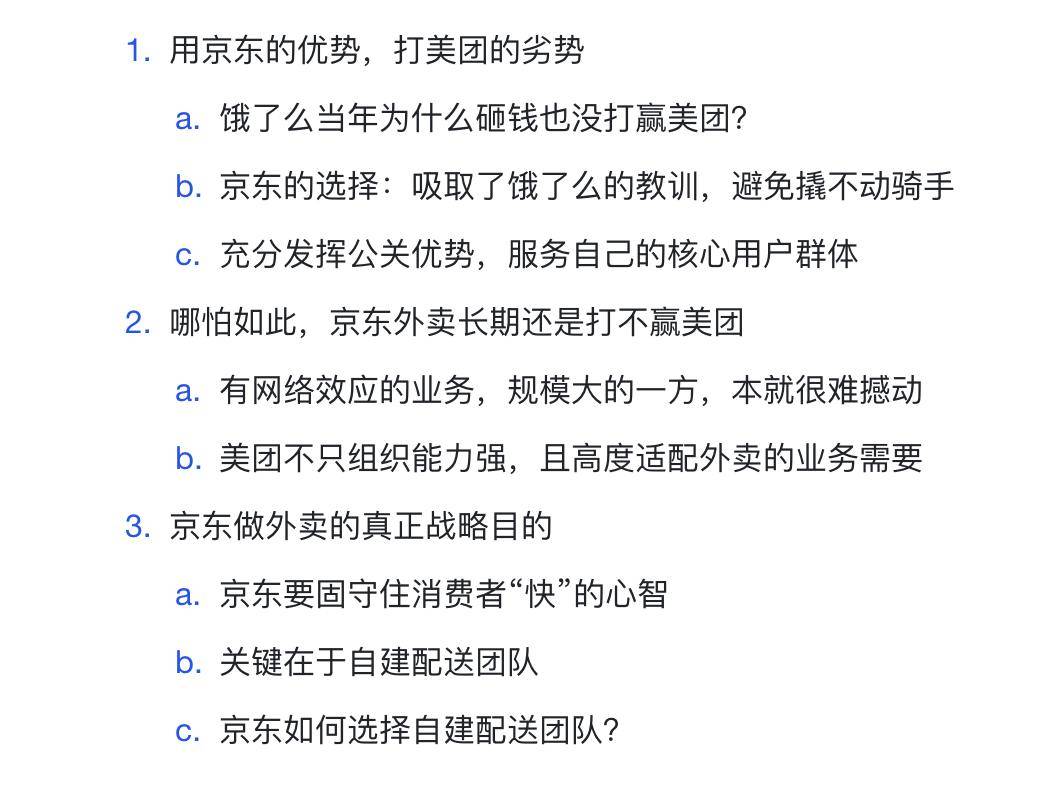
深度解读:京东打不赢美团外卖,为什么还要打?
Sou Hu Cai Jing· 2025-05-29 00:51
Core Viewpoint - The public relations battle between JD and Meituan has significantly benefited JD, with its daily orders for food delivery skyrocketing from zero to over 10 million in less than three months [2][8]. Group 1: Competitive Strategies - JD has effectively utilized its strengths to exploit Meituan's weaknesses, particularly by focusing on public relations and social responsibility, such as providing social insurance for delivery riders [13][30]. - The strategy of JD contrasts with the failed approach of Ele.me, which attempted to compete with Meituan through heavy subsidies without addressing the simultaneous growth of users, merchants, and riders [13][14]. - JD's public relations efforts have included high-profile actions by its founder, such as delivering food and engaging with riders, which have resonated positively with consumers [36][38]. Group 2: Long-term Outlook - Despite the short-term success in public relations, JD is unlikely to surpass Meituan in the long run due to the latter's established competitive advantages, including a deeper market penetration and organizational capabilities [8][56]. - The network effects inherent in the food delivery business favor Meituan, as its larger order volume leads to lower delivery costs, making it difficult for JD to compete effectively [58][65]. - JD's organizational structure lacks the adaptability and decision-making capabilities that Meituan has developed, which are crucial for managing the complexities of the food delivery market [70][85]. Group 3: Strategic Intent - JD's primary goal in entering the food delivery market is not necessarily to dominate but to maintain consumer perceptions of speed and quality, which are critical to its brand identity [91][92]. - By establishing a food delivery service, JD aims to create a stable order volume that can support its logistics team, thereby reinforcing its commitment to fast delivery [112][114]. - The investment in food delivery is seen as a strategic move to reclaim the "fast" mindset among consumers, especially as competition from Meituan intensifies [99][102].


2025,不做草台班子
Sou Hu Cai Jing· 2025-05-15 01:08
Core Viewpoint - The article discusses the differences between "grassroots teams" and "regular armies" in business, emphasizing the importance of strategic thinking, structured management, and data-driven decision-making to avoid chaos and inefficiency in organizations [10][12][54]. Group 1: Characteristics of Grassroots Teams vs. Regular Armies - Grassroots teams rely on ideas rather than models for strategy, leading to inconsistent and reactive decision-making [12][14]. - Management in grassroots teams is task-oriented, while regular armies focus on achieving specific goals [48][54]. - Goals in grassroots teams are often based on wishes rather than organizational structure, whereas regular armies utilize structured planning [55][58]. Group 2: Decision-Making Processes - Grassroots teams make decisions based on intuition, while regular armies depend on data to inform their choices [84][97]. - The reliance on intuition can lead to inconsistent outcomes, whereas data-driven decisions provide a clearer path to success [85][88]. Group 3: Performance Evaluation and Accountability - In grassroots teams, performance assessments are often based on appearances and subjective evaluations, while regular armies implement structured rules for evaluation [98][110]. - A well-defined evaluation system connects organizational goals with employee incentives, ensuring accountability and fairness [110][116]. Group 4: Strategic Planning Models - The article introduces the "5-3-1" model for strategic planning, which involves looking five years ahead, planning for three years, and executing for one year [22][38]. - The "PEST+I" model is recommended for analyzing macro trends and industry dynamics over a five-year horizon [27][28]. - The "Strategic Six Variables" model helps organizations identify competitive advantages and areas for improvement over a three-year period [30][37]. Group 5: Importance of Structured Management - Structured management practices, such as regular meetings and clear goal-setting, are essential for executing strategies effectively [66][80]. - The article emphasizes that successful organizations must evolve from informal, chaotic structures to more organized and systematic approaches to sustain growth [141][142].