
零信任架构

Search documents
汽车数据安全监管趋严,奇瑞打出“隐私保护牌”
Jing Ji Guan Cha Wang· 2025-10-15 12:08
Core Insights - Chery's Fengyun T11 has officially started pre-sales, positioning "privacy protection" as its core selling point, contrasting with the trend of data collection in mainstream smart vehicles [2] - The global smart automotive industry is entering a critical period of reshaping privacy protection rules, with user privacy expected to become a significant competitive arena [2][8] Data Privacy and Technology - The rapid proliferation of smart vehicles has transformed them into massive data collection platforms, raising concerns about user privacy [3] - Fengyun T11 features four core privacy protection functions, supported by a comprehensive technology system that integrates hardware security, encryption, local processing, and zero-trust principles [3] - The account information isolation function exemplifies the application of the zero-trust security concept in vehicle systems, ensuring that user data remains protected from cross-account leakage [3][4] Regulatory Environment - China's data security regulatory framework has evolved, making privacy protection a mandatory requirement for automotive companies [5][6] - A complete legal system for automotive data security has been established, providing clear legal boundaries for data processing activities [5] - Recent inspections revealed data security vulnerabilities in several vehicle models, highlighting the need for compliance with data protection regulations [7] Global Trends - The global landscape for data privacy protection regulations is also intensifying, with the EU's Data Act granting users greater control over vehicle-generated data [8] - China's initiative to establish an international standard for privacy protection in smart mobility services marks a significant step in global privacy regulation [8] - Privacy protection is becoming a key dimension for assessing automotive companies' market competitiveness, shifting from a compliance cost to a means of building brand trust and creating value [8]


安博通2025年半年报:H1营收大幅增长至4.29亿元 同比增长124%
Xin Lang Cai Jing· 2025-08-26 02:01
Core Insights - The company reported a significant revenue increase of 124% year-on-year, reaching 429 million yuan in the first half of 2025 [1] - The company achieved a reduction in operating costs by 29.62%, indicating effective cost control measures [1] - The company made notable advancements in its strategic focus on "security, computing power, and AI" [1] Financial Performance - Revenue for the first half of 2025 was 429 million yuan, marking a 124% increase compared to the previous year [1] - The per capita output reached 1.56 million yuan [1] Product Development and Innovation - The company successfully developed five core products that were included in the China Academy of Information and Communications Technology's "AI + Cybersecurity Product Capability Map" [1] - New AI-related products such as "Compliance Intelligent Agent" and "Security Detection Intelligent Agent" were launched [1] - The company achieved breakthroughs in key technology areas including zero trust architecture, data security, and cloud security [1] Strategic Partnerships and Global Expansion - The company signed cooperation agreements with multiple international institutions, indicating progress in its global expansion strategy [1]

零信任架构技术指南:腾讯iOA助力大规模企业安全转型
Sou Hu Cai Jing· 2025-08-06 12:11
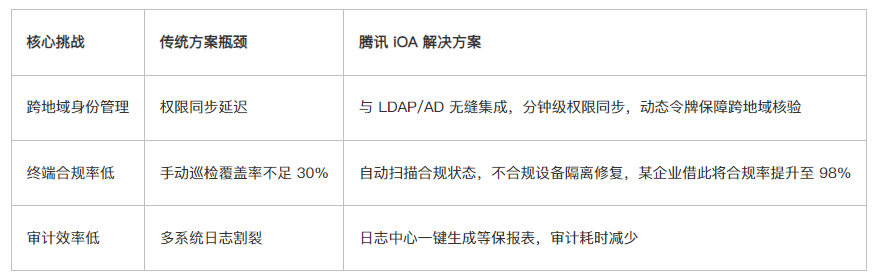
Core Insights - Zero Trust architecture is essential for large enterprises to address hybrid work risks, with Tencent's iOA providing a comprehensive guide from deployment to operation [1] Group 1: Implementation Challenges and Solutions - Cross-regional identity management faces delays in permission synchronization, which Tencent iOA addresses through seamless integration with LDAP/AD, achieving minute-level permission synchronization and dynamic token verification [2] - Low terminal compliance rates, with manual inspection coverage below 30%, can be improved by automatic compliance status scanning and isolation of non-compliant devices, as demonstrated by a company that raised compliance rates to 98% [2] - Audit efficiency is hindered by fragmented logs across multiple systems, but Tencent iOA offers a centralized log management solution that reduces audit time significantly [2] Group 2: Steps for Implementation - Step 1 involves building an identity authentication system - Step 2 focuses on securing terminal access - Step 3 emphasizes compliance and auditing [3] Group 3: Solution Features Comparison - Tencent iOA provides an integrated solution that combines ZTNA, EDR, and DLP, reducing integration costs by 80%, compared to traditional solutions that require multiple products [3] - Tencent iOA natively supports over 100,000 terminals with dynamic scaling capabilities, unlike general solutions that typically support only up to 10,000 terminals [3] Group 4: Case Studies - SF Group manages over 500,000 terminals through iOA, resulting in a 97% reduction in remote faults and zero data leakage incidents [7] - A certain automotive company achieved a 90% interception rate of ransomware through the EDR module, reducing response time from 24 hours to 1 hour [7] Group 5: Technical Principles - iOA's identity management module binds user identities to terminals, utilizing multi-factor authentication and RBAC for precise permission control, suitable for complex organizational structures [5][6] - The terminal security loop integrates EDR and DLP modules to block risky terminals preemptively, intercept malicious actions during operations, and trace attack paths post-incident [5] - iOA's log center automatically collects user access records and terminal operation logs, supporting log retrieval and compliance report generation to meet audit requirements [6]

2025年金融行业数字化转型白皮书
Sou Hu Cai Jing· 2025-08-01 10:24
Core Insights - The financial industry is undergoing an unprecedented digital transformation driven by economic shifts and technological advancements, emphasizing a new paradigm where technology is the backbone and ecosystems are the flesh [1][2]. Group 1: Global Economic Landscape and Financial Digitalization - Global economic growth is projected between 2.3% and 2.8% for 2025, with emerging Asia leading at 3.7% while mature economies lag at 1.4% [2][20]. - The divergence in economic growth is prompting distinct digital strategies, with Asian banks focusing on mobile-first services and Western institutions enhancing wealth management efficiency [2][23]. - Inflation is expected to decline to 4.2% in 2025, influencing financial institutions to adapt their risk models and operational frameworks to navigate varying regional policies [2][27][29]. Group 2: Technological Innovations in Finance - Financial technology is evolving from isolated innovations to a stage where technology integration drives ecosystem reconstruction, with AI and blockchain playing pivotal roles [3]. - AI applications in risk management have shown significant results, such as a platform predicting supply chain disruptions with 89% accuracy, reducing potential credit losses by 45% [3][33]. - Cloud-native architectures are enhancing transaction processing speeds by an average of 80%, allowing for rapid deployment and compliance monitoring [3][34]. Group 3: Regional Market Dynamics - The Asia-Pacific region is identified as a hub for financial digitalization, with the fintech market expected to grow from $46.82 billion in 2024 to $325.95 billion by 2032, driven by mobile payments and digital banking [4]. - In Africa and Latin America, mobile payment systems are leading the way, with Kenya extending financial services to remote areas and Mexico establishing a regulatory framework for fintech [4]. - The diverse growth trajectories in the Asia-Pacific region highlight the importance of tailored digital strategies, with countries like Indonesia leveraging demographic advantages for rapid digital payment adoption [4][25]. Group 4: Compliance and Security in Digital Finance - The shift towards online financial services necessitates a robust compliance and security framework, moving from reactive to proactive monitoring systems [5]. - Regulatory frameworks are evolving to require real-time risk management, with institutions implementing AI-driven compliance platforms to streamline processes and reduce error rates [5][35]. - The adoption of zero-trust security architectures and blockchain technology is enhancing the efficiency of KYC processes, significantly reducing the time required for compliance [5]. Group 5: Future Trends in Financial Digitalization - The future of financial digitalization is characterized by three main trends: ecosystem integration, intelligent services, and sustainability [6]. - Financial institutions are transitioning from service providers to ecosystem orchestrators, utilizing APIs to connect various sectors [6]. - The integration of ESG factors into financial services is becoming increasingly important, with banks using technology to track environmental impacts and incorporate them into credit assessments [6].
自主可控的通信安全革命:京数科技重塑企业级私有通信新范式
Cai Fu Zai Xian· 2025-06-27 07:09
Core Insights - The global digital transformation is accelerating, leading to an exponential increase in data security risks, with a projected annual growth rate of 32.6% for data breaches in 2024 [1] - Traditional public cloud communication tools are inadequate for high-security industries such as finance, military, and research, creating a demand for private communication solutions [1] - JingShu Technology (Shanghai) Co., Ltd. has emerged as a preferred solution provider for high-security demand industries with its fully controllable private communication products [1] Group 1: Technological Strength - JingShu Technology was established in 2022 but has a technological foundation dating back to 2012, with a successful entry into the high-tech enterprise category in 2024 [2] - The company has implemented a "1 + 2 + 1" strategy, establishing a complete and efficient product closed-loop capability system centered around its Shanghai headquarters [2] - JingShu Technology has obtained 34 core patents and 60 software copyrights, forming a significant technological barrier for its full-stack secure communication solutions [2] Group 2: Security Framework - The company employs a three-tiered defense system encompassing endpoint security, transmission encryption, and data sovereignty [3] - Vargo security phones utilize hardware-level encryption to protect 18 types of personal privacy data, with mechanisms for remote data destruction in case of device loss [3] - A distributed disaster recovery solution ensures business continuity, while a zero-trust architecture underpins dynamic key management and multi-factor authentication [3] Group 3: Data Sovereignty - Enterprises can choose between cloud or localized deployment options, with public cloud solutions ensuring absolute data control through exclusive key systems [4] - The modular architecture allows seamless scaling from small teams to large organizations, ensuring that initial investments yield long-term value as business grows [4] Group 4: Industry Positioning - JingShu Technology has gained recognition as a benchmark for secure communication in Shanghai, showcasing its customized capabilities at the 2025 MWC Shanghai exhibition [5] - The company's strategic layout in Pudong aligns with Shanghai's vision of becoming an "International Digital Capital," enhancing its industry collaboration [5] Group 5: Market Expansion - The implementation of data security and personal information protection laws in China is driving the transition of private communication systems from "high-end options" to "basic standards" [6] - JingShu Technology's flexible customization capabilities are lowering deployment barriers for enterprises, opening new market opportunities for small and medium-sized enterprises [6] - The modular architecture and elastic pricing model are expected to facilitate the penetration of secure communication capabilities into the long-tail market, becoming a key driver of the security autonomy process [6]
破发股亚信安全首季增亏去年扭亏 上市即巅峰募12.2亿
Zhong Guo Jing Ji Wang· 2025-04-30 06:43
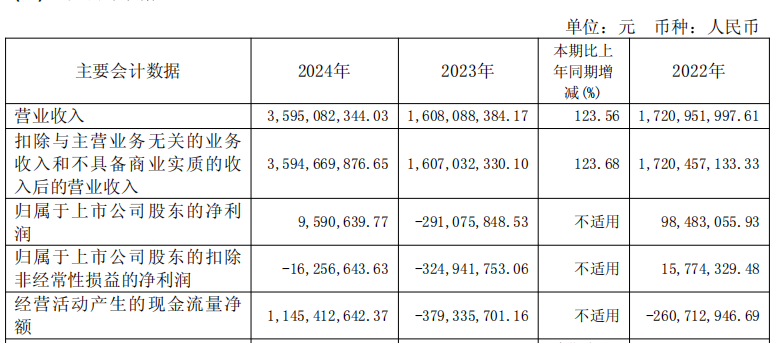
Core Viewpoint - The company, AsiaInfo Security (688225.SH), reported significant growth in its 2024 annual revenue and a turnaround in net profit compared to the previous year, indicating a strong recovery and operational improvement [1][3]. Financial Performance Summary - The company achieved an operating revenue of 3.595 billion yuan in 2024, representing a year-on-year increase of 123.56% [1][3]. - The net profit attributable to shareholders was 9.59 million yuan, a substantial improvement from a net loss of 291 million yuan in the previous year [1][3]. - The net profit attributable to shareholders, excluding non-recurring gains and losses, was -16.26 million yuan, compared to -32.49 million yuan in the previous year [1][3]. - The net cash flow from operating activities was 1.145 billion yuan, a significant recovery from a negative cash flow of 379 million yuan in the previous year [1][3]. Q1 2025 Performance Summary - In the first quarter of 2025, the company reported an operating revenue of 1.29 billion yuan, marking a remarkable year-on-year growth of 347.54% [4]. - The net profit attributable to shareholders for Q1 2025 was -22.74 million yuan, compared to -14.59 million yuan in the same period last year [4]. - The net cash flow from operating activities for Q1 2025 was -685.57 million yuan, worsening from -204.41 million yuan in the previous year [4]. Company Background - AsiaInfo Security was listed on the Shanghai Stock Exchange's Sci-Tech Innovation Board on February 9, 2022, with an initial public offering of 40.01 million shares at a price of 30.51 yuan per share [5]. - The stock reached a peak price of 41.55 yuan on its listing day but has since experienced a decline, currently trading below its initial offering price [5]. - The total amount raised during the IPO was 1.221 billion yuan, with a net amount of 1.123 billion yuan after expenses, which were higher than initially planned [5].

安博通设立“鲁班”AI研究院 致力成为“AI时代安全算力生态构建者”
Zheng Quan Ri Bao Wang· 2025-03-26 03:13
Core Viewpoint - Anbotong Technology Co., Ltd. has established the "Luban" AI Research Institute to integrate security, AI, and computing power technologies, aiming to create a secure connection between AI and the world [1][2]. Group 1: Establishment and Purpose of the AI Research Institute - The "Luban" AI Research Institute was inaugurated in Shanghai, focusing on the integration of security and AI technologies in response to the rapid penetration of generative AI into industrial transformation [1]. - The establishment of the institute is timely, as it addresses new challenges and opportunities in network security brought about by advancements in generative AI and computing networks [1]. Group 2: Strategic Vision and Growth - Anbotong's chairman, Zhong Zhu, articulated the company's strategic shift from being a "visual network security innovator" to an "AI era security computing ecology builder," emphasizing the importance of embedding security into computing infrastructure [2]. - Since its listing, Anbotong has achieved a compound annual growth rate of 26% in revenue, highlighting its significant accomplishments in the network security sector [2]. Group 3: AI Delivery Architecture and Innovations - The "Luban" AI Research Institute introduced the "ESAiD" AI delivery architecture, which includes a three-tier AI delivery system focused on intelligent development, computing resource scheduling, and security protection [3]. - Anbotong launched a super silent liquid-cooled intelligent computing workstation, designed for various scenarios, featuring high-performance CPUs and AI acceleration cards [3]. Group 4: Future Directions and Collaborations - The research institute aims to gather top AI security talent, develop autonomous security models, and build an intelligent security ecosystem to support national digital security strategies [4]. - The event highlighted the importance of supply chain security, as emphasized by Jiangyuan Technology's vice president, underlining the need for self-controlled chips in the context of national security [3].
AI周观察:博通业绩反映ASIC高景气度,Manus引发Agent热潮
SINOLINK SECURITIES· 2025-03-11 02:37
Investment Rating - The report does not explicitly state an investment rating for the industry or specific companies Core Insights - Oracle's cloud services and licensing business showed strong performance, particularly in IaaS driven by robust GPU demand, indicating high market activity and significant contract backlog [2] - Despite exceeding revenue expectations, Marvell's data center business growth significantly declined from 98% to 78%, leading to a nearly 20% drop in stock price, while Broadcom's strong AI orders resulted in a nearly 6% increase in stock price [2][11] - The report highlights the increasing demand for data security as more enterprises opt for cloud services for AI analysis, with zero trust architecture and AI-driven analytics expected to play a crucial role in cybersecurity [2][17] - Apple's C1 chip, supporting 5G mmWave bands, is positioned to potentially replace Qualcomm's baseband chips in the US, while the new Mac Studio with M3 Ultra processor exceeds expectations, showcasing Apple's significant advantage in AI PCs [2][18] Summary by Sections Financial Performance - Oracle's revenue for the last quarter was $14.1 billion, a year-over-year increase of 8.64% and a quarter-over-quarter increase of 5.65%, with cloud services revenue reaching $10.8 billion, up 12% year-over-year [6][10] - Marvell reported revenue of $1.817 billion, a year-over-year increase of 27.4%, while Broadcom's revenue was $14.916 billion, a year-over-year increase of 24.71% [11] AI Models and Applications - Domestic AI applications like Tencent's Yuanbao and Doubao saw over 10% week-over-week growth, while video generation applications like Sora experienced a significant 56% increase [21][24] - Alibaba's Qwen-QwQ model enhances edge deployment capabilities, and Inception Labs' Mercury significantly improves generation speed, indicating advancements in AI model capabilities [22] Market Trends - The report notes a shift towards AI-driven private cloud services, with increasing enterprise demand for data security solutions, suggesting a positive outlook for cybersecurity companies [17] - The report emphasizes the potential of low-cost, high-density ASIC chips benefiting from the deployment of large-scale inference services in the AI sector [11]

