
高质量竞争

Search documents
A股市场“三大痛点”正在消解?
Sou Hu Cai Jing· 2025-06-19 02:51
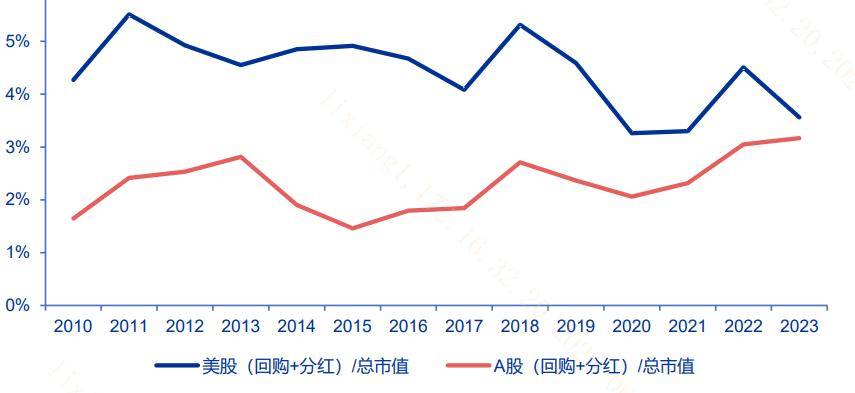
Core Viewpoint - The recent positive developments in the A-share market suggest a potential alleviation of three long-term pain points affecting the market, despite the usual mid-year valuation pressures from bank deposit assessments [1] Pain Point 1: High Savings Rate of Residents - The trend of declining deposit rates is accelerating the "savings migration" phenomenon, with residents increasingly shifting their savings from deposits and real estate to the capital market [2] - The total annual dividend amount for A-shares has exceeded 2.4 trillion yuan, and the buyback scale has reached 147.6 billion yuan, with the combined dividend and buyback yield approaching 70% of that in the US market [2][4] Pain Point 2: Preference for "Small and New" Stocks - New regulations on mergers and acquisitions have simplified the approval process, significantly lowering the barriers for corporate integration, resulting in a 114% year-on-year increase in major asset restructuring cases in A-shares [5] - The surge in mergers and acquisitions is enhancing the market concentration, allowing leading companies to acquire core technologies and expand market share, thus strengthening their pricing power [5][7] Pain Point 3: Intense Competition in Manufacturing - Various industry associations are advocating against "involution," promoting high-quality competition and resource concentration towards superior companies [8] - The gross profit margin for leading companies in sectors like photovoltaics and lithium batteries has rebounded from 15% to over 25%, driven by capacity elimination and technological upgrades [8]

强制高管午休集体跑腿接单?UU跑腿回应
21世纪经济报道· 2025-05-27 07:58
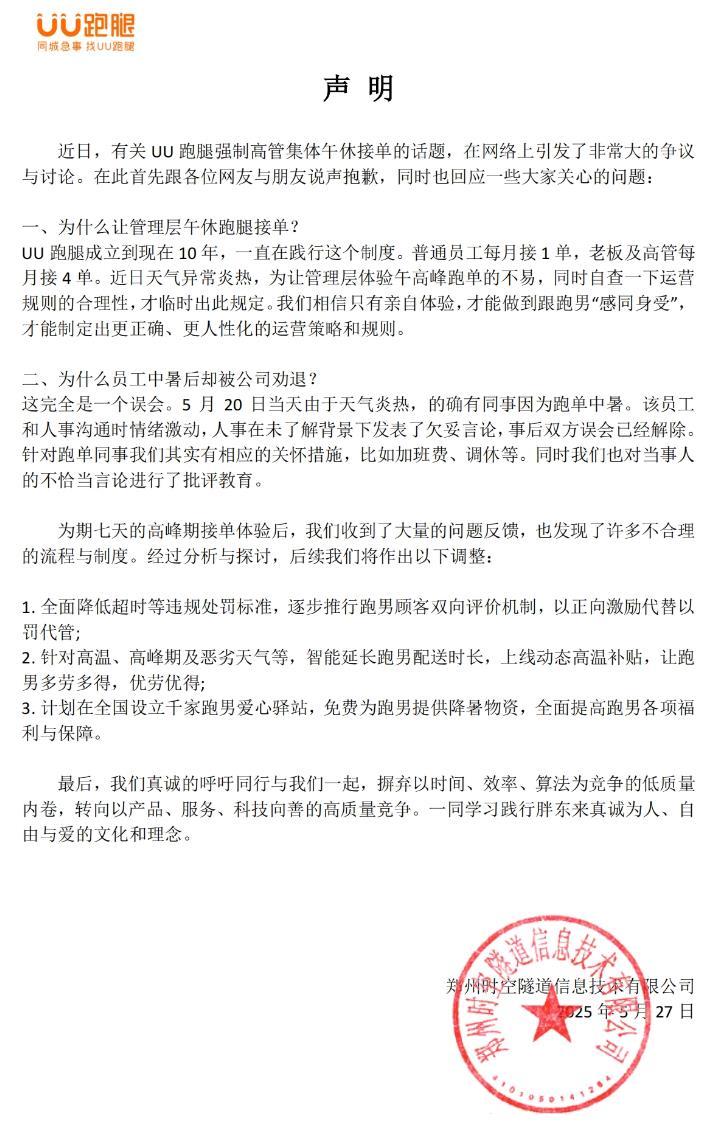
Core Viewpoint - UU Run's management has implemented a policy requiring executives to experience the challenges of delivery during peak hours, which has sparked significant public debate and controversy [1][3][6]. Group 1: Management's Response - The company has apologized for the misunderstanding regarding the forced lunch break delivery orders and clarified that this practice has been in place for 10 years to foster empathy with delivery personnel [1][3]. - The management emphasized that the decision was made to allow executives to personally experience the difficulties faced by delivery staff during peak hours, especially in extreme weather conditions [3][6]. Group 2: Employee Concerns - There was a reported incident of an employee suffering from heatstroke while delivering orders, which led to a miscommunication with HR, resulting in the employee feeling pressured to resign [1][4]. - The company has stated that it has measures in place to support employees, such as overtime pay and time off, and that the misunderstanding has since been resolved [4]. Group 3: Future Adjustments - Following feedback from the recent peak delivery experience, the company plans to implement three key adjustments: 1. Lowering penalties for delays and introducing a dual evaluation system for both delivery personnel and customers to encourage positive reinforcement [4]. 2. Extending delivery times during extreme weather and peak periods, along with introducing dynamic heat subsidies to reward hard work [4]. 3. Establishing 1,000 "care stations" nationwide to provide cooling supplies for delivery personnel, enhancing their welfare and support [4]. Group 4: Industry Perspective - The founder of UU Run highlighted the importance of management understanding the operational challenges faced by delivery staff, advocating for a shift from algorithm-driven efficiency to a more empathetic approach to service [6][7].
UU跑腿回应“让管理层午休跑腿接单”:体验并自查运营规则
Huan Qiu Wang· 2025-05-27 03:54
Core Viewpoint - UU Run's recent decision to mandate executives to participate in delivery during peak lunch hours has sparked significant controversy and discussion online, with the company stating that this initiative aims to help management understand the challenges faced by delivery personnel and to review the reasonableness of operational rules [1][3]. Group 1: Management's Experience and Policy Changes - The company has implemented a policy where ordinary employees are required to complete one delivery per month, while executives must complete four deliveries per month, a practice that has been in place for the past ten years [3][5]. - The recent heatwave prompted the company to temporarily enforce this policy to allow management to experience the difficulties of peak delivery times firsthand [3][5]. - Following a seven-day feedback period from this experience, the company identified numerous unreasonable processes and plans to make several adjustments, including lowering penalties for delays, implementing a dual evaluation mechanism for delivery personnel, and introducing dynamic heat subsidies [4][5]. Group 2: Employee Welfare and Miscommunication - The company addressed a misunderstanding regarding an employee who suffered from heatstroke during deliveries, clarifying that the employee was not dismissed but rather that there was a miscommunication with HR [4][5]. - The company has measures in place to support delivery personnel, such as overtime pay and time off, and has criticized inappropriate comments made during the incident [4][5]. - Plans are underway to establish a thousand "care stations" nationwide to provide cooling supplies for delivery personnel, enhancing their welfare and support [4][5].
加大技术研发投入,推动汽车企业高质量竞争
2 1 Shi Ji Jing Ji Bao Dao· 2025-05-26 17:18
Group 1 - The core viewpoint of the articles highlights the recent decline in A-shares and Hong Kong stocks, particularly in the automotive sector, driven by significant price cuts from major players like BYD and the potential for a price war affecting industry profits [1][2] - BYD's price reduction strategy is aimed at clearing out older inventory lacking new driving assistance features, while the company still maintains a strong market position despite increased competition from other new energy vehicle manufacturers [1][2] - The Chinese automotive market is experiencing a transition characterized by slowing overall growth and increasing penetration of new energy vehicles, which poses challenges such as potential overcapacity and rising inventory levels [2][3] Group 2 - As of April 2025, the inventory of passenger vehicles in China reached a historical high, indicating potential market saturation and increased pressure on sales [3] - The ongoing price war could lead to financial losses for both new energy and traditional fuel vehicle manufacturers, as evidenced by the significant revenue and profit figures of major companies like Toyota [3] - The industry is urged to move away from "involution" competition, which focuses on price wars, and instead prioritize innovation, quality, and service improvements to enhance long-term competitiveness [4]
