AI生成视频

Search documents
AI生成视频已成“流量王牌”,Meta AI下载量也出现暴涨
硬AI· 2025-10-21 10:26
Core Insights - Meta has experienced explosive user growth with the launch of its short video feature "Vibes," increasing daily active users from 775,000 to 2.7 million within four weeks, with daily downloads reaching 300,000 [2][3][5] Group 1: Launch of Vibes Platform - On September 25, Meta integrated the AI video creation platform "Vibes" into the Meta AI application, allowing users to create, discover, and share short video content [5][7] - The user experience on Vibes is enhanced through personalized recommendations as users spend more time browsing the content [7] Group 2: Competitive Landscape - While Meta AI's user base surged, competitors like ChatGPT, Grok, and Perplexity faced user declines, with daily active users dropping by 3.51%, 7.35%, and 2.29% respectively, while Meta AI grew by 15.58% [5][9] - The recent strategies of competitors, particularly OpenAI's Sora, which adopted an "invitation-only" approach, may have inadvertently driven users to explore alternatives like Meta AI [9][10]



AI生成视频已成“流量王牌”,Meta AI下载量也出现暴涨
美股IPO· 2025-10-21 03:37
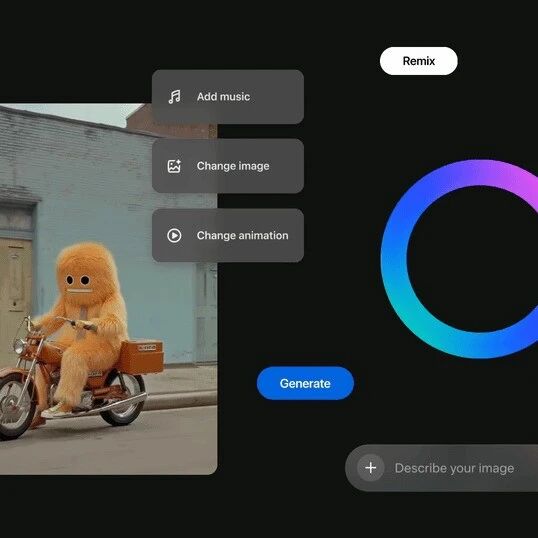
Core Insights - Meta has experienced explosive user growth following the launch of its short video feature "Vibes," with daily active users increasing from 775,000 to 2.7 million in just four weeks, and daily downloads reaching 300,000 [1][2][5] User Growth and Market Impact - The launch of "Vibes" on September 25 is closely correlated with the surge in Meta AI's user numbers, providing strong data support for the argument that AI video drives traffic [2][5] - On October 17, Meta AI's daily active users grew by 15.58%, while competitors ChatGPT, Grok, and Perplexity saw declines of 3.51%, 7.35%, and 2.29% respectively [4] Features of Vibes - "Vibes" allows users to create, discover, and share AI-generated short video content, with personalized recommendations improving over time as users engage more [7] - Users can easily repurpose content and share it across platforms like Instagram and Facebook, enhancing the potential for viral spread [7] Competitive Landscape - Meta AI's growth may also be indirectly supported by competitor Sora's recent strategies, which have drawn attention to AI video generation technology [8][9] - Sora's "invite-only" strategy may have inadvertently created opportunities for Meta AI, as users unable to access Sora may seek alternatives like Meta AI [9]
AI生成视频已成“流量王牌”,Meta AI下载量也出现暴涨
Hua Er Jie Jian Wen· 2025-10-21 01:59
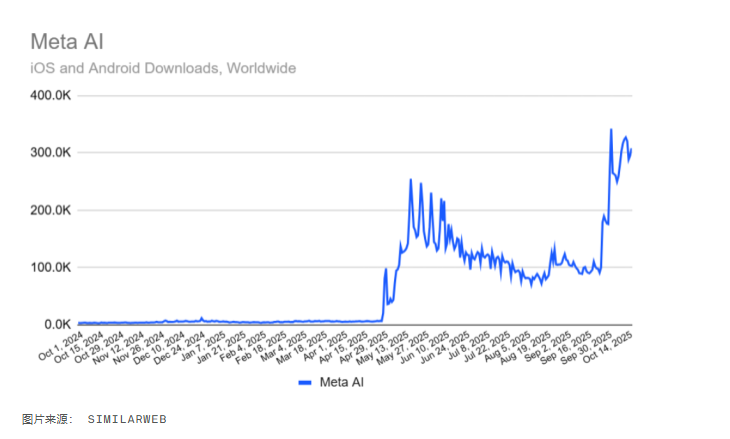
Core Insights - AI-generated video is rapidly becoming a key user attraction, with Meta leveraging this "traffic ace" to gain an advantage in the competitive AI application landscape [1][2] - The launch of the AI short video platform "Vibes" on September 25 has significantly boosted user engagement for Meta AI, with daily active users (DAU) rising to 2.7 million from 775,000 in just four weeks [1][2] - The download rate for the Meta AI app has also surged, with daily downloads reaching 300,000, compared to less than 200,000 a few weeks prior, and a dramatic increase from just 4,000 downloads a year ago [1][2] User Growth and Market Impact - The correlation between the launch of "Vibes" and the increase in user numbers supports the argument that "AI video drives traffic" [2] - While Meta AI's user base is growing, competitors like ChatGPT, Grok, and Perplexity are experiencing user declines, with daily active users dropping by 3.51%, 7.35%, and 2.29% respectively, while Meta AI saw a 15.58% increase [2] Features of Vibes Platform - The Vibes platform allows users to create, discover, and share short video content, enhancing user engagement through personalized recommendations as usage increases [3][6] - Users can easily remix content and share it across platforms like Instagram and Facebook, increasing the potential exposure and virality of AI-generated content [6] Competitive Landscape - Meta AI's growth may also benefit from the recent attention on OpenAI's video generation model Sora, which has led users to explore similar products, including Meta AI [7] - Sora's "invitation-only" strategy may inadvertently create opportunities for competitors, as users unable to access Sora may turn to other available alternatives [7]
Sora让人人都能当导演,但这些雷区你别碰
Hu Xiu· 2025-10-19 04:50
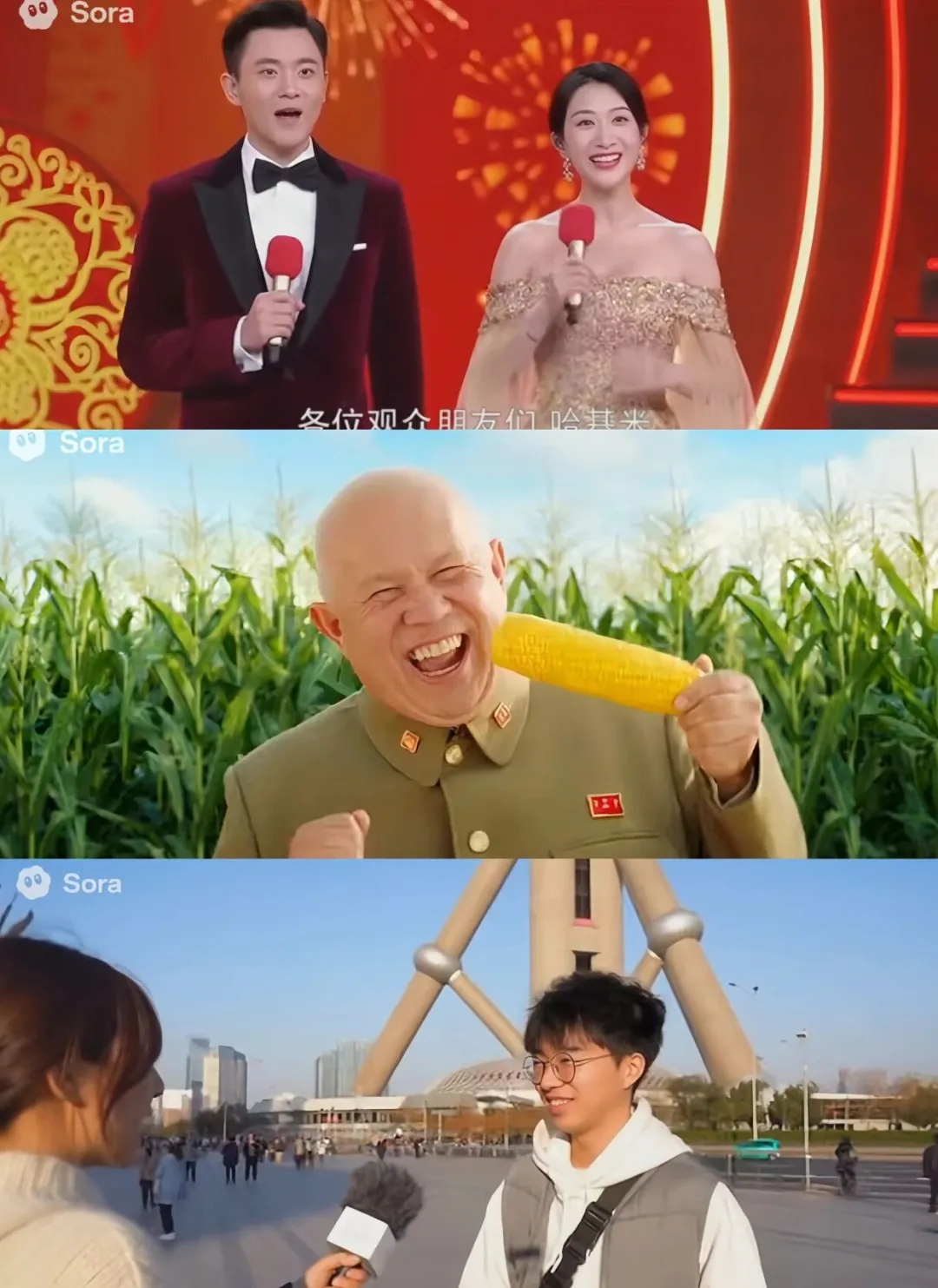
Core Insights - The article discusses the rise of AI-generated videos, particularly focusing on the new model Sora2 from OpenAI, which has quickly gained popularity with over 1 million downloads in less than five days, surpassing the initial momentum of ChatGPT [3][9]. Group 1: AI Video Generation - Sora2 allows users to create videos by simply inputting a prompt or an image, making it accessible and user-friendly [12]. - The model excels in simulating physical movements and maintaining character consistency across different scenes, resembling a reality simulator [13]. - Users can upload their photos to create digital avatars that can appear in various short videos, enhancing the realism of the generated content [14]. Group 2: Domestic Competition - Domestic AI applications like ByteDance's Jimeng and Kuaishou's Keling have emerged as alternatives to Sora, catering to the local market [4][5]. - Jimeng benefits from the vast user base of Douyin, while Keling demonstrates superior capabilities in generating short videos with complex cinematography [5]. Group 3: Cultural Impact and Trends - The popularity of AI-generated videos has led to a surge in creative content, with users leveraging AI to produce humorous and satirical videos featuring historical and contemporary figures [6][17]. - The blending of reality and virtuality is becoming increasingly blurred, as some real events are mistakenly perceived as AI-generated due to the quality of the content [28]. Group 4: Industry Transformation - The introduction of Sora2 signifies a shift in the video industry, where individual creators can produce content that previously required extensive teams and resources, promoting "technological equity" [30]. - AI-generated short dramas are gaining traction, with notable examples like Mango TV's "Coordinates" and Tencent Video's "Chuanwu," which have achieved significant viewership [32][33]. Group 5: Ethical and Legal Considerations - The rise of AI-generated content raises ethical concerns, particularly regarding the use of deceased individuals' likenesses in entertainment, prompting discussions about the boundaries of creative expression [48][50]. - Legal risks associated with deepfakes and AI-generated content are becoming more pronounced, as evidenced by incidents where individuals have been adversely affected by malicious AI-generated videos [54].
AI制作监控视频——“狗狗救孩子”火爆网络 虚拟世界如何做到真假可辨?
Yang Guang Wang· 2025-10-18 11:46
Core Viewpoint - The article discusses the rise of AI-generated videos that mislead viewers into believing they are real surveillance footage, highlighting the need for clearer labeling and regulation of such content [1][4][5]. Group 1: AI-Generated Content - A viral video titled "Dog Saves Child" is identified as AI-generated, misleading many viewers who believed it to be real surveillance footage, garnering 77,000 likes [1]. - Many similar AI-generated videos are labeled as "surveillance footage," but the disclaimers are often in small, inconspicuous text, leading to widespread misinformation [3][5]. Group 2: Regulatory Framework - The "Artificial Intelligence Generated Synthetic Content Identification Measures," effective from September 1, 2025, mandates explicit labeling of AI-generated content, requiring visible prompts at the beginning and around the video [3][4]. - Legal experts argue that the current labeling practices do not meet the legal requirement for "significant perception," as they are often placed in less noticeable areas [4][5]. Group 3: Digital Literacy and User Awareness - Experts emphasize the importance of digital literacy among internet users, advocating for the development of skills to identify AI-generated content and verify information through multiple sources [6]. - The article suggests that users should be trained to recognize AI-generated content and cross-check information to discern its authenticity [6].
OpenAI发布Sora2及社交应用Sora
Huan Qiu Wang Zi Xun· 2025-10-01 02:59
Core Insights - OpenAI has launched two new products: the next-generation video generation model Sora 2 and a social application named Sora [1][3] - Sora 2 enhances video realism by accurately adhering to physical laws, improving the authenticity of generated content compared to previous models [3] - The Sora application features a "cameos" function, allowing users to insert themselves into Sora-generated scenes by uploading a one-time video and audio recording [3][4] Product Features - Sora 2 showcases realistic video generation, with examples including beach volleyball, skateboarding, gymnastics, and diving, demonstrating a significant improvement in video quality [3] - The "cameos" feature enables users to share their generated videos with friends, allowing for collaborative content creation [3] - The Sora iOS application is currently available for download in the US and Canada, with plans for expansion to other countries [4] Industry Context - The launch of Sora indicates increasing competition in the short video space, particularly with Meta introducing similar features in its Meta AI application [4] - OpenAI faces challenges related to user safety and potential misuse of the "cameos" feature, as issues with non-consensual video generation persist in the AI landscape [4]

特朗普发布AI生成视频嘲讽民主党高层,遭对方发照片反击
Xin Jing Bao· 2025-09-30 11:33
Core Points - On September 29, Trump released an AI-generated video targeting Democratic leaders after a meeting at the White House, which included a portrayal of House Democratic leader Jeffries in a derogatory manner [1] - In response, Jeffries shared a photo of Trump with Epstein, criticizing Trump's actions and stating that "paranoia will get you nowhere" [1] - The U.S. federal government is set to run out of funding by midnight on September 30, and reports suggest that Trump's actions may lead to a government shutdown [1]
可灵VS即梦:初探“多模态”
Tai Mei Ti A P P· 2025-09-11 05:33
Core Insights - The article discusses the current state of AI-generated video platforms in China, specifically focusing on two leading platforms: Keling and Jimeng [1] - It explores the process of creating a film using AI, highlighting the roles of AI in scriptwriting, storyboarding, and directing [5][10][18] - The article emphasizes the strengths and weaknesses of the AI platforms in generating videos, particularly in terms of creativity and fidelity [35][42] Group 1: AI Video Generation Process - The first step involves using AI as a screenwriter to create scripts, demonstrating that AI can effectively handle text-based tasks [7][8] - The second step is utilizing AI as an artist to create storyboards, where the quality of images generated can vary, with some instances of misunderstanding instructions [12][14] - The third step involves AI directing the video, where initial results may be impressive, but inconsistencies and logical errors become apparent in later outputs [18][20][24] Group 2: Performance of AI Platforms - Keling shows better performance in understanding abstract concepts and artistic interpretation, often producing videos that reflect the intended themes [36][38] - Jimeng excels in image fidelity and stability, ensuring that the generated videos maintain a consistent visual quality [43][44] - Both platforms face challenges in simulating physical realism and maintaining narrative coherence, leading to issues such as "memory loss" within short video segments [31][50] Group 3: Technical and Cost Considerations - The article notes that the current technology in AI video generation struggles to balance fidelity and creativity, with limitations on video length impacting content expression [50][52] - The cost of using these platforms can be significant, with basic configurations priced at 1 yuan per video for Jimeng and 2 yuan for Keling, indicating that achieving high-quality outputs may require additional investment [59][60] - The need for patience is emphasized, as generating visually appealing films with AI may take time and repeated adjustments [62]

大行评级|里昂:预计快手第二季度将实现稳健增长 目标价上调至83港元
Ge Long Hui· 2025-08-19 04:04
Core Viewpoint - Credit Lyonnais forecasts that Kuaishou will achieve steady growth in the second quarter, with online marketing revenue and adjusted EBIT expected to grow by 12% and 15% year-on-year, reaching 19.7 billion yuan and 5 billion yuan respectively [1] Group 1: Financial Performance - Online marketing revenue is projected to grow by 12% year-on-year, reaching 19.7 billion yuan [1] - Adjusted EBIT is expected to increase by 15% year-on-year, amounting to 5 billion yuan [1] - The forecast for GMV (Gross Merchandise Volume) is a stable year-on-year growth of 13.5% [1] Group 2: Business Drivers - The expansion of the shelf model e-commerce and the trade-in policy are key factors driving growth [1] - Kuaishou's new product, Keling, is anticipated to exceed revenue expectations, with second-quarter revenue projected at 300 million yuan [1] - Keling attracts global professional users with high-quality AI-generated videos and competitive pricing, becoming a new revenue driver [1] Group 3: Target Price Adjustment - Based on the launch of Keling and moderate growth in e-commerce, the target price for Kuaishou has been adjusted from 67 HKD to 83 HKD [1] - The rating for Kuaishou remains "Outperform" [1]

“魅KTV”AI生成抽象MV引争议 视频惊现骷髅或仓鼠头人
Xi Niu Cai Jing· 2025-08-12 02:52
Group 1 - The core issue raised by users is the AI-generated videos played in MeikTV, which often do not match the original music videos, leading to confusion and dissatisfaction among customers [1][3] - MeikTV's staff stated that the company is currently promoting an AI system, but customers have the option to switch to the original music videos if they prefer [3] - The parent company of MeikTV, Jiangxi Aimei Cultural Technology Co., Ltd., was established in 2017 and received A-round financing from Sequoia China in 2021, indicating a growing interest from investors [3] Group 2 - In March of this year, the company announced plans to initiate a Hong Kong stock listing, which has generated significant attention in the capital markets [3]