个人信息保护

Search documents
扫码点餐疯狂索权,为啥这么难改?
Qi Lu Wan Bao Wang· 2025-09-19 07:26
Core Viewpoint - The increasing trend of excessive personal information collection during QR code ordering is raising privacy concerns among consumers, despite the convenience it offers [1][3][4] Group 1: Consumer Concerns - Consumers are frustrated with the requirement to authorize numerous permissions for simple transactions, which are often unnecessary for completing orders [1][3] - Many consumers feel that the process of filing complaints is cumbersome, leading to a low rate of follow-through on grievances [2][3] - The lack of substantial consequences for businesses that violate privacy norms diminishes their motivation to change practices [2][3] Group 2: Regulatory Challenges - Current regulations and guidelines, such as the recently published "Network Security Standard Practice Guide," lack enforceability, making compliance optional for businesses [4][7] - The fragmented nature of regulatory oversight across multiple departments contributes to ineffective enforcement of privacy protections [3][7] - There is a need for stronger legal frameworks that convert guidelines into binding regulations to ensure compliance and protect consumer rights [8][9] Group 3: Recommendations for Improvement - Implementing a rapid response mechanism for complaints, including inspection and penalties, could enhance compliance among businesses [8][9] - Establishing clear legal definitions of necessary personal information in the context of QR code ordering could help curb excessive data collection [9] - Strengthening the role of consumer protection organizations in advocating for stricter compliance and facilitating public interest litigation could improve the situation [9]

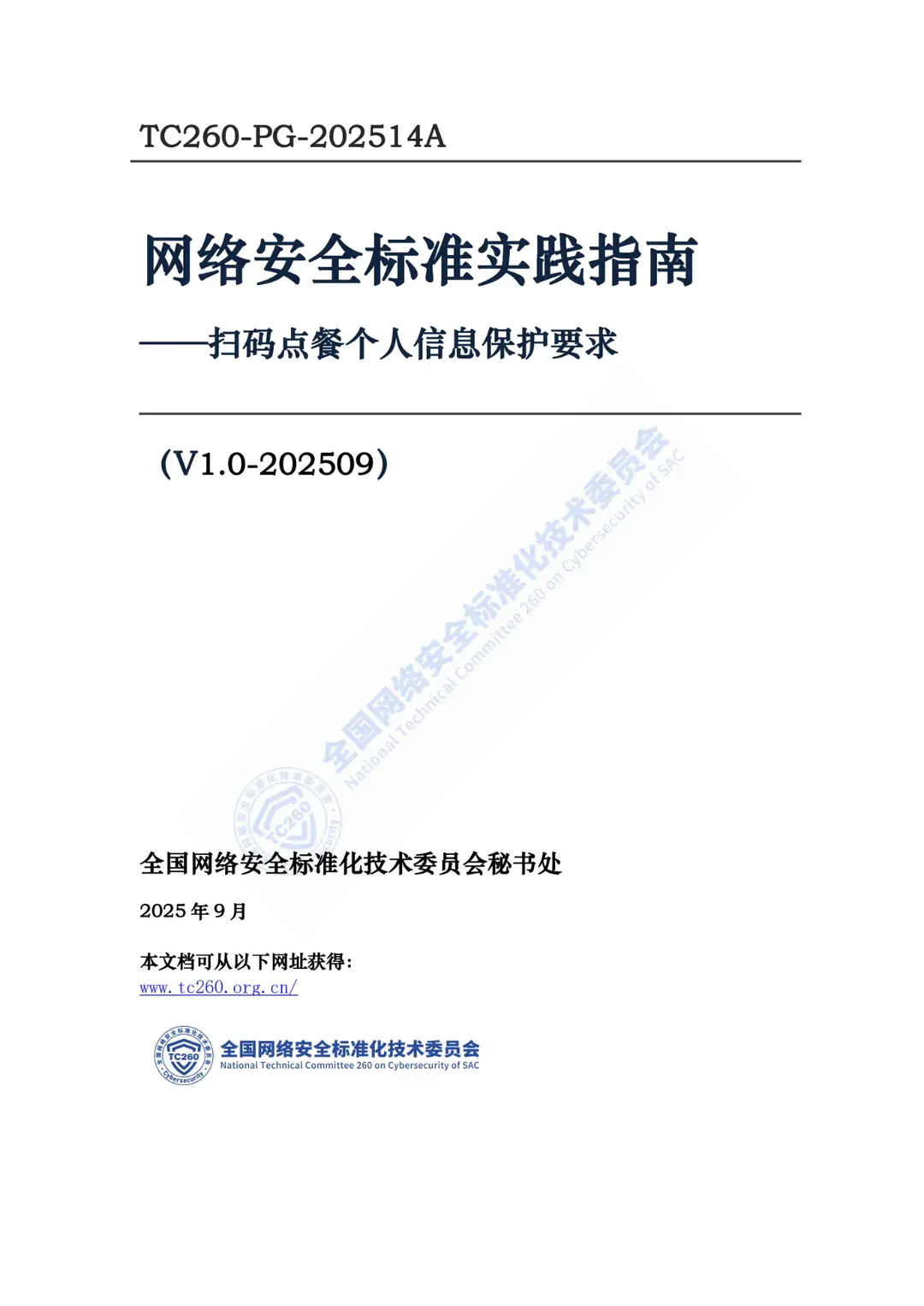
法眼|扫码点餐疯狂索权,为啥这么难改?
Qi Lu Wan Bao· 2025-09-19 06:18
Core Viewpoint - The increasing trend of excessive personal information collection during QR code ordering is raising privacy concerns among consumers, despite the convenience it offers [2][3][4] Group 1: Consumer Concerns - Many consumers are frustrated by the requirement to authorize numerous permissions for simple tasks like ordering food, which are often unnecessary for the transaction [2] - The issue has been highlighted by media reports and consumer advocacy groups, indicating a widespread sentiment against the invasion of privacy [2][3] - The Chinese Consumers Association has pointed out that such practices violate consumers' rights to fair trade and informed consent, particularly affecting vulnerable groups like the elderly [2] Group 2: Regulatory Challenges - Despite ongoing regulatory scrutiny, the phenomenon of excessive data collection persists, leading to confusion among consumers about how to protect their privacy [2][3] - Complaints from consumers are often easy to file but difficult to resolve, with many giving up due to the cumbersome process [3] - The lack of strong enforcement mechanisms and low penalties for violations contribute to a culture where businesses feel little incentive to change their practices [3][4] Group 3: Industry Response - A recent guideline on personal information protection in QR code ordering has been issued, but many businesses remain unaware or dismissive of its importance [4][8] - The guideline lacks legal force, making it merely a recommendation rather than a binding regulation, which diminishes its effectiveness [8] - Experts suggest that transforming these guidelines into enforceable laws and establishing a rapid response mechanism for complaints could improve compliance and accountability [9][10] Group 4: Recommendations for Improvement - To address the issue, it is recommended to implement mandatory regulations that clearly define the necessary information for transactions and prohibit the collection of non-essential data [9][10] - Collaborative efforts among regulatory bodies, including public interest litigation, could enhance enforcement and compliance [10] - Legislative measures should be expedited to create a clear framework for personal information collection in QR code ordering scenarios, establishing penalties for non-compliance [10]

网络安全宣传周 | 网络安全知识科普,建议学习+收藏!
Sou Hu Cai Jing· 2025-09-18 14:13
Core Points - The 2025 National Cybersecurity Awareness Week will take place from September 15 to 21, focusing on the theme "Cybersecurity for the People, Cybersecurity Relies on the People" to ensure high-level security for high-quality development [1] - The event aims to promote the implementation of various cybersecurity laws and regulations, including the Cybersecurity Law, Data Security Law, and Personal Information Protection Law, while showcasing achievements in the cybersecurity field since the 18th National Congress of the Communist Party of China [1] Group 1: Cybersecurity Laws and Regulations - The Cybersecurity Law, enacted on June 1, 2017, is China's first comprehensive law regulating cybersecurity management, marking a significant milestone in the country's legal framework for cyberspace [3] - The Data Security Law, effective from September 1, 2021, serves as a foundational law in the data sector and is crucial for national security [6][7] - The Personal Information Protection Law, effective from November 1, 2021, aims to protect personal information rights and regulate personal information processing activities [9] Group 2: Key Initiatives and Frameworks - The Critical Information Infrastructure Security Protection Regulations, effective from September 1, 2021, are the first administrative regulations specifically targeting the security of critical information infrastructure [4][5] - The Generative Artificial Intelligence Service Management Interim Measures, effective from August 15, 2023, are the first normative policies in China aimed at regulating generative AI services [11] - The establishment of a comprehensive cybersecurity legal framework indicates that cyberspace is not a lawless area, emphasizing the importance of legal compliance in cybersecurity [12] Group 3: Cybersecurity Awareness and Education - The event will focus on educating the public about cybersecurity risks, including telecom fraud, information leakage, and malicious software, while promoting cybersecurity knowledge and skills [1] - The initiative aims to raise awareness about the potential dangers of the internet while highlighting the importance of cybersecurity in daily life [1]

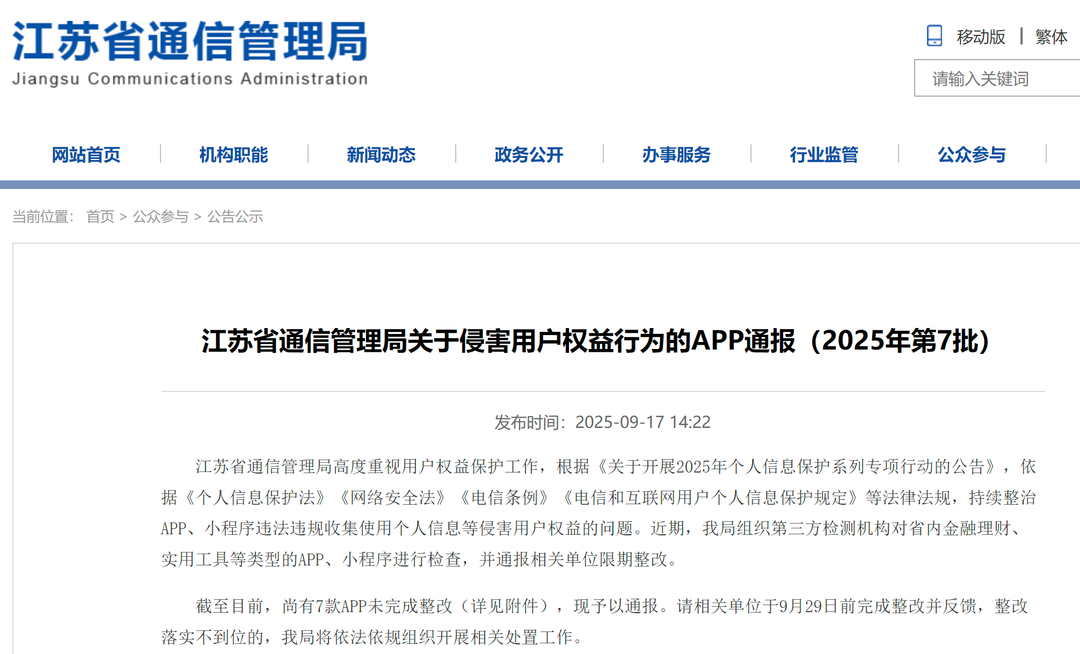
7款侵害用户权益行为的APP被通报
Yang Zi Wan Bao Wang· 2025-09-18 06:42
Core Points - Jiangsu Provincial Communication Administration has reported on APPs that infringe on user rights, as part of its ongoing efforts to protect personal information [1][3] - The administration is conducting inspections of financial and utility APPs to address illegal collection and use of personal information [3][4] - Seven APPs have been identified for failing to rectify their issues and must complete corrections by September 29 [3][4] Summary by Category Regulatory Actions - Jiangsu Provincial Communication Administration is implementing a series of special actions for personal information protection, based on various laws including the Personal Information Protection Law and Cybersecurity Law [3] - The administration has organized third-party inspections to identify APPs that violate user rights [3] Identified APPs and Issues - Seven APPs have been reported for issues such as illegal collection and use of personal information, with specific details as follows: 1. **闪用花** - Violations include illegal collection and use of personal information [4] 2. **小橙借款** - Violations include illegal collection of personal information [4] 3. **东海通** - Violations include illegal collection of personal information [4] 4. **蜜柚目历** - Violations include illegal collection of personal information [4] 5. **晶算师企业版** - Violations include illegal collection of personal information and frequent self-starting [4] 6. **伞送货主** - Violations include illegal collection, excessive collection of personal information, and frequent self-starting [4] 7. **点石智投** - Violations include illegal collection of personal information [4] Compliance Requirements - The identified APPs must complete their rectifications by September 29, and failure to comply will result in further legal actions [3][4]
公安部通报:某跨国公司违规向境外传输用户信息
财联社· 2025-09-18 05:36
Core Viewpoint - The article highlights the enforcement actions taken by the Ministry of Public Security in China regarding data protection violations by various companies, emphasizing the importance of compliance with personal information protection regulations and the consequences of negligence in data security practices [1][2]. Group 1: Case Summaries - A multinational fashion brand was penalized for failing to protect personal information, including not conducting necessary security assessments and not obtaining user consent for data transfer to its overseas headquarters [2]. - A government service system in Guizhou was attacked due to inadequate technical protections, resulting in over 4 million yuan in losses for the public [3]. - A messaging platform in Jiangsu was compromised, leading to the unauthorized sending of over 27,000 fraudulent messages due to a lack of security measures [4]. - A school in Henan experienced a data breach due to vulnerabilities in its smart card billing system, which lacked encryption and proper access controls [6]. - An e-commerce company in Anhui faced data leaks from its ticketing system due to weak security awareness and failure to implement necessary protective measures [8]. - A technology company in Yunnan was found responsible for a significant leak of personal information through its "contacts" app, attributed to poor internal management and lack of user verification [11].

加大公民个人信息保护力度
Ren Min Wang· 2025-09-18 00:53
Core Viewpoint - The importance of personal information protection has gained significant attention, especially highlighted during the 2025 National Cybersecurity Awareness Week, emphasizing the need for robust legal frameworks and effective enforcement to safeguard citizens' rights [1][2]. Group 1: Legal Framework and Challenges - China has established a solid legal framework for personal information protection through laws such as the Personal Information Protection Law, Cybersecurity Law, and Data Security Law, which define basic principles and grant citizens rights like the right to know and delete their personal information [1]. - Despite the legal framework, challenges persist as some companies continue to collect, misuse, and leak user information for commercial gain, threatening citizens' rights [1][2]. Group 2: Enforcement and Public Awareness - Relevant authorities are urged to enhance enforcement efforts, conduct special operations to dismantle criminal networks targeting personal information, and increase public awareness through various campaigns [2]. - Companies are encouraged to fulfill their responsibilities by establishing robust data management systems and ensuring compliance in the collection, use, storage, and transmission of personal information [2]. Group 3: Collective Responsibility - Protecting personal information is a collective responsibility involving government departments, companies, and the public, all of whom must collaborate to create a secure digital environment [3].
晶采观察丨守护数字生活!从细节处筑牢网络安全“防火墙”
Yang Guang Wang· 2025-09-17 13:23
Group 1 - The core issue highlighted is the importance of personal information protection in the digital age, emphasizing the need for "cybersecurity awareness" among individuals [1] - The scale of internet users in China has surpassed 1.1 billion, with a particular focus on the vulnerability of the youth demographic due to their relatively weak awareness and discernment regarding online safety [1] - Recent cases of telecom fraud targeting minors have been on the rise, exploiting their naivety and lack of preventive measures, which can lead to significant financial losses for families [1] Group 2 - The theme of this year's National Cybersecurity Awareness Week is "Cybersecurity for the People, Cybersecurity Relies on the People," underscoring the collective responsibility of individuals in maintaining online safety [2] - Various themed days are scheduled during the Cybersecurity Awareness Week, including Campus Day, Telecom Day, Legal Day, Financial Day, Youth Day, and Personal Information Protection Day, aimed at raising awareness across different sectors [2] - Activities will be organized to promote cybersecurity awareness in communities, rural areas, enterprises, government agencies, schools, and households, making the education efforts more relatable and engaging for the public [2]
热搜炸了!查查你的支付宝,赶紧关掉!有人被“偷”不少钱
Qi Lu Wan Bao· 2025-09-17 08:48
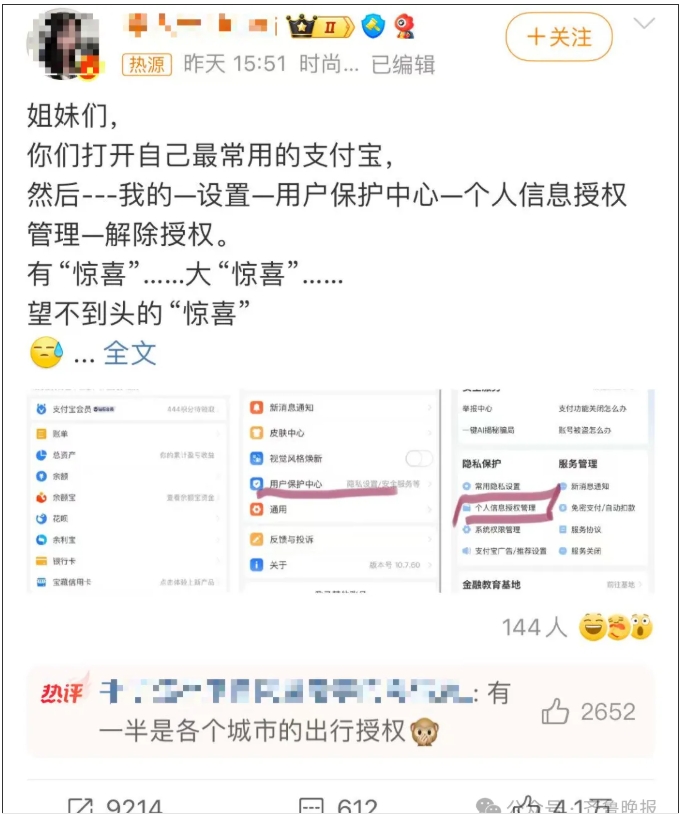
Core Viewpoint - The discussion around personal data authorization and automatic payment features on platforms like Alipay has gained significant attention, highlighting the risks of unintentional data sharing and financial deductions [1][4]. Group 1: Personal Data Authorization - Users are often unaware of the extent of personal information they have authorized third-party applications to access, with some individuals discovering they had authorized up to 121 items, including sensitive information like names and ID numbers [4][5]. - The trend of granting permissions has been ongoing since at least 2015, leading to a growing list of authorizations that can result in privacy concerns and unwanted solicitations [2][4]. Group 2: Automatic Payment Features - Many users have reported unexpected automatic payments, with some discovering new agreements for automatic deductions that they were not aware of, such as video membership renewals and other subscription services [5][10]. - The importance of regularly checking and managing automatic payment settings is emphasized, as users may inadvertently incur charges for services they no longer use or were unaware they had signed up for [7][14]. Group 3: Consumer Awareness and Recommendations - Consumers are encouraged to periodically review their authorization settings and automatic payment agreements to mitigate risks associated with unauthorized deductions [7][15]. - Specific steps for managing account authorizations on Alipay are provided, suggesting users actively engage in monitoring their financial commitments [9][10].
淘宝、美团、支付宝都在做AI导购,能不能用你的消费数据?
2 1 Shi Ji Jing Ji Bao Dao· 2025-09-17 04:58
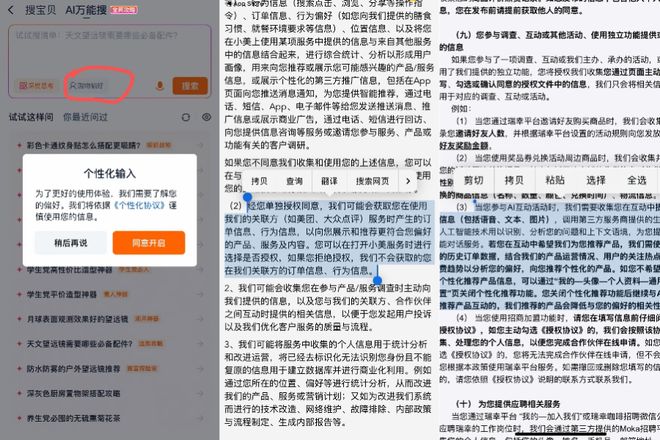
Core Insights - The article discusses the emergence of general-purpose AI agents in various consumer platforms, highlighting their integration into core products to enhance user experience and streamline decision-making processes [1][2] Group 1: AI Integration in Consumer Platforms - Major companies are embedding AI assistants into their applications, such as Taobao's AI assistant for multi-turn dialogue shopping and Meituan's "Xiao Mei" for food delivery and local services [1][2] - Alipay has launched the first "AI payment" service in China, allowing users to place orders and complete payments with a single command through the AI assistant [1] Group 2: Data Utilization and Personalization - AI assistants utilize user data, including order history and behavior information, to provide personalized recommendations, thereby enhancing conversion rates [2][3] - Taobao's "AI Universal Search" and Meituan's "Xiao Mei" both rely on user data to tailor search results and recommendations based on past interactions [2][3] Group 3: User Consent and Compliance - Platforms must obtain explicit user consent to utilize personal data for AI-driven recommendations, as outlined in their user agreements [3][5] - Compliance with regulations, such as the Personal Information Protection Law, requires platforms to inform users about data usage and provide options to opt-out of personalized recommendations [5][6] Group 4: Regulatory Considerations - The design of AI features must include easy opt-out options for users, as mandated by regulations governing algorithmic recommendations [6][8] - The article emphasizes the importance of user choice and transparency in data usage to mitigate regulatory risks and enhance user trust [8][9]


冲上热搜!赶紧查查你的支付宝
中国基金报· 2025-09-17 03:13
Core Viewpoint - The article highlights the risks associated with personal data leakage in the era of big data, emphasizing the importance of managing app permissions and automatic payment authorizations [2][3]. Group 1: Personal Information Management - Users are often unaware of the extent of personal information they have authorized third-party apps to access, with some individuals discovering they had granted up to 121 permissions, including sensitive data like names and ID numbers [7]. - The trend of automatic payment authorizations has increased, with users finding new agreements for services they did not recall signing up for, leading to unexpected charges [7][8]. Group 2: Consumer Awareness and Actions - Consumers are encouraged to regularly check and manage their account authorizations and automatic payment settings to avoid unauthorized charges [8][9]. - Specific steps are provided for users to access their authorization settings in Alipay, allowing them to revoke unnecessary permissions and disable unwanted payment features [9]. Group 3: Caution on Automatic Payments - The article advises consumers to be cautious when enabling automatic payment features, particularly for memberships and services that may have hidden renewal fees after initial discounts [12][13]. - Regularly reviewing bills and payment statements is recommended to identify any unusual charges, ensuring that consumers are aware of all transactions and can act promptly against unauthorized deductions [13].