
多边贸易体制

Search documents
海关总署副署长吴海平访问瑞士、保加利亚对口部门及相关国际组织
Zheng Quan Shi Bao Wang· 2025-10-21 11:00
Core Points - The visit of the Chinese Customs delegation, led by Deputy Director Wu Haiping, to Switzerland and Bulgaria from October 13 to 18 focused on enhancing international cooperation in customs and trade [1] - Discussions included trade facilitation, intellectual property protection, and the establishment of a food safety mechanism under the Belt and Road Initiative [1] - A quarantine access agreement for agricultural products imported to China was signed during the visit [1] Group 1 - The delegation engaged in courtesy meetings with Bulgarian Deputy Prime Minister Tomislav Donchev [1] - Meetings were held with leaders from the World Trade Organization and the World Intellectual Property Organization to discuss customs-related issues [1] - The delegation emphasized the importance of multilateral trade systems and global governance initiatives [1] Group 2 - In-depth discussions took place with Swiss and Bulgarian customs and inspection authorities regarding various topics, including smart customs and anti-smuggling enforcement [1] - The signing of the quarantine access agreement marks a significant step in facilitating agricultural trade between China and the visiting countries [1]
商务部报告揭美所谓“对等关税”本质,敦促其遵守世贸组织规则
2 1 Shi Ji Jing Ji Bao Dao· 2025-10-20 11:37
Core Viewpoint - The report from the Ministry of Commerce highlights concerns over the United States' unilateral trade practices, which undermine the multilateral trading system and disrupt global supply chains [1][3][9]. Group 1: U.S. Trade Practices - The U.S. has implemented unilateral tariffs and trade measures under the guise of "America First," which have hindered the global economic recovery [3][4]. - The U.S. has been accused of abusing trade remedies and export controls, leading to increased trade barriers and unfair competition [3][5]. - The report emphasizes that the U.S. has become a destroyer of the multilateral trading system, engaging in unilateralism and manipulating industrial policies [3][4]. Group 2: Economic Impact - The report states that U.S. tariffs and trade policies could lead to a 1% reduction in global trade volume by 2025, equivalent to a loss of 4% in expected growth [8]. - New tariffs may increase annual household expenses in the U.S. by $2,500, with 92% of tariff costs ultimately borne by American consumers [8]. - The effective tariff rate in the U.S. has reached its highest level since the Smoot-Hawley Tariff Act of 1930, raising concerns about potential global economic recession [8]. Group 3: Call for Compliance - The report urges the U.S. to abandon its unilateral and protectionist measures, including the so-called "equivalent tariffs," and to adhere to WTO rules [8][9]. - It emphasizes the need for the U.S. to cooperate with other WTO members to enhance the multilateral trading system and promote a more predictable global economic environment [9].


李詠箑任中国常驻WTO代表 她说:中方坚定维护多边贸易体制
Di Yi Cai Jing· 2025-10-20 06:25
据新华社消息,中华人民共和国主席习近平根据全国人民代表大会常务委员会的决定任免驻外大使。 任命李詠箑(女)为中华人民共和国常驻世界贸易组织代表、特命全权大使,兼常驻联合国日内瓦办事 处和瑞士其他国际组织副代表。 李詠箑强调,中国发展中国家地位和身份没有改变,始终是"全球南方"的重要一员,将继续支持发展中 成员在WTO中争取自身合法权益,持续推动经济全球化普惠包容发展。 欧盟、瑞士、巴西、巴基斯坦、尼日利亚(代表非洲集团)等45方代表超100个WTO成员发言,对中方 重大举措予以高度评价。 牙买加、塞内加尔盛赞中方的立场宣示具有重大历史意义,展现了中方对多边主义的坚定承诺,在当前 挑战背景下有助于维护以规则为基础的多边贸易体制。巴基斯坦、埃及、巴巴多斯等称赞中国立场展现 了负责任发展中大国形象,维护了发展中国家团结,有助于推动世贸组织发展议程取得成果。加纳、塞 拉利昂等成员表示感谢中方在WTO特殊和差别待遇问题上一直以来的建设性立场和领导力,期待与中 方携手推动包容性发展。 新加坡表示,中方此举展现了对自身发展进程的信心和加强多边贸易体制的决心,对WTO具有重要意 义。欧盟、澳大利亚、瑞士、挪威等对中方的重要决 ...
李詠箑任中国常驻WTO代表,她说:中方坚定维护多边贸易体制
Di Yi Cai Jing· 2025-10-20 06:17
任命李詠箑(女)为中华人民共和国常驻世界贸易组织代表、特命全权大使。 据新华社消息,中华人民共和国主席习近平根据全国人民代表大会常务委员会的决定任免驻外大使。 任命李詠箑(女)为中华人民共和国常驻世界贸易组织代表、特命全权大使,兼常驻联合国日内瓦办事 处和瑞士其他国际组织副代表。 根据公开信息显示,李詠箑曾历任商务部条约法律司副司长、司长等职。自2024年6月起,任商务部党 组成员、国际贸易谈判副代表(副部长级)。 据商务部网站显示,9月30日,李詠箑在2025年9月WTO贸易谈判委员会上发言。 她表示,"我也想借此机会表示,我愿与总干事及各位同事一道,在日内瓦共同推进世贸组织各项工 作。" 她还表示,关于农业议题,中方与多数成员持相似看法,即我们的预期应当务实。我们认为,成员仍有 机会在一些具体领域取得实质成果,例如帮助最脆弱成员应对粮食安全挑战,以及推动棉花发展领域的 合作。我们建议优先开展这些方面的工作。同时,我们也欢迎提案方在关键谈判支柱议题上所作的努 力。 据央视新闻显示,10月6日至7日,WTO在瑞士日内瓦召开总理事会2025年度第四次会议。中方主动设 置议题并提交《中国关于WTO特殊和差别待遇的 ...

商务部连续三年发布报告详解美国履行WTO规则义务情况,最新版讲了什么?
第一财经· 2025-10-18 08:29
Core Viewpoint - The article discusses the 2025 report by China's Ministry of Commerce on the United States' compliance with WTO rules, highlighting the unilateral measures taken by the U.S. government and their negative impact on the multilateral trade system [3][6][14]. Summary by Sections U.S. Trade Policies - The report emphasizes that the U.S. has deviated from its claimed policy stance and WTO rules, acting as a disruptor of the multilateral trade system and engaging in unilateralism [3][6]. - Since 2017, the U.S. has adopted a series of unilateral and protectionist measures under the "America First" principle, including the introduction of "reciprocal tariffs" in 2025, which violate core WTO values [6][9]. Impact on Global Trade - The unilateral tariff measures are expected to shrink global trade volume by 1% by 2025, equivalent to erasing 4% of expected growth, according to the World Bank [9]. - The International Monetary Fund has indicated that these measures pose significant risks to global economic growth, especially in a context of already weak growth [9]. Multilateral Trade System Challenges - The U.S. has been accused of placing domestic law above international rules, obstructing the normal functioning of the WTO, and threatening the survival and development of the multilateral trade system [11][12]. - The U.S. has repeatedly blocked the selection of appellate body members in the WTO, leading to a paralysis of the dispute resolution mechanism [11]. Call for Cooperation - The report urges the U.S. to adhere to its commitments and return to a rules-based multilateralism, emphasizing the need to eliminate unilateral measures like "reciprocal tariffs" [14][15]. - China expresses its commitment to working closely with other nations to uphold the multilateral trade system and participate in WTO reforms, aiming for a more predictable and inclusive global economy [15][16].

商务部连续三年发布报告详解美国履行WTO规则义务情况 最新版讲了什么?
Di Yi Cai Jing· 2025-10-18 03:47
Core Viewpoint - The report by the Chinese Ministry of Commerce highlights the U.S. failure to adhere to WTO rules, emphasizing unilateral measures such as "reciprocal tariffs" that undermine the multilateral trade system [1][2][3] Summary by Sections U.S. Unilateral Actions - The report indicates that the U.S. has deviated from its claimed policy positions and WTO rules, acting as a disruptor of the multilateral trade system and engaging in unilateralism [2][3] - Since 2017, the U.S. has adopted a series of unilateral and protectionist measures under the "America First" principle, including the introduction of "reciprocal tariffs" in 2025, which violate core WTO values [3][4] Impact on Global Trade - The unilateral tariff policies, particularly the "232 tariffs" on imports like steel and aluminum, are seen as a misuse of national security concepts, violating WTO non-discrimination principles and creating significant uncertainty in the global automotive industry [5][6] - The World Bank estimates that U.S. unilateral tariff measures could lead to a 1% decline in global trade volume by 2025, equivalent to erasing 4% of expected growth [6][7] Threats to Multilateral Trade System - The report outlines that the U.S. has placed domestic law above international rules, obstructing the normal functioning of the WTO and threatening its survival and development [7][8] - The U.S. has repeatedly blocked the selection of appellate body members, leading to a paralysis of the dispute resolution mechanism, and has failed to comply with WTO rulings in a significant number of cases [7][8] Call for Cooperation and Reform - The report urges the U.S. to adhere to its commitments and return to a rules-based multilateralism, emphasizing the need to eliminate unilateral measures like "reciprocal tariffs" to maintain the authority and integrity of the multilateral trade system [9][10] - China expresses its commitment to working with other members to promote the WTO's role in global governance and to achieve a more equitable and inclusive economic globalization [9][10]
商务部连续三年发布报告详解美国履行WTO规则义务情况,最新版讲了什么?
Di Yi Cai Jing· 2025-10-18 03:41
Core Viewpoint - The report highlights the unilateral measures taken by the new U.S. government, such as "reciprocal tariffs," which are seen as violations of WTO rules and detrimental to the multilateral trade system [2][5][10] Summary by Relevant Sections U.S. Trade Policy - The report indicates that the U.S. has shifted towards unilateralism and protectionism since 2017, blaming domestic issues on "unfair trade" and using globalization as a scapegoat for its failures [5][8] - The U.S. has implemented various unilateral measures, including the "232 tariffs" on steel and aluminum, which are viewed as a significant departure from WTO principles [6][7] Impact on Global Trade - The unilateral tariffs are expected to reduce global trade volume by 1% by 2025, equivalent to erasing 4% of expected growth, according to World Bank estimates [7] - The uncertainty created by U.S. trade policies is likely to lead to a decline in global merchandise trade volume by 1.5% in 2025, as per WTO predictions [7] Multilateral Trade System Challenges - The U.S. is accused of undermining the multilateral trade system by prioritizing domestic law over international rules, which poses a serious threat to the survival and development of the WTO [8][9] - The U.S. has obstructed the selection of appellate body members in the WTO, leading to a paralysis of the dispute resolution mechanism [8] Call for Compliance and Cooperation - The report urges the U.S. to adhere to WTO rules and eliminate unilateral measures like "reciprocal tariffs" to restore authority and effectiveness to the multilateral trade system [10] - China emphasizes the importance of multilateralism and cooperation, advocating for a return to a rules-based international trading system that benefits all parties involved [10][11]

商务部连续三年发布美国履行世贸组织规则义务情况年度报告
Zheng Quan Shi Bao Wang· 2025-10-17 12:03
Core Viewpoint - The report highlights the United States' failure to adhere to World Trade Organization (WTO) rules, emphasizing the negative impact of its unilateral and protectionist policies on the multilateral trade system [1][2][3] Group 1: Overall Evaluation of U.S. Compliance - The report evaluates the U.S. compliance with WTO rules, stating that as a key founder and beneficiary of the multilateral trade system, the U.S. should act as a role model in upholding these rules [1] - It criticizes the U.S. for adopting a "America First" approach, which leads to unilateralism, protectionism, and economic bullying, severely impacting the multilateral trade system [1] Group 2: Specific Concerns Regarding U.S. Policies - The report identifies eleven key areas where the U.S. has implemented trade policies that violate WTO rules, including tariffs, non-tariff barriers, industrial subsidies, agricultural subsidies, trade remedies, standards and technical regulations, service trade, intellectual property, export controls, investment review policies, and discriminatory arrangements in international economic cooperation [1][2] Group 3: Efforts to Address U.S. Violations - The report outlines China's collaborative efforts with other members to correct U.S. violations and promote genuine multilateralism, including restoring the appellate body and safeguarding the rights of developing members [2] - It expresses concerns over the U.S.'s continued disregard for member expectations and its escalation of unilateral measures, including the introduction of "reciprocal tariffs" and the initiation of a global trade war [2][3] Group 4: Call for U.S. Compliance - The report urges the U.S. to rectify its erroneous practices, comply with WTO rules, and eliminate violations such as "reciprocal tariffs" to enhance the role of the multilateral trade system in global governance [3]
商务部连续第三年发布美国履行世贸组织规则义务情况报告
2 1 Shi Ji Jing Ji Bao Dao· 2025-10-17 11:34
Core Viewpoint - The report highlights concerns regarding the United States' compliance with World Trade Organization (WTO) rules, emphasizing that the U.S. has engaged in unilateralism and protectionism, undermining the multilateral trade system [4][5]. Summary by Sections Overall Evaluation of U.S. Compliance - The report evaluates the U.S. compliance with WTO obligations from four aspects, stating that as a key founder and beneficiary of the multilateral trade system, the U.S. should lead by example in adhering to rules [4]. - The U.S. has been accused of ignoring WTO rules and member expectations, engaging in economic bullying and unilateral measures that severely impact the multilateral trade system [4]. Concerns Raised by China - The Chinese Ministry of Commerce has expressed ongoing concerns about the U.S.'s trade policies, including trade bullying and manipulation of industrial policies, which disrupt global supply chains [4]. - The 2025 report continues to express serious concerns over the U.S.'s discriminatory policies and the escalation of unilateral measures, including the introduction of "reciprocal tariffs" and the initiation of a global trade war [4]. Importance of Multilateral Trade System - The WTO is described as the cornerstone of economic globalization and international trade, relying on member compliance with obligations and mutual cooperation [5]. - The report aims to urge the U.S. to correct its policies, comply with WTO rules, and eliminate illegal measures such as "reciprocal tariffs," promoting a more equitable and inclusive global economic environment [5].
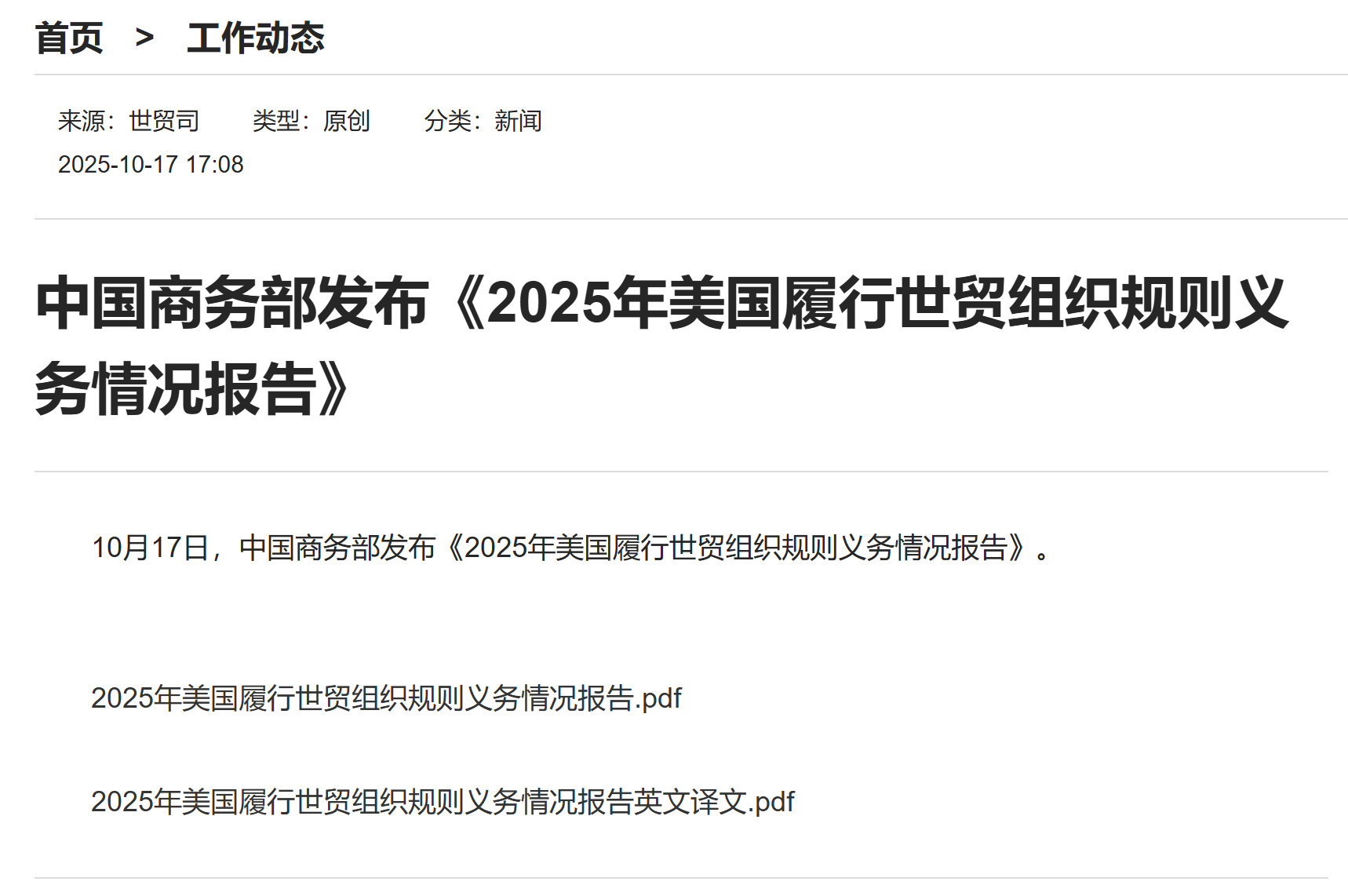
商务部:敦促美方及时纠正错误做法 切实遵守世贸组织规则
智通财经网· 2025-10-17 09:40
Core Viewpoint - The Chinese Ministry of Commerce released the "2025 Report on the United States' Compliance with WTO Rules," expressing concerns over the U.S. undermining the multilateral trade system and urging the U.S. to correct its practices and adhere to WTO rules [1][2]. Group 1: U.S. Compliance with WTO Rules - Since 2023, China has continuously published annual reports on the U.S.'s compliance with WTO rules, highlighting issues such as trade bullying and manipulation of industrial policies [2]. - The 2024 report indicated that the U.S. has disregarded member expectations and escalated unilateral measures, including the implementation of discriminatory policies and "reciprocal tariffs" [2]. - The 2025 report aims to express serious concerns regarding the U.S.'s actions that violate WTO rules and harm the multilateral trade system [2]. Group 2: Multilateral Trade System - The WTO is considered the cornerstone of economic globalization and international trade, relying on member compliance with rules and mutual cooperation [2]. - The current multilateral trade system faces significant challenges, and China hopes the 2025 report will encourage the U.S. to adhere to its obligations and eliminate "reciprocal tariffs" [2]. - The goal is to promote a more significant role for the multilateral trade system in global governance and to work towards a more equitable and inclusive economic globalization [2].