报行合一

Search documents
打破“内卷”!非车险“报行合一”来了
Guo Ji Jin Rong Bao· 2025-10-10 15:56
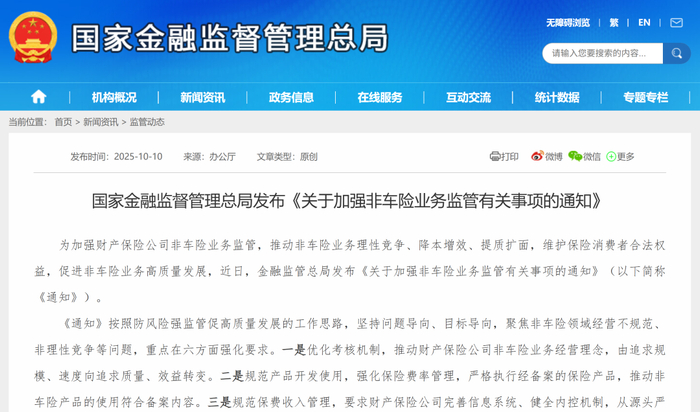
非车险"报行合一"新规落地! 所谓"报行合一",是指保险公司实际执行的保险条款和保险费率,要与向监管部门报送的备案材料保持 一致。通俗来说,就是不能"说一套,做一套"。此前,车险以及人身险银保、个险等渠道均已深化执 行"报行合一"要求。 《通知》明确,其所称非车险业务,是指机动车辆保险以外的其他财产保险业务。农业保险、出口信用 保险另有规定的,从其规定。 近些年来,非车险业务持续快速发展。数据显示,2024年,非车险保费收入达7770亿元,近五年的年均 复合增速超10%,贡献近半数财险保费规模。为了抢占市场份额,恶性竞争问题日益凸显。 对此,《通知》强调,财险公司应按照高质量发展要求,合理降低保费规模、业务增速、市场份额的考 核要求,有效提高合规经营、质量效益、消费者权益保护的考核权重。同时,要结合市场承载能力和自 身发展基础,合理规划非车险业务发展,加快由追求规模、速度向追求质量、效益转变。 10月10日,金融监管总局发布《关于加强非车险业务监管有关事项的通知》(下称《通知》),从优化 考核机制、加强费率管理、严格条款费率使用等方面加强财险公司非车险业务监管,推动非车险业务理 性竞争、降本增效、提质扩面,自 ...

非车险“报行合一”来了!金融监管总局发布新规
Zhong Guo Zheng Quan Bao· 2025-10-10 14:15
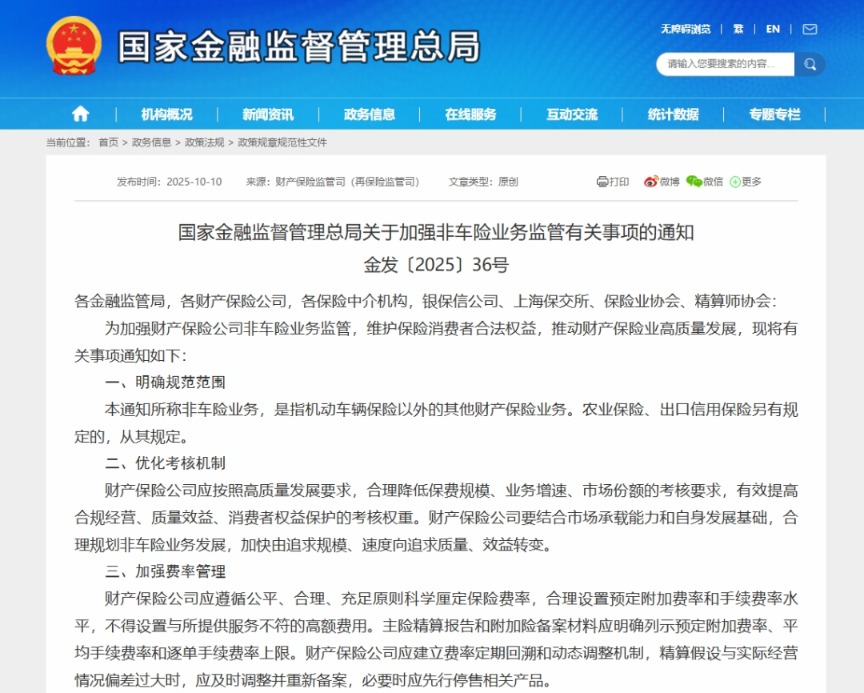
继车险、人身险行业实行"报行合一"之后,非车险行业"报行合一"也正式落地。 金融监管总局网站10月10日消息,近日,金融监管总局发布《关于加强非车险业务监管有关事项的通知》。 《通知》聚焦非车险领域经营不规范、非理性竞争等问题,重点在六方面强化要求,包括优化考核机制、规范产品开发使 用、规范保费收入管理、强化市场行为监管、推动改进非车险承保理赔服务、发挥行业组织支撑服务作用等。 其中,《通知》要求,财产保险公司应按照高质量发展要求,合理降低保费规模、业务增速、市场份额的考核要求,有效 提高合规经营、质量效益、消费者权益保护的考核权重。财产保险公司要结合市场承载能力和自身发展基础,合理规划非 车险业务发展,加快由追求规模、速度向追求质量、效益转变。 在加强费率管理方面,《通知》要求,财产保险公司应遵循公平、合理、充足原则科学厘定保险费率,合理设置预定附加 费率和手续费率水平,不得设置与所提供服务不符的高额费用。主险精算报告和附加险备案材料应明确列示预定附加费 率、平均手续费率和逐单手续费率上限。财产保险公司应建立费率定期回溯和动态调整机制,精算假设与实际经营情况偏 差过大时,应及时调整并重新备案,必要时应先行停 ...
非车险“报行合一”落地,预计推动行业盈利表现改善
Soochow Securities· 2025-10-10 13:45
证券研究报告·行业点评报告·保险Ⅱ 保险Ⅱ行业点评报告 非车险"报行合一"落地,预计推动行业盈 利表现改善 增持(维持) 2025 年 10 月 10 日 证券分析师 孙婷 执业证书:S0600524120001 sunt@dwzq.com.cn 证券分析师 曹锟 执业证书:S0600524120004 -17% -13% -9% -5% -1% 3% 7% 11% 15% 2024/10/10 2025/2/8 2025/6/9 2025/10/8 保险Ⅱ 沪深300 [Table_Tag] [Table_Summary] 投资要点 相关研究 《推动健康险高质量发展,分红型健 康险产品将回归市场》 2025-09-30 《保险行业 8 月保费:寿险单月保费 强势增长,财险非车业务短期承压》 2025-09-26 东吴证券研究所 1 / 4 ◼ 【事件】10 月 10 日,金监总局发布《关于加强非车险业务监管有关事 项的通知》,就非车险业务强化监管要求,新规自 11 月 1 日起执行。 ◼ 优化考核机制由追求规模、速度向追求质量、效益转变。1)新规范围 包括车险以外的其他财险业务,农险和出口信用保险另有规定的 ...
“报行合一”大幕拉开,非车险监管政策重磅上新
Bei Jing Shang Bao· 2025-10-10 12:39
Core Viewpoint - The Financial Regulatory Authority has issued a notification to strengthen the regulation of non-auto insurance, emphasizing the requirement for "reporting and execution to be unified" and enhancing rate management and premium income oversight [1][3][4]. Regulatory Requirements - The notification defines non-auto insurance as all property insurance excluding motor vehicle insurance and establishes strict guidelines for product development and rate management [4][5]. - Insurance companies and intermediaries are prohibited from altering approved insurance terms and rates through special agreements or other means, ensuring compliance with the approved terms [4][5]. Market Impact - The notification aims to eliminate unhealthy competition in the non-auto insurance sector, which has seen rapid growth but also significant losses due to high costs and low rates [6][7]. - The non-auto insurance premium income is projected to reach 777 billion yuan in 2024, with a compound annual growth rate of over 10% in the past five years, indicating a shift in market dynamics [6]. Quality Development Focus - The notification encourages a shift from a focus on scale and speed to quality and efficiency in non-auto insurance operations, promoting better consumer experiences and service standards [5][7]. - It emphasizes the need for insurance companies to enhance their risk management, product innovation, and service quality to foster high-quality development in the industry [5][7]. Challenges for Implementation - Insurance companies must overcome challenges such as restructuring their operational philosophies and assessment systems to prioritize compliance and consumer satisfaction over mere market share [8]. - There is a need for improved product management and actuarial pricing to ensure all products comply with approved terms and to adjust pricing strategies as necessary [8].

金融监管总局最新发布!这一新规11月正式落地
Zheng Quan Shi Bao· 2025-10-10 12:22
Core Viewpoint - The Financial Regulatory Bureau has issued a notification to strengthen the regulation of non-auto insurance business, requiring property insurance companies to optimize their assessment mechanisms, standardize product development, and enhance premium rate management, effective from November 1, 2025 [1][2]. Group 1: Non-Auto Insurance Business Overview - Non-auto insurance business refers to all property insurance activities excluding motor vehicle insurance, with agricultural insurance and export credit insurance subject to separate regulations [2]. - The share of non-auto insurance in total property insurance premiums has increased from 37.1% in 2019 to 47.4% in 2024, contributing nearly half of the total property insurance premium scale [2]. Group 2: Regulatory Changes and Implications - The notification emphasizes the need for property insurance companies to shift their focus from scale and speed to quality and efficiency in their non-auto insurance operations [2]. - The long-term losses in non-auto insurance are attributed to deviations from the law of large numbers, with many products sold at reduced rates through differentiation, undermining proper pricing [2]. Group 3: Rate Management and Compliance - The notification outlines detailed requirements for rate management, including the need for reasonable setting of additional rates and fees, and mandates that companies establish mechanisms for periodic review and dynamic adjustment of rates [3]. - Property insurance companies must strictly adhere to the approved insurance terms and rates, prohibiting any substantial changes through special agreements or other means [3][4]. Group 4: Insurance Intermediary Management - Property insurance companies are required to manage insurance intermediaries responsibly, ensuring that only qualified entities are engaged in sales activities and that fees paid align with the services provided [4]. - Companies must accurately report management expenses and ensure that intermediary fees do not exceed the approved limits, avoiding any disguised payments [4]. Group 5: Enforcement and Industry Standards - The notification specifies that regulatory measures or administrative penalties will be enforced against companies that fail to comply with the approved terms and rates or provide false documentation [5]. - Industry organizations are tasked with developing standard clauses and self-regulatory guidelines for underwriting and claims processes to support the implementation of the new regulations [6]. Group 6: Future Directions - The Financial Regulatory Bureau emphasizes that the notification is a significant step towards optimizing non-auto insurance regulation, aiming to promote high-quality development in the sector and better protect consumer rights [6].
金融监管总局最新发布!这一新规11月正式落地
证券时报· 2025-10-10 12:19
Core Viewpoint - The article discusses the implementation of new regulatory measures for non-auto insurance businesses in China, emphasizing the need for compliance with approved insurance terms and rates, aiming to enhance the quality and effectiveness of the insurance sector [2][4][10]. Summary by Sections Regulatory Changes - The Financial Regulatory Bureau issued a notification requiring property insurance companies to optimize their assessment mechanisms for non-auto insurance, standardize product development, and strengthen premium rate management, effective from November 1, 2025 [2][4]. - The notification extends the "reporting and execution consistency" regulation to non-auto insurance, ensuring that actual insurance terms and rates align with those submitted to regulatory authorities [2][4]. Industry Trends - Non-auto insurance has seen significant growth, with its share of total property insurance premiums rising from 37.1% in 2019 to an expected 47.4% in 2024, contributing nearly half of the total premium scale [4]. - The industry is shifting focus from scale and speed to quality and effectiveness, as highlighted by industry leaders [3][4]. Compliance and Management - The notification outlines detailed requirements for premium rate management, including the need for reasonable setting of additional premium rates and fees, and mandates that companies establish mechanisms for periodic review and adjustment of rates [6][7]. - Property insurance companies must strictly adhere to approved insurance terms and rates, prohibiting any unauthorized changes through various means [6][7]. Role of Insurance Intermediaries - The notification emphasizes the responsibility of property insurance companies to manage insurance intermediaries, ensuring that only qualified entities are involved in sales activities and that fees are aligned with the services provided [7]. - Companies are prohibited from circumventing fee limits through deceptive practices, and any violations will be subject to regulatory measures [7]. Industry Self-Regulation - Industry organizations are tasked with developing standard clauses and self-regulatory guidelines for underwriting and claims processes to support the implementation of the new regulations [9][10]. - The notification is seen as a comprehensive effort to enhance the regulatory framework for non-auto insurance, promoting rational competition and high-quality development in the sector [10].

非车险监管要求落地 明确“报行合一”
Xin Hua Wang· 2025-10-10 10:56
新华社北京10月10日电(记者张千千、李延霞)国家金融监督管理总局10日对外发布《关于加强非车险 业务监管有关事项的通知》,明确非车险"报行合一"要求,提出加强费率管理,严格条款费率使用,优 化考核机制,健全保费收入管理。 非车险业务是指机动车辆保险以外的其他财产保险业务。2024年,非车险保费收入7770亿元,近五年的 年均复合增速超10%。为加强财产保险公司非车险业务监管,推动理性竞争、降本增效、提质扩面,金 融监管总局发布了这一通知。 "报行合一"是指保险公司应严格执行经备案的保险条款和保险费率,确保备案内容与实际经营行为完全 一致。此前,车险领域及人身险银保、个险等渠道均已深化执行"报行合一"要求。 此次通知要求,规范产品开发使用,强化保险费率管理,严格执行经备案的保险产品,推动非车险产品 的使用符合备案内容,即明确了非车险"报行合一"要求。对未按照规定使用经备案条款费率,编制或提 供虚假报告、报表、文件、资料等行为,依法采取监管措施或实施行政处罚。 同时,通知要求,优化考核机制,推动财产保险公司非车险业务经营理念由追求规模、速度向追求质 量、效益转变;规范保费收入管理,要求财产保险公司完善信息系统、 ...
上半年银保新单保费占比64% 预计年底将达70%
2 1 Shi Ji Jing Ji Bao Dao· 2025-09-28 08:11
Core Insights - The insurance premium from bank-insurance cooperation accounted for 64% of the new insurance premiums in the first half of the year, expected to approach 70% by year-end, indicating a solidified channel structure dominated by bank-insurance partnerships [1] - The relationship between banks and insurance companies has evolved from merely sharing profits to a comprehensive strategic collaboration across various sectors including ecology, deposits, bonds, custody, and technology [1] Group 1: Trends in Bank-Insurance Cooperation - Four major trends in bank-insurance cooperation have been identified: the establishment of a bank-insurance dominated sales channel, an increase in complex insurance products, the growing importance of ecological services, and the empowerment of the entire bank-insurance operation chain through digital technology [1] - The bank-insurance cooperation is crucial for banks as it serves as a significant source of non-interest income, helping to alleviate the pressure from narrowing net interest margins [2] Group 2: Policy Impact on Growth - The substantial growth of bank-insurance channels is closely linked to recent policy changes, such as the "Report and Action Integration" policy, which encourages a shift from fee-driven models to customer service-centered value creation [3] - The cancellation of the "1+3" cooperation limit allows banks to partner with more insurance companies, thereby expanding collaboration opportunities [3] Group 3: Shift Towards Complex Products - The demand for complex insurance products is increasing, driven by macro trends such as aging population and declining interest rates, with customers showing a preference for long-term savings and protection products [4] - The sales of floating yield products like dividend insurance have been actively promoted by listed insurance companies to reduce rigid liability costs and alleviate long-term interest spread pressure [4]

2025上半年度10家上市寿险公司分析
Sou Hu Cai Jing· 2025-09-25 05:38
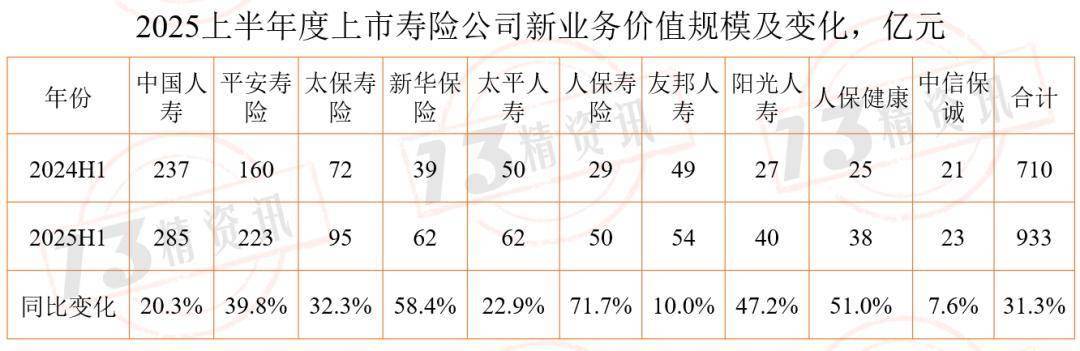
Core Insights - The new business value of listed life insurance companies in China saw a significant increase of 31.3% in the first half of 2025, with all but one company achieving double-digit growth [1][24][26]. New Business Value - In the first half of 2025, the new business value for listed life insurance companies totaled 933 billion yuan, with notable growth from major players such as China Life (285 billion yuan, +20.3%) and Ping An Life (223 billion yuan, +39.8%) [24][25]. - The overall new business value rate for the industry increased by 6.7 percentage points, reaching a weighted average of 27.8% [30][34]. New Single Premiums - The total new single premium income for listed life insurance companies in the first half of 2025 was 5,227 billion yuan, reflecting a year-on-year growth of 7.8% [38]. - However, the agent channel saw a decline of 13.8% in new single premiums, while the bancassurance channel experienced a robust growth of 61.1% [8][16][40]. Factors Influencing Growth - The increase in new business value and value rate is attributed to the adjustment of preset interest rates and the implementation of cost control policies under the "reporting and operation integration" framework [4][14][34]. - The shift from guaranteed products to floating yield products has increased sales difficulty, impacting the attractiveness of insurance products [6][47]. Agent Channel Performance - The number of agents decreased by 2.9% to 1.605 million, with average productivity dropping by 11.3% to 139,000 yuan per agent [51][55]. - Despite the decline in agent numbers, the overall industry is showing resilience through the growth in the bancassurance channel, which compensates for the downturn in the agent channel [64].



2025上半年度10家上市寿险公司分析:新业务价值大增31.3%的背后是量价齐升,而新单保费涨7.8%的背后则是渠道切换!
13个精算师· 2025-09-24 11:01
Core Viewpoint - The insurance industry is experiencing a significant recovery in new business value, with a year-on-year increase of 31.3% in the first half of 2025, driven by both volume and price growth across various companies [1][16][18]. Summary by Sections New Business Value - In the first half of 2025, all listed life insurance companies, except for CITIC Prudential, achieved double-digit growth in new business value, with the overall industry growth rate reaching 31.3% [1][16]. - The new business value for major companies includes China Life at 28.5 billion yuan (20.3% increase), Ping An Life at 22.3 billion yuan (39.8% increase), and others showing significant growth rates [18]. New Business Value Rate - The new business value rate for most listed life insurance companies increased significantly, with an overall rise of 6.7 percentage points in the first half of 2025 [3][22]. - Notable increases in new business value rates include Ping An Life at 26.1% (up 8.8 percentage points) and China Life at 32.4% (up 9.2 percentage points) [22][24]. New Policy Premiums - The overall new policy premium for listed life insurance companies reached 522.7 billion yuan, reflecting a year-on-year growth of 7.8% [28]. - However, there was a notable decline in new policy premiums from the agent channel, which dropped by 13.8%, while the bank insurance channel saw a substantial increase of 61.1% [31][39]. Market Dynamics - The insurance sector is transitioning from a "volume and price decline" phase (2018-2022) to a "volume and price increase" phase in 2025, indicating a healthier growth trajectory [48][51]. - The shift in market dynamics is attributed to the effectiveness of the "reporting and operation integration" policy and the adjustment of premium rates, which have improved the new business value rates significantly [40][41]. Agent Channel and Bank Insurance Channel - The agent channel is facing challenges with a decline in the number of agents and average productivity, while the bank insurance channel is experiencing robust growth, indicating a shift in sales strategy [42][39]. - The average productivity of agents decreased by 11.3%, highlighting the ongoing transformation within the agent channel [46]. Conclusion - The insurance industry is showing resilience and adaptability, with a clear trend towards high-quality development characterized by simultaneous growth in new business value and premiums, driven by strategic channel shifts and improved operational efficiencies [51][52].